Websites, SEO, PPC, and lifecycle automation for industrial manufacturers, B2B fabricators, and multi-plant OEMs. Every dollar you spend tracks to qualified RFQs inside your ERP. A written report lands in your inbox every Friday, covering what has moved and what is next.
Selected clients we've run full marketing programs for
Three problems draining qualified RFQs from every manufacturer
If any of these looks familiar, the free website audit names the fix and what it's worth, before you spend a dollar.
PROBLEM 01 · INDEXING
Distributors outrank you on your own part numbers
Google indexes distributor HTML while your specs sit in gated PDFs. Buyers land on the distributor page, request a quote, and never see your name.
THE FIX · INDEXABLE SPEC PAGES + STRUCTURED SCHEMA
PROBLEM 02 · RFQ FUNNEL
The RFQ funnel dies at the product spec page early
Engineers hit spec tables with no CAD file, no lead time, and no RFQ button. Thomasnet gets the click and a distributor closes the sale on your work.
THE FIX · SPEC-FIRST PAGE + CAD + PART DOWNLOAD
PROBLEM 03 · ATTRIBUTION
Marketing cannot tie RFQs to signed contracts
Cycles run 60 to 180 days. Marketing reports impressions, finance reports revenue, and nobody has a shared view of what channel started the RFQ deal.
THE FIX · CRM + ERP CONVERSION IMPORT PIPELINE
Four manufacturing marketing services, one accountable team
Each pillar is a full program. Run any one on its own, or bundle SEO and paid media into one retainer with a single point of contact, with builds and maintenance quoted separately. Every channel ties back to qualified RFQs and signed deals.
Same rhythm on every manufacturer. Audit before we spend a dollar. Position before we launch an asset. Build against the RFQ. Scale against qualified RFQs and closed orders.
DISCOVERYDiagnose the funnel
Site, product pages, ad accounts, CRM, and distributor pipeline. Channel-by-channel teardown against qualified RFQs and closed orders per market.
SIGN-OFF: 3 WINS READY TO APPLY
OFFERSharpen the offer
Nail the product line, target buyer persona, and RFQ path. Every product page, ad, and sequence built off one positioning brief.
SIGN-OFF: PRODUCT LINE + OFFER LOCKED
BUILD + LAUNCHBuild the assets
Launch the site, product pages, RFQ flow, and CRM-linked tracking. The site build runs 4 to 10 weeks. Weekly written notes so every asset has a live date.
SIGN-OFF: ASSETS LIVE, FULLY OWNED
ONGOING GROWTHCompound the growth
Compound paid, SEO, and distributor wins. Reviews on your tier’s cadence, tied to qualified RFQs and closed orders, not vanity impressions.
SIGN-OFF: RFQ + REVENUE TRACKING LIVE
Not every manufacturing agency reports the same things
Most industrial marketing agencies report on impressions and clicks. Wix templates report on nothing. Here is what actually shows up in your ERP and your CRM when your program runs the right way.
WHAT YOU ACTUALLY GET
REDEFINE WEB
TYPICAL AGENCY
DIY
Reports on qualified RFQs (not clicks)
NO
NO
One accountable industrial team for SEO and ads
NO
NO
Integrates with HubSpot, Salesforce, Dynamics, ERP
NO
NO
Owned website source you keep at handoff
NO
NO
Manufacturing content written by writers who cover industry
SOMETIMES
NO
Part-number + spec-page SEO on technical queries
YES
NO
Dedicated account lead from Scale up
NO
YES
Case studies
Real manufacturers, real receipts
Three programs where we tied the work to booked RFQs and closed orders.
Published case study
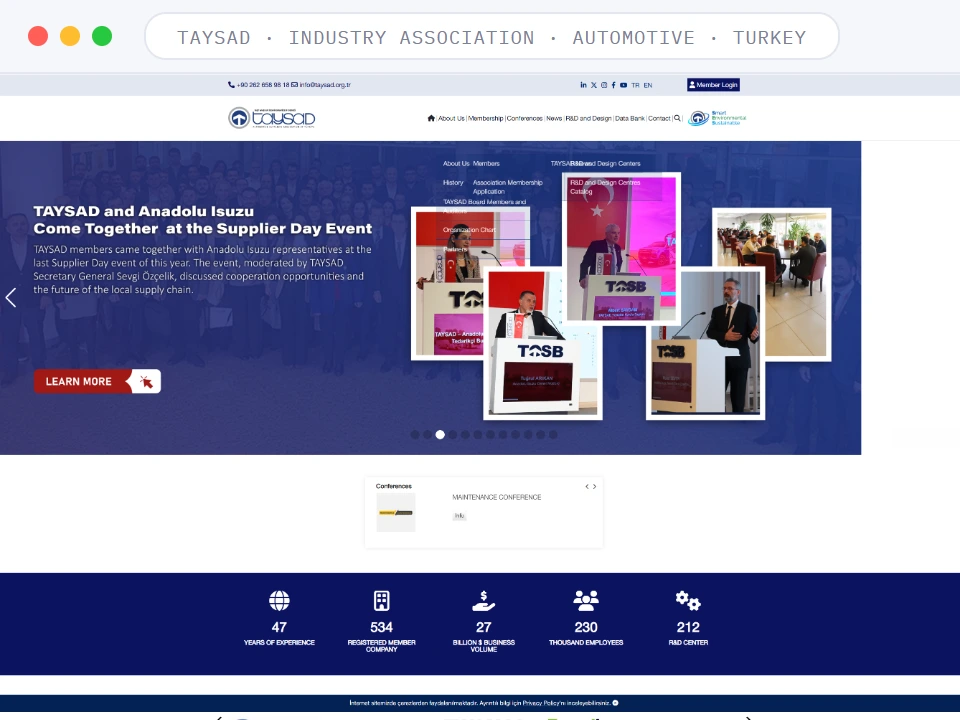
TAYSAD
TAYSAD.ORG.TR
Industry Association · Automotive · Turkey•Web Design · Web Development
Grew TAYSAD organic traffic 160% with a secure, accessible online hub.
TAYSAD represents 490+ members of Turkey's automotive supplier industry. Its outdated site was slow, not secure and hard to use for members with limited tech skills. We built a secure backend with encryption, a simple design for every skill level and a faster build that can scale. Organic users grew 160%, page load time fell 80% and average sessions lasted 40 seconds longer.
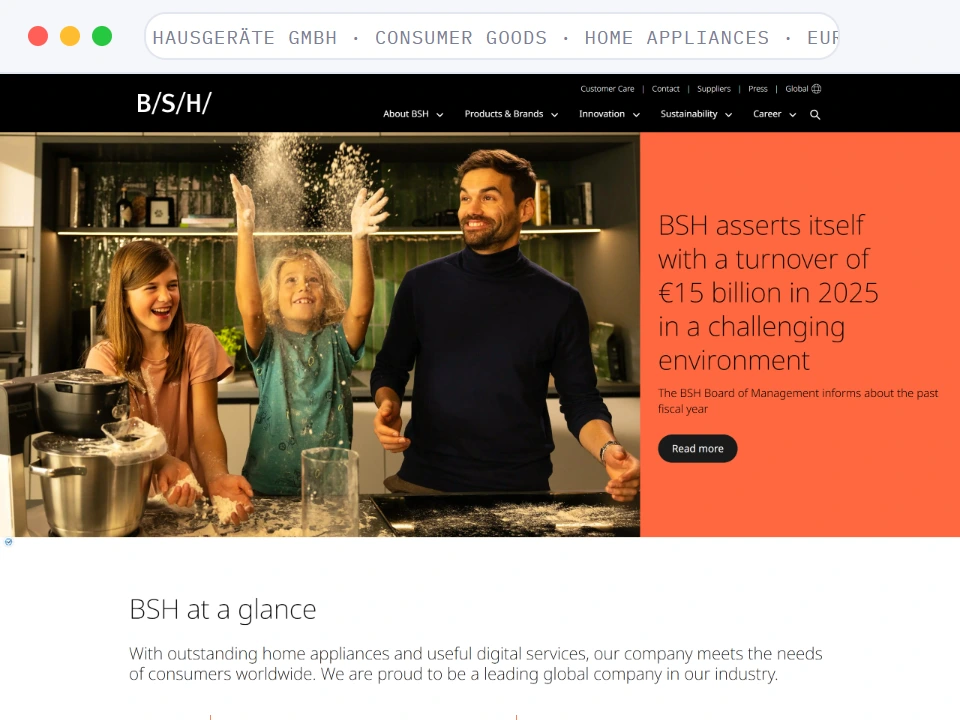
Consumer Goods · Home Appliances · Europe•Web Design · Web Development
Grew BSH Turkey lead generation 15% with backend and UX optimization.
BSH Turkey, part of Europe's largest home appliance maker, had strong traffic but low conversions. An outdated backend and hard-to-use navigation held it back. We modernized the backend, redesigned the frontend and funnel, and preserved the SEO structure throughout. Lead generation rose 15%, organic traffic grew 3% and average sessions lasted 45 seconds longer.
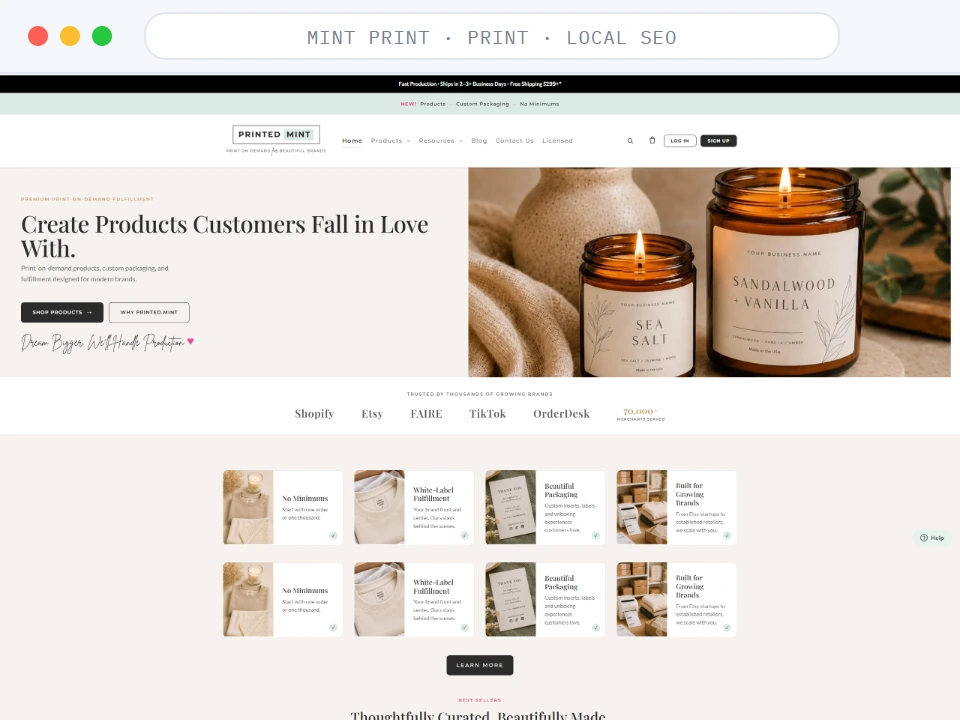
Print on Demand · Ecommerce Fulfillment•Web Design · Web Development
Drove 5K+ monthly visits and cut CPA 60% at Printed Mint with an SEO-led redesign.
Printed Mint had a strong reputation with the brands it already served, but an outdated website with weak calls to action, almost no organic visibility and costly paid ads. We redesigned the site around clear calls to action, ran SEO and published content built for engagement. Within six months it drew 5,000+ organic visits a month, ranked on page one for 125+ keywords and cut CPA 60%.
Manufacturing marketing is the full stack of channels that pulls qualified RFQs from procurement teams and engineers into your sales pipeline. It covers industrial SEO, technical PPC, spec-first web design, distributor portal support, and lifecycle email for long procurement cycles. A B2B industrial marketing agency runs those channels under one accountable roadmap tied to signed contract value, not clicks or impressions.
Manufacturing buyers do not act like consumer buyers. Procurement teams and engineers research for weeks or months before submitting an RFQ. They want spec sheets, cut sheets, CAD files, tolerance data, and material certifications before they will call. Sites that hide that data behind gated forms lose to sites that publish it openly and rank on the technical queries buyers type. Programs also lean on ISO and industry certification signals since procurement filters shortlists by compliance before evaluating price. The program that wins is the one that treats the RFQ as the primary conversion event and every other metric as a leading indicator to that outcome.
What do you mean by industrial marketing?
Industrial marketing is the marketing of goods and services from one business to another inside the industrial supply chain. Think OEMs selling to Tier 1 assemblers, contract manufacturers selling to product companies, distributors selling to plant operators, and component suppliers selling to engineers. The buyer is a business, not a consumer, and the buying committee usually pulls in procurement, engineering, quality, and finance before signing.
Industrial marketing rewards specificity. A buyer searching for a 316 stainless flange with a specific pressure rating wants the exact spec, tolerance, and lead time on the page. Generic brand copy loses to a page that answers the technical question. That is why industrial marketing programs invest heavily in indexable spec content, part-number pages, application notes, CAD downloads, and RFQ forms before spending on ads. Reference standards like ASTM and material data sheets belong on the page, not gated behind a contact form. Buyers cross-check the spec on the page against your data sheet before shortlisting.
What is a manufacturer in marketing?
A manufacturer in marketing terms is a business that produces physical goods, sells them to other businesses (OEMs, contract manufacturers, distributors, resellers) or to end buyers, and typically enters the market through channels that respect long buying cycles and technical evaluation. The manufacturer sits at a specific point in the supply chain: raw material supplier, component maker, subassembly builder, or finished-goods producer.
Marketing for a manufacturer looks different from marketing for a service or SaaS company. Buyers evaluate on spec compliance, lead time, tolerance data, material certifications, and cost per part before evaluating brand. That shifts the manufacturing marketing plan toward spec-first content, part-number SEO, distributor enablement, RFQ generation on paid search, and lifecycle nurture for 60 to 180 day procurement cycles. Brand advertising still matters for enterprise pursuit but rarely converts on its own inside industrial categories. Positioning has to lead with what your plant can actually produce, at what tolerance, on what lead time, backed by which certifications.
What is SEO in manufacturing?
Manufacturing SEO is search engine optimization tuned to how engineers, procurement teams, and buyers actually search for industrial products. The keywords are part numbers, material specs, tolerances, application phrases like "cnc machining for aerospace brackets", certifications, and capability queries. The pages that rank are spec sheets, application notes, capability pages, and case studies with real technical detail written by writers who understand the vertical, not generalist blog editors.
Most manufacturers lose organic traffic on their own SKUs to distributors and directories like Thomasnet. That happens when the manufacturer publishes specs as PDFs instead of indexable HTML, when part numbers are hidden inside product filter widgets, or when the site has no application-level content. Fixing indexability, publishing part-number HTML pages, and adding structured data markup usually recovers rankings inside 4 to 6 months, faster if the site has strong domain authority already. Internal linking from application pages to product pages accelerates the recovery.
How do I advertise a manufacturing company?
Start with intent-heavy paid channels: Google Search on part numbers and capability queries, LinkedIn Ads targeted to engineering and procurement titles at named accounts, and trade-publication placement inside industry outlets your buyers already read. Skip broad display and generic awareness campaigns first. Industrial buyers convert on high-intent search and account-based prospecting, not on prospecting banners.
Pair paid with a spec-first landing experience. An ad that lands on a generic "Contact Us" page wastes the click. An ad that lands on a page with tolerances, materials, lead time, CAD download, and a same-day RFQ form converts far more of the clicks you pay for. Google Ads on part number and spec queries produces first qualified RFQs in 14 to 30 days at typical industrial ranges. Layer in retargeting to buyers who downloaded a spec sheet but did not submit an RFQ, and pull in trade show follow-up sequences after every event.
How much does manufacturing marketing cost per month?
Managed industrial marketing retainers at Redefine Web start at $750 per month and scale with channel mix, content velocity, and media budget under management. Website builds are scoped separately as fixed-price projects at $2,500, $4,500, $7,500, or from $12,000 for custom scope. Single-channel PPC or SEO plans run $500, $750, $1,250, or from $3,000 per month depending on spend and content velocity.
The Foundation retainer at $750 per month covers industrial SEO with a modest technical content calendar, 1 blog post a month and 1 new service page a quarter. Growth at $1,250 adds Google Ads management on up to $3,000 a month of ad spend, with 2 posts a month and 2 pages a quarter. Scale at $1,999 adds Meta ads, programmatic SEO, and monthly landing page CRO tests on spec pages. Enterprise custom retainers cover multi-channel execution with no cap on managed Google Ads spend and weekly CRO tests. Distributor portal support, ABM for target enterprise accounts, and CRM integration inside HubSpot, Salesforce, or your ERP-adjacent stack are quoted separately. Ad spend is billed separately by the networks and does not sit inside the management fee, which keeps our recommendations honest when the plan calls for cutting spend on a channel that is not producing qualified RFQs.
How long before B2B manufacturing marketing shows real RFQs?
Manufacturing PPC produces first qualified RFQs in 14 to 30 days. Manufacturing SEO shows first ranking gains on part number and spec queries in 6 to 10 weeks with steady traction by month 4. Website builds go live in 4 to 10 weeks and improve RFQ conversion immediately once spec-heavy content replaces marketing fluff. B2B industrial marketing programs pay back on a compounding curve, not a spike.
Signed contract revenue lags RFQs by the length of the sales cycle. Most industrial contracts carry 60 to 180 day cycles from RFQ to signed contract since procurement teams cross-check pricing, run internal approvals, and often re-quote. That gets modeled into the pipeline plan on week one so nobody expects month-one contract revenue on a channel designed to feed a long procurement cycle. Distributor and rep channel work follows a different pattern. Distributor-driven demand shows up as pull-through orders, not RFQs, and needs tracking against portal engagement and rep enablement content usage.
What B2B manufacturing marketing channels give the best return on investment?
For most manufacturers under $20M in revenue, industrial SEO plus a spec-first website produces qualified RFQs fastest and cheapest. Google Ads on part number and spec queries closes the search intent gap and SEO compounds in parallel. LinkedIn Ads work for higher-consideration industrial products where the buying committee is titled at engineering and procurement leadership.
Trade publication placement (both editorial and paid) matters for categories where buyers still research inside industry publications. Distributor and rep enablement content matters when demand is channel-driven. Direct mail and industrial trade shows still work for specific verticals like custom fabrication and heavy equipment where relationships close on a plant floor visit. A real B2B industrial marketing agency recommends channels based on your buyer research pattern, not a template. If we recommend the same channel mix to an aerospace machine shop and a plastic injection molder, we are guessing on the plan and you should walk away from the pitch.
Do you handle manufacturing lifecycle marketing and long-cycle nurture?
Yes. Lifecycle email for long procurement cycles, dormant-RFQ reactivation, sales-assisted nurture for enterprise accounts, and post-contract expansion campaigns are scoped as their own project and quoted separately from the retainer tiers. We build the sequences inside HubSpot, Marketo, Pardot, or your ERP-integrated CRM depending on what your team already runs, and we hand you the workflows at end of engagement so nothing lives inside an agency-only tool.
Long-cycle nurture matters more in manufacturing than in most verticals since a 6-month sales cycle means marketing has to keep buyers engaged without being annoying. The right sequence pairs technical content (application notes, spec updates, material bulletins, tolerance-comparison charts) with occasional soft check-ins from your sales team. That keeps trust building through the full cycle without burning the list. Post-contract expansion sequences drive 15 to 30 percent of net-new revenue for manufacturers with cross-sell potential. Reorder campaigns, application cross-sell, and new product introduction to existing customers pay back higher than net-new prospecting.
Do we own the ad accounts, analytics, and website?
You own everything. Google Ads, LinkedIn Ads, Meta Business Manager, GA4, Search Console, your CRM integration (HubSpot, Salesforce, Dynamics, or your ERP-adjacent system), and your website. All accounts are created in your name with your billing details on file. Agency users get access as invited collaborators with least-privilege permissions, not as account owners with hidden administrative control.
The reason is honest incentives. Agencies that own client accounts have room to hold data hostage on offboarding. We do not want that pressure since we do not want to keep clients who want to leave. If you leave, you leave with everything intact: ad accounts, pixels, analytics history, CRM integrations, tag management, and the codebase for anything we built. Written offboarding is included in every contract and covers a 30-day handoff window with documented credentials, transferred creative assets, and a walkthrough call for your incoming team so nothing breaks in the transition or gets lost inside a Slack thread nobody archived.
How do you measure and report on manufacturing marketing performance?
Every industrial marketing engagement includes a written monthly review. SEO adds a live dashboard from the Traffic tier and PPC from Growth, and retainer strategy calls run quarterly on Foundation and monthly from Growth, with a dedicated account lead from Scale. The dashboard shows RFQ volume by channel, RFQ-to-quote rate, quote-to-signed contract rate, cost per RFQ, cost per signed contract, and pipeline coverage against sales quota. Attribution runs multi-touch (first-touch, last-touch, linear) so you see prospecting-driven awareness that closes on a later sales-assisted touch, not just the final click.
Every claim ties back to Google Ads, LinkedIn Campaign Manager, GA4, and your CRM (HubSpot, Salesforce, Dynamics, or your ERP-adjacent system) so nothing is unverifiable. The monthly review pairs numbers with narrative. What worked, what did not, what the next 30-day plan is, and what we need from your team on spec updates, engineering interviews, or facility capability documentation. Every workstream has an owner, a due date, and a written scope so accountability sits with a named person, not the agency at large.
Can you scale manufacturing marketing across multiple product lines or facilities?
Yes. Multi-product-line and multi-facility industrial marketing sits at the Scale and Enterprise retainer tiers. Enterprise includes per-product-line content clusters, per-facility landing pages with capability details, and consolidated reporting for operations leadership across every plant on a single scorecard.
Multi-product-line work adds category-specific keyword strategy so different product lines rank on their own technical queries without cannibalizing each other in search. Portfolio manufacturers with 5 or more product lines usually graduate to Enterprise for portfolio-level information architecture, cross-line SKU navigation, and consolidated RFQ routing to the right sales pod. Multi-facility work maps each facility to its own capabilities page with equipment lists, certifications (ISO 9001, AS9100, IATF 16949), tolerances achievable, and material specialties. That helps procurement teams find the right facility for their specific spec requirements without a sales call, which reduces friction on the RFQ and shortens the first-response window your sales pod needs to cover. The reporting rolls up plant-level RFQs into one operations dashboard so leadership sees channel performance across every facility on the same page.
Free · Written in 24 hours · No pitch
Get your free website audit.
A written report in your inbox within 24 hours, with three fixes you can ship the same week, whether or not you hire us.
Written in 24 hours · 10,000+ audits run · 300+ clients since 2021



 Published case study
 Published case study
 Published case study