Care plan
$199
Monthly
Essential, 24/7 uptime monitoring

Manufacturing website maintenance and hosting for industrial OEMs, fabricators, contract manufacturers, and multi-plant operators from $199/mo. uptime watched 24/7, RFQ form and SAP or NetSuite catalog imports monitored from Growth up, ISO 9001 and AS9100 certification pages audited, spec sheet and CAD file edits included, weekly patching on staging first, a 99.9% uptime commitment on every plan, and a written SLA with service credits when we miss it.
Selected clients we've run full marketing programs for


If any of these looks familiar, the free website audit names the fix and what it's worth before you spend a dollar.
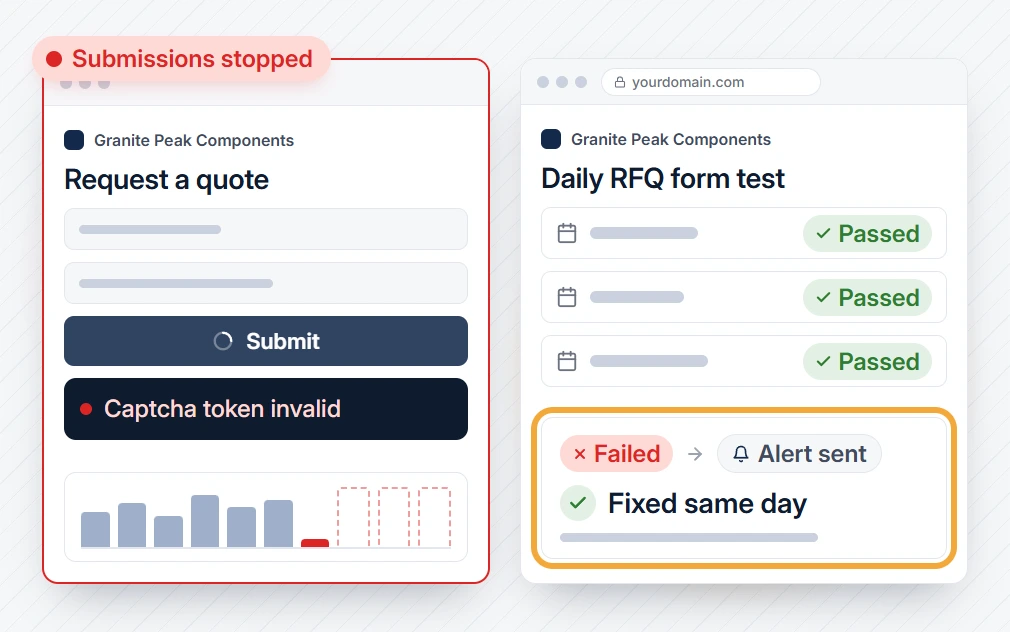
A Gravity Forms or Contact Form 7 update quietly breaks the reCAPTCHA token on the RFQ page. Buyers and engineers looking to spec a part hit submit, get nothing, and email the fabricator across town. Owners find out 22 quote requests walked away over 3 weeks at $9,400 average job value before anyone flagged the drop. A generic care plan patched the plugin and closed the ticket.
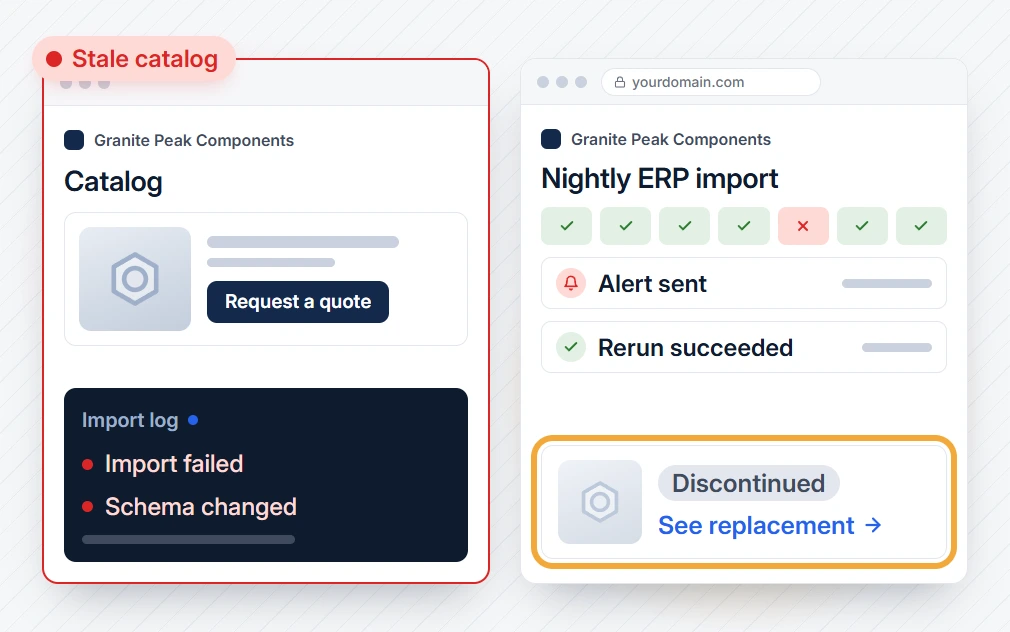
The nightly SAP or NetSuite catalog CSV import fails on a schema change. Engineers request quotes on discontinued part numbers, procurement drops the RFQ once they learn the SKU is dead, and the site sits stale for 2 to 3 weeks while nobody watches the import log. A vendor patching plugins does not watch the ERP webhook, and the missed intake is silent.
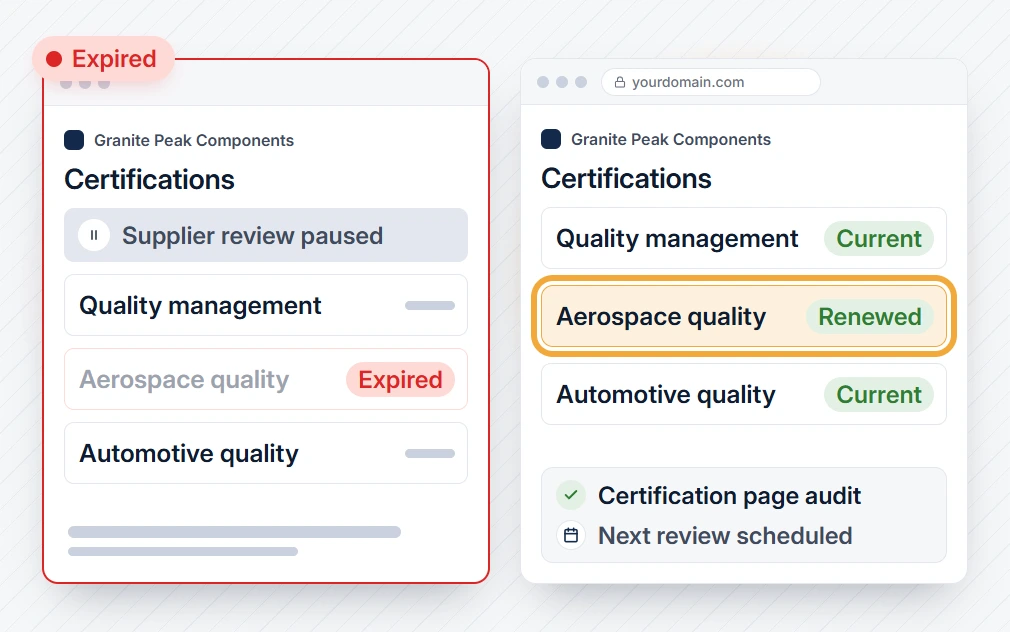
AS9100 renewed in March. The certification page on the marketing site still shows the expired 2024 date. A Tier 1 aerospace buyer runs supplier due diligence, flags the outdated cert, and pauses the vendor onboarding for 90 days. Every quarterly recert needs a real human on the calendar, not a note in a shared drive nobody opens.
Uptime, security and monthly edits: three results an ops lead can check.
On-call engineers know before buyers or distributors do. Uptime is 99.9% on every plan, with the written SLA and service credits when we miss it.
WAF, malware scans (weekly on Essential, daily on Growth and Scale, continuous on Enterprise), weekly patching, WCAG 2.1 AA checks, ITAR-aware access controls, and consent validation on every manufacturing maintenance plan.
CAD file uploads (STEP, IGES, DWG, DXF), capability page updates, cert renewals, and distributor announcements. 1 edit Essential, 2 Growth, 4 Scale.
Onboarding gets you access, credentials, and a full baseline scan on day one. From there, infrastructure, monitoring, and weekly reporting run without your input until you need something changed for a new SKU family, a spec sheet revision, or a fresh ISO recert.
Hosting, DNS, WordPress admin, SAP or NetSuite integration keys, HubSpot or Salesforce CRM credentials, catalog CMS logins, and ThomasNet or IndustryNet portal access logged with rotation schedule. Off-site backup taken and restored on staging to prove it works. Full baseline security, speed, and accessibility scan documented in writing.
Managed LiteSpeed hosting for WordPress manufacturing sites. Cloudflare CDN with edge cache tuned for large PDF spec sheets, CAD downloads, and product photography. WAF blocking bot and brute-force traffic before it reaches the origin. 99.9% written SLA on every plan with service credits when we miss.
Core, plugin, and theme updates tested on staging before they touch production. From Growth up, SAP, NetSuite, Epicor, Microsoft Dynamics, HubSpot, Salesforce, RFQ form, and product configurator integrations regression-tested on every deploy. Rollback path automated and under 5 minutes if a patch breaks the RFQ flow or catalog import.
5 global POPs pinging your site and buyer login every 60 seconds, plus RFQ forms and the ERP catalog webhook from Growth up. Malware scans run weekly on Essential, daily on Growth and Scale, and continuously on Enterprise, with auto-quarantine. A named engineer is paged inside 30 minutes on any critical incident, trade-show weeks and paid ThomasNet flights carry sev-1 escalation by default.
Five phases, every item listed. Fixed scope, defined deliverable per phase, written sign-off on the calendar for every spec sheet revision, catalog refresh, and cert page audit.
Day one covers WordPress admin, DNS, hosting credentials, SAP or NetSuite integration keys, HubSpot or Salesforce CRM logins, catalog CMS access, ThomasNet portal owner rights, and a full baseline security, speed, and accessibility scan documented in writing. First off-site backup taken and restored on staging to prove it works before we touch anything on the live site.

WordPress admin, hosting, DNS, SAP or NetSuite, HubSpot, Salesforce, catalog CMS, ThomasNet, and analytics owner access logged with a rotation schedule.
Encrypted off-site backup running before end of day one, on your tier's schedule. First backup restored on staging to prove it works.
Security posture, Core Web Vitals baseline, plugin and theme health, catalog import log review, disk usage, and WCAG 2.1 AA gaps. All captured before we touch anything.
Emergency numbers, the ticket process with your tier’s response time, and 30-minute response coverage for critical incidents. Owner and ops lead both have it before day one closes.
Every WordPress plugin cataloged with version, license, dependency, and business owner. SAP, NetSuite, Epicor, Microsoft Dynamics, HubSpot, Salesforce, and catalog CMS mapped.
WCAG 2.1 AA posture, Cookiebot or OneTrust consent banner state, Consent Mode v2 wiring on GA4 and Google Ads captured in writing.
Managed LiteSpeed hosting for WordPress manufacturing sites. Cloudflare CDN with edge cache tuned for large PDF spec sheets, CAD downloads, and product photography so a buyer in Germany or Mexico gets the datasheet from a nearby POP, not from a single US origin. WAF blocking bot and brute-force traffic before it reaches your site.

Isolated resources with proper caching, PHP tuning, and object-cache sized for your catalog page load and RFQ form spike pattern.
Cloudflare plus Quic.Cloud CDN so an engineer in Munich or Monterrey gets the PDF spec sheet from a POP nearby, not from a single origin server.
Bot traffic, brute-force login attempts on the buyer portal, and known-bad IP ranges blocked at the edge. No traffic tax on your origin.
Auto-renewed SSL plus HSTS. Mixed content flagged and fixed. Search Console and Google Ads never break because of a cert expiry.
Theme deploys via Git integration with a versioned rollback path on every push. No cowboy pushes to a live catalog the day before a big trade show.
From Growth up, RFQ form, product configurator, and SAP or NetSuite catalog webhook watched with a 60-second ping, and a 30-minute critical incident response if either breaks.
Every week, core, plugin, and theme patches tested on staging before they touch production. If a patch breaks the RFQ form, catalog import, or product configurator, rollback in under 5 minutes. Small spec sheet edits, capability page updates, and CAD file uploads covered inside the maintenance hours.

Patched to current stable weekly. Never behind by more than one minor release on manufacturing WordPress setups.
Every third-party plugin update tested on staging with real RFQ form submissions and catalog CSV imports before production.
From Growth up, every theme deploy runs the SAP, NetSuite, Epicor, Microsoft Dynamics, HubSpot, Salesforce, and product configurator regression suite before going live.
Spec sheet revisions, CAD file uploads, capability page tweaks, cert page date bumps, distributor announcements, and redirect adds. Covered inside your tier’s monthly edit count.
Quarterly ISO 9001, AS9100, and IATF 16949 page date audit so Tier 1 auditors never flag an expired cert during supplier due diligence.
Every deploy has an automated rollback path. Failed patches revert without a support ticket war room on a trade show week.
24/7 coverage on your site. Uptime pings every 60 seconds from 5 global POPs. Malware scans weekly on Essential, daily on Growth and Scale, and continuous on Enterprise, with automatic quarantine. Speed check hourly. If a critical incident trips, a named engineer is paged and on the incident inside 30 minutes.

5 global POPs (US East, US West, EU, APAC, LATAM) pinging your site, RFQ forms, ERP catalog webhook, and buyer portal login. False-positive filtering built in.
Weekly on Essential, daily on Growth and Scale, continuous on Enterprise. Full-site scan against known malware signatures and WordPress IOCs. Auto-quarantine and owner notified same-hour.
Core Web Vitals and full-page load tracked hourly on capability pages, part number pages, and the RFQ form. Regressions surface before CrUX field data.
On-call engineer paged on any critical incident, like the site going down or the RFQ form breaking. Real human, not a chatbot. IMTS, FABTECH, and paid ThomasNet feature weeks carry the same coverage.
From Scale up, the annual compliance audit reviews WCAG 2.1 AA posture, ITAR gating where required, and consent banner posture. Written snapshot in the weekly report.
From Growth up, synthetic iPhone SE and Pixel RFQ form submissions running on schedule so mobile RFQ regressions surface fast.
Every Friday, one clear report showing uptime, average catalog page and RFQ form load, patches applied, edit tickets closed, trade-show week incidents, and any regressions with root cause and fix. Sent to owner and ops lead, no chase.

Monthly uptime against the 99.9% SLA on every plan. Service credit issued when we miss during an IMTS week or paid ThomasNet flight.
Real-user data from Chrome UX Report. Not lab scores. What your buyers and engineers actually experience on their laptops and phones.
What we patched, what we edited, what stayed the same. Full audit trail in case anything comes up on a cert renewal or supplier audit.
Zero incidents most months. When something does happen, root cause and fix documented in writing, sent inside 48 hours.
From Growth up, weekly RFQ form submission volume, catalog import success rate, and part number page performance summary per SKU family.
Ahead of IMTS, FABTECH, and quarterly ISO cert renewals, monthly readiness checklist showing load-test pass, on-call rota, and rollback plan.
THREE FIXES YOU CAN APPLY · NO SALES DECK · 30-MIN CRITICAL INCIDENT RESPONSE · No card needed. No sales call required.
Pick the tier that matches your operation. Essential, Growth and Scale run a 6-month minimum term, and larger sites on Enterprise run 12 months. Move up or down a tier with 30 days notice. Hover any feature name to see what it means.
Stable sites that need patching, backups, and uptime
Sites with booking, checkout or lead forms that must not break
High-traffic sites and businesses running paid campaigns
Multi-site estates and multi-brand groups
6-MONTH MINIMUM · ENTERPRISE 12 MONTHS · 30 DAYS NOTICE AFTER · HOSTING INCLUDED · YOU OWN SITE, DOMAIN + DATA
Each one includes where the client started, what we changed and what happened.
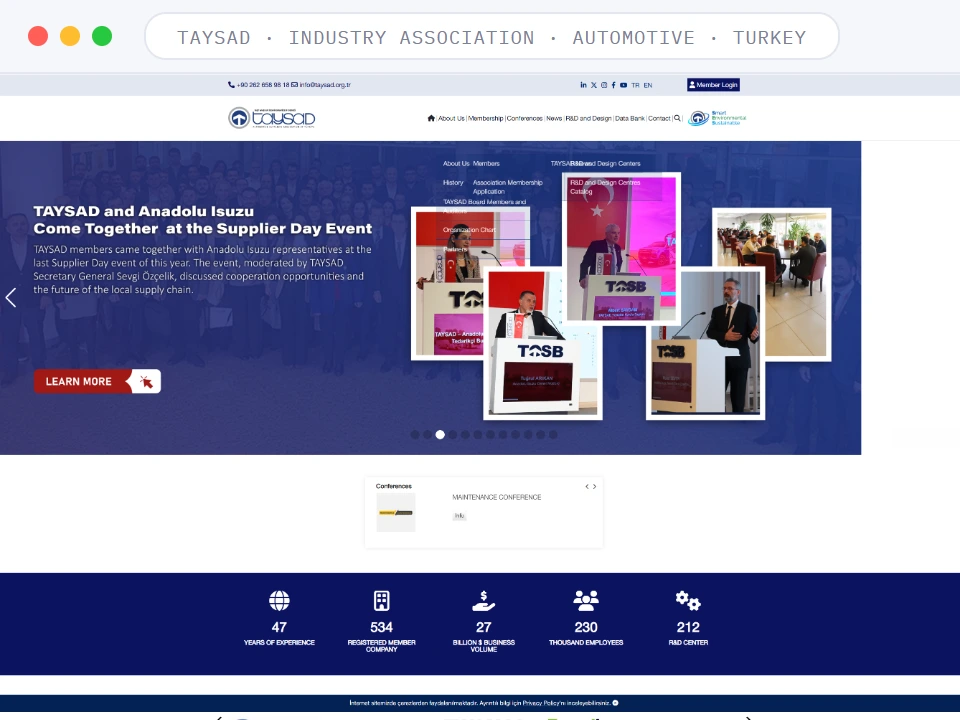 Published case study
TAYSAD
TAYSAD.ORG.TR
TAYSAD represents 490+ members of Turkey's automotive supplier industry. Its outdated site was slow, not secure and hard to use for members with limited tech skills. We built a secure backend with encryption, a simple design for every skill level and a faster build that can scale. Organic users grew 160%, page load time fell 80% and average sessions lasted 40 seconds longer.
 Published case study
BSH Hausgeräte GmbH
BSH-GROUP.COM
BSH Turkey, part of Europe's largest home appliance maker, had strong traffic but low conversions. An outdated backend and hard-to-use navigation held it back. We modernized the backend, redesigned the frontend and funnel, and preserved the SEO structure throughout. Lead generation rose 15%, organic traffic grew 3% and average sessions lasted 45 seconds longer.
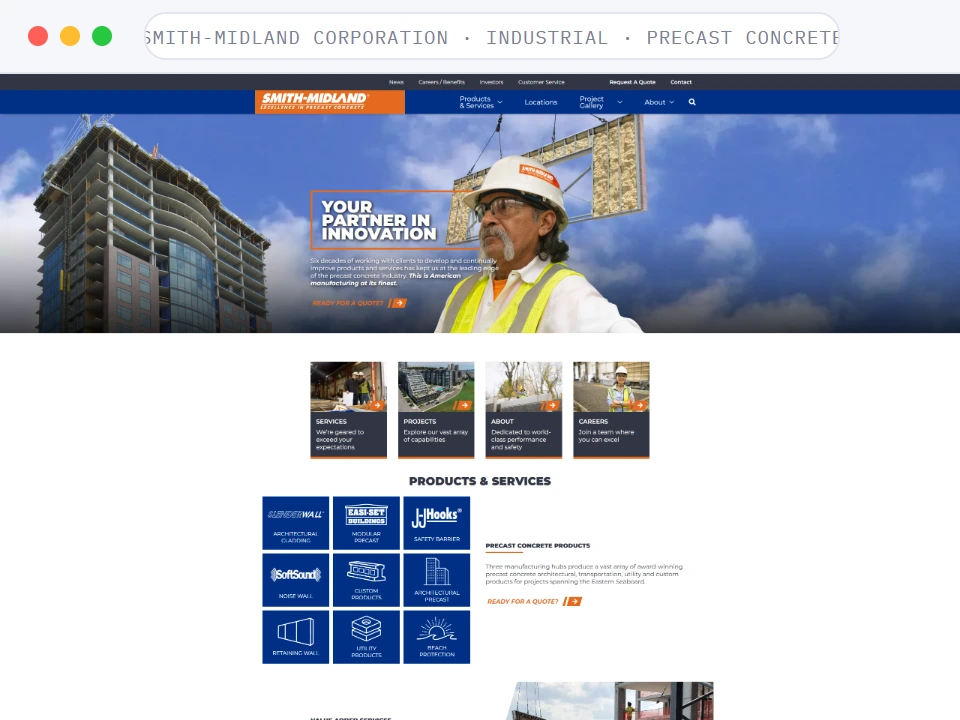 Published case study
Smith-Midland Corporation
SMITHMIDLAND.COM
Smith-Midland Corporation makes precast concrete for infrastructure. Its separate regional websites looked inconsistent, had unclear calls to action and did little for hiring. We merged them into two UX-led WordPress platforms with video, case studies, clearer calls to action and hiring stories. Bounce rate fell 65%, conversions doubled and the team now manages content in-house.
THREE FIXES YOU CAN APPLY · NO SALES DECK · 30-MIN CRITICAL INCIDENT RESPONSE · No card needed. No sales call required.
Enterprise demo requests up 3.2x. First operator we have worked with who cared about the CRM number, not the ad account.

Move the sliders to your numbers. This is your own revenue, divided by the days it arrives on.
Free · Written findings · Yours to keep
From real quote calls with OEMs, fabricators, contract manufacturers, and multi-plant operators. Anything else, ask on the strategy call and get an answer in the first 5 minutes.
Manufacturing website maintenance from a specialist vendor runs $199/mo on Essential, $299/mo on Growth, and $499/mo on Scale at Redefine Web. Multi-facility manufacturers and holding companies run on custom Enterprise quotes scoped per operation. Hosting is bundled into every tier, so buyers, engineers, and procurement teams are not stacking a separate host bill on top.
Generic care plans start around $50 to $200 a month and stop at basic core patching. A manufacturing-specialist plan covers ISO 9001 and AS9100 certification page audits and CAD file uploads on every tier, plus RFQ form watch, SAP or NetSuite catalog import health, and product configurator upkeep from Growth up. That extra coverage stops a stale spec sheet or a broken RFQ form from burning a Tier 1 supplier onboarding. Essential, Growth and Scale run a 6-month minimum term and Enterprise runs 12 months, then the plan rolls month to month on 30 days notice. You keep full ownership of the site, code, and part number list at all times. No auto-renew tricks and no forced multi-year commit.
In this context, manufacturing website maintenance means the ongoing work to keep an industrial manufacturer’s marketing site running as a real quote-intake channel. That includes RFQ form monitoring, SAP or NetSuite catalog import health checks, product configurator upkeep, ISO 9001 and AS9100 certification page audits, CAD file uploads (STEP, IGES, DWG, DXF), and CMS security patching on a weekly cadence.
It is different from plant-floor equipment maintenance. This work sits on the digital side: the WordPress admin, the hosting stack, the CDN, and the ERP or CRM integrations that feed catalog data to buyers and procurement teams. When done right, an ISO 9001 renewal never surfaces a Tier 1 audit flag because the cert page shows the wrong date, and an SAP schema change never burns 22 RFQs in silence. Weekly patching runs on staging first, deploys to production with automated rollback in under 5 minutes. The result is a manufacturing marketing site that stays a real quote-intake channel every business day.
A manufacturing marketing site needs six recurring tasks: uptime monitoring at 60-second intervals, weekly WordPress core and plugin patches tested on staging first, daily off-site backups with quarterly restore drills, malware scans with auto-quarantine, monthly Core Web Vitals checks against real Chrome UX Report data, and quarterly WCAG 2.1 AA audits covering the RFQ form and buyer login. On our plans, backups run weekly on Essential and daily from Growth, and a quarterly restore drill is quoted separately. Core Web Vitals tune-ups run quarterly on Growth and monthly on Scale, and the WCAG review sits in the annual compliance audit from Scale up.
Industrial sites need three extras on top of that: RFQ form test submissions on a daily cadence, ERP catalog import log review (SAP, NetSuite, Epicor, Microsoft Dynamics), and ISO 9001, AS9100, and IATF 16949 certification page date audits every 90 days. Miss any of those three and a stale spec sheet, a dead SKU, or an expired cert flag can quietly push procurement teams to the fabricator across town. See Google Search Central for baseline site health signals we track monthly. Buyers and engineers get a fast, consistent RFQ path across desktop and mobile. That is documented in the master services agreement and reviewed on renewal.
Generic small-business website maintenance runs $50 to $200 a month and covers plugin patching, a basic malware scan, and one shared backup. Industry-specialist plans, including manufacturing website maintenance, run $200 to $2,000 a month depending on integration coverage, SLA tier, and the monthly content edits included. Custom enterprise retainers for multi-facility operators or ITAR-controlled manufacturers can run above that when a named engineer and a monthly incident review are on the plan.
Redefine Web plans start at $199/mo on Essential, $299/mo on Growth, and $499/mo on Scale. Multi-plant operators and holding companies get a custom Enterprise quote. Every plan includes hosting, so procurement teams are not stacking a separate host bill. Essential, Growth and Scale also run a 6-month minimum term and Enterprise runs 12 months, then month to month, and buyers keep full ownership of the code, catalog data, and part number list on cancellation. No hidden fees on ERP or CRM integration upkeep once the retainer is signed. Every manufacturing site owner gets a copy of the weekly report by email.
The four common web hosting types are shared hosting (multiple sites on one server, cheapest, slowest), VPS hosting (virtualized slice of a server, more resources), dedicated hosting (a whole server for one site), and cloud or managed hosting (auto-scaling, tuned for a specific stack like WordPress or Next.js).
Manufacturing marketing sites almost always run on managed WordPress hosting on a LiteSpeed or Nginx stack, with a CDN in front for large PDF spec sheets and CAD downloads. Shared hosting kills the RFQ flow the first time a bot swarm hits the login page. Dedicated hosting is overkill for a single-facility catalog. Every Redefine Web manufacturing maintenance plan bundles managed LiteSpeed hosting plus Cloudflare CDN and WAF into the retainer, with US-only data centers where ITAR requires it. See Google Search Central for host performance baselines every buyer should confirm before signing. The hosting stack is documented in every weekly report so the ops lead can verify it independently.
Standalone managed WordPress hosting from a name-brand host runs $30 to $300 a month depending on traffic, resources, and support tier. A dedicated server for a single-site manufacturer runs $150 to $600 a month. Enterprise-grade cloud hosting with 99.99% SLA, WAF, and dedicated engineers runs $500 to $3,000 a month or more when named-engineer coverage is part of the deal.
Redefine Web bundles hosting into the manufacturing website maintenance retainer, so buyers are not paying twice. Essential at $199/mo covers a single-facility WordPress catalog. Growth at $299/mo covers ERP or CRM integration health and same-week edits. Scale at $499/mo covers multi-facility operators. The written 99.9% uptime SLA and its service credits cover every plan. Enterprise plans scope to ITAR, AS9100, IATF 16949, or multi-plant operator needs. See HubSpot Support for CRM integration prerequisites. Buyers see the price on the pricing page, not after the long discovery call and paid audit some agencies require. The engineering team notes each patch, edit, and incident in a shared log.
The best host depends on the site type. For a manufacturing marketing site running WordPress with SAP, NetSuite, or HubSpot integrations, RFQ forms, product configurators, and CAD downloads, a managed WordPress specialist beats a generic shared host on every dimension that matters: uptime SLA, RFQ form watch, edge caching for PDF spec sheets, and rollback speed on a failed patch.
Redefine Web runs manufacturing sites on managed LiteSpeed with Cloudflare CDN, WAF, and Quic.Cloud edge routing. That stack was picked because it caches large PDF datasheets and CAD file directories at the edge so a buyer in Munich or Monterrey gets the same page load as one in Cleveland. For ITAR-controlled catalogs, US-only data centers are on every plan. For non-ITAR sites, the global POP network drops trans-Atlantic PDF load times by 40 to 60% versus a single US origin. Buyers and engineers notice the speed difference on their first visit. Reference calls with two existing manufacturing clients are available on request during the sales cycle.
Yes, technically. A manufacturer can self-host on a spare in-plant server or a free-tier cloud VM. That is almost never the right call for a marketing site that runs a public RFQ form, an ERP-fed catalog, and CAD file downloads. In-plant IT is already fully loaded on ERP, MES, and PLM systems and does not have spare cycles for public-facing site work.
Self-hosting a public marketing site means the in-plant team owns SSL renewal, WordPress patching, WAF tuning, uptime monitoring, DDoS response, and RFQ form watch on top of their day job. A single missed reCAPTCHA update can burn 22 RFQs before anyone notices, and the fix takes a full afternoon of triage that nobody has time for. Managed hosting inside a manufacturing maintenance plan takes those tasks off the plant IT queue and puts them on a dedicated web engineer, so buyers and procurement teams reach the RFQ page every time. Managed hosting also cuts insurance premiums for cyber liability policies at some carriers.
No. WordPress still runs about 40.2% of the public web in 2026, and it is the dominant CMS for manufacturing marketing sites because the plugin catalog, block editor, and headless-Next.js hybrid options fit RFQ forms, product configurators, ERP-fed catalogs, and ISO cert display pages without a full custom rebuild.
What is outdated is a WordPress site that has not been patched in 18 months, running on a shared host with a $99 lifetime theme and 32 abandoned plugins. That kind of site is a security incident waiting to happen and it drags Core Web Vitals into the red. A properly maintained WordPress catalog on managed LiteSpeed, patched weekly on staging, and monitored for RFQ form health is a fast, ranked, and secure asset for the manufacturing site owner. See Google Search Central for current best-practice signals we track on every plan. Ranking on manufacturing-specific keywords still favors WordPress sites with clean structured data and healthy Core Web Vitals.
Some small teams move off WordPress toward Webflow, Framer, or a headless Next.js stack when their marketing site is a brochure with three pages and no forms. For manufacturing marketing sites running a real RFQ pipeline, SAP or NetSuite catalog feeds, product configurators, and ISO cert pages, WordPress remains the fit because the plugin and integration ecosystem is deeper than any competitor. Nothing else covers the industrial-specific tooling well.
Most manufacturers who leave WordPress do so because their prior vendor never maintained the site properly. Plugin conflicts, unpatched core, bloated themes, and unmonitored ERP webhooks stack up over 3 to 5 years and the whole thing feels broken. The fix is a specialist manufacturing maintenance plan, not a full platform migration that costs 6 figures and locks you into a new vendor’s stack. Buyers rarely need to leave WordPress. They need to leave the vendor who neglected the site for three years.
To put a WordPress site into maintenance mode, install a plugin like WP Maintenance Mode or LightStart. The plugin shows a temporary landing page to public visitors while allowing logged-in admins to work on the site. A second option is to add a .maintenance file to the WordPress root with a die() message and a 60-second lockout window, which is the built-in method core uses during updates.
For a manufacturing site with a live RFQ form, public catalog, and ERP webhook, we recommend against manual maintenance mode. Every minute the site shows a maintenance banner is a minute buyers and engineers hit the fabricator across town. On managed Redefine Web hosting, patches run on a staging clone, the RFQ form and catalog webhook get regression-tested, and the deploy to production takes under 5 minutes with an automated rollback path if anything breaks. Zero visitor-facing downtime, no maintenance banner, no lost RFQs. Owner and ops lead get an email confirming the deploy landed clean before end of business.
For a manufacturing WordPress site with 100 to 500 pages, weekly maintenance runs about 2 to 4 hours: core plus plugin patches on staging, RFQ form and catalog webhook regression tests, a Core Web Vitals check, a malware scan review, and an off-site backup verification. Monthly maintenance adds 3 to 6 hours for a full security audit, ISO cert page date review, and a written report sent to owner and ops lead.
On a Redefine Web manufacturing maintenance retainer, buyers and procurement teams do not track those hours. The plan covers the recurring work plus content edits (1 on Essential, 2 on Growth, 4 on Scale) for spec sheet swaps, CAD uploads, capability page updates, and distributor announcements. Everything is documented in one weekly report so the ops lead reads it in 90 seconds. Emergency incidents outside the recurring window carry the same 30-minute response on every tier. Buyers who add ad campaigns or a rebrand mid-year can flex hours forward, no change order overhead.
Yes, from Growth up. SAP, NetSuite, Microsoft Dynamics, Epicor, HubSpot, Salesforce, product configurators, and CPQ tools like DealHub and PandaDoc are all monitored on Growth, Scale and Enterprise manufacturing website maintenance plans. We watch the API connection, the catalog import log, and the RFQ webhook submission rate. When an ERP vendor pushes a breaking change 4 to 8 times a year, we patch it before it kills catalog freshness or the quote flow. A break that stops the quote flow is a critical incident with a 30-minute human response; other integration tickets get your tier’s response time, 24 hours on Growth and same day on Scale.
A broken SAP catalog import is invisible to most owners for 2 to 3 weeks. In that window, engineers request quotes on discontinued SKUs, procurement teams kill the RFQ once they learn the part is dead, and dozens of qualified quotes walk away silently. We surface the drop the same day it happens and open a ticket with the SAP or NetSuite side within your tier’s response time. Reports also cover distributor portal login volume and buyer session depth on capability pages.
Trade show weeks are treated as sev-1 by default. IMTS, FABTECH, WESTEC, and paid ThomasNet feature weeks carry priority escalation on every manufacturing maintenance plan. Uptime monitoring at 60-second intervals alerts on-call engineers before buyers and distributors notice, and every plan includes a pre-show readiness checklist covering load-test pass, on-call rota, rollback plan, and CDN cache warm-up.
Every plan carries the same 30-minute critical incident response, and the 99.9% uptime SLA pays service credits if we miss it. Every trade show week gets a post-event summary: total uptime against SLA, RFQ form submission volume, catalog page load, and any incidents with root cause and fix. Buyers and procurement teams who see the booth traffic spike also see the RFQ intake spike, without a broken form burning the lead. Content edits for booth-driven spec sheet requests get your tier’s ticket response, 24 hours on Growth and same day on Scale. The IMTS and FABTECH readiness checklist is shared 3 weeks ahead of the show for owner review.
Free · Written in 24 hours · No pitch
A written report in your inbox within 24 hours, with three fixes you can ship the same week, whether or not you hire us.
Written in 24 hours · 10,000+ audits run · 300+ clients since 2021


