Fixed price
$2,500
One-time project
Starter, up to 8 pages

Most agencies split web design and development services across 2 vendors. The build launches late and looks nothing like the Figma. Redefine Web keeps both under one team, one contract, and the same weekly standup. From $2,500 fixed. 4 to 10 weeks to launch.
Selected clients we've run full marketing programs for


If any of these looks familiar, the free website audit names the fix and what it's worth before you spend a dollar.
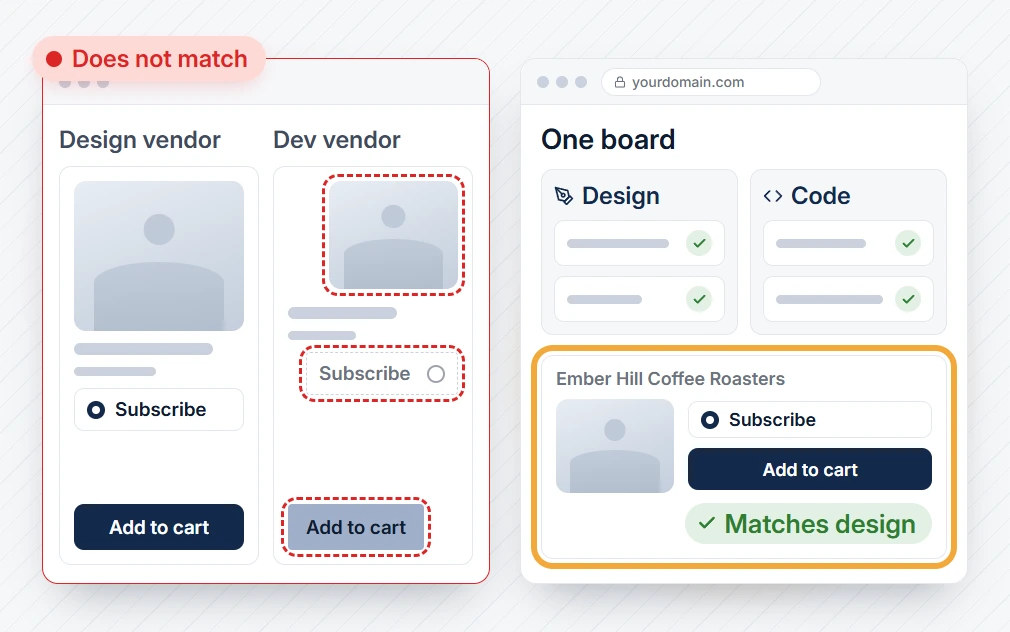
Two vendors on WordPress plus Next.js almost never share a Slack channel. Every edit becomes a ticket war. Launch slides 6 weeks and the Figma stops matching the code. One team on both sides closes the gap on the first standup.
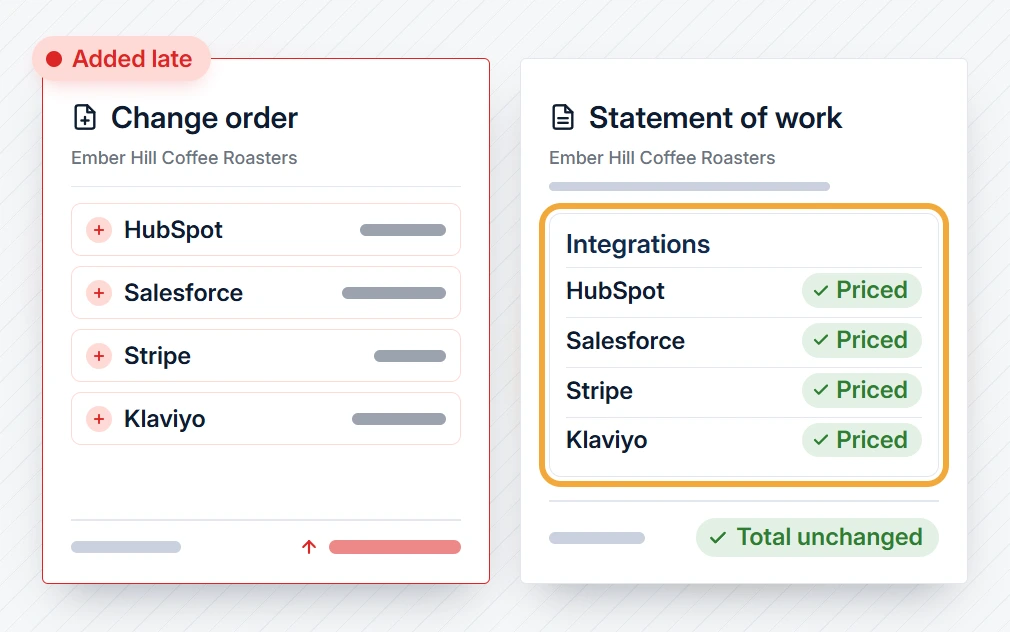
Most agencies quote HubSpot, Stripe, and Klaviyo as one-line integrations then balloon the number to $14K at week 8. Every integration on this page is priced on page 1 of the SOW. Scope grows, the number does not.
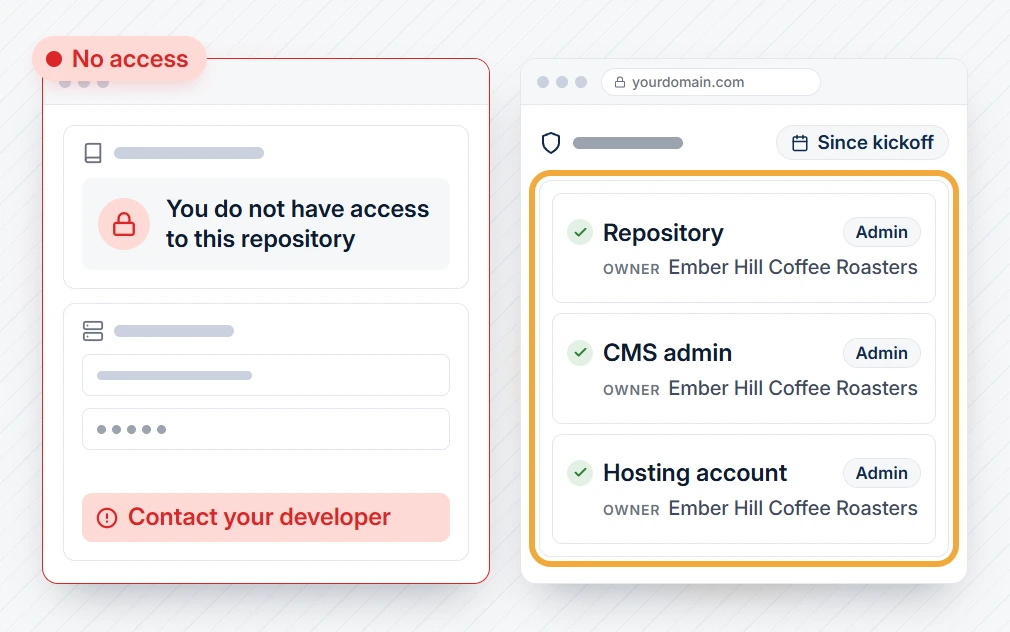
Half the industry treats GitHub and hosting as lock-in. Migration alone runs $8K when you leave. Redefine Web puts the repo, the CMS admin, and the hosting under your name from week 1, so you own the exit path before you sign the contract.
Three things you get when one team owns both design and code.
Design and engineering under one bundled web design and development contract. One invoice, one project owner, one Slack channel that owns delivery.
Design system tokens export to JSON and CSS variables the engineer imports directly. Components deploy 1:1 from Figma to code, iteration in the same week.
One designer, one engineer, one project owner. The people on the pitch are the same people on delivery, straight through the 30-day post-launch window.
Same rhythm across every combined design and development project. Each stage ends in something your team reviews, from the signed brief to the handoff docs.
Stakeholder interviews, technical audit of your current stack, competitor benchmark, and a sitemap workshop. Written brief signed off by founder, dev lead, and marketing before a pixel moves. Discovery wrong means every phase after is wrong.
Mobile-first design system, engineer-validated the same week components are drawn. Interactive prototypes tested on real devices. Component handoff package delivered with the engineer in the room, not thrown over the wall.
WordPress with custom blocks, Webflow, Next.js headless, or Sitecore. Recommendation comes from the audit and what your team can maintain. CMS your team edits. CRM integrations source-tagged from day one. From Growth up, every launch hits 90+ PageSpeed mobile.
Off-hours DNS launch with a runbook and rollback plan. A 1:1 redirect map from Growth up. Search Console daily review for 30 days. Core Web Vitals RUM dashboard live. Handoff docs covering CMS, deployment, and repo access. The site is yours the second it goes live.
Every phase has a written deliverable, a signed acceptance page, and a date on the calendar. You always know what is due, when, and which discipline owns it on our side.
Nothing gets designed until both the designer and the engineer understand your business. Discovery covers owner interviews, a full audit of your current site, and a benchmark against 5 direct competitors. You end with a written brief your leadership signs off on before we touch a pixel. If we get discovery wrong, every phase after gets wrong.

Founder, dev lead, and marketing sit for 3 to 5 working sessions. Business rules, edge cases, and success criteria captured in writing.
Existing stack, plugin inventory, CRM setup, analytics gaps, and page-by-page traffic + conversion data pulled and reviewed.
Five direct competitors benchmarked on speed, conversion pattern, content depth, and technical SEO. Written scorecard with gap notes.
Full sitemap drafted, information architecture validated against buyer journey, and content model scoped before design starts.
Every decision written down. Founder, dev lead, and marketing sign the brief before we touch a pixel. Scope changes go through change orders.
Every CRM, form, analytics, and payment touchpoint diagrammed with rate limits and failure modes so nothing surprises us at week 8.
Every design decision has to earn its place on the page, and the engineer is in the room the same day. Wireframes get validated against your top 3 conversion actions before pixels are drawn. Components get reviewed the same week they are designed, so what looks right in Figma holds up in code. You own the design system, the tokens, and the Figma files at handoff.

Every screen wireframed on mobile first, validated against your top 3 conversion actions before a pixel of visual design is drawn.
Buttons, inputs, cards, tables, modals, and layout primitives. Variants, states, and dark mode drawn once and used everywhere.
Color, type, space, radius, and motion tokens exported for direct import into your frontend. No pixel-pushing at build time.
Figma prototype covering the top 3 user flows. Tested on real phones and real users, findings written up and shared with your team.
Every component gets reviewed by the engineer the same week it is drawn. What looks right in Figma holds up in code on day one.
Focus order, ARIA roles, color contrast, and keyboard navigation baked into the handoff, not audited after launch.
Slow sites lose leads, so from Growth up, Core Web Vitals is an acceptance criterion, not an afterthought. The engineer sitting next to the designer writes hand-tuned PHP on WordPress or Next.js, with LiteSpeed and an edge CDN handling caching and delivery. Every page launches with WCAG 2.1 AA verified by both Axe and a human on NVDA, and from Growth up, with LCP under 1.8s, INP under 200ms, and CLS under 0.05.

CMS picked from the audit and what your team can maintain. WordPress with custom blocks, headless Next.js, Webflow, or Sitecore.
No page builder bloat. Hand-tuned PHP on WordPress or React on Next.js. Every route reviewed for LCP, INP, and CLS before staging opens.
From Growth up, LCP under 1.8s, INP under 200ms, and CLS under 0.05 as a launch gate written into the SOW. Miss it, no invoice for the extra week.
Code in your git from day 1. Every PR reviewed by a second engineer. Preview environments per branch. Weekly promotion to staging so you always see the real build.
Axe scans, manual audit, and NVDA plus VoiceOver passes on every page before launch. Docs included in your handoff pack.
Every template ships with canonical, meta title/description patterns, and open graph tags, plus schema from Growth up. Rank Math score 82+ per page on launch.
Runs in parallel with the final weeks of engineering. Your CRM, analytics, and review platform are not going anywhere in the next 2 years, so we build against them properly. Forms and conversion events route straight into your CRM with campaign source tagging so paid channels can actually attribute. Abstraction layers get documented so when you swap tools 18 months from now, the migration takes days, not months.

Two-way contact and lead sync, form-to-lead handoff, and pipeline stage writes. Queue-backed with retries and dead-letter alerts.
Subscriptions, one-time charges, invoicing, and dunning wired native. Webhook idempotency by design, so retries never double-charge.
List sync, transactional email, and consent handling wired into GDPR and CCPA banners on the first deploy.
Server-side events for revenue-touching actions, client-side for engagement. Google Ads offline conversions and Meta CAPI included.
Dynamic number insertion, session-level source attribution, and call recordings piped into your CRM against the right campaign.
Every integration listed with a fixed number on page 1. No change orders at week 8. Scope grows, the number does not.
Cutover day is where most agencies drop the ball. Redefine Web runs DNS off-hours with a written rollback plan, a full 301 map from the old site on Growth and up, and uptime plus Core Web Vitals monitoring live from the minute the record propagates. You get 30 days of post-launch support built in, plus every design file, CMS login, and repo credential. The site is yours the second it goes live.

DNS switched off-hours with a tested rollback plan. Legacy site stays online for 30 days as a hot standby if anything moves sideways.
From Growth up, every legacy URL scored on traffic, ranking, and conversion. Retired pages 301d to the closest new URL. Nothing loses its rank on migration day.
Coverage, indexation, and Core Web Vitals reviewed daily for 30 days after cutover. Any drop caught inside 24 hours.
Real-user monitoring live from minute one. LCP, INP, CLS reported per page, per device, per country in a dashboard your team owns.
CMS login, deployment runbook, repo access, design files, and integration credentials handed over in a single pack. Signed clause.
Bug fixes on delivered scope and daily launch monitoring for the first 30 days, handled by the same engineer who built it.
3 FIXES YOU CAN APPLY · No card needed. No sales call required.
Pick the tier that fits your build today. Every tier is a one-time fixed-price project quoted before we start, with code in your git from day 1.
THE FOUNDATION: New businesses that need a credible, fast site on a template base
EVERYTHING IN STARTER, PLUS: Single-location businesses replacing an underperforming site
EVERYTHING IN GROWTH, PLUS: Larger sites with more page templates and integrations
EVERYTHING IN SCALE, PLUS: Large site estates, multi-brand or multi-location
EVERY TIER: FIXED-PRICE SOW · CODE IN YOUR GIT · 30-DAY POST-LAUNCH SUPPORT · YOU OWN REPO, INFRA + DATA
Each one includes where the client started, what we changed and what happened.
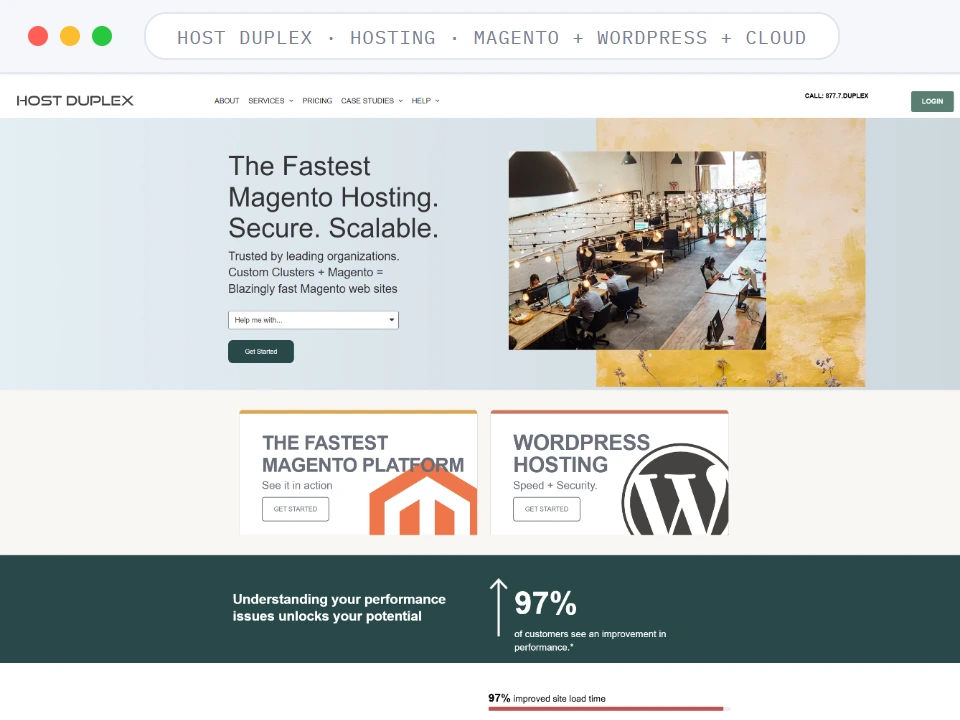 Published case study
Host Duplex
HOSTDUPLEX.COM
Host Duplex sells high-performance hosting, yet its own website took 8+ seconds to load. We rebuilt it on a lightweight WordPress theme and swapped plugins for custom code. Chat and tracking stayed, without slowing the site. Pages now load in under a second, with 65% fewer server requests and about 5K more organic visits.
 Published case study
iSmile Dental Spa
ISMILEDENTALSPA.COM
iSmile Dental Spa had a strong local name but an old, insecure website. Online channels brought in 1 to 2 new patients a month. We rebuilt the site on HTTPS, added treatment pages, cleaned up local listings and launched Google Ads and video. Within 6 months it ranked on page one for 75 keywords. It now sees 12 to 14 new patients a month.
 Published case study
IECA
IECA.ORG
IECA, the leading authority in ethical educational consulting since 1976, had an outdated site. Its consultant directory was hard to use and not secure. We built a secure, mobile-friendly site with a new consultant directory, SEO content and PPC campaigns. Within 6 months it drew 50K+ monthly organic visits, leads rose 18% and 750+ keywords ranked on page one.
3 FIXES YOU CAN APPLY · No card needed. No sales call required.
Demos doubled in a quarter after the funnel rewrite. Nothing about the traffic changed. The pipeline math finally works.

Move the sliders to your numbers. A redesign earns its cost from the visitors already landing on the site, before it wins a single new one.
Free · Written findings · Yours to keep
From real quote calls with founders, product leads, and marketing owners. Anything else, ask on the call, answered in the first 5 minutes.
Website design and development services combine two disciplines under one contract. Design covers layout, typography, color, mobile flow, and conversion patterns. Development covers the code, CMS wiring, forms, integrations, and hosting. On split-vendor jobs the designer hands a Figma file to a coder and walks away, so the launched site rarely matches the mockup. Redefine Web bundles both sides in the same team, same weekly standup, same project owner, same Slack channel, and one signed contract. You get a working site, not a stack of files. When you compare website designers near me, ask each one who writes the code after sign-off. Every build ships with WCAG 2.1 AA passing on Axe plus a human tester on NVDA and full ownership of the repo, hosting, and CMS from day one. From Growth up, it also ships with Core Web Vitals green, web.dev vitals verified. Timeline runs 4 to 10 weeks against a signed date. Pricing is fixed on page one of the SOW, so there are no change orders at week 8. That is what real web design and development services should look like in 2026 for founders and marketing owners.
Web design decides how the site looks and how a visitor moves through it. Grid, type, color, hierarchy, mobile flow, form patterns, and conversion CTAs. Web development turns that design into code that works in every browser and every device. HTML, CSS, JavaScript, CMS templating, server logic, integrations, and hosting. On split-vendor projects the designer hands a Figma file to a developer, then leaves. On a combined design and development contract, one team owns both sides, so the button that looks right in Figma renders right on Android Chrome at 320 pixels wide. That is how you get a working site that still feels like the brand and the business. Redefine Web keeps the designer and engineer in the same standup, on the same Slack channel, under one project owner, from kickoff to launch and 30 days after. That handoff gap is where 40% of split-vendor budgets vanish before the site goes live.
The industry-standard 7 stages of web development: 1) discovery and requirements, 2) sitemap and information architecture, 3) wireframes and visual design, 4) content and copywriting, 5) front-end and back-end coding, 6) testing and quality assurance, 7) launch and long-term maintenance. Redefine Web runs a compressed 5-phase version of the same rhythm on every custom web design and development engagement: discovery, design system, engineering, integrations, and cutover. Stages 4 and 6 fold into the phases before and after each block. Every phase closes with a signed acceptance so scope creep does not sneak into the next block undocumented. Discovery is where most projects go wrong, so we spend 2 full weeks on it, with owner interviews, competitor benchmarks, and a technical audit of the current stack. Cutover has a written rollback plan, a 1:1 redirect map from Growth up, then 30 days of post-launch monitoring on Core Web Vitals, Search Console, and CRM handoffs. The handoff pack covers every credential you need for the exit, so nothing is stuck behind a login you cannot access on the day after launch.
For most SMBs and mid-market businesses the top 3 are WordPress, Webflow, and Framer. WordPress runs roughly 40.2% of the web and scales from a $2,500 marketing site to headless Next.js in front of an ecommerce backend, on a familiar admin. Webflow wins on brand sites where a marketing team wants to edit visually without a developer in the loop. Framer is the fastest option for startups that need a landing page live in a week and a lightweight CMS behind it. Redefine Web builds on all three, plus Next.js and Astro headless for scale scenarios that outgrow visual builders. The recommendation comes from your team, not our preference. If your marketing lead knows Webflow, we build on Webflow. If you have a HubSpot CRM and a lean team, WordPress with ACF or SCF is usually the honest answer. Read the Google Search docs before you pick a stack, so SEO is not an afterthought.
Fixed price, published on the page, no hidden hourly bill. Starter marketing sites on WordPress or Framer start at $2,500. Growth builds of up to 15 pages run $4,500 with custom website design, schema, site migration, and live scheduling wired into HubSpot or Salesforce. Scale builds of up to 25 pages run $7,500 and add a shared design system, CRO testing setup, and a dedicated project lead. Enterprise custom web design and development on Next.js headless with ecommerce, multi-region deploys, and heavy CRM wiring runs $12,000 and up, scoped per project against a written brief. Every tier includes accessibility and full ownership on handoff, with Core Web Vitals green from Growth up, so the number on page one of the SOW is the number on the final invoice for the client. Change orders happen only when scope changes, and every scope change gets its own signed addendum with a new line item. If another website design company quotes half the price with no fixed launch date, ask for the change-order schedule before you sign. That is where the real number lives on most bad quotes in this market.
Design-only work at Redefine Web is quoted separately, from a single-page brand site to a full design system across 15 to 25 pages, with mobile-first components and a token export. Design-only projects skip the coding, so what you get is a Figma file, a component library, a design system token export, and a written handoff pack your in-house developer or a third-party shop can build against. Most buyers shopping for web design services need a working site, so they end up bundling design and development in one contract. That removes the handoff gap where 40% of budget disappears in translation between vendors. If you already have a strong in-house dev team on staff, design-only is a valid path. If you do not, a combined design and dev contract costs less overall since one team owns both sides of the launch date. That is the honest math for most SMB and mid-market businesses shopping this category in 2026 across every industry we serve.
Custom web design and development runs $4,500 for a small business marketing site with 8 to 15 pages, $7,500 for a mid-market build of up to 25 pages with HubSpot or Salesforce integrations, and $12,000 and up for enterprise headless builds on Next.js or Astro with ecommerce, multi-region deploys, and heavy application logic in the mix. Custom means the code is written for your team, not a theme dropped on a Bootstrap grid on a rushed build. Redefine Web uses ACF or SCF on WordPress to keep the CMS editor-friendly, and the front end stays fully hand-tuned on a clean grid. Every custom build ships with 90+ mobile PageSpeed, WCAG 2.1 AA passing, and a written handoff pack covering CMS, repo, hosting, and every CRM key. Timeline runs 4 to 10 weeks depending on scope and integrations count.
Custom web development is code written from scratch against a written spec, not a theme configured out of the box on a stock grid. On WordPress it means custom blocks, ACF or SCF field groups, and hand-tuned PHP templates instead of a bloated page builder plugin. On Next.js it means a component library, hand-written API routes, and typed data models against a strict schema. Custom lets the CMS match how your team edits, and the front end match how your customers convert, without fighting a theme framework at every turn of the build. Redefine Web delivers custom web design and development on WordPress, Next.js, Astro, and Webflow, based on what your team can actually maintain after the launch date. The tradeoff is timeline: custom takes 4 to 10 weeks where a theme build can launch in 4 to 6, but the site lasts 5 years instead of 18 months before a redesign is due on the calendar for most SMB businesses across every vertical.
4 to 10 weeks from kickoff to launch, on a signed date in the SOW. Starter marketing sites sit at the fast end. Growth builds take longer, with light integrations wired in. Enterprise custom web design and development runs at the long end, with heavy integrations, deep CRM work, and multi-region deploys. The 5-phase rhythm is the same on every project: discovery, design system, engineering, integrations, cutover. Only the depth of engineering and integrations changes between tiers, not the shape of the process itself. If a competing agency quotes 3 weeks with no discovery, that is a rebuild waiting to happen inside 12 months for the same customers.
Yes, and this is where a combined design and dev contract pays off for real on a live project. A pure design shop cannot wire the CRM properly. A pure dev shop rarely gets the UX around it right on the first pass. Redefine Web builds the form, the flow, the confirmation state, and the CRM handoff as one unit, with an architecture diagram documented in the handoff pack for the client. Standard integrations include HubSpot, Salesforce, Pipedrive, Stripe, Klaviyo, Mailchimp, Google Ads offline conversions, GA4, and Meta CAPI. Integrations are priced on page one of the SOW, not billed as change orders at week 8. HubSpot buyers can cross-check every field mapping against the HubSpot support docs before the site goes live for the first time in production. Campaign source tagging routes through UTM parameters so paid channels attribute closed revenue for the business, not just raw form fills on a page.
Yes, fully, from week one of every project. Half the industry treats code and hosting as vendor lock, and marks it up hard on the exit. Redefine Web does the opposite from week one of every engagement we sign. The GitHub or Bitbucket repo lives under your organization from week one, not ours. Hosting on Cloudflare, Vercel, or WP Engine sits in your name, the first year comes with every tier, and after that it is billed to your card, not passed through us with a markup. CMS admin, analytics accounts, and CRM API keys are all in your name from day one of the project on the shared drive. If you leave, you leave clean, no migration fee, no admin swap, no dependency on us or any subvendor. A written handoff pack with runbooks, architecture diagrams, and integration credentials closes every custom web design and development engagement we run. That is the ownership standard buyers should expect from any website design and development agency in 2026.
The three types most agencies quote: static, dynamic, and responsive. Static sites are hand-coded HTML pages, fast and cheap but painful for a marketing team to edit on the fly. Dynamic sites run on a CMS like WordPress or Webflow so non-developers can update copy without touching code, on their own schedule. Responsive design is not a type on its own anymore, it is the baseline every build ships with, so a marketing site works from a 320-pixel Android phone to a 4K desktop monitor without a rebuild. Redefine Web builds dynamic responsive sites by default. 65% of traffic is mobile, and a static site cannot keep up with a marketing team that publishes new pages twice a week. Every custom web design and development engagement includes a CMS your team can edit, mobile-first breakpoints, and WCAG 2.1 AA accessibility verified before launch on Axe plus a human tester on NVDA and VoiceOver. That baseline is the same on every tier of the pricing sheet.
Free · Written in 24 hours · No pitch
A written report in your inbox within 24 hours, with three fixes you can ship the same week, whether or not you hire us.
Written in 24 hours · 10,000+ audits run · 300+ clients since 2021


