Custom Web Development Services Built on Your Team's Stack

For teams past what page builders can carry. Redefine Web builds on Next.js, Laravel, Node, headless WordPress, or Shopify Hydrogen. Whatever your team already runs. Every commit lands in your git. Every deploy runs through your CI. Fixed-price scope quoted before we start.

4.9Across 126 reviews on 6 platforms
Fixed price
$2,500 One-time project
Starter, up to 8 pages

Where we start Weeks 1-2
Sign-off: scope + price
What’s included Starter
  • Hosting + SSL, first year
  • 30-day launch monitoring
  • On-page SEO setup
Contact form + click-to-call
Ownership 100% yours
Full ownership on handoff

Selected clients we've run full marketing programs for

  • Armanino
  • BSH
  • Delicate Dental
  • Government Legal Department
  • Hightop Health
  • LifeStance Health
  • Marmalade
  • Montegra Capital Resources
  • Noelle Collins Dental Clinic
  • Oxford Capital
  • Paquin & Carroll Insurance
  • PCO Bookkeepers & M&A Specialists
  • Peaceful Mind Psychology
  • Peak Accounting Solutions
  • Pelvic Rehabilitation Medicine
  • RiverSaaS Capital
  • Rosenbaum Personal Injury Lawyers
  • Smile Design Dentistry
  • Stanhope Capital Group
  • Stella Maris
  • Tilghman Builders
  • Toyota
  • Uptime
  • VP Dental & Medical Supplies
  • Wilentz Attorneys at Law

Three ways WordPress and page builders are quietly capping your product

If any of these looks familiar, the free website audit names the fix and what it's worth before you spend a dollar.
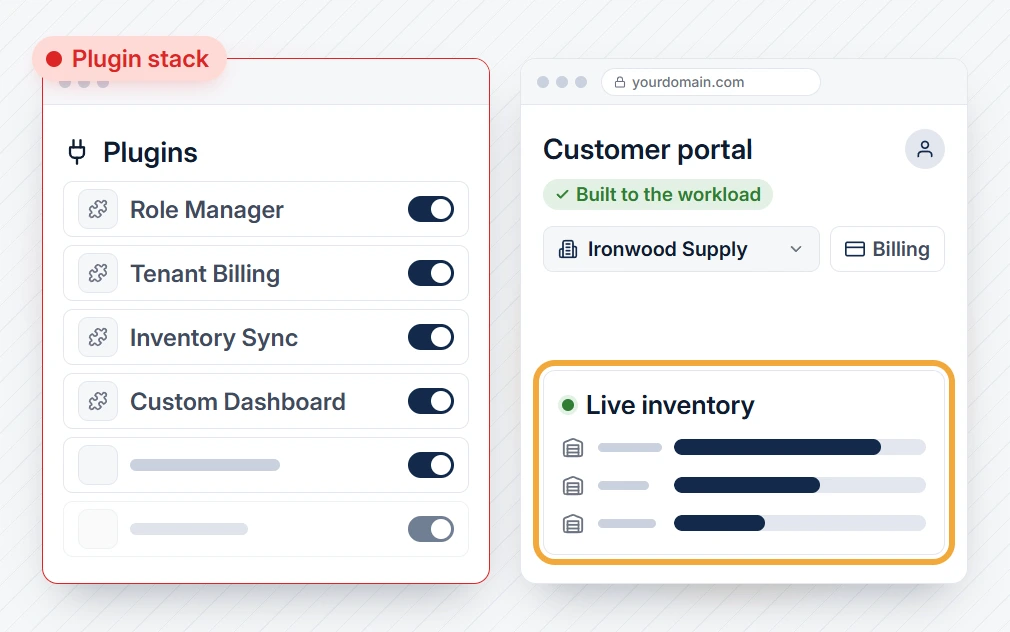
Custom web development services plugin stack replaced by a role-based customer portal with live inventory
PROBLEM 01 · STACK

WordPress hits a ceiling that Laravel or Next.js clears

WordPress hits a wall at role-based dashboards, multi-tenant billing, or 200+ SKUs with real-time inventory. Ten plugins glued together with custom PHP turns into a maintenance bill inside 2 years. If the workload needs 4+ plugins bolted together, the right call is Laravel or Next.js picked to the workload.
THE FIX · STACK PICKED TO THE WORKLOAD
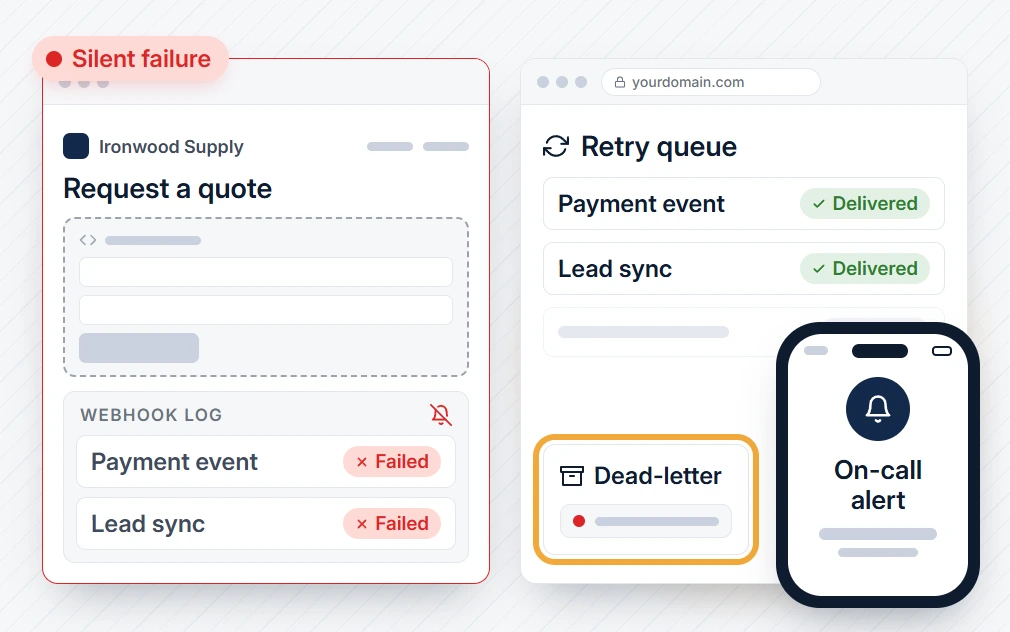
Custom web development services webhook failures caught by a retry queue and a dead-letter alert
PROBLEM 02 · INTEGRATIONS

HubSpot, Salesforce, and Stripe get iframe-glued into the page

Most agencies drop a HubSpot form embed and call it integrated. A failed Stripe webhook at 3 AM never pages an engineer, and a Salesforce lead handoff drops on a rate-limit spike. Real webhook-safe middleware with retry queues and dead-letter alerts keeps every lead. That is table stakes on a build over $12K.
THE FIX · WEBHOOK-SAFE MIDDLEWARE
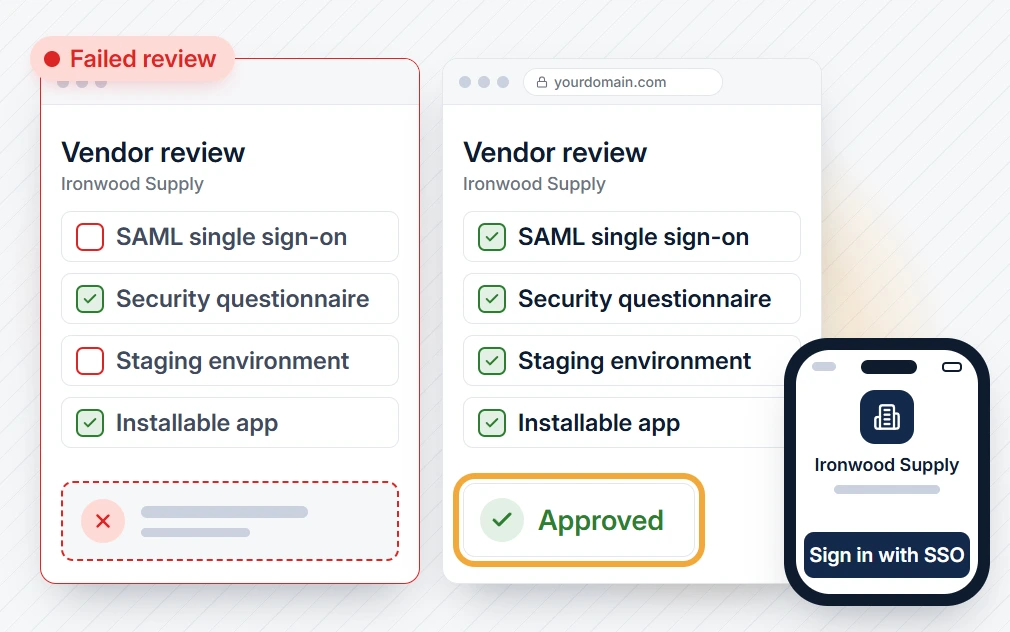
Custom web development services IT review checklist that failed on SSO and staging, then passed
PROBLEM 03 · ENTERPRISE

Enterprise buyers want Okta SAML, staging, and PWA on day 1

Procurement asks for SAML SSO, a SOC 2 questionnaire, and a real staging environment before UAT starts. Agencies that treat security as a phase-2 add-on lose the deal in IT review. Wire Okta or Azure AD, staging that mirrors production 1:1, and a PWA shell on day 1 so IT signs off first pass.

THE FIX · ENTERPRISE-READY OUT OF THE GATE

Three outcomes every custom build produces

McCormick Heating & Cooling doubled annual revenue after a custom WordPress rebuild, SEO and review work.

Custom code in your git from day one · full ownership

Every commit lands in your repository, not ours. Every deploy runs through your CI. Every rollback stays under your control. Ownership is written into day 1.

Architecture that survives handoff without a meeting

Decision log, storybook, API contracts, test coverage, and runbook handed over with the code. The engineer who takes over at month 12 has what they need.

Integrations that hold clean on vendor version bumps

Semver pinning on every dependency. Contract tests per integration. CI runs against sandbox APIs. Salesforce and Stripe version bumps land as reviews.

Four stages. One engineering discipline

Every one of our custom web development projects follows the same path. Scope the build in writing. Design against real data. Push to staging every week. Cut over with monitoring live.

WEEKS 1-2

Scope the build in writing

Stack audit, integration map, and a fixed-price SOW signed before a single commit lands in your repo. Product and engineering interviews, existing codebase review, dependency graph, CI/CD flow, and a written list of technical debt worth paying down.

SIGN-OFF: SCOPE + PRICE
WEEKS 3-5

Design against real data

Component library, admin patterns, and edge-case states validated on real data volumes before engineering starts. Design tokens exported to JSON and CSS variables the engineers import directly. Clickable prototype tested on real users.

SIGN-OFF: DESIGN + TOKENS
WEEKS 5-13

Push weekly to staging

Code in your git from day 1. Every PR reviewed by a second engineer. Preview environments per branch. Weekly promotion to staging so you always see the actual build, not screenshots. Next.js, Laravel, Node, or hand-written PHP against the stack you already run.

WEEKLY DEPLOY
WEEK 13 + 30 DAYS

Cut over with monitoring live

Blue-green cutover with a tested rollback plan. Load test at 10x forecast traffic. Sentry and Datadog dashboards live from the minute traffic switches. Signed runbook per top-10 failure mode. 30 days of post-launch support.

HANDOFF

What you get from our custom web development services

Every phase has defined deliverables, a signed acceptance page, code committed to your git, and a date on the calendar. You always know what is due, when, and who owns it on our side.

DISCOVERY

Discovery that scopes the build honestly

Nothing gets built until we understand your stack, your data, and your team's engineering discipline. Discovery is the web development consulting step: 1 to 2 weeks of working sessions with your product and engineering leads, a technical audit of the existing stack, an integration map of every third-party the app touches, and a signed fixed-price scope document with line-item deliverables before a single commit lands in your repo.

Phase Duration: 1-2 weeks Sign-off: Fixed-price SOW signed
Custom web development services discovery session where a lead talks engineers through the build scope
GATE · FIXED-PRICE SOW SIGNED

Product + engineering interviews

3 to 5 working sessions with your PM, tech lead, and ops owner. Business rules, edge cases, and success criteria captured in writing.

Stack + repo audit

Existing codebase review, dependency graph, CI/CD flow, observability gaps, and a written list of technical debt worth paying down.

Integration + API map

Every third-party API, auth flow, webhook, and data source diagrammed with rate limits, contracts, and failure modes.

Fixed-price SOW + milestones

Feature-by-feature scope, dated milestones, sign-off gates, and payment schedule. What you approve is what you pay.

Data + content model

Schema draft, content types, and migration inventory scoped so engineering starts against real data volumes, not fake JSON.

Risk register + assumptions log

Every assumption we made, every dependency on your side, every risk ranked by impact. Nothing hides in a slide deck.

Code in your repo, however you bring us in

Some teams need a front end, some need extra engineers, and some need a second opinion first. Each runs on your stack, with every commit in your git.

Front-end development services built for speed

Front-end development services build the part of your site people see and click, from layout to load time. We work in Next.js, Nuxt or Astro, with a Storybook entry for every component. Every page must hit Largest Contentful Paint under 2.5 seconds, the bar in Google's Core Web Vitals guide. A pull request that drops the score gets blocked.

WCAG 2.2 AA on every engagement

Outsourced web development on your own stack

Outsourced web development should add engineers to your roadmap without adding a new stack. We build on what your team runs, from Laravel to headless WordPress. Every commit lands in your git, a second engineer reviews every pull request, and builds ship to staging every Friday. When the final invoice clears, our engineers revoke their own access.

Live staging build every Friday

Web development consulting with a fixed-price plan

Web development consulting gives you an outside read on your stack before you spend on a build. In 1 to 2 weeks of working sessions, we audit your codebase, map every integration and list the technical debt worth paying down. You get a risk register and a fixed-price scope with dated milestones. Nothing is built until you sign it.

Free engineering audit in 24 hours

Get a free engineering audit. Written report in 24 hours

TECHNICAL + SPEED FIXES, RANKED · No card needed. No sales call required.

Get my website audit →

Four web design tiers for every stage of growth

These four tiers are the fixed-price website builds, quoted before a commit is written. Custom application and headless engineering engagements are scoped separately and start at $12,000.

Starter

$2,500ONE-TIME PROJECT

THE FOUNDATION: New businesses that need a credible, fast site on a template base

  • Pages included: Up to 8
  • Contact form + click-to-call
  • Compliance-aware form handling
  • On-page SEO setup: Basic
  • Hosting + SSL, first year
  • 30-day launch monitoring
  • Full ownership on handoff
Get this quote

Scale

$7,500ONE-TIME PROJECT

EVERYTHING IN GROWTH, PLUS: Larger sites with more page templates and integrations

  • Pages included: Up to 25
  • Custom design (no template)
  • Per-service page layouts
  • Team + staff profile pages
  • Shared design system
  • Contact form + click-to-call
  • Live scheduling integration
Get this quote

Enterprise

Starts at $12,000ONE-TIME PROJECT

EVERYTHING IN SCALE, PLUS: Large site estates, multi-brand or multi-location

  • Pages included: Unlimited
  • Custom design (no template)
  • Per-service page layouts
  • Team + staff profile pages
  • Shared design system
  • Contact form + click-to-call
  • Live scheduling integration
Scope my build

EVERY TIER: FIXED-PRICE SOW · CODE IN YOUR GIT · 30-DAY LAUNCH MONITORING · YOU OWN REPO, INFRA + DATA

Every web design feature, tier by tier

SCROLL THE TABLE SIDEWAYS FOR EVERY TIER
Website + design
FEATURE
STARTER
GROWTH
SCALE
ENTERPRISE
Pages included
Up to 8
Up to 15
Up to 25
Unlimited
Custom design (no template)
—
Per-service page layouts
—
Team + staff profile pages
—
Shared design system
—
—
Booking + conversions
FEATURE
STARTER
GROWTH
SCALE
ENTERPRISE
Contact form + click-to-call
Live scheduling integration
—
Payment + financing copy
—
Compliance-aware form handling
Conversion (CRO) testing setup
—
—
SEO + visibility
FEATURE
STARTER
GROWTH
SCALE
ENTERPRISE
On-page SEO setup
Basic
Organization + LocalBusiness schema
—
Site migration + redirects
—
Core Web Vitals speed budget
—
Local citation setup
—
—
Care + support
FEATURE
STARTER
GROWTH
SCALE
ENTERPRISE
Hosting + SSL, first year
30-day launch monitoring
Team training call
—
Full ownership on handoff
Dedicated project lead
—
—
Case studies

Real clients, real numbers

Each one includes where the client started, what we changed and what happened.
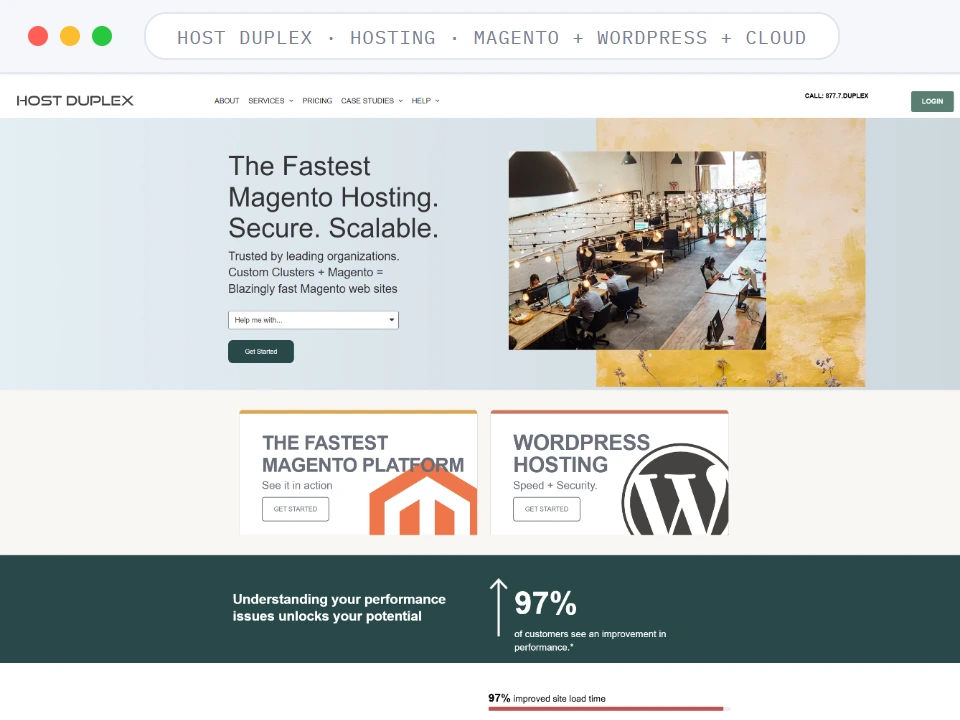
Homepage of Host Duplex, a Hosting · Magento + WordPress + Cloud business, shown in a browser window Published case study

Host Duplex

HOSTDUPLEX.COM

Hosting · Magento + WordPress + Cloud Web Design · Web Development

Cut Host Duplex page load to sub-second with a clean rebuild.

Host Duplex sells high-performance hosting, yet its own website took 8+ seconds to load. We rebuilt it on a lightweight WordPress theme and swapped plugins for custom code. Chat and tracking stayed, without slowing the site. Pages now load in under a second, with 65% fewer server requests and about 5K more organic visits.

-65%
Server requests
+5K
Organic visits

Get a free engineering audit. Written report in 24 hours

TECHNICAL + SPEED FIXES, RANKED · No card needed. No sales call required.

Get my website audit →

Client words

Demos doubled in a quarter after the funnel rewrite. Nothing about the traffic changed. The pipeline math finally works.
Myles Scolnick
Head of Growth, QuoteWell
Verified via NPS survey 2x booked demos 41s lead response time
QuoteWell Insurance website homepage in a browser window, a wholesale insurance hero above the industries it serves
1 / 10

See what a higher converting site is worth

Move the sliders to your numbers. A redesign earns its cost from the visitors already landing on the site, before it wins a single new one.

4,000
200 50,000
$800
$100 $10,000
1.5%
0.5% 6%
What a 20% improvement on your current conversion rate adds, at today's traffic. Traffic is held flat on purpose.
Added revenue per month
/mo

Free · Written findings · Yours to keep

FAQ

Common engineering questions

From real quote calls with CTOs and product leads. Anything else, ask on the call, answered in the first 5 minutes.

How much do custom web development services cost?
The four fixed-price tiers published on this page run $2,500 to $12,000 and up for website builds. Custom web development services at Redefine Web start at $12,000 for a scoped web app, a custom marketing site with a real backend, or a headless frontend running against a proper CMS. Multi-service backends, enterprise SSO, and large data migrations have run up to $180,000 on prior client work. Every quote is fixed-price, written into the SOW before code starts, and includes staging, CI/CD, and Sentry monitoring in the base scope. Time-and-materials is only used when discovery genuinely cannot be scoped, and even then the budget cap is fixed up front so no invoice ever comes in higher than expected. For teams that want a public benchmark on what quality development takes, Google web.dev Core Web Vitals is a fair reference on the performance work included in every build. Discovery, design, engineering, integrations, launch, and 30 days of post-launch support all sit inside the number quoted on day 1, never billed as add-ons.
What is custom web development?
Custom web development is engineering a website or web app from scratch against your workflow, data model, and integrations, rather than assembling a template or page builder. On every project, we pick the stack to the workload: Next.js, Nuxt, or Astro for the frontend, Laravel or Node for the backend, and Postgres or MySQL for data. That gives you role-based dashboards, multi-tenant billing, real-time inventory across 200 SKUs, and enterprise SSO that WordPress plugins genuinely cannot hold at scale without a maintenance bill inside 2 years. Google's own guidance on search-friendly custom implementations is the baseline we build to on every project we quote. Custom means: your git repo, your cloud account, your API keys, your data model, and code you own on the final invoice. Nothing is licensed back to you and no vendor lock-in gets written into the delivery contract at any stage. Ownership and IP assignment are default terms, not premium extras that carry a change order.
How much does it cost to pay someone to build your website?
What website development services cost depends on what you are building end to end. A marketing site with a real backend and CMS lands $12,000 to $45,000. A single-app frontend with authentication and a small admin panel runs $25,000 to $70,000 on typical scope. A multi-service backend, headless commerce migration, or enterprise SaaS build runs $70,000 to $180,000 on our recent engagements with mid-market clients. Off-the-shelf template work from a freelancer is cheaper ($3,000 to $8,000) but caps out at what the template can carry, and re-platforming inside 18 months is common when the business outgrows the template. Our engagements are priced fixed on the SOW, so you know the ceiling on day 1. Payment is milestone-based (30/30/30/10 typical), and the final 10% releases only when handoff docs, code ownership, and access transfer are signed. No hourly billing surprises, no scope creep clauses that quietly move the price. Every add-on runs through a written change order signed before extra engineering time starts on any new module.
How much does it cost to have a custom website built?
Fixed-price ranges we deliver most often on custom website development: $12,000 to $35,000 for a headless marketing site with a custom CMS backend, $35,000 to $75,000 for a member-gated web app or portal, $75,000 to $180,000 for multi-service backends with enterprise SSO, HubSpot and Salesforce sync, and Stripe billing across products. Every number is quoted before a commit is written, tied to a milestone plan you sign, and locked into the SOW as the ceiling on price. Discovery, design, engineering, QA, and 30 days of post-launch support all sit inside the base number. Add-ons that some agencies bill separately (Sentry setup, staging environment, contract tests per integration, blue-green cutover) come included by default on every engagement. What you approve on the scope is what you pay on the final invoice, with no hourly surprises hiding in the fine print of the master services agreement. Change orders only exist when you request extra scope, priced up front.
Can ChatGPT build me a website?
ChatGPT can reliably generate boilerplate HTML, a starter Next.js scaffold, or a WordPress theme skeleton in minutes. It cannot decide the right stack for your workload, wire HubSpot to Salesforce through a queue with dead-letter alerts, or hold a SOC 2 questionnaire in front of your prospect's IT team. On our engagements, we use AI-assisted tooling (Copilot, Cursor, Claude) inside the engineering workflow, but a real engineer owns the decision, the code review, and the production deploy every time. Buyers who tried ChatGPT-only builds usually come back inside 6 months with maintenance debt, security holes, or an integration that broke on a vendor version bump they never saw coming until traffic hit it. Support docs from HubSpot for developers are one example of the vendor-specific patterns AI tools do not reliably get right on the first try without engineering review sitting on top and validating the output against real webhook payloads.
What is the 3 second rule in website design?
The 3-second rule says over half of mobile visitors leave a page that takes longer than 3 seconds to load. On every custom website development build, that number is baked into the SOW as a hard target on every build we quote. Every page has to clear Largest Contentful Paint under 2.5 seconds on a real 4G connection, or engineering does not sign off on the milestone. We deliver against Google's Core Web Vitals thresholds, which cover LCP, INP, and CLS across every route on the finished site. Static generation, image optimization, code splitting, edge caching, and lazy loading are wired on day 1, not added as a phase-2 fix after launch traffic exposes the problem to real users. Weekly Lighthouse runs land in the deploy pipeline as a quality gate. If a pull request drops the score below the target, the merge gets blocked automatically until an engineer fixes the regression, not left for launch week to catch.
What is bespoke web development?
Bespoke web development is the UK-English term for what US teams usually call custom web development. It means the site or app is engineered against your business logic, data model, and integrations, rather than assembled from a template or SaaS builder. A bespoke web development agency owns the stack decision, the code, the integrations, and the QA discipline across the whole build from discovery to launch. On our engagements, bespoke means you get your own git repository, your own cloud account, your own secret manager, and a fixed-price SOW signed before engineering starts on any real work. Everything is picked to the workload: Next.js or Astro for the frontend, Laravel or Node for the backend, Postgres for data, and Sentry plus Datadog for observability. Nothing is white-labeled or licensed back to you at handoff. Full IP assignment on final invoice is a standard clause in the master services agreement, not a premium add-on that shows up on a change order.
How much does a bespoke website cost?
A bespoke website from a UK or US custom web development agency typically runs anywhere from $12,000 to $180,000 depending on scope and integrations. On the entry end, a bespoke marketing site with a custom backend lands $12,000 to $35,000. A member-gated web app runs $35,000 to $75,000 on typical scope. Enterprise-grade builds with SSO, multi-service backends, and payments run $75,000 to $180,000 on our recent projects. Our engagements are fixed-price across every tier. Every number is quoted against a written scope you sign before code starts on any milestone. Discovery, design, engineering, integrations, and 30 days of post-launch support all sit inside the base number. Hosting on your cloud account, code sitting in your git repo, and full ownership at final invoice are default terms, not premium add-ons that carry an extra invoice line. The SOW is the ceiling on price. Change orders only happen when you request extra scope, signed and priced before extra engineering time starts.
Which company is best for web development?
The right web development company is the one whose stack, engineering discipline, and integration breadth match the workload you are building today. Ask custom website developers three things on every shortlist call: what git will the code sit in (yours, not theirs), what does the fixed-price SOW cover end to end, and what is the day-90 handoff plan in writing. Redefine Web is a fully remote web development agency that builds on your team's existing stack (Next.js, Laravel, Node, headless WordPress, or Shopify Hydrogen), commits into your repo from day 1, and hands over a signed runbook per top-10 failure mode at launch. We are not the right pick for off-the-shelf template work. We are the right pick when you need engineering discipline, real observability, and a build that survives version bumps without a 3 AM page ringing on your on-call rotation. Ownership transfer at the final invoice is written into every contract, not negotiated after launch.
What tech stacks do you use for custom web development services?
Stack gets picked to the workload on each build, not to what we like this quarter or what our engineers prefer working on any given week. Front-end development services default to Next.js (App Router, RSC, TypeScript), Nuxt 3, or Astro for content-heavy static sites with heavy SEO needs. Backend defaults: Laravel (Eloquent, Horizon, Sanctum) or Node (NestJS or Fastify) depending on data patterns and team preference. Data: Postgres for relational, MySQL where the client already runs it, Redis for sessions and queues. Search: Meilisearch or Algolia depending on scale and query volume. Auth: Okta, Auth0, Azure AD, or Google Workspace with SAML 2.0 or OIDC on top. Hosting: Vercel, Netlify, AWS, GCP, or Azure on your account, under your billing so ops stays yours. Outsourced development should never mean a new stack. If your team runs one we do not name here, we build on it as long as it is production-grade and actively maintained. Our custom web development services never force you off a stack you already have engineering talent on. Handoff always lands into your existing tooling.
What is your timeline for a custom web development project?
Single-app frontends and admin panels launch in 4 to 6 weeks. Marketing sites with a custom backend run 6 to 10 weeks on typical scope. Multi-service backends and headless commerce migrations run 12 to 20 weeks with regular staging demos. Enterprise SSO, procurement review, and vendor sign-offs add 2 to 4 weeks and get called out in the SOW before the contract is signed by legal. Every timeline is signed and tracked against milestones week by week on a shared plan. Weekly staging deploys land every Friday so you review the actual build, not screenshots or slide decks from the design tool. Dependencies on your side (content approvals, integration sandbox access, IdP admin) get logged in the weekly stand-up notes so nothing hides in a side chat. If a milestone slips, the reason is written down the same week and the recovery plan is on the next call. Custom website development runs on visible dates, not vague quarters.
Do you build ADA and WCAG compliance into the site?
Yes. WCAG 2.2 AA is a baseline on every engagement, wired into design and engineering rather than audited after launch as a fix-up phase. Focus order, ARIA roles, color contrast, keyboard navigation, and screen-reader semantics get annotated in the Figma handoff and validated on real assistive tech before staging opens to the client team. Automated checks (axe-core, Lighthouse) run in CI on every pull request against the main branch. Manual VoiceOver and NVDA passes happen at the end of design QA and again right before cutover to production traffic. If your industry sits under stricter accessibility law (healthcare, government, financial services), we add ADA legal review as a separate phase and route findings through your compliance team for sign-off. Accessibility is a legal risk we do not let clients carry into launch. Reports land on the same shared drive as engineering ADRs and stay auditable long after the build wraps up.
What happens after launch on ongoing support and hosting?
Post-launch support on our custom web development services runs 30 days on every tier, included in the base project price. You get a direct Slack channel with the engineering lead, bug fixes on delivered scope, hotfix deploys, and weekly office hours through the support window on scheduled days. Hosting sits on your cloud account (AWS, GCP, Azure, Vercel, or Netlify) under your billing, with our engineers as invited users only during the support window. Runbooks per top-10 failure mode are signed off by your on-call rotation before we cut over to production traffic on launch day. After the support window closes, a maintenance plan from $199 a month covers dependency updates, patching, and uptime monitoring, and a monthly feature sprint against your product backlog is quoted separately. Ongoing work is optional, never a condition of the build. A maintenance plan runs a 6-month minimum term on Essential, Growth and Scale and 12 months on Enterprise, then rolls on 30 days written notice. You can revoke our access at any time, and the code stays yours no matter what happens next.

Free · Written in 24 hours · No pitch

Get your free website audit.

A written report in your inbox within 24 hours, with three fixes you can ship the same week, whether or not you hire us.

Written in 24 hours · 10,000+ audits run · 300+ clients since 2021