Manufacturing Marketing Retainer Plans That Turn Spec Sheets Into Signed POs

One monthly retainer covering catalog SEO, the engineer-content pipeline, and RFQ-to-PO reporting, with Google Ads from Growth and Meta from Scale. Priced from $750/mo. Quarterly scale reviews. Foundation, Growth and Scale run a 6-month minimum term and Enterprise runs 12 months, then month to month on 30-day notice.

4.9Across 126 reviews on 6 platforms
One monthly retainer
$750 Monthly
Foundation, quarterly strategy calls

Where we start Week 1
Signed audit deck
What’s included Foundation
  • 1 blog post a month
  • 1 service page a quarter
  • On-page SEO + technical fixes
Google Business Profile management
Reporting Weekly
Booked-lead pipeline report every week

Selected clients we've run full marketing programs for

  • Armanino
  • BSH
  • Delicate Dental
  • Government Legal Department
  • Hightop Health
  • LifeStance Health
  • Marmalade
  • Montegra Capital Resources
  • Noelle Collins Dental Clinic
  • Oxford Capital
  • Paquin & Carroll Insurance
  • PCO Bookkeepers & M&A Specialists
  • Peaceful Mind Psychology
  • Peak Accounting Solutions
  • Pelvic Rehabilitation Medicine
  • RiverSaaS Capital
  • Rosenbaum Personal Injury Lawyers
  • Smile Design Dentistry
  • Stanhope Capital Group
  • Stella Maris
  • Tilghman Builders
  • Toyota
  • Uptime
  • VP Dental & Medical Supplies
  • Wilentz Attorneys at Law

Three signals your industrial pipeline is leaving RFQs on the table

If any of these looks familiar, the free SEO audit names the fix and what it's worth before you spend a dollar.
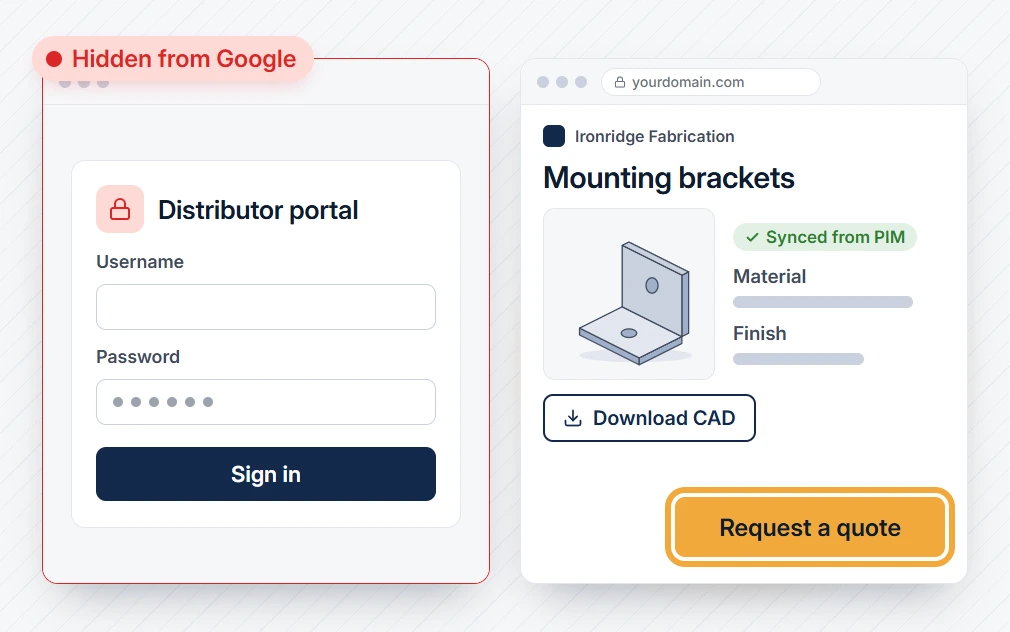
Manufacturing marketing retainer catalog moved from a distributor login wall to an open bracket page with CAD
CATALOG SEO GAP

Buyers cannot find your part numbers

Engineers search by part number, SKU family, and spec. If your catalog pages are behind a distributor portal or hidden from Google, procurement buys from the competitor whose CAD file loads on page one. A CAD-hosted, PIM-synced catalog with clean schema puts you back in the shortlist.
Fix: catalog SEO tied to your PIM feed
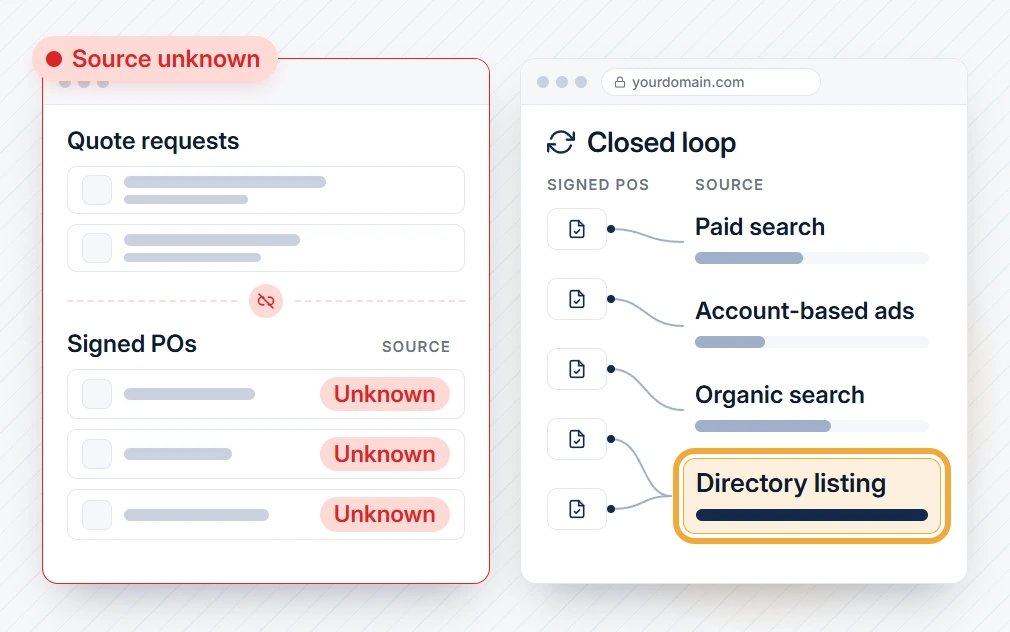
Manufacturing marketing retainer CRM view tracing each signed PO back to the channel that opened the RFQ
RFQ ATTRIBUTION

You have 300 quote requests, 40 signed POs, and no idea which channel closed

Long industrial cycles (6-18 months) mean the click that opened the RFQ rarely gets credit for the PO. Without HubSpot or Salesforce firing back to marketing, the ThomasNet listing looks weak and the LinkedIn ABM budget gets cut. A closed-loop CRM feed shows what actually funded the quarter.
Fix: RFQ-to-PO reporting inside your CRM
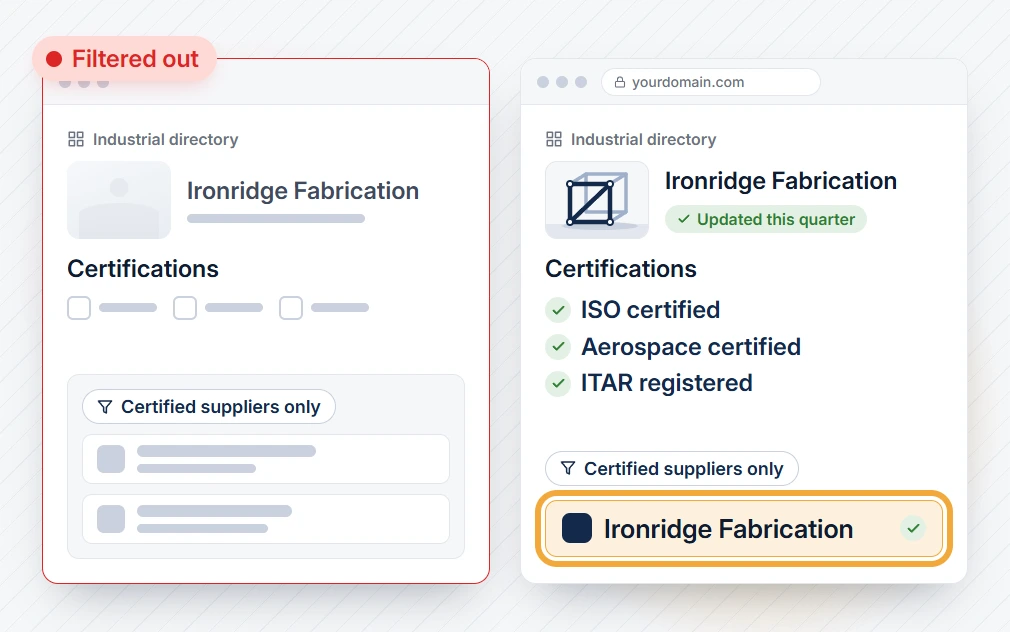
Manufacturing marketing retainer directory profile refreshed with certifications so it passes a buyer filter
DIRECTORY DRIFT

ThomasNet, GlobalSpec, and MFG.com profiles are out of date

Every industrial directory pulls buyer intent from spec, cert, and capability fields. Missing ISO 9001, AS9100, or ITAR flags drops you off filtered searches. Stale product photos and expired capabilities cost you 30-40% of directory reach. A quarterly sweep keeps every profile ranking on the categories you sell.

Fix: quarterly directory + cert audit

Three outcomes every manufacturing retainer produces

What we track and report on every manufacturing retainer, from quote requests to signed POs.

A named RFQ pipeline you can hold the team to

Every retainer account gets a pipeline report showing quote requests by source, sample requests, and signed POs, every Friday on every tier. See which channel funded the quarter.

Higher PO revenue per account, not just more RFQs

We track average PO size and account expansion, not raw quote count. The goal is repeat OEM orders and multi-SKU wins across a 6 to 18 month cycle.

One industrial team and one pipeline report

Your industrial marketing retainer team runs every channel in your tier and opens each pipeline report with PO revenue by source. From Scale up, a dedicated account lead owns your account.

Four stages. Every step ends in a sign-off

You approve at each gate. No surprise scope, no black-box work.

WEEK 1

Industrial audit and CRM baseline

We pull your catalog data, ThomasNet and GlobalSpec profiles, CAD library, and RFQ history from HubSpot or Salesforce. You get a written gap map showing catalog coverage, directory reach, and closed-loop reporting holes.

Signed audit deck
WEEKS 2-3

12-month roadmap tied to PO revenue

Every channel in your tier gets a target: catalog SEO by SKU family, engineer content by buyer persona, and from Growth up, Google Ads by part-number query. LinkedIn ABM and RFQ nurture are quoted separately. Roadmap ranked by expected PO impact, not by tactic novelty.

Signed roadmap
MONTH 1+

Every channel under one industrial team

One senior team owns catalog SEO, the engineer-content pipeline, RFQ reporting, and the paid media your tier includes, with a dedicated account lead from Scale. You get PO-revenue reports every Friday and joined-up execution across every buyer touchpoint.

Monthly numbers review
EVERY 90 DAYS

Quarterly scale review

We look at PO revenue by source, account expansion, and cost per RFQ across the last 90 days. If a channel is underperforming, we cut it and reallocate. If a channel is compounding, we double the investment. You sign off before we move.

Signed scale plan

Every deliverable inside your manufacturing marketing retainer

Named deliverables, not vague retainer hours. Every item has an owner, a cadence, and a KPI.

Catalog + PIM audit

Industrial audit and CRM setup

The first 30 days map your catalog, directories, CRM, and buyer path so every channel we run is tied to a real RFQ or PO signal.

Phase Duration: Catalog + PIM audit Sign-off: ThomasNet + GlobalSpec baseline
Manufacturing marketing retainer audit session with two colleagues reviewing large printed sheets in an engineering office
GATE · CRM CLOSED-LOOP SETUP

Catalog and PIM data audit

Every SKU family reviewed for search coverage, missing spec fields, and CAD file access. Feeds a prioritized fix list ranked by RFQ potential per part number.

ThomasNet and GlobalSpec profile review

Full profile audit across ThomasNet, GlobalSpec, MFG.com, and MacRAE. Missing certs, expired capabilities, stale photos, and category gaps flagged in the audit, with directory management quoted separately.

HubSpot or Salesforce closed-loop setup

RFQ form fields wired to your CRM, deal stages mapped to industrial cycle, marketing source captured on every quote. Reporting view built to show PO revenue by channel.

Named-account ABM list build

Target-account list built with your sales team by SIC code, revenue band, and buying-committee role. LinkedIn Sales Navigator lists for engineer, procurement, and plant manager personas come with LinkedIn ABM, quoted separately.

Cert and compliance visibility check

ISO 9001, AS9100, ITAR, EAR, RoHS, and REACH flags verified on every buyer-facing page and directory profile. Missing badges added to catalog and hero pages first.

Competitor SERP and directory read

Top three competitors read for catalog depth, directory rank, and engineer-content library. Gap map delivered as your first 90-day priority list.

Get a free manufacturing SEO audit before you commit to a retainer. Written report in 24 hours

One senior industrial lead reads your catalog, directories, and CRM. · No card needed. No sales call required.

Get my SEO audit →

Four manufacturing marketing retainer tiers for every stage

Ad spend billed separately. Foundation, Growth and Scale run a 6-month minimum term and Enterprise runs 12 months, then month to month on 30-day notice. Quarterly scale review built in.

Foundation

$750MONTHLY

THE FOUNDATION: Solo operators starting structured marketing

  • Blog posts / month: 1
  • Service pages / quarter: 1
  • On-page SEO + technical fixes
  • Google Business Profile management, for local markets
  • Automated review requests, where reviews drive the category
  • Booked-lead pipeline report: Weekly
  • Strategy calls: Quarterly
Get a Foundation quote

Scale

$1,999MONTHLY

EVERYTHING IN GROWTH, PLUS: High-growth businesses; adds Meta ads and a dedicated account lead

  • Blog posts / month: 4
  • Service pages / quarter: 4
  • On-page SEO + technical fixes
  • Google Business Profile management, for local markets
  • Programmatic service-line SEO
  • Google Ads + Local Services Ads management: Up to $8K
  • Meta ads management
Get a Scale quote

Enterprise

Starts at $3,000MONTHLY

EVERYTHING IN SCALE, PLUS: Multi-location, multi-brand or group operators

  • Blog posts / month: Custom
  • Service pages / quarter: Custom
  • On-page SEO + technical fixes
  • Google Business Profile management, for local markets
  • Programmatic service-line SEO
  • Google Ads + Local Services Ads management: Unlimited
  • Meta ads management
Request an Enterprise proposal

Every tier includes catalog SEO and RFQ reporting, and directory management is quoted separately. Scale and Enterprise add a dedicated senior industrial lead.

Every retainer feature, tier by tier

SCROLL THE TABLE SIDEWAYS FOR EVERY TIER
Content + SEO
FEATURE
FOUNDATION
GROWTH
SCALE
ENTERPRISE
Blog posts / month
1
2
4
Custom
Service pages / quarter
1
2
4
Custom
On-page SEO + technical fixes
Google Business Profile management, for local markets
Programmatic service-line SEO
—
—
Paid media
FEATURE
FOUNDATION
GROWTH
SCALE
ENTERPRISE
Google Ads + Local Services Ads management
—
Up to $3K
Up to $8K
Unlimited
Meta ads management
—
—
Landing page CRO tests
—
—
Monthly
Weekly
Reviews + reputation
FEATURE
FOUNDATION
GROWTH
SCALE
ENTERPRISE
Automated review requests, where reviews drive the category
Review response management
—
Competitor tracking, local pack included where it applies
—
Reporting + strategy
FEATURE
FOUNDATION
GROWTH
SCALE
ENTERPRISE
Booked-lead pipeline report
Weekly
Weekly
Weekly
Weekly
Strategy calls
Quarterly
Monthly
Monthly
On demand
Dedicated account lead
—
—
Case studies

Manufacturers that compounded

Each one includes where the client started, what we changed and what happened.
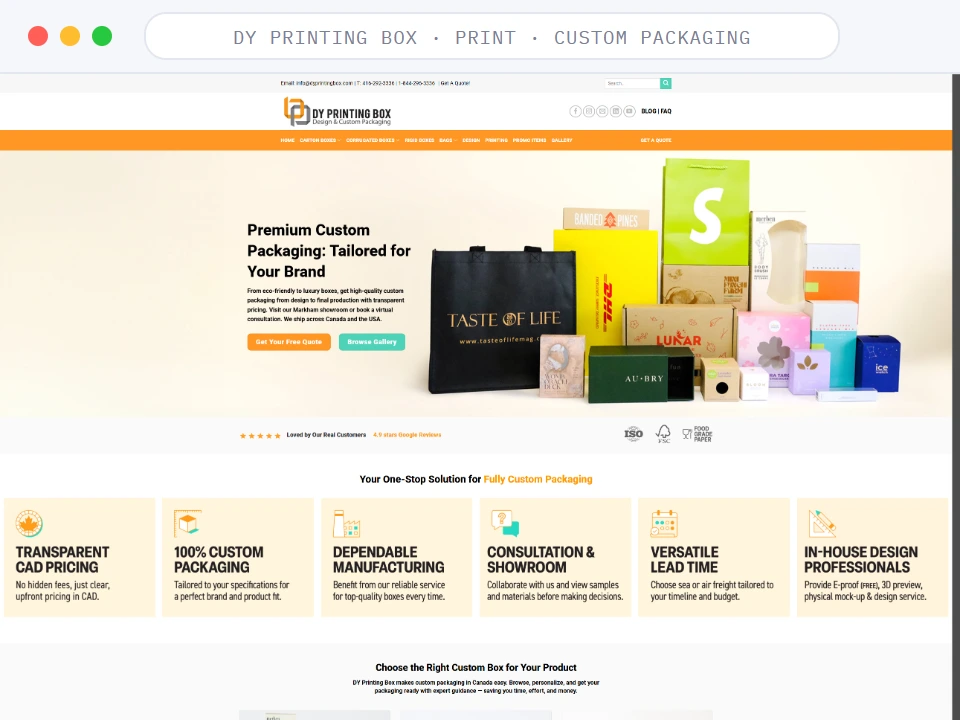
Homepage of DY Printing Box, a Print · Custom Packaging business, shown in a browser window Published case study

DY Printing Box

DYPRINTINGBOX.COM

Measured over 18 months
Print · Custom Packaging Strategy · Ads · Website Optimization

Grew DY Printing Box revenue 200% in 18 months with digital ads tracked to conversions.

DY Printing Box makes custom packaging. It had a small budget, no conversion tracking and little presence beyond a basic website. We set up tracking across channels, built ads around its strengths, scheduled them for peak buying times and A/B tested landing pages. Sales grew 200% in 18 months, and the site now brings in 150+ quote requests a month.
100%
Organic growth
+200%
Sales
150+
Monthly leads

Get a free manufacturing SEO audit before you commit to a retainer. Written report in 24 hours

One senior industrial lead reads your catalog, directories, and CRM. · No card needed. No sales call required.

Get my SEO audit →

Client words

Enterprise demo requests up 3.2x. First operator we have worked with who cared about the CRM number, not the ad account.
Michael Reid
VP Marketing, Forward Networks
Verified via Trustpilot 3.2x enterprise demos CRM-tied reporting
Forward Networks website homepage in a browser window, a move fast, break nothing hero for its network platform
1 / 10

See what one accountable program could be worth

Move the sliders to your numbers. One team across search, ads and the site, measured on the same conversion rate.

4,000
200 50,000
$1,200
$100 $10,000
1.5%
0.5% 6%
What a 20% improvement on your current conversion rate adds, at today's traffic.
Added revenue per month
/mo

Free · Written findings · Yours to keep

FAQ

Common manufacturing retainer questions

Straight answers on scope, pricing, reporting, and how the retainer fits an industrial sales cycle.

How much does a marketing retainer cost?
A monthly retainer at Redefine Web starts at $750/mo Foundation, $1,250/mo Growth, $1,999/mo Scale, and from $3,000/mo Enterprise. Tier choice depends on how many SKU families you sell, how many named accounts your sales team targets, and whether you run one plant or many. Ad spend is billed separately and paid direct to LinkedIn Campaign Manager, Google Ads, or your industrial directory. Every tier includes catalog SEO and RFQ reporting inside your CRM, and ThomasNet and GlobalSpec management is quoted separately. Scale and Enterprise add a dedicated senior industrial lead who joins your sales call and reads the RFQ log before every review. Foundation, Growth and Scale run a 6-month minimum term and Enterprise runs 12 months, then month to month with 30-day notice to cancel. Buyers and procurement teams see PO revenue by source inside HubSpot or Salesforce so the tier you pay for maps to signed PO revenue, not vanity impressions or click volume. Foundation is intended for shops under $5M revenue with a tight SKU list; Growth for multi-plant OEMs pushing new categories; Scale for OEMs adding Meta ads and programmatic SKU-family SEO; Enterprise for export markets and distributor networks. Every tier gets a pipeline report every Friday and a quarterly scale review with the industrial marketing retainer lead.
How much should a manufacturing company spend on marketing?
Most manufacturers land between 2% and 5% of annual revenue on marketing, with growth-stage OEMs closer to 5% and mature contract shops around 2%. Retainer scope drives the split: catalog SEO and RFQ tracking sit in the base retainer, ThomasNet or GlobalSpec management is quoted separately, and ad spend for LinkedIn ABM and Google Ads on part-number queries is billed separately. A Foundation tier at $750/mo suits shops under $5M revenue with a tight SKU list; Growth at $1,250/mo covers multi-plant OEMs pushing new categories; Scale at $1,999/mo adds Meta ads and programmatic SKU-family SEO; Enterprise starting at $3,000/mo scales export markets and distributor networks. Engineers, procurement teams, and plant managers each need separate creative, and multi-persona ABM lifts the ceiling. If your last industrial marketing retainer produced RFQs but no signed POs, cost per RFQ, not spend share, is the number to fix first. Every tier reports PO revenue by source, not just RFQ count, so procurement teams and CFOs see marketing spend tied to signed revenue over a trailing 6, 12, and 18 month window. That reporting cadence keeps the 2%-5% share defensible at the next quarterly board review.
What does retainer mean in business?
A retainer means you pay a fixed monthly fee for a named scope of ongoing work, delivered by the same team every month. In an industrial retainer scope, that covers catalog SEO on SKU-family and part-number pages, engineer-first content publishing, PO revenue reporting, and Google Ads from the Growth tier. ThomasNet, GlobalSpec, and MFG.com profile management, LinkedIn ABM for engineers and procurement teams, and RFQ nurture inside your CRM are quoted separately. The retainer trades project unpredictability for compounding output: catalog rankings, directory authority, and named-account pipeline all build month over month. Buyers get a senior industrial lead who owns every channel and reads the RFQ log before reporting, and from Scale up that lead is dedicated to the account and joins the sales meeting. Contracts run a 6-month minimum term, 12 months on Enterprise, then month to month with 30-day notice to cancel. You keep every asset built inside the retainer: catalog schema, ABM lists, engineer content library, and CRM reporting views. Nothing gets held hostage. The scope on this manufacturing marketing retainer is written by named deliverable, not by vague retainer hours, so procurement teams see exactly which SKU families, directories, and named accounts land which hours each month before the check clears.
What is B2B in manufacturing?
B2B in manufacturing means you sell parts, assemblies, or capacity to other businesses, not to consumers. Buyers are OEM design engineers specifying components, procurement teams issuing quote requests, and plant managers approving capital purchases. The sales cycle runs 6 to 18 months from first RFQ to signed PO, and revenue lives in repeat orders, multi-SKU wins, and long-term OEM contracts. A B2B manufacturing retainer wires catalog SEO and engineer content around that cycle, with ThomasNet and GlobalSpec presence and LinkedIn ABM quoted separately, then reports PO revenue by source inside HubSpot or Salesforce. Certifications matter more than in B2C: ISO 9001, AS9100, ITAR, and RoHS badges from ISO and material specs from ASTM filter you into or out of shortlists before the first engineer call. The retainer keeps every buyer touchpoint aligned with those signals. Every industrial marketing retainer deliverable, from part-number pages to ad creative, gets published with those buyer signals in mind. Engineers, procurement teams, and plant managers see consistent capability, cert, and material data across catalog, directory, ABM, and engineer-content touchpoints.
How to create a monthly marketing plan?
A monthly manufacturing marketing plan starts with the pipeline, not the tactic. Pull last month RFQs by source, signed POs by channel, and named-account engagement from your CRM. Rank the top five SKU families by PO revenue, then decide which get catalog SEO refreshes, LinkedIn ABM waves, engineer content, and directory profile updates. Set one KPI per channel: RFQ count for catalog SEO, meetings booked for LinkedIn ABM, category rank for ThomasNet, sample requests for engineer content. Assign one owner per KPI, set weekly check-ins, and log every test in a shared library. Report monthly with PO revenue by source over trailing 6, 12, and 18 months so the industrial sales cycle noise does not hide the pipeline funding the year. Buyers and procurement teams should see the same dashboard sales sees. A manufacturing marketing retainer runs this plan for you, with a PO revenue report every Friday, without the plan slipping when a plant crisis pulls your VP away.
How long before an industrial marketing retainer produces RFQs?
Fresh RFQs from part-number SEO usually show in months 3 to 5, when part-number pages and SKU-family hubs finish indexing and directory profiles finish their first refresh. LinkedIn ABM produces first meetings in weeks 4 to 8, first RFQs in months 2 to 4. Google Ads on high-intent part-number queries fires faster, often first RFQs in weeks 2 to 3. Signed POs from those RFQs then follow the 6 to 18 month industrial sales cycle. Foundation tier at $750/mo runs on organic catalog SEO and content only, so the RFQ curve starts slower but compounds harder. Growth tier layers Google Ads on top, pulling first RFQs into weeks 3 to 6. Weekly reports track RFQ count by source, sample requests, and PO revenue by trailing window so engineers and buyers see where the pipeline is thick and where it is thin. Reports go out every Friday on every tier, and every tier gets a quarterly scale review with your industrial marketing retainer lead in the room. Buyers, engineers, and procurement teams see the same numbers on the same day every week.
What is the contract length and how do I cancel the retainer?
Every manufacturing marketing retainer opens with a 90-day discovery, roadmap, and initial-execution window inside its minimum term. Foundation, Growth and Scale run a 6-month minimum term and Enterprise runs 12 months. Leaving inside the minimum term means paying the remaining months of the term. After the minimum term, the retainer runs month to month with 30-day written notice to cancel, and the term does not auto-renew. If you cancel, you keep every asset built inside the retainer: catalog page schema, downloadable CAD library structure, ABM named-account lists, engineer-content library, RFQ nurture sequences inside HubSpot or Salesforce, and every reporting view. Access to LinkedIn Campaign Manager, Google Ads, and ThomasNet or GlobalSpec dashboards stays under your billing the entire time. Nothing gets held behind an agency login. Cancellation triggers a 30-day handoff window where your senior industrial lead documents every open workflow, exports every asset library, and briefs your in-house team or your next partner. Buyers, engineers, and procurement teams see continuity even if the retainer moves. Handoff after cancellation runs inside the 30-day notice window: your senior industrial lead documents every open workflow, briefs your in-house team or your next partner, and exports asset libraries. Buyers, engineers, and procurement teams see continuity across catalog, ABM, and RFQ workflows.
What KPIs does the manufacturing marketing retainer report every week?
Weekly reports open with PO revenue by source over trailing 6, 12, and 18 months so the industrial sales cycle noise does not hide the pipeline funding the year. Next comes RFQ count by SKU family, sample requests, CAD downloads, and named-account engagement. When directory management is in scope, category rank on ThomasNet, GlobalSpec, and MFG.com follows, tracked against the top three category competitors. Catalog SEO reports show impressions, clicks, and part-number query rank pulled from Google Search Console. When LinkedIn ABM is in scope, its reports show accounts engaged, meetings booked, and RFQs opened by the ABM list versus the broader retainer. From Growth up, Google Ads reports show cost per RFQ, not cost per click. Click cost is a poor proxy for signed PO revenue. Buyers, engineers, and procurement teams see the same dashboard sales sees. Every number ties back to a channel spend line, so retainer ROI is visible every week, not implied. Between reports, your lead flags anything drifting before it reaches your CFO, so procurement teams never learn about a slippage from a spreadsheet after the fact.
Who owns the catalog SEO, ABM lists, and CRM setup if we cancel?
You own every asset built inside the manufacturing marketing retainer. Catalog page schema, SKU-family hub structure, CAD library gating, PIM sync mappings, and part-number keyword clusters stay in your CMS and PIM. LinkedIn ABM named-account lists, LinkedIn Sales Navigator saved searches, and Campaign Manager campaigns stay under your billing account. Google Ads campaigns, ad copy libraries, and RFQ conversion setups stay in your Google Ads account. HubSpot or Salesforce workflows, deal-stage mappings, marketing source fields, and reporting views built during closed-loop setup stay inside your CRM. ThomasNet, GlobalSpec, MFG.com, and MacRAE profile logins and content stay with your team. Engineer-content library, application notes, material guides, and spec-sheet explainers stay on your CMS with source files handed over. Nothing lives inside an agency-only tool. If you cancel, the 30-day handoff window includes a documented asset inventory, workflow map, and briefing session for your next team. Every asset ownership handoff is documented as part of the 30-day cancellation window, so procurement teams see exactly what returns to your team the day the retainer ends.
Do you handle ThomasNet, GlobalSpec, and industrial directory profiles?
Yes, quoted separately, since no retainer tier includes it. Directory management covers monthly ThomasNet, GlobalSpec, MFG.com, and MacRAE profile management. Scope covers new capability writeups, updated cert badges pulled from ISO registrations, refreshed product photos, category expansion, and sponsored placement management where you fund it. Directory category rank is tracked weekly against the top three category competitors and reported every Friday so buyers and procurement teams see where you gained ground and where a profile refresh is due. Missing ISO 9001, AS9100, ITAR, or RoHS flags drop you off filtered searches, so cert visibility gets checked every quarter alongside ASTM material-spec accuracy on every listing. Slippage triggers a same-week profile refresh; category leadership triggers a capability-expansion push. The quote sets the depth, from baseline profile hygiene to sponsored placement management and category expansion campaigns. Directory work ships weekly ranking snapshots and a monthly written recap so buyers, engineers, and procurement teams see directory momentum without waiting for a quarterly review. New certifications, new SKU categories, and new plant capabilities land inside every profile the same week they clear your quality team.
What ad spend do I need to make the retainer work?
For Growth tier at $1,250/mo, plan on $1,500 to $3,000/mo in Google Ads spend on high-intent part-number and application queries, the most Growth manages. LinkedIn ABM spend comes on top when you add it, quoted separately. Accounts often push $5,000 to $10,000/mo on Scale or Enterprise when named-account lists expand or new SKU categories launch. Foundation tier at $750/mo runs on organic catalog SEO and content only, with no paid media. Enterprise starts at $3,000/mo and scales spend to match export markets and distributor networks. Ad spend is billed direct to LinkedIn Campaign Manager and Google Ads, not through the retainer, so you see every impression, click, and RFQ inside your own platform account. Cost per RFQ, not cost per click, is the reporting metric. Engineers and procurement teams do not respond to display retargeting the way ecommerce buyers do, so the mix skews toward LinkedIn Sponsored Content, InMail sequences, and Google Ads on part-number queries. Engineers and procurement teams read part-number pages and cert badges before hero copy, so ad copy stays factual and spec-first. Every ad variant gets logged in the shared test library so winners scale across similar SKU families and account lists inside the manufacturer monthly marketing plans cadence.
What CRM and ERP systems does the retainer integrate with?
CRM: HubSpot and Salesforce are core. Marketing automation runs inside HubSpot Marketing Hub, Marketo, or Pardot when your stack already uses them. ERP: SAP, NetSuite, Epicor, Infor, Sage, and IQMS for PO revenue feeds when closed-loop reporting requires ERP-side data. Directory: ThomasNet, GlobalSpec, MFG.com, and MacRAE dashboards. Ads: LinkedIn Campaign Manager, LinkedIn Sales Navigator, Google Ads, and Google Merchant when catalog data flows to Shopping. Analytics: Google Search Console and GA4. PIM: Salsify, Akeneo, and inRiver for catalog data sync. Closed-loop reporting depends on your CRM firing marketing source back on every quote, sample, and signed PO. That wiring gets set up in the Discovery week during onboarding so month 2 reports already show PO revenue by channel. Buyers, engineers, and procurement teams see the same source-of-truth dashboard sales sees. If your team runs custom ERP tables or a homegrown PIM, the wiring plan gets added to the audit deck for sign-off before the roadmap opens.

Free · Written in 24 hours · No pitch

Get your free SEO audit.

A written report in your inbox within 24 hours, with three fixes you can ship the same week, whether or not you hire us.

Written in 24 hours · 10,000+ audits run · 300+ clients since 2021