A written SEO audit that names every technical, on-page, content, and link issue holding your rankings back, ranked by revenue impact. You get a written report, a prioritized fix list, and a 30-minute walkthrough.
Selected clients we've run full marketing programs for
Three ways your rankings are stuck and no tool has told you
If any of these looks familiar, the free SEO audit names the fix and what it's worth before you spend a dollar.
PROBLEM 01 · TRAFFIC STALLED
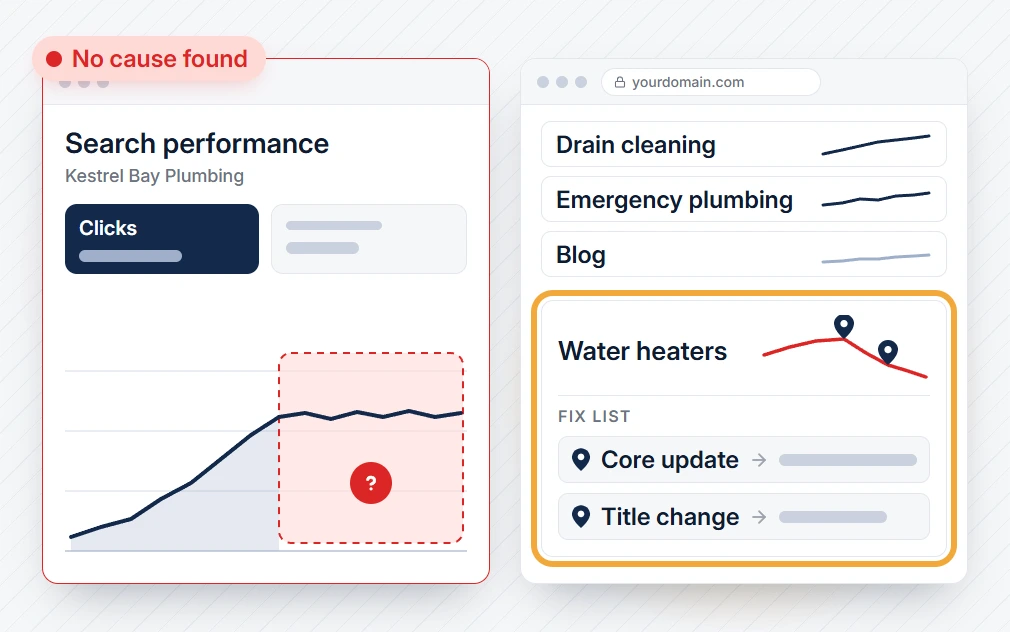
Your organic traffic peaked six months ago and no one can say why
The site used to grow every quarter. Now the graph is flat and no dashboard explains it. A real SEO audit maps the exact page groups that lost rank, ties each drop to a Google update or on-page change, and hands you the fix list in writing. Not a chart, a plan.
FLAT ORGANIC 6+ MONTHS
PROBLEM 02 · TOOL BLIND SPOTS
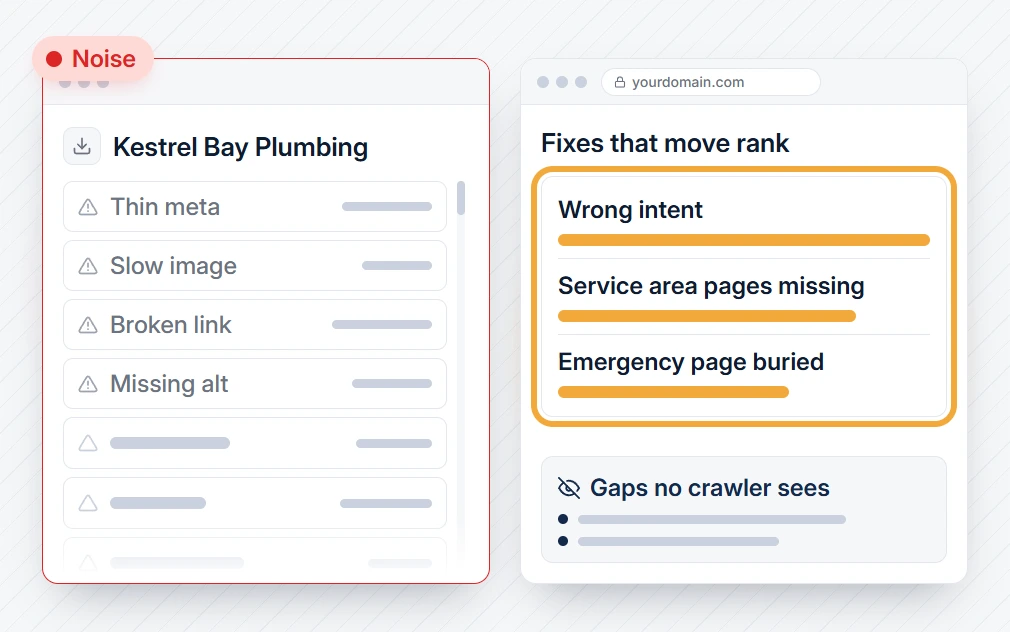
Free scanners flag 200 warnings that never move a ranking
Ahrefs, Semrush, and Screaming Frog surface the same list every time: 200 pages with thin meta, 40 slow images, 15 broken links. You fix them, nothing moves. A human SEO audit filters the tool noise, keeps the 20 items that actually shift rank, and shows the buyer-intent gaps no crawler sees.
TOOL WARNINGS IGNORED
PROBLEM 03 · AGENCY UPSELL
Agencies want a monthly retainer before they diagnose the site
Ask three agencies for a scope and two will pitch you a $2,000 retainer before they open the site. You end up paying for guesses. A free SEO audit turns that around. You get a written diagnosis, a ranked fix list, and full permission to hand it to any developer.
RETAINER PITCH BEFORE DIAGNOSIS
Three outcomes every SEO audit report delivers
What every SEO audit report gives you, in writing and yours to keep.
A prioritized ranking-fix list you actually understand
Every finding ranked by revenue impact, with the exact page, tag, or query it affects. You leave with a fix list your developer or agency can start on Monday.
Ranking changes you can check yourself after the fixes go live
Every finding lands with the page or query it came from, a fix path, and the rank signal it should move. Your team applies them in that order and watches the change in Search Console.
A written report you keep, forever
The PDF is yours the day it lands. Hand it to any developer, in-house team, or new agency. No proposal gate, no upsell wall, no expiring access.
Four stages, 24 hours, one written sign-off
Fixed scope, written sign-offs, dates on the calendar. Every SEO audit follows the same four stages so you know what lands on which day. Nothing slips.
HOUR 1
Discovery and access
You send your URL, your revenue targets, and the competitors you want compared. You share Search Console, GA4, and any ranking tool, read-only. We confirm what the audit will and will not cover in writing.
SIGN-OFF: SCOPE + ACCESS
HOURS 7-10
Crawl and technical audit
Full crawl scored against Core Web Vitals, indexation, render-blocking, schema, and canonical rules. Every technical blocker logged with a fix path and expected rank impact.
TECH FINDINGS LOGGED
HOURS 10-14
Content and on-page audit
Every money page checked for intent match, topical depth, header structure, internal linking, and buyer questions your content misses. Content gaps mapped to the search queries you should be winning.
CONTENT MAP DRAFTED
HOURS 14-17
Link and authority audit
Backlink profile scored for toxic links, quality ratio, and topical relevance versus your top 5 rivals. Anchor text distribution charted so you see over-optimization risk before Google flags it.
LINK AUDIT SIGNED
What you actually get from our SEO audit
Four workstreams and the report they land in. Every line item listed here is in the written report. No hidden phase-two column, nothing held back behind a proposal.
HOURS 7-10
Technical audit that names every crawl and speed blocker
The technical section of the SEO audit checks every signal Google reads before it ranks a page. Crawl, indexation, speed, mobile UX, schema, canonicals, and log-file patterns. Each finding maps to the page it hits and the expected rank movement after the fix.
Phase Duration: CRAWL + INDEX AUDITEDSign-off: CORE WEB VITALS SCORED
GATE · SCHEMA GAPS LISTED
Full site crawl and indexation report
every page checked for crawlability, index status, and duplicate content, with a fix path per issue.
Core Web Vitals score per template
LCP, CLS, INP, and TTFB measured on 20 sample pages against your top 5 rivals.
Schema and structured data check
FAQ, Article, LocalBusiness, and Product schema audited for coverage, syntax, and rich-result eligibility.
Mobile UX and render audit
tap targets, layout shift, viewport rules, and mobile-first indexing signals reviewed on live devices.
Canonical and hreflang rules
canonical tags, hreflang setup, and pagination rules checked for signal conflicts Google reads badly.
XML sitemap and robots.txt review
sitemap freshness, priority tags, and robots directives verified against actual crawl behavior.
HOURS 10-14
On-page audit that finds intent gaps and header failures
Every money page gets a template-level and page-level review. Header structure, keyword targeting, intent match, internal linking, and buyer-question coverage. The on-page section of the SEO audit is where most sites recover 20% to 40% of lost traffic.
Phase Duration: INTENT MATCH SCOREDSign-off: HEADERS REVIEWED
GATE · FIXES RANKED
Search intent match per page
each money page scored against the actual SERP intent for its target query, gap flagged in writing.
Header and content structure
H1, H2, H3 order reviewed for topic coverage, keyword placement, and readability across 20 pages.
Title tag and meta description audit
every title and description scored on CTR patterns, length, and focus keyword placement.
Internal linking review
link equity map showing where authority pools, where it drains away, and which money pages need more inbound links.
Image and media optimization
alt text, file names, format, and lazy-load rules audited for accessibility and rank signals.
Featured snippet targeting
top 20 target queries checked for snippet win potential, format recommended per query.
HOURS 10-14
Content audit that maps every gap versus your top rivals
The content section of the audit compares your topical coverage against the top 5 ranking rivals for each money term. Missing pages, thin pages, outdated pages, and cannibalization all logged with a rebuild path.
every keyword cluster your rivals cover but you do not, ranked by search volume and buyer intent.
Thin content list
pages under 500 words that target money queries, with rewrite word count and outline per page.
Cannibalization report
pages fighting each other for the same query, with a consolidation and redirect plan.
Outdated content refresh queue
top 20 organic pages older than 18 months flagged for update priority and new angle.
Buyer question coverage
PAA and buyer-intent questions your money pages do not answer, mapped to the sections that should carry them.
New content queue with volume data
ranked list of pages you should build next, each with target query, search volume, and rank projection.
HOURS 14-17
Link audit that scores every toxic and quality signal
The link section of the SEO audit reviews your backlink profile against your top 5 rivals. Quality ratio, topical relevance, anchor distribution, toxic clusters, and disavow candidates all logged with a cleanup plan.
total refdomains, quality tier ratio, and topical relevance versus your top 5 rivals in the SERP.
Toxic link cluster report
links flagged for spam patterns, PBN traces, or manual penalty risk, with a disavow file draft.
Anchor text distribution chart
branded, exact, partial, and generic anchor ratios reviewed for over-optimization risk.
Competitor link gap analysis
links your top 5 rivals earned that you did not, with outreach angle and priority per domain.
Lost and broken link recovery
lost placements and broken external links you can reclaim or redirect for immediate authority gain.
Digital PR outreach targets
ranked list of publishers, podcasts, and industry sites worth pitching for your money queries.
HOURS 21-24
A written report you keep and use
The final SEO audit deliverable is a written PDF plus a 30-minute walkthrough call. Findings ranked by revenue impact, fixes listed with the page and the expected rank movement. Yours to keep, share, or hand to any developer.
Phase Duration: WRITTEN PDFSign-off: 30-minute WALKTHROUGH
GATE · YOURS TO KEEP
Written PDF report
every finding written up with the page, the fix, and the expected rank impact scored 1 to 5.
Prioritized fix roadmap
top 20 fixes ranked by revenue impact and time-to-implement so your team knows where to start.
30-minute walkthrough call
live call with the auditor to ask questions, agree the top 3 fixes, and plan the rollout together.
Search Console health snapshot
coverage, performance, and manual-action review captured the day of the audit with fix notes.
Competitor benchmark scorecard
side-by-side scorecard versus your top 5 rivals on technical, content, and link signals.
Follow-on retainer proposal
optional attached scope if you want us to apply the fixes, priced from our SEO packages tiers.
Get a free SEO audit. Written report in 24 hours
FIXED SCOPE · 47 ITEMS AVG · WRITTEN REPORT YOU KEEP · No card needed. No sales call required.
Real sites, real SEO audit fixes, real ranking gains
Each one includes where the client started, what we changed and what happened.
Published case study
iSmile Dental Spa
ISMILEDENTALSPA.COM
Dental · Carmichael, CA•Website Redesign · SEO · PPC
Drove 900% patient growth at iSmile Dental Spa with SEO, PPC and video marketing.
iSmile Dental Spa had a strong local name but an old, insecure website. Online channels brought in 1 to 2 new patients a month. We rebuilt the site on HTTPS, added treatment pages, cleaned up local listings and launched Google Ads and video. Within 6 months it ranked on page one for 75 keywords. It now sees 12 to 14 new patients a month.
Fashion · D2C apparel•SEO · Google Ads · Performance Max
Grew Google Ads revenue 121% and organic users 106% for French Crown
French Crown was underperforming online, with weak search visibility and paid campaigns that spent without reaching the right shoppers. One connected plan across SEO, site experience and paid media grew Google Ads revenue 121% and organic users 106%.
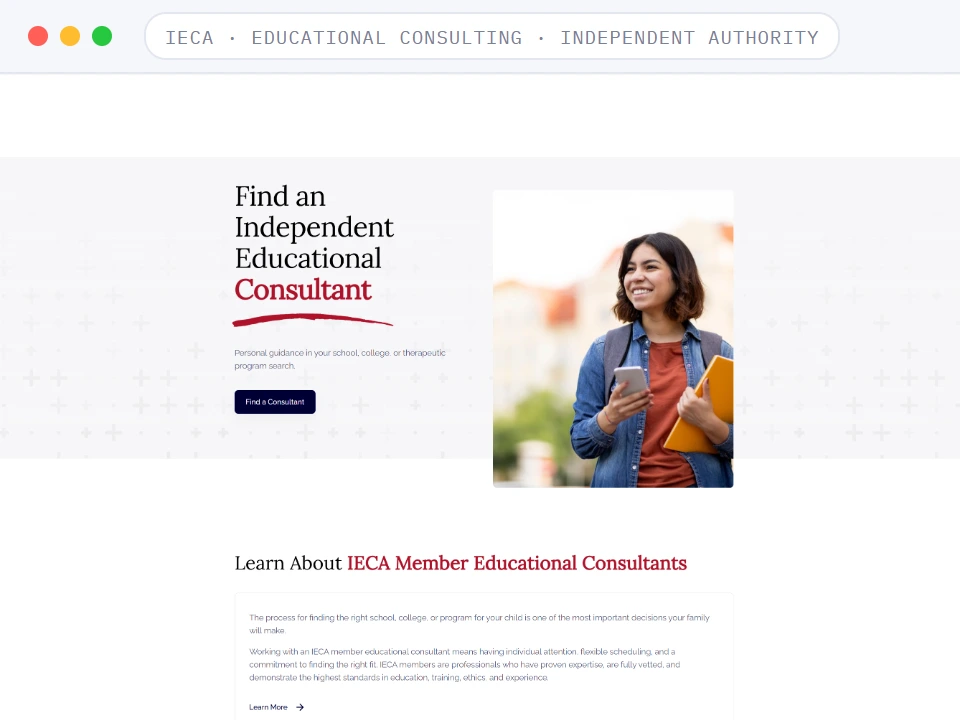
Educational Consulting · Independent Authority•Website Redesign · Development · SEO
Grew IECA to 50K+ monthly visits and 18% more leads.
IECA, the leading authority in ethical educational consulting since 1976, had an outdated site. Its consultant directory was hard to use and not secure. We built a secure, mobile-friendly site with a new consultant directory, SEO content and PPC campaigns. Within 6 months it drew 50K+ monthly organic visits, leads rose 18% and 750+ keywords ranked on page one.
They cut wasted spend on non-buyer keywords and moved the budget to product-page campaigns. Blended ROAS climbed 40% in the first quarter.
Katetey Maxwell
Digital Marketing Lead, BSH Group
Verified via GoodFirms+40% blended ROAS−22% wasted spend
Enterprise demo requests up 3.2x. First operator we have worked with who cared about the CRM number, not the ad account.
Michael Reid
VP Marketing, Forward Networks
Verified via Trustpilot3.2x enterprise demosCRM-tied reporting
The paid team ran an audit that found $18K/mo in wasted spend on brand terms we were already ranking for. Fixed inside two weeks.
Benjamin Sanger
Director, Demand Generation, Mendix
Verified via Trustpilot$18K / mo saved−21% CPA
The team split our national spend by store catchment. Every location got its own landing page and creative. Booked eye exams up 47% inside two quarters with the same media budget.
Karen Williams
Head of Marketing, Vision Express
Verified via NPS survey+47% booked eye examsPer-store attribution
Demos doubled in a quarter after the funnel rewrite. Nothing about the traffic changed. The pipeline math finally works.
Myles Scolnick
Head of Growth, QuoteWell
Verified via NPS survey2x booked demos41s lead response time
Sign-ups tripled without adding ad spend. They rebuilt the checkout, fixed the pricing page, and the numbers moved every week.
Francis Strutt
Co-founder, N1Mailbox
Verified via NPS survey3x sign-ups−28% churn
Catalog ads at 5.8x where our old agency plateaued at 2x. Weekly notes tell us exactly what changed and what is next.
Josh Gingrich
CEO, Printed Mint
Verified via Clutch5.8x catalog ROAS3.4x return vs prior agency
Site, ads, and follow-up under one contract. Partner inquiries doubled without adding headcount.
Brandon Smith
Marketing Director, Intelisys
Verified via Trustpilot2x partner inquiries1 contract, 3 channels
Vendor and buyer leads went from unpredictable to a monthly forecast we could staff against. First agency that treated the CRM as the scoreboard, not the ad account.
Callan Pang
Marketing Manager, Abels Residential
Verified via NPS surveyForecastable pipelineCRM-tied reporting
Client retainers doubled without adding a single account manager. They rebuilt our funnel and the reporting dashboard sold itself on demo calls.
Corin Goodman
Founder, Corin Management
Verified via NPS survey2x client retainersSame team, same headcount
1 / 10
See what a better organic conversion rate is worth
Move the sliders to your numbers. No ad spend in this one, it works from the organic traffic you already have.
3,000
20050,000
$800
$100$10,000
1.5%
0.5%6%
What a 20% improvement on your current conversion rate adds, on today's traffic. Rankings are assumed flat, so nothing here depends on new traffic arriving.
Added revenue per month
/mo
Free · Written findings · Yours to keep
FAQ
Common questions on the SEO audit process
Straight answers on pricing, timelines, deliverables, and what you get in the written report. If your question is not here, book the scoping call.
An SEO audit is a full technical, on-page, content, and link review of a website against current Google ranking signals. The point is to find every issue holding rankings back, name the exact page or query it affects, and hand you a prioritized fix list you can act on. A good SEO audit runs across four disciplines: technical health such as crawl, indexation, and Core Web Vitals; on-page factors such as intent match, headers, and internal linking; content coverage versus your top ranking rivals; and backlink profile quality and toxic-link risk. A written report is the deliverable, not a chart in a scanner. The audit does not fix anything on its own. What it does is give your team, developer, or agency the roadmap needed to move rankings inside 90 days. It also shows the wins your rivals are already stacking. Google Search Central publishes the official baseline for reference: developers.google.com/search.
How do I do an SEO audit?
A DIY SEO audit runs in five stages. First, crawl the whole site with Screaming Frog or a similar tool and log every 4xx, 5xx, redirect chain, duplicate title, and thin page. Second, open Google Search Console and note coverage errors, Core Web Vitals status, and top losing queries in the last 90 days. Third, pick your 10 money pages and score each against the actual SERP for its target query, noting intent gaps, missing headers, and thin sections. Fourth, run your backlink profile through a scanner and mark toxic clusters plus lost-link recovery targets. Fifth, write it all up ranked by revenue impact, not by ease of fix. The full audit takes a week if you know what you are doing. Most in-house teams stop at the crawl stage and never get to intent match or link quality, which is where the biggest ranking wins actually live. See PageSpeed Insights docs for baseline speed data: pagespeed.web.dev.
How much does an SEO audit cost?
The Redefine Web SEO audit is free. You get all four disciplines, technical, on-page, content, and links, plus the written report and the 30-minute walkthrough call, with no monthly lock-in attached. What moves the number other vendors quote is site size, template count, and whether a human reads the pages or a scanner does. Free scanner audits from tool vendors are cheap in dollars and expensive in wasted work: 200 warnings and no ranking movement afterward. Ask any vendor for a sample report before you pay a cent. If the sample looks like a screenshot dump with no ranking scoring, walk away.
How long does an SEO audit take?
Twenty-four hours from the moment you apply. A senior strategist runs the checklist by hand and writes the report the same day, so what lands in your inbox is a prioritized fix list rather than a crawler export with a cover page glued on. Scope is fixed before we start, so you know exactly what is covered and nothing expands mid-audit. If anything would push past the day, you get a note explaining why before the deadline, not after it.
What is included in an SEO audit?
A complete SEO audit covers four workstreams and ends in a written report. First, technical health: full crawl, indexation, Core Web Vitals scored against top rivals, schema check, canonical and hreflang rules, plus XML sitemap and robots.txt review. Second, on-page: search intent match per money page, header structure, title and description review, internal linking map, and image optimization work. Third, content: topical coverage gap versus your top 5 rivals, thin content list, cannibalization report, outdated content refresh queue, and new content roadmap. Fourth, backlinks: profile quality score, toxic link report, anchor distribution chart, competitor link gap, and lost link recovery targets you can act on. Finally, reporting: a written PDF ranked by revenue impact, 30-minute walkthrough call, Search Console health snapshot, and a follow-on retainer proposal if you want the fixes applied. Every finding lands on a page or query, not a chart. See Web.dev for Core Web Vitals reference numbers and thresholds: web.dev/vitals.
What tools are used for an SEO audit?
A proper SEO audit uses six tool categories, not one. Crawlers such as Screaming Frog or Sitebulb for the technical crawl and log-file work. Search Console and GA4 for real query and traffic data straight from Google. Rank trackers such as Ahrefs, Semrush, or SE Ranking for the ranking and backlink data. PageSpeed Insights and Chrome DevTools for the speed and Core Web Vitals audit. Schema validators for structured data checks against Google guidelines. And competitor tools for the SERP intent match analysis. No single tool covers all six, which is why free scanner reports miss most of the real ranking blockers on a site. At Redefine Web the audit uses the tool that best fits each specific check, then a human writes up the finding, ranks it by rank impact, and ties it to a page. The tool output is the raw material, not the deliverable. If a vendor sells you a tool export as an audit, ask for a sample and read it before you pay a dollar.
What is the best free SEO audit tool?
Google Search Console is the best free SEO audit tool because it shows the actual queries, impressions, clicks, and Core Web Vitals for your site as Google sees it. No paid tool matches that data source. For a free crawl, use the Screaming Frog SEO Spider free tier, which handles up to 500 URLs per site. For a free speed check, use PageSpeed Insights and the Chrome Lighthouse extension in DevTools. For a free schema check, use the Google Rich Results Test on any money page. Combined, those four Google tools cover about 60% of what a full SEO audit does. What they miss is the human interpretation layer: intent match analysis, competitor gap mapping, and the ranked fix list that ties findings to expected rank movement. Free tools give you data. Paid tools give you more data. A written audit gives you a plan. For most sites under $10,000 monthly revenue, the free stack plus a weekend of focused work is enough to move rankings inside 90 days.
What is the difference between on-page and off-page SEO audit?
An on-page SEO audit reviews everything on your site: technical health, content coverage, header structure, internal links, schema markup, and page speed. An off-page audit reviews signals that live outside your site: backlink profile quality, anchor text distribution, brand mentions across the web, and citation consistency for local search. On-page fixes move rankings on individual money pages inside 30 to 60 days because Google recrawls the page and rescores it. Off-page fixes move domain-level authority over 90 to 180 days because earned links take time to build, index, and pass equity. Most sites need both sides audited. A ranking problem on a single page is usually on-page. A ranking problem across a whole site is usually authority, which is off-page. A complete SEO audit covers both sides so you know which lever to pull first. Redefine Web audits split findings by side so your team can prioritize on-page work in-house and outsource the link earning work to a specialist team.
How often should you do an SEO audit?
Run a full SEO audit once a year at minimum, and once a quarter if the site earns over $100,000 monthly revenue from organic. Between full audits, run a monthly mini-check on Search Console coverage errors, Core Web Vitals status, and top losing queries in the last 30 days. Google updates its core algorithm 3 to 4 times per year, and those updates often surface as ranking swings inside a week of rollout. A quarterly audit catches the shift before you lose 6 months of traffic waiting to react. A yearly audit works for stable content sites under $50,000 monthly revenue where the SERP does not move much between updates. For ecommerce, SaaS, and any site running paid content pushes, quarterly is the right cadence. Ad-hoc audits are also worth running after a redesign, a domain migration, a CMS switch, or a suspected Google penalty. See Google Search Central for update cadence records: developers.google.com/search/updates.
Is Google's SEO audit tool free?
Google does not publish one single SEO audit tool under that name. It publishes several free tools that together cover most of an SEO audit. Google Search Console is the primary one and it is free forever with a verified property. It shows coverage errors, Core Web Vitals status, query performance, backlinks, and manual actions on your site. PageSpeed Insights is free and gives you a full speed and Core Web Vitals score for any URL. The Rich Results Test checks schema and structured data for eligibility. Lighthouse in Chrome DevTools runs a page-level SEO check including headers, alt text, mobile UX, and accessibility signals. Combined, those four Google tools give you a decent free SEO audit if you know how to read the outputs and act on them. What Google does not publish is a ranked fix list, a competitor benchmark, or a content gap map. That work still needs a human interpreter. A written SEO audit combines Google data with a plan and a walkthrough.
What is a technical SEO audit?
A technical SEO audit is the discipline that checks every signal Google reads before it ranks a page. Crawl behavior, indexation status, page speed and Core Web Vitals, mobile UX, schema and structured data, canonical rules, hreflang setup, XML sitemap freshness, robots.txt directives, HTTPS security, and log-file patterns for bot behavior. The point is to remove every technical blocker so the on-page and content work can actually move rankings after publish. A page cannot rank if Google will not crawl it, cannot index it, or renders it too slowly to score properly. Most sites have 10 to 20 real technical blockers hiding behind 200 tool warnings that do not move rank. A human technical SEO audit filters the noise and lists only the fixes that will actually move rank. Redefine Web scores every technical finding 1 to 5 on rank impact so your developer knows exactly where to start Monday morning. See Core Web Vitals docs: web.dev/vitals.
How do I audit a website for SEO?
To audit a website for SEO, follow the same five stages any team can run. Stage one, run a full crawl with Screaming Frog and export every issue: 4xx, 5xx, redirect chains, duplicate titles, thin pages, missing schema markup. Stage two, pull Search Console data for the last 90 days and note coverage errors, Core Web Vitals status, top gaining queries, and top losing queries. Stage three, pick your 10 money pages and score each against the actual top-10 SERP for its target query: intent match, header coverage, word count, internal links, buyer questions answered. Stage four, review your backlink profile in Ahrefs or Semrush against your top 5 rivals and flag toxic clusters plus link gap targets. Stage five, write it all up ranked by revenue impact with a fix path per finding. That is the exact SEO audit process Redefine Web runs, condensed for solo use. It works for any site, any vertical, any CMS.
What is the best SEO audit software?
The best SEO audit software depends on site size and monthly budget. For small sites under 500 pages, Screaming Frog SEO Spider paired with Google Search Console covers 80% of what a paid platform does, at $259 per year total. For growing sites, Ahrefs Site Audit or Semrush Site Audit run automated weekly crawls and flag regressions, with software subscriptions at $200 to $500 per month depending on the plan. For enterprise sites, Botify, DeepCrawl, or Sitebulb handle log-file analysis and JavaScript rendering that lighter tools miss, at $2,000 or more per month. Software gives you the data. It does not give you the ranked fix list or the intent match analysis. A written SEO audit combines the best tool output with a human interpretation layer and a plan. Software subscriptions and audits solve different problems on the same site. Pick one lane. If you want ongoing monitoring, pay for software. If you want a diagnosis and a plan, start with the audit.
Can I do my own SEO audit?
Yes, and for sites under $10,000 monthly organic revenue, DIY is often the right call to make. The tools you need are free or near-free: Search Console, Screaming Frog free tier for up to 500 URLs, PageSpeed Insights, and the Rich Results Test. Block a full weekend, work through the five stages, and write the findings up ranked by expected rank impact and time to fix. What you will miss is competitor benchmarking, backlink quality scoring, and the intent match analysis, because those need paid tools or a trained eye to do well. If organic revenue is stalled and you have already tried DIY twice with no ranking movement, that is when it pays to hand the audit to a trained eye. The written report gives you a plan you can act on for 6 to 12 months of work. For any site earning over $50,000 monthly from organic search, DIY audits are usually false economy.
What is a link audit in SEO?
A link audit in SEO reviews your entire backlink profile for quality, relevance, and toxic-link risk. The audit pulls every referring domain from Ahrefs, Semrush, or Majestic, then scores each one on domain authority, topical relevance to your niche, anchor text pattern, and spam signals. The output is a five-part report: total refdomains and quality tier breakdown, toxic link cluster list with disavow file draft, anchor text distribution chart flagging over-optimization risk, competitor link gap showing links your top 5 rivals earned that you did not, and lost-link recovery targets you can reclaim quickly. A quality SEO audit on links is worth running once a year on any site with over 500 referring domains, and quarterly for sites in high-competition niches like finance, health, or SaaS. Google penalties for toxic link patterns are rare now, but they still hit sites that never audited proactively. Better to catch the risk before Google does it for you.
Free · Written in 24 hours · No pitch
Get your free SEO audit.
A written report in your inbox within 24 hours, with three fixes you can ship the same week, whether or not you hire us.
Written in 24 hours · 10,000+ audits run · 300+ clients since 2021