Fixed price
$2,500
One-time project
Starter, up to 8 pages

Manufacturing company website design for contract manufacturers, industrial suppliers, and B2B component makers. Single-plant shops up to multi-facility groups. Every build launches with a filterable product catalog, spec-driven RFQ forms with CAD and STEP file upload, ISO 9001 and AS9100 trust signals in the hero, and a written timeline you can plan around, from 4 weeks on Starter. ERP or PIM sync is scoped and quoted with the build. From Growth up, a Core Web Vitals speed budget keeps pages at 98+ on mobile, so more engineer visits turn into qualified RFQs.
Selected clients we've run full marketing programs for


If any of these looks familiar, the free website audit names the fix and what it's worth before you spend a dollar.
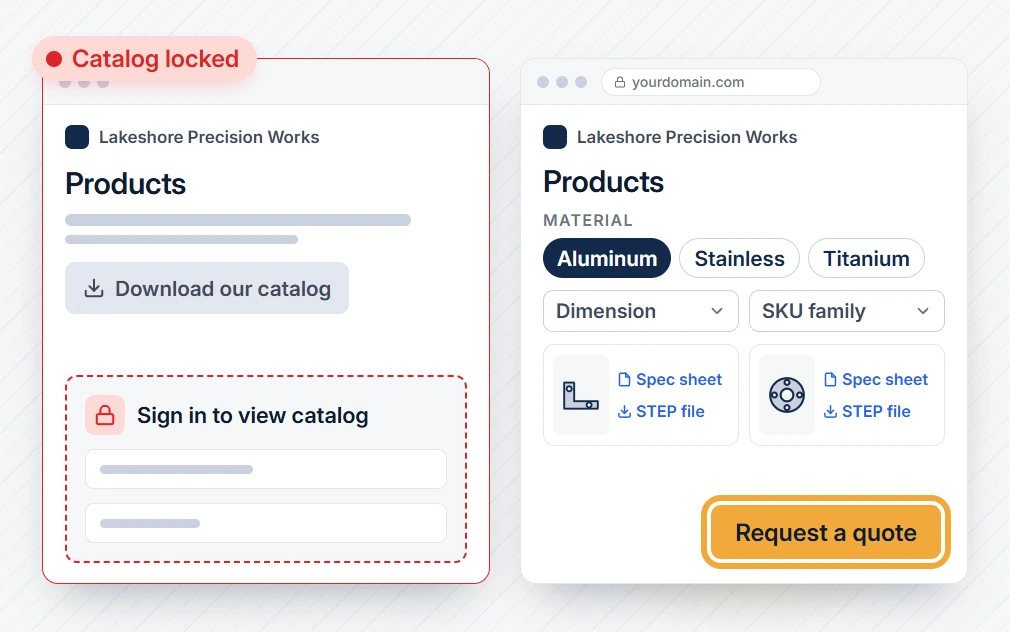
Engineers arrive with a part number or a tolerance spec and expect to filter by material, dimension, or SKU family in one screen. When the catalog lives inside a 40 MB PDF or a login wall, 68% of them close the tab and open a competitor. A live product catalog with real filter facets, downloadable spec sheets, and STEP file links keeps the engineer on the page long enough to hit the quote button.
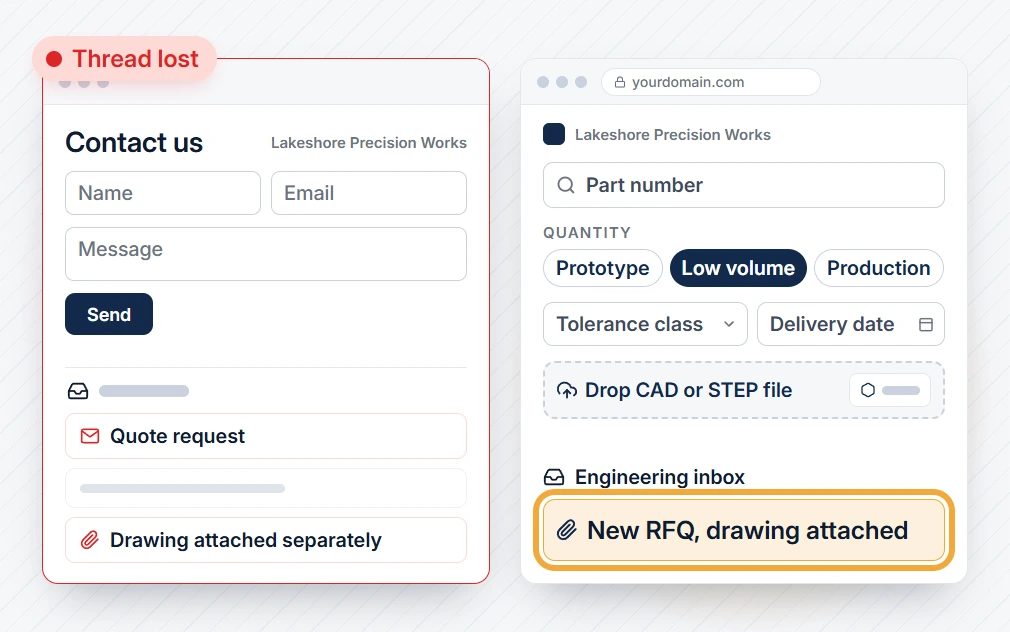
Procurement teams want to attach a drawing, name a target quantity, and pick a tolerance class in one form. Sites that route every request through a 4-field contact form force buyers to email a PDF separately and lose the thread. A real RFQ form with CAD or STEP file upload, part-number lookup, quantity ranges, and delivery date routes the request straight to your engineering inbox with the spec attached.
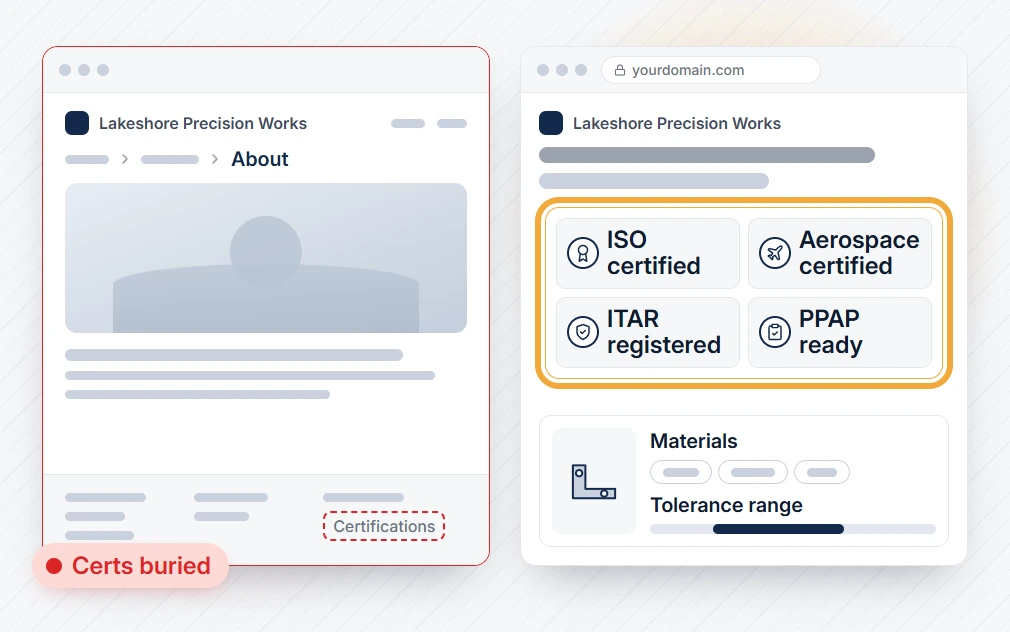
Procurement short-lists get built from ISO 9001, AS9100, ITAR, and PPAP compliance stamps before the phone rings. Sites that bury certifications on a hidden "About" page fail the first pass of the vendor audit. Every manufacturing site we build lands with the certification block wired into the hero, material capabilities named on every product page, and tolerance ranges published against real drawings.
Three outcomes in every SOW. Smith-Midland Corporation doubled conversions after we merged its regional sites.
Filterable manufacturing website design catalog, spec-driven RFQ with CAD upload, capability pages that route qualified RFQs to your engineer inbox in 90 days.
Quoted with your build, an ERP or PIM sync pulls live stock, lead time, and price tiers into every product page from NetSuite, Epicor, SAP Business One, Infor, or Fishbowl through a documented layer.
Your domain, CMS logins, WordPress admin, ERP keys, Figma file all in your name. From Growth up, your team is trained on the platform. Walk away whole if you ever leave the agency.
Your engineering lead signs each stage before the next one starts. Every milestone has a calendar date, and ERP export access is set up in week one so catalog data never holds up launch.
A brief signed by owner, engineering lead, and inside sales lead. Owner interview, technical audit of your current site, product catalog inventory, ERP or PIM review, and a benchmark of 5 direct competitors on Thomas Net and IndustryWeek. Nothing moves until it is locked.
Mobile-first design with filterable catalog, RFQ form with CAD upload, and ISO 9001 or AS9100 trust block baked in from wireframe. Starter builds on a template base, Growth gets custom design, and Scale adds a shared design system. Every component engineer-validated the same week it is drawn. You walk away with an editable Figma file your team owns.
WordPress on LiteSpeed by default, with headless Next.js quoted when the SKU count or distributor roster demands it. From Growth up, Core Web Vitals is an acceptance criterion. GA4 goes in on every build, and NetSuite, Epicor, SAP Business One, Infor, or Fishbowl catalog sync and marketing automation are quoted with the build.
We cut over off-hours, so inside sales never loses the RFQ form mid-quote. For 30 days we check RFQ submissions, part-number URLs, and Search Console daily. On day 31 you take the keys, or move to a maintenance plan.
Our industrial website design runs in five phases, from catalog data mapping to the 301 map that keeps your part-number rankings. Each ends with a dated deliverable and a sign-off.
Owner interview, technical audit of your current site, ERP or PIM plus analytics plus CRM stack, competitor benchmark of five direct peers on Thomas Net and IndustryWeek, and product catalog data mapping. The output is a written brief your owner, engineering lead, and inside sales lead sign off on before we design a pixel or write a line of code.

One hour with owner plus engineering plus inside sales leads to lock brand voice, capability position, and non-negotiable product categories.
Core Web Vitals baseline, WordPress theme review, product catalog audit, ERP or PIM connection check, and analytics wiring audit.
Five direct competitors scored on catalog UX, RFQ flow, spec sheet accessibility, and Thomas Net or IndustryWeek presence.
SKU families, part number logic, material capability tags, and tolerance ranges mapped to the new site before design starts.
Full page inventory with URL structure. Part-number pages carry forward with the same URLs so long-tail organic rankings hold through the migration.
A document. Owner, engineering lead, and inside sales lead sign before anything else moves.
Design starts from a buyer holding a drawing. Catalog filters cover material and tolerance, the RFQ form takes a STEP file, and your ISO 9001 or AS9100 block sits near the top. A developer checks each component the week it is drawn, and the Figma file is yours.

Standard RFQ path, sample request path, and distributor pricing request path all surface from the hero. CAD, STEP, IGES, or PDF drawing upload above the fold.
Real filter facets by material, dimension, tolerance class, and SKU family. Part-number search returns a spec sheet, downloadable STEP file, and quote button in one screen.
ISO 9001, AS9100, ITAR registration, RoHS or REACH compliance stamps wired on hero and every product page. Ranks stronger for vendor-audit search terms.
Optional distributor login area with tiered pricing, bulk order history, and part-number quick-order, quoted separately on any tier.
Page templates handed over on every build, with the full component library and design tokens from Scale up. Your team can add new SKU families and capability pages without touching code.
Spec sheet library, tolerance tables, material property PDFs, and CAD downloads housed in a searchable resource center that ranks on long-tail engineer queries.
Most plants get WordPress, on a template base for Starter and a custom theme from Growth up. Catalogs above 10,000 SKUs or large distributor rosters can move to headless Next.js, quoted separately. Either way, pages load fast on a shop-floor phone and pass WCAG 2.1 AA, and from Growth up they meet the Core Web Vitals targets before launch.

Default stack for most manufacturers. Fastest launch, tight NetSuite or Epicor integration, and the tightest GA4 wiring.
For regional groups or multi-plant manufacturers with a shared parent brand. Same speed and Core Web Vitals bar across every facility page.
Quoted separately where SKU count above 10,000 or distributor roster size justifies the added stack.
From Growth up, LCP under 1.8s, CLS under 0.05, INP under 200ms on 4G, so spec sheets open fast on the shop floor. Checked before launch.
Axe, NVDA, and VoiceOver checks on catalog filters, the RFQ form, and CAD upload before launch. New SKU pages stay covered by maintenance.
From Growth up, Organization schema on the home page, Product schema on every SKU page, and manufacturer metadata wired for Google Merchant and part-number rich results.
GA4 on every build. NetSuite, Epicor, SAP Business One, Infor, or Fishbowl integration, HubSpot or Pardot marketing automation, Thomas Net feed sync, and distributor portal wiring are scoped and quoted with the build. RFQ forms and inbound calls route into the CRM with campaign-source tagging. Built with documented abstraction layers so the next ERP swap is days, not months.

NetSuite, Epicor, SAP Business One, Infor, or Fishbowl wired to the product catalog with real stock, lead time, and tiered pricing. Same for Akeneo or Salsify on the PIM side.
Product data feed to Thomas Net and IndustryWeek maintained from the same catalog source of truth. Zero drift between site and directory listing.
HubSpot, Pardot, or Marketo wired to the RFQ form. Engineer registration triggers spec sheet nurture, procurement RFQs route straight to inside sales.
Salesforce, HubSpot CRM, or Microsoft Dynamics wired to every RFQ. Deal source, campaign, and part-number requested captured on the record.
Optional distributor login area with tiered pricing, bulk order history, and part-number quick-order. Wired to the same ERP source, quoted separately on any tier.
CallRail or CallTrackingMetrics tags each inbound call with its campaign and the capability page it came from, so phoned-in RFQs count in GA4.
From Growth up, every old part-number and capability URL gets a 301 before DNS moves, so rankings built over years carry over. Uptime and speed monitoring go live with 30 days of launch monitoring on every tier. Design files, CMS logins, and the repo stay with you.

DNS flips outside shift hours with the team on one call. RFQ submissions, CAD uploads, and error logs are checked hourly for the first 24 hours.
From Growth up, every legacy URL mapped before cutover. Part-number pages, capability pages, and blog carry over. Zero 404s on organic winners.
Each business day for 30 days we review RFQ volume, CAD downloads, part-number 404s, and page speed against the old site's numbers.
Hourly checks on the catalog, the RFQ form, and the ERP sync, with alerts to Slack or SMS through Pingdom or Better Uptime.
30 days on every tier. Bug fixes, RFQ field changes, and product page swaps are covered in that window.
Design files, CMS logins, WordPress admin, ERP integration keys, GA4, and repo all in your name at handoff. Agency access removed when the window closes.
Process plants, heavy equipment makers and industrial distributors sell in different ways, so the catalog, the RFQ path and the documents on the site change with each.
Industrial website design for a process plant has to answer a buyer's paperwork questions before price. OSHA's Hazard Communication Standard has chemical makers prepare a Safety Data Sheet for each hazardous chemical. Our resources hub puts spec sheets and material property PDFs in one searchable library, with room for your Safety Data Sheets. Certification stamps such as ISO 9001 or REACH sit on every product page.
An industrial website designer should build each heavy equipment model page around the specs buyers compare, such as capacity, weight and dimensions. Each page puts a spec sheet download and a quote button on one screen. An optional configurator, priced with the build, turns chosen options into a valid part number and a live quote. From Growth up, Product schema goes on every model page.
An industrial distributor website should show stock, lead time and price before the buyer has to ask. Quoted with the build, an ERP sync from NetSuite or Epicor puts live stock, lead time and tiered pricing on each product page. An optional login area adds bulk order history and part-number quick-order for repeat buyers. The same catalog can feed your Thomas Net listing, so the site and the directory match.
WCAG AA and a fixed launch date on every build, plus every legacy part-number URL mapped 301 and 98+ mobile Lighthouse from Growth up. Written into the SOW before we start. · No card needed. No sales call required.
Single-plant shops start on Starter, and a distributor portal is quoted separately on any tier. Every build is a fixed-price quote, not a monthly bill.
THE FOUNDATION: New businesses that need a credible, fast site on a template base
EVERYTHING IN STARTER, PLUS: Single-location businesses replacing an underperforming site
EVERYTHING IN GROWTH, PLUS: Larger sites with more page templates and integrations
EVERYTHING IN SCALE, PLUS: Large site estates, multi-brand or multi-location
A separate maintenance plan from $199/mo, on a 6-month term, keeps the catalog current.
Each one includes where the client started, what we changed and what happened.
 Published case study
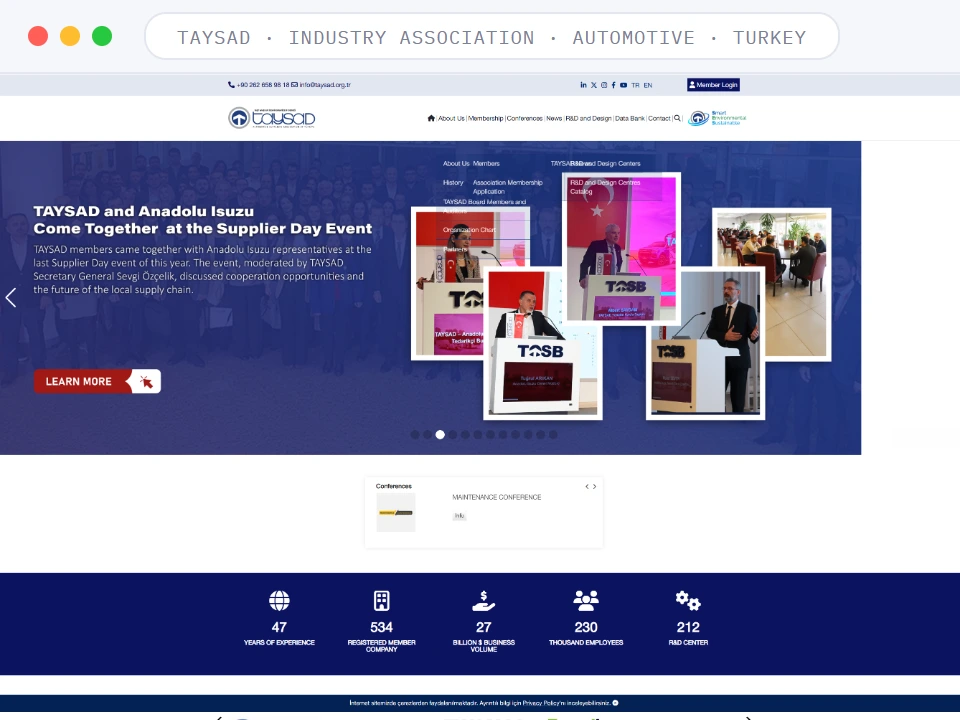
TAYSAD
TAYSAD.ORG.TR
TAYSAD represents 490+ members of Turkey's automotive supplier industry. Its outdated site was slow, not secure and hard to use for members with limited tech skills. We built a secure backend with encryption, a simple design for every skill level and a faster build that can scale. Organic users grew 160%, page load time fell 80% and average sessions lasted 40 seconds longer.
 Published case study
Printed Mint
PRINTEDMINT.COM
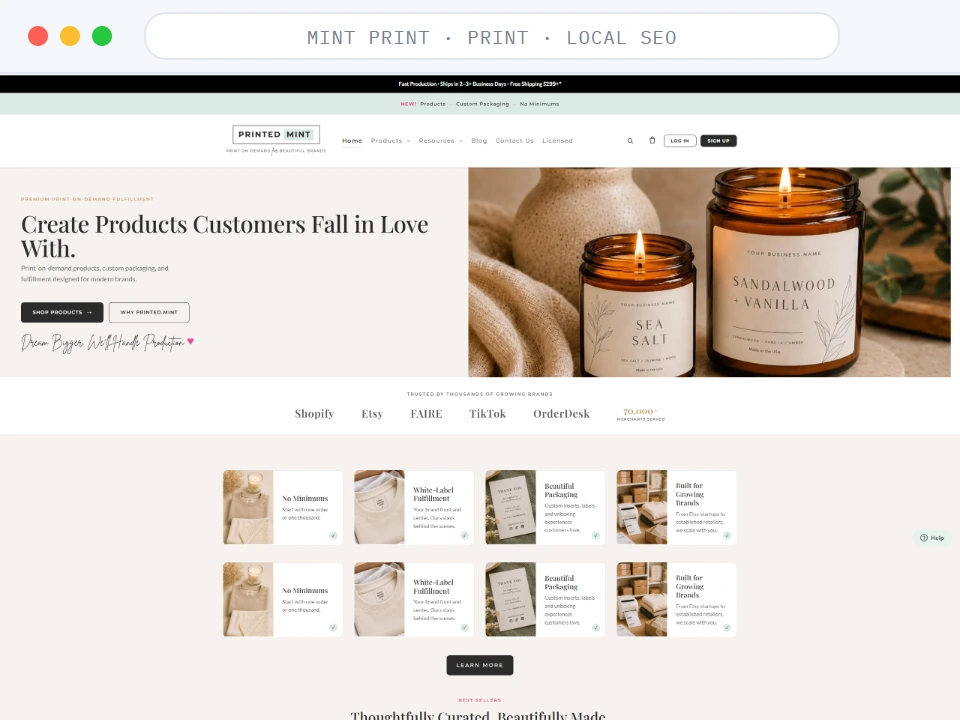
Printed Mint had a strong reputation with the brands it already served, but an outdated website with weak calls to action, almost no organic visibility and costly paid ads. We redesigned the site around clear calls to action, ran SEO and published content built for engagement. Within six months it drew 5,000+ organic visits a month, ranked on page one for 125+ keywords and cut CPA 60%.
 Published case study
Smith-Midland Corporation
SMITHMIDLAND.COM
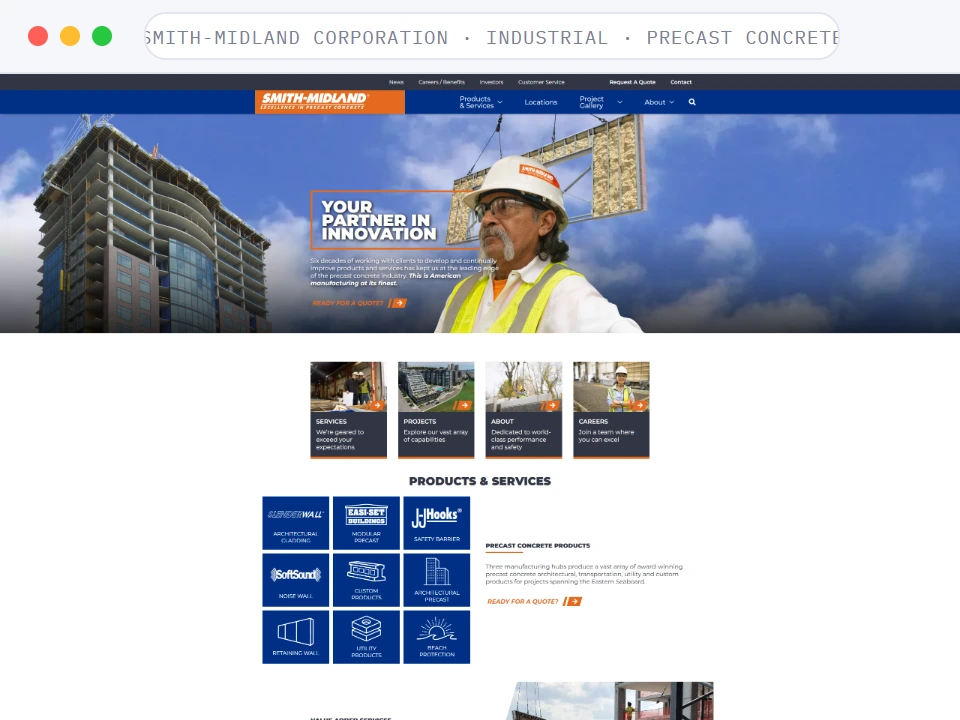
Smith-Midland Corporation makes precast concrete for infrastructure. Its separate regional websites looked inconsistent, had unclear calls to action and did little for hiring. We merged them into two UX-led WordPress platforms with video, case studies, clearer calls to action and hiring stories. Bounce rate fell 65%, conversions doubled and the team now manages content in-house.
WCAG AA and a fixed launch date on every build, plus every legacy part-number URL mapped 301 and 98+ mobile Lighthouse from Growth up. Written into the SOW before we start. · No card needed. No sales call required.
Enterprise demo requests up 3.2x. First operator we have worked with who cared about the CRM number, not the ad account.

Move the sliders to your numbers. A redesign earns its cost from the visitors already landing on the site, before it wins a single new one.
Free · Written findings · Yours to keep
Straight answers on cost, timeline, platform, RFQ flow, ERP integration, and ADA compliance. Call or email if we missed yours.
Free · Written in 24 hours · No pitch
A written report in your inbox within 24 hours, with three fixes you can ship the same week, whether or not you hire us.
Written in 24 hours · 10,000+ audits run · 300+ clients since 2021


