Manufacturing SEO Services That Rank for Part Numbers Buyers Search

Rank across every part number, capability page, and spec sheet engineers search when they source. Real HTML pages for CNC, castings, gaskets, fasteners, hydraulics, and more. Every ranking traces back to RFQs logged in HubSpot, Salesforce, or your CRM. Retainers start at $500 per month.

4.9Across 126 reviews on 6 platforms
Flat monthly fee
$500 Monthly
Visibility, 1 new service page a quarter

Where we start Week 1
Sign-off: keyword-to-page map
What’s included Visibility
  • Technical + Core Web Vitals audit
  • Google Business Profile
  • Rank tracking
Directory citations + NAP cleanup
Reporting Weekly
Weekly written report

Selected clients we've run full marketing programs for

  • Armanino
  • BSH
  • Delicate Dental
  • Government Legal Department
  • Hightop Health
  • LifeStance Health
  • Marmalade
  • Montegra Capital Resources
  • Noelle Collins Dental Clinic
  • Oxford Capital
  • Paquin & Carroll Insurance
  • PCO Bookkeepers & M&A Specialists
  • Peaceful Mind Psychology
  • Peak Accounting Solutions
  • Pelvic Rehabilitation Medicine
  • RiverSaaS Capital
  • Rosenbaum Personal Injury Lawyers
  • Smile Design Dentistry
  • Stanhope Capital Group
  • Stella Maris
  • Tilghman Builders
  • Toyota
  • Uptime
  • VP Dental & Medical Supplies
  • Wilentz Attorneys at Law

Three ways buyers find your competitor before you

If any of these looks familiar, the free SEO audit names the fix and what it's worth before you spend a dollar.
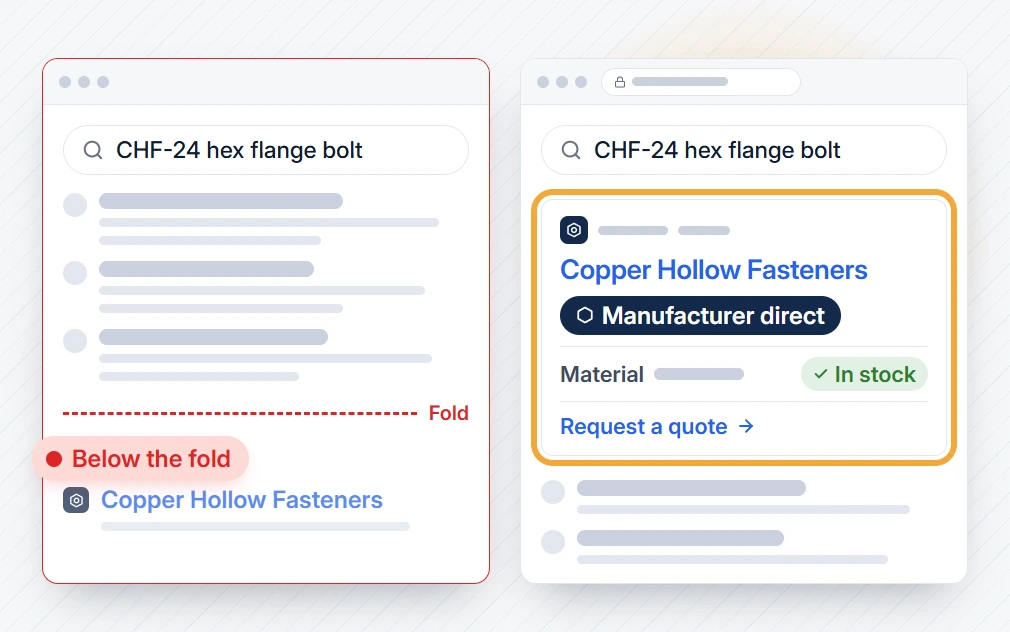
Manufacturing SEO services results page where the maker's product page moves above three distributors
PROBLEM 01 · DISTRIBUTOR

ThomasNet outranks your product page for your own part numbers

Engineers search a specific part number and land on ThomasNet, McMaster-Carr, or Grainger before your own PDP. Every RFQ that distributor page fires goes to a rival stocking your part or a competing spec. Your product page sits below the fold, so buyers never see the direct manufacturer they were trying to reach in the first place.
DISTRIBUTORS RANK ABOVE YOUR OWN SKU
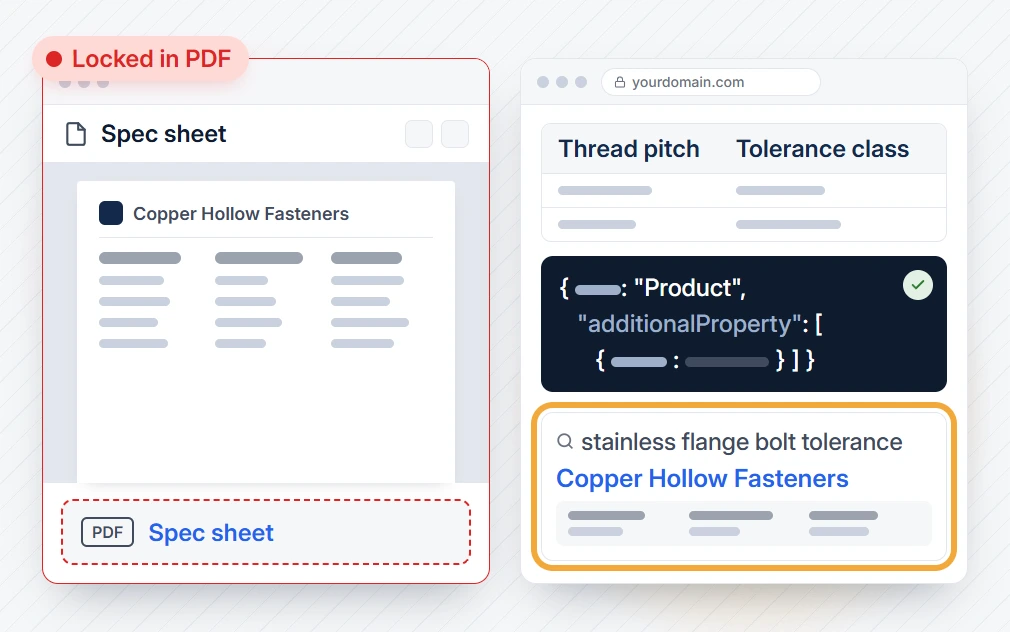
Manufacturing SEO services spec sheet moved out of a PDF into an HTML page with Product schema
PROBLEM 02 · PDF LOCK

Spec sheets live in PDFs Google barely indexes

Every tolerance, material chart, and dimension buyers need sits inside a PDF Google indexes at 20 percent of the equity of an HTML page. Competitors with real HTML spec pages carrying Product schema beat you on material queries, tolerance ranges, and application searches. Your engineering data carries a fraction of the index equity an HTML page would.
20% INDEX EQUITY ON PDF SPEC SHEETS
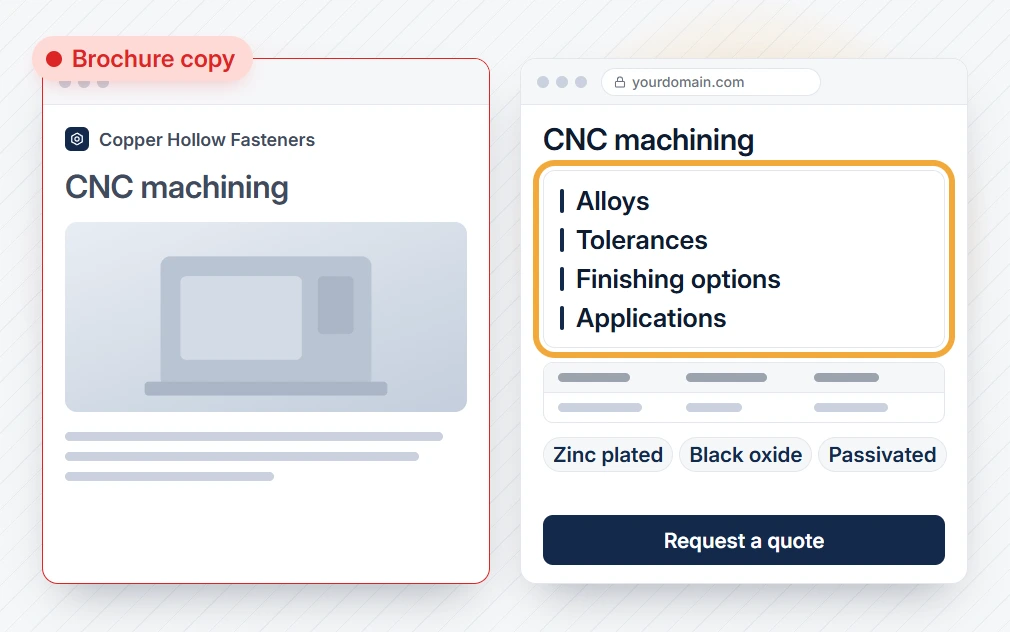
Manufacturing SEO services capability page rebuilt from a brochure paragraph into alloys, tolerances and finishes
PROBLEM 03 · THIN CONTENT

Category pages read like brochure blurbs, not engineer answers

A 120-word CNC machining page cannot outrank an 1,800-word rival with alloys, tolerances, finishing options, and application detail. Google ranks the page that answers the engineer, not the one that reads like a sales brochure. Your capability pages lose every technical search to the competitor that wrote the depth.

120 WORDS/PAGE · LOSING TO 1,800-WORD RIVALS

Three outcomes every manufacturing SEO retainer produces

Each one shows up in the weekly report. Printed Mint reached page one for 125+ keywords within six months.

Indexable part-number pages outranking rivals

HTML pages for your SKU families at your tier’s pace (1 new page a quarter on Visibility, 2 on Traffic, 4 on Scale), each with Product schema, tolerance data, material specs, and STEP file links. Buyers land on you, not on ThomasNet listings.

Depth-first capability pages built for engineers

Capability pages rewritten at your tier’s pace with alloys, tolerances, finishing options, MOQ, and lead times. Engineers land on your RFQ form with intent, not confusion.

Reports tying every ranking gain to a real RFQ

A weekly written report every Friday on every tier, plus a live ranking dashboard from Traffic up. Every gain traces to a real quote request logged in HubSpot, Salesforce, or Dynamics CRM.

Four stages from spec audit to booked RFQs

Each stage ends with a written sign-off, and your engineers approve every spec page before it goes live. Dates are planned around your trade shows and plant shutdowns.

WEEK 1

Part number and capability audit

Every SKU family, capability page, and spec PDF audited against real buyer searches. We pull your current rankings, Google Search Console impressions, and RFQ data. We map every distributor that outranks you and every PDF spec sheet Google is undervaluing. You get a written keyword-to-page map before any content work starts.

SIGN-OFF: KEYWORD-TO-PAGE MAP
WEEKS 2-3

HTML spec pages and Product schema build

Priority PDF spec sheets rebuilt as HTML pages at your tier’s pace (1 new page a quarter on Visibility, 2 on Traffic, 4 on Scale, custom on Enterprise), with Product schema, Offer schema, and structured tolerance tables. We add CAD and STEP file downloads inline, not behind a form wall. Category pages get depth-first rewrites with alloys, tolerances, finishing, and application detail engineers actually search. Your part numbers become indexable content.

SIGN-OFF: FIRST HTML SPEC PAGES LIVE
WEEKS 4-12

Technical resource content and internal linking

From Traffic up, technical resource pages built for engineer-intent keywords (material selection guides, tolerance calculators, application notes), 1 a month on Traffic and 2 on Scale. Every page links to the capability and PDP it supports. Internal linking rebuilt so authority flows from the resource hub to the RFQ-ready pages. Your site reads like a technical reference, not a sales brochure.

SIGN-OFF: RESOURCE HUB LIVE
MONTH 2+

RFQ attribution and CRM wiring

GA4, Search Console, and your CRM wired so every organic ranking traces to a real quote request. HubSpot, Salesforce, or Dynamics fields tagged with source SKU family and landing page. Your weekly report shows rankings, RFQs, and pipeline in one view. You know exactly which pages drove revenue and which need more depth.

WEEKLY REPORT

Every deliverable inside a manufacturing SEO retainer

Five workstreams of industrial SEO services, from Product schema on every part page to the quarterly review of RFQs and pipeline.

Product schema

Site architecture built to rank part numbers

Core Web Vitals, crawl budget, XML sitemap segmentation by SKU family, canonical rules for part-number variants, hreflang for international distributors, and Product schema on every PDP. Technical work runs first because no content ranks on a broken index.

Phase Duration: Product schema Sign-off: Core Web Vitals
Manufacturing SEO services sitemaps by SKU family, a canonical tag and passing Core Web Vitals
GATE · XML SITEMAPS

Schema build

Product, Offer, Organization, BreadcrumbList schema on every commercial page. Validated in Rich Results test before push live.

Site speed

LCP under 2.5s, CLS under 0.1, INP under 200ms across every PDP and capability page. Image compression, lazy loading, critical CSS.

Crawl budget

Faceted navigation cleaned, thin variant pages canonicalized, XML sitemap split by SKU family so Google indexes what you want ranked.

CAD file access

STEP, IGES, and DWG files linked inline on PDPs. Downloads tagged in GA4 as buyer-intent events feeding your CRM.

Industrial SEO that puts your plant on the RFQ shortlist

Industrial companies sell to engineers and procurement teams, not consumers. So the plan, the proof and the links all follow how those buyers source.

Industrial SEO services sized to your plant count

Industrial SEO services rank your capability and part pages for the searches engineers run when they source. The plan follows your plant count. Visibility, at $500 a month, fits a single-plant OEM. Scale, at $1,250, suits multi-plant operators and diversified contract manufacturers. Enterprise, from $3,000, adds distributor SEO alongside your OEM channels.

Retainers from $500 a month

SEO for industrial companies engineers can trust

SEO for industrial companies has to prove expertise first, because engineers vet a supplier before they send an RFQ. Google's guidance on helpful content asks who created each page, so your engineer signs off every spec page and gets a reviewed-by credit. Organization schema lists your ISO 9001, AS9100 or IATF certifications. Each plant gets its own Google Business Profile.

Engineer sign-off on every spec page

Industrial SEO links earned in the trade press

Industrial SEO earns authority where your buyers already read. From the Traffic tier up, we pitch Modern Machine Shop, IndustryWeek, Manufacturing.net and vertical trade sites. We also claim your NAM, PMA, NTMA and SME member pages. No private blog networks, comment spam or forum drops, the kind of links Google's spam policies forbid.

Trade press links from Traffic up

Free manufacturing SEO audit of your part pages, written in 24 hours

3 FIXES FOR YOUR PART NUMBER PAGES · YOURS TO KEEP · No card needed. No sales call required.

Get my SEO audit →

Four manufacturing SEO tiers for every plant size

Single-plant OEMs start on Visibility; multi-plant operators run Scale or Enterprise. Each tier is a monthly retainer on the terms below.

Visibility

$500MONTHLY

One focus market or product line, lower competition

  • New service pages / quarter: 1
  • Google Business Profile management, for local markets
  • Rank tracking by target market, map pack included where it applies
  • Directory citations and NAP cleanup, for local markets
  • Technical + Core Web Vitals audit
  • Organization schema
  • Weekly written report
Quote me for Visibility

Scale

$1,250MONTHLY

Competitive categories with established revenue

  • New service pages / quarter: 4
  • Content briefs + optimization
  • Blog / education content: 2/mo
  • Google Business Profile management, for local markets
  • Rank tracking by target market, map pack included where it applies
  • Directory citations and NAP cleanup, for local markets
  • Review velocity strategy, where reviews drive the category
Quote me for Scale

Enterprise

Starts at $3,000MONTHLY

Multi-location, multi-brand or large site estates

  • New service pages / quarter: Custom
  • Content briefs + optimization
  • Blog / education content: Custom
  • Google Business Profile management, for local markets
  • Rank tracking by target market, map pack included where it applies
  • Directory citations and NAP cleanup, for local markets
  • Review velocity strategy, where reviews drive the category
Request a proposal

6-MONTH MINIMUM · ENTERPRISE 12 MONTHS · 30-DAY ROLLING AFTER · YOU OWN SITE, DATA + REPORTS · PART NUMBER PAGES ARE YOURS TO KEEP

Every SEO feature, tier by tier

SCROLL THE TABLE SIDEWAYS FOR EVERY TIER
Pages + content
FEATURE
VISIBILITY
TRAFFIC
SCALE
ENTERPRISE
New service pages / quarter
1
2
4
Custom
Content briefs + optimization
—
Blog / education content
—
1/mo
2/mo
Custom
Local + GBP
FEATURE
VISIBILITY
TRAFFIC
SCALE
ENTERPRISE
Google Business Profile management, for local markets
Rank tracking by target market, map pack included where it applies
Directory citations and NAP cleanup, for local markets
Review velocity strategy, where reviews drive the category
—
Technical
FEATURE
VISIBILITY
TRAFFIC
SCALE
ENTERPRISE
Technical + Core Web Vitals audit
Organization schema
Authority links / month
—
2
5
Custom
AI-answer (GEO) visibility work
—
—
Reporting + support
FEATURE
VISIBILITY
TRAFFIC
SCALE
ENTERPRISE
Weekly written report
Live dashboard
—
Quarterly strategy call
—
Dedicated SEO strategist
—
—
Case studies

Real manufacturers, real RFQs

Each one includes where the client started, what we changed and what happened.
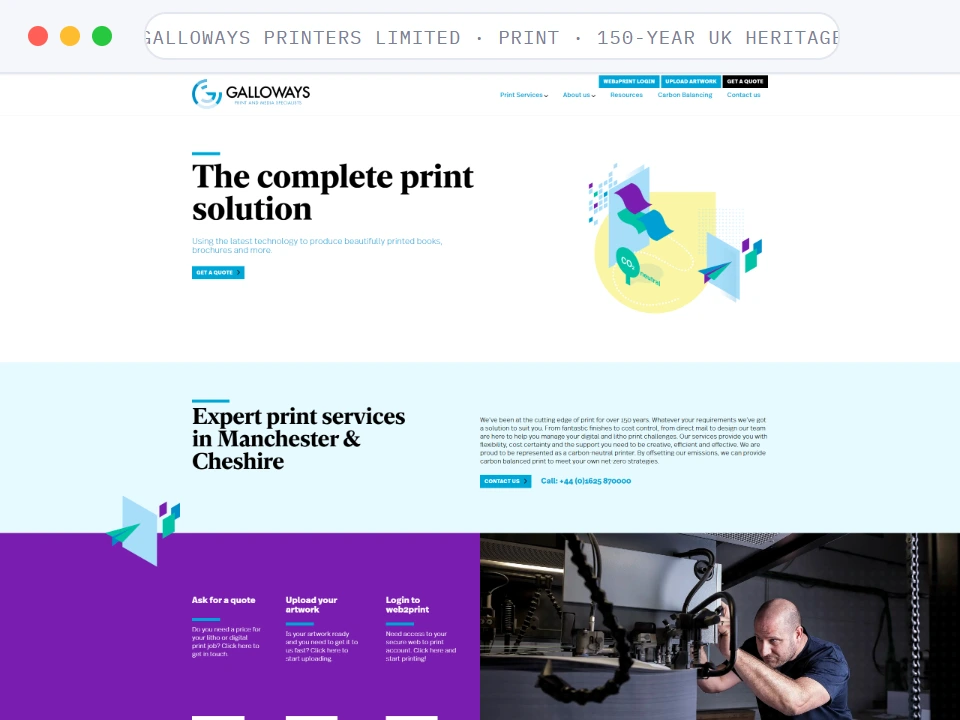
Homepage of Galloways Printers Limited, a Print · 150-Year UK Heritage business, shown in a browser window Published case study

Galloways Printers Limited

GALLOWAYSPRINTERS.CO.UK

Measured over 12 months
Print · 150-Year UK Heritage Digital Marketing · Content · SEO

Grew Galloways inquiries 34% with a sustainable rebrand for a 150-year-old printer.

Galloways Printers, a UK print provider with over 150 years in business, faced prospects who saw print as outdated and bad for the planet. We ran a Fall in Love with Print Again campaign with SEO content, LinkedIn and Instagram storytelling and a greener brand story. Inquiries grew 34% in 12 months, the site passed 11,000 unique visitors and social posts reached over 90,000 accounts.
90K+
Social impressions
+34%
Inquiries
11K
Unique users

Free manufacturing SEO audit of your part pages, written in 24 hours

3 FIXES FOR YOUR PART NUMBER PAGES · YOURS TO KEEP · No card needed. No sales call required.

Get my SEO audit →

Client words

Enterprise demo requests up 3.2x. First operator we have worked with who cared about the CRM number, not the ad account.
Michael Reid
VP Marketing, Forward Networks
Verified via Trustpilot 3.2x enterprise demos CRM-tied reporting
Forward Networks website homepage in a browser window, a move fast, break nothing hero for its network platform
1 / 10

See what a better organic conversion rate is worth

Move the sliders to your numbers. No ad spend in this one, it works from the organic traffic you already have.

3,000
200 50,000
$800
$100 $10,000
1.5%
0.5% 6%
What a 20% improvement on your current conversion rate adds, on today's traffic. Rankings are assumed flat, so nothing here depends on new traffic arriving.
Added revenue per month
/mo

Free · Written findings · Yours to keep

FAQ

Common manufacturing SEO questions

Straight answers on pricing, timelines, ThomasNet, part number ranking, and what actually gets done each month. If your question is not here, book the optional walkthrough call.

How much do SEO services typically cost?
Manufacturing SEO services at Redefine Web run $500 to $3,000+ per month, priced against the size of your part number library and the number of capability pages that need rewrites. Visibility is $500/mo for a single-plant OEM targeting one metro or one capability. Traffic is $750/mo and covers 2 new capability pages a quarter plus HTML spec pages replacing your priority PDFs. Scale is $1,250/mo for multi-plant operators or diversified contract manufacturers targeting national engineer-intent searches. Enterprise starts at $3,000/mo for fabricators running distributor SEO alongside OEM channels with a real Salesforce or HubSpot attribution build. Every tier includes a weekly report every Friday, tied to RFQs in your CRM. Traffic tier and above add weekly ranking dashboards and quarterly executive reviews with your procurement and sales leads. Ad spend, third-party crawl tools, and premium directory listings sit outside the retainer and are billed at cost. See Google Search Central docs for the technical standards our team benchmarks against.
How soon does manufacturing SEO rank part numbers and bring RFQs?
Manufacturing SEO shows first ranking gains in 8 to 12 weeks once HTML spec pages replace the PDFs Google was undervaluing. Part-number searches usually hit page one by month 4 as Product schema, internal linking, and depth-first capability content compound. Steady quote volume and organic RFQs land between month 6 and month 9. Recovery projects on sites carrying prior thin-content pages or aggressive backlink work from a previous agency take an extra 60 to 90 days because month one goes to backlink cleanup and thin-page pruning before net-new capability pages go live. The 90-day launch plan is fixed. Week 1 is the part-number and capability audit. Weeks 2 to 4 build the first HTML spec pages, at your tier’s page count, with schema validated in Google Rich Results Test. Weeks 5 to 8 build internal linking, and the resource hub from Traffic up. Weeks 9 to 12 wire CRM attribution and deliver the first weekly report tying rankings to RFQs.
Do manufacturers still need SEO if we already list on ThomasNet and Grainger?
Yes, and the ThomasNet listing is why the SEO matters more, not less. ThomasNet, Grainger, McMaster-Carr, and MSC Direct all outrank your own PDP for your own part numbers when you leave the direct search to them. Every RFQ that lands on ThomasNet is a lead your distributor captures first, and the distributor decides which supplier gets the quote. Real manufacturing SEO gets your PDP above the distributor listing so buyers hit you first, download your CAD, and quote through your form. The directory listings still matter for reach, but they should not own your part number rankings. SKU families get indexable HTML pages at your tier’s page count, with tolerance tables, application copy, and schema so Google treats your PDP as the authoritative source for the part number. Distributor pages then become a second referral path, not the only path. Buyers who search a specific part number land on you, and the RFQ fires on your form with attribution tagged to the source SKU family in HubSpot or Salesforce.
How do you rank product pages for specific part numbers?
We rank product pages for part numbers with a three-layer build: real HTML content, Product schema, and internal link authority. Priority SKU families get a 600 to 1,200 word HTML page, at your tier’s new-page count, with the part number in the H1, tolerance and material data in a structured table, a CAD or STEP download link inline, and Product schema wrapping the entire page. Internal links from category and resource pages point to the PDP with the part number as anchor text. Google reads it as the authoritative page for that exact SKU query. Where a part number is a common industry standard, we cross-reference the ASTM International spec or the ISO reference so Google connects the page to a recognized standards body. Every page validates against the current schema requirements before it goes live, and re-validates monthly as prices, MOQ, or lead time updates flow from your ERP. Buyers who search the exact SKU or a close variant land on your PDP, download the CAD, and fire an RFQ.
What schema markup do you add to manufacturing product pages?
We add Product, Offer, Organization, and BreadcrumbList schema across every commercial page, plus Service schema on capability pages and MerchantReturnPolicy where applicable. Product schema carries the part number, brand, material, and tolerance where structured data supports it. Offer schema handles price on request or MOQ ranges. Organization schema surfaces your ISO, AS9100, or IATF certifications as trust signals engineers scan before requesting a quote. Every schema validates in Google Rich Results Test before push live and re-validates monthly as pages update. Schema is not optional on a manufacturing site because it is how engineers surface your part numbers in Google Shopping tabs, knowledge panels, and AI overviews. See the official schema definitions on Google Search Central. Our team also audits your existing schema before any rebuild and fixes duplicate, malformed, or missing markup pulled from legacy templates. Every published page carries a schema hash you can verify against the deployment log.
How is B2B manufacturing SEO different from consumer SEO?
B2B manufacturing SEO ranks for part numbers, tolerances, materials, and capabilities engineers type when they source. Consumer SEO chases brand and category queries with high volume and lower intent. A single manufacturing keyword may only get 30 monthly searches, but three of them close a $180K purchase order, so the numbers that measure success are RFQs, spec downloads, and pipeline value, not sessions or bounce rate. Content depth is technical, not lifestyle. Buyers read alloy grades, tolerance ranges, and finishing options before they fire a quote request. Attribution runs on CRM stages, not ecommerce revenue events. Every RFQ ties back to a source SKU family and last-touch keyword in HubSpot or Salesforce so procurement teams see which pages drove pipeline. The two disciplines share the same technical foundation (Core Web Vitals, crawl budget, schema, internal linking) but almost nothing above it. A consumer SEO agency running a manufacturing site treats every page like a category blog post, and the RFQ pipeline dies.
Do you rewrite our spec sheets or work with our engineering team?
We rewrite the HTML spec pages ourselves and route every technical detail through your engineering team for sign-off. Our content team drafts the page shell, tolerance table, material chart, and application copy from your existing PDF and part datasheet. Your engineer reviews the tolerance ranges, material grades, and any certification references before push live. Every published page carries a reviewed-by credit tying the content to a real engineer on your team, which Google reads as expertise on YMYL and technical topics alike. On sites carrying ISO 9001 or AS9100 certifications, we surface the standards on the About and capability pages as trust signals procurement teams scan before shortlisting. The engineering review takes 20 to 40 minutes per page, and we batch pages into weekly review queues so your team never gets buried. If you have a technical writer on staff, we hand the page shell and data table over for expansion instead of writing net-new copy. The workflow stays flexible.
How do you attribute organic rankings to actual RFQs and quote requests?
We wire GA4 to HubSpot, Salesforce, or your CRM so every RFQ form submit fires with the source landing page, last-touch keyword, and SKU family the buyer searched. Every quote request tags with pipeline stage and value as your sales team qualifies it. The weekly report pulls those tags into a written recap tying rankings to real RFQs, not sessions. You know which SKU families drove pipeline, which capability pages closed deals, and where the next 90 days of content depth should go. The attribution build takes 3 to 5 business days and covers form fires, CAD download events, spec sheet downloads, and phone number clicks. On the HubSpot CRM, we tag deals with source SKU family and content cluster so procurement teams see which content earned the pipeline. On Salesforce we mirror the same tag structure using custom fields. Dynamics 365 gets a matching schema wired through the Data Loader. Every attribution stays live after the retainer ends because the fields sit inside your CRM, not ours.
What is SEO in manufacturing?
Manufacturing SEO is the discipline of ranking part numbers, capability pages, spec sheets, and technical resources for the searches engineers, buyers, and procurement teams type when they source parts. Industrial SEO is the same discipline for equipment makers, component suppliers, and contract fabricators, so SEO for industrial companies follows the same playbook. It merges technical SEO (Core Web Vitals, schema, internal linking, XML sitemaps) with depth-first content built for engineer intent, plus RFQ attribution wired into HubSpot, Salesforce, or Dynamics so every ranking gain traces to a real quote request. Consumer SEO chases high-volume brand queries. Manufacturing SEO chases low-volume high-intent queries like an exact SKU, a tolerance range, or a material grade in a specific application. Every winning manufacturing SEO program ships three things: indexable HTML replacing PDF spec sheets, Product and Offer schema wrapping every PDP, and a CRM tag structure tying organic rankings to pipeline value. Distributor pages like ThomasNet, Grainger, and McMaster-Carr are handled inside the strategy so your PDP outranks them for your own part numbers, and the directory listings become a second referral path, not the only path.
What are the 4 types of SEO?
The four types of SEO are technical SEO, on-page SEO, off-page SEO, and local SEO. Technical SEO covers site architecture, Core Web Vitals, crawl budget, XML sitemaps, canonical rules, and schema markup, and it is what earns Google the right to rank your pages at all. On-page SEO covers the H1, subheadings, body copy, image alt text, internal links, and structured data on the page itself. Off-page SEO covers editorial links from trade publications, association pages, and unlinked brand mentions converted to links. Local SEO covers Google Business Profile per plant location, NAP consistency across industrial directories, and reviews from real buyers. Traffic, Scale and Enterprise retainers at Redefine Web run all four in parallel, because ranking part numbers demands technical foundations and content depth working together. The Visibility tier at $500/mo covers technical, on-page, and local SEO for a single plant, and off-page starts on Traffic at $750/mo with 2 authority links a month, rising to 5 on Scale. Scale and Enterprise cover all four across multi-plant operators and multi-vertical fabricators.
Which is better, SEO or SEM?
For manufacturers, SEO and SEM answer different problems and the honest answer is you run both. SEM (paid search on Google Ads and Bing Ads) captures immediate intent on queries you have not yet earned organic ranking for, which matters when a plant is booking cash-flow work in month one. SEO compounds free organic impressions on part numbers, capability pages, and spec sheet searches that would cost you $8 to $22 per click on Google Ads. A brand-new manufacturing site with zero domain authority and immediate quote-volume needs should start with SEM because it books RFQs in week one. An established plant with steady RFQ volume and 6 months of runway should lead with SEO because it drops blended cost per RFQ by 40 to 60 percent inside 9 months versus SEM alone. Run both, and the compounding effect drops cost per booked quote further because SEM catches searches SEO cannot rank for in the first 6 months, and SEO frees SEM budget for high-value engineer-intent keywords.
What is the contract length, and who owns the pages if we cancel?
Visibility, Traffic and Scale run a 6-month minimum term and Enterprise runs 12 months. Leaving inside the minimum term means paying the remaining months of the term. After that, the retainer rolls month to month with 30 days notice. Every page we build, every schema block we write, every CRM tag structure we wire, and every dashboard we hand you belongs to you the day it goes live. Cancel at any point after the minimum term, and your HTML spec pages, capability rewrites, resource hub content, Product schema, internal linking, and the full attribution build stay in your CMS and CRM. There is no lockout, no export fee, no template license. The only thing that ends on cancel is our monthly work, weekly reporting, and access to our internal keyword and ranking tools. Your Google Business Profiles, Search Console properties, and CRM stay under your account admins from day one because we work as delegated users, never as the account owners. The minimum term exists because manufacturing SEO does not show its first ranking gains before week 8 and does not compound before month 6, and shorter contracts push both sides into vanity work.

Free · Written in 24 hours · No pitch

Get your free SEO audit.

A written report in your inbox within 24 hours, with three fixes you can ship the same week, whether or not you hire us.

Written in 24 hours · 10,000+ audits run · 300+ clients since 2021