In this article
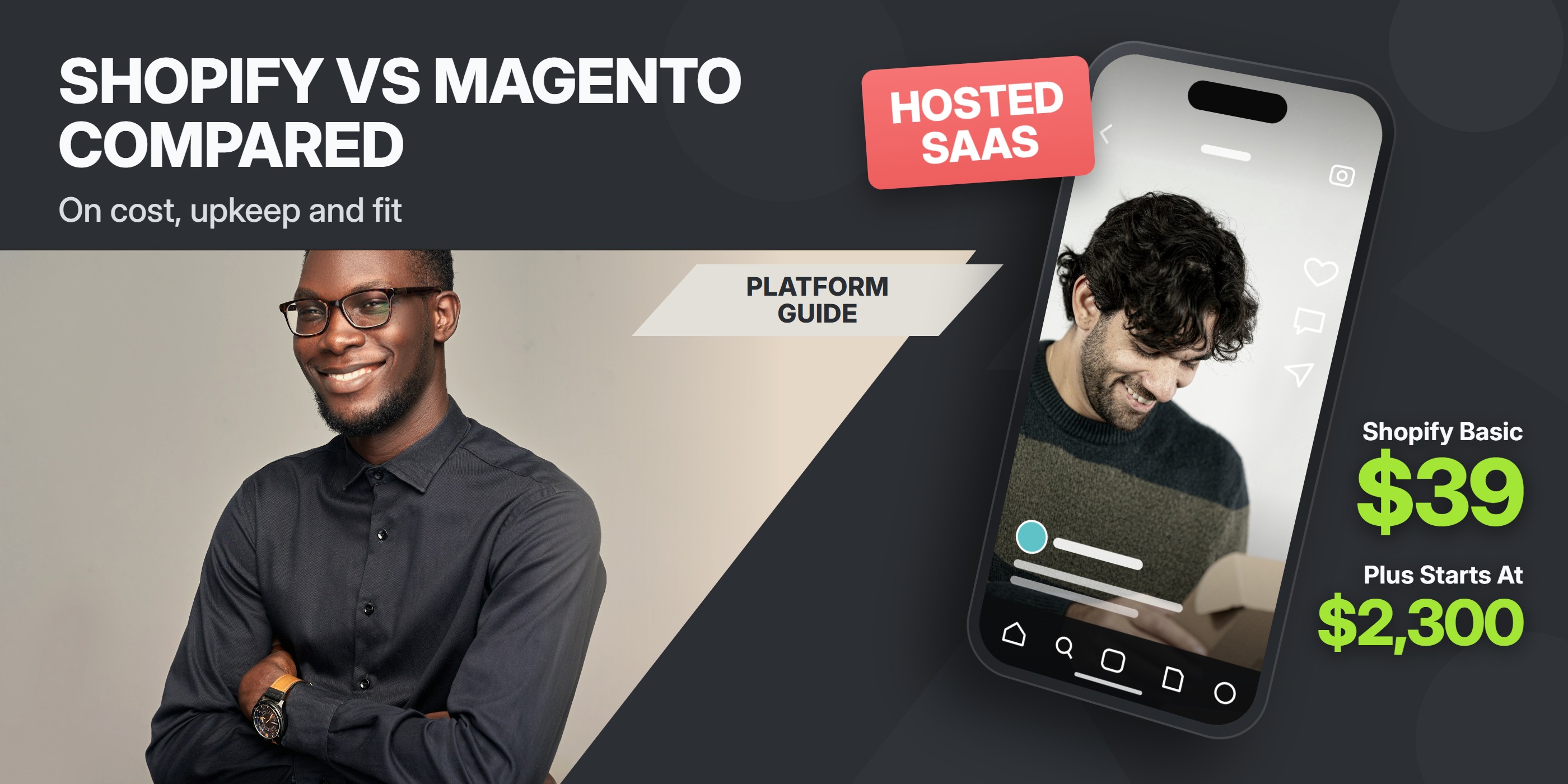
- Shopify's US plans cost $39, $105 or $399 a month, and Shopify Plus starts at $2,300 a month.
- Magento Open Source has no license fee, but you pay for hosting, extensions, developers and every upgrade yourself.
- Adobe Commerce is priced by quote, and Adobe's pricing page offers a request form instead of figures.
- Adobe's table shows 2.4.6 left standard support on August 11, 2026, and 2.4.7 leaves it on May 31, 2027.
- On Adobe Commerce on Cloud, Adobe issues the patches but applying them is your job, unlike on Shopify.
Shopify vs Magento comes down to who runs the software. Shopify is a hosted platform you pay for each month, and Shopify runs the servers, the security patches and the card compliance behind your checkout. Magento is software that you or Adobe run, either as free Magento Open Source on hosting you choose or as Adobe Commerce, which Adobe prices by quote.
We build Shopify stores and move stores off Magento onto Shopify, so we gain if you move. Read the verdict with that in mind. Every price, support date and responsibility below comes from Shopify’s and Adobe’s own pages, and Magento’s real strengths come before the verdict.
The choice is hard to undo, and each wrong turn costs you in a different way. Choose Magento without developers on hand and you inherit patches and version upgrades on a calendar Adobe sets. Choose Shopify for a wholesale operation built on negotiated quotes and approval chains, and you may end up rebuilding that logic with apps.
Shopify vs Magento side by side for a growing store
Magento isn’t one product anymore, so the table splits it in two. Magento Open Source is the free edition you host yourself. Adobe Commerce is the licensed edition, sold on Adobe’s cloud or for your own servers, and it now includes a software-as-a-service version Adobe calls Adobe Commerce as a Cloud Service. Shopify figures are its US prices in US dollars, and Shopify sets prices by country.
| What you’re comparing | Shopify | Magento Open Source | Adobe Commerce |
|---|---|---|---|
| How you get it | Monthly subscription, hosted by Shopify | Free download you install and host | Licensed by quote, on Adobe’s cloud, on your servers or as a cloud service |
| Published price | $39, $105 or $399 a month, Plus from $2,300 a month | No license fee | None published, pricing on request |
| Hosting | Included in every plan | You choose it and pay for it | Adobe runs it on its cloud options, you run it on premises |
| Updates | Shopify updates the platform for you | You apply patches and upgrades | You apply them on Cloud and on premises, automatic on Cloud Service |
| Add-ons | Apps from the Shopify App Store | PHP extensions from Magento Marketplace | PHP extensions and App Builder apps, App Builder only on Cloud Service |
| B2B | Built into every plan, up to 3 catalogs below Plus | Not a supported platform for Adobe’s B2B extension | B2B extension with company accounts, quotes and approvals |
| Card data compliance | Stores are PCI compliant by default | Yours to assess | Adobe certifies its cloud, you answer for your custom code |
Read the price row with the hosting and updates rows beside it. Shopify’s price covers most of what it takes to keep the platform running. Magento Open Source’s zero is only the license line, and the hosting, upgrade and security work arrive on other invoices. Adobe Commerce adds Adobe’s B2B extension, support and hosting options on the same release line, at a price you only learn by asking.
What is the Magento ecommerce platform today?
The Magento ecommerce platform began as open-source store software, and Adobe has owned it since the acquisition closed on June 19, 2018. Adobe now sells the paid edition as Adobe Commerce and keeps a free edition, which its Magento Open Source page calls “A free eCommerce platform” for small businesses, though you still pay to host and maintain it.
Adobe’s documentation lists three ways to run Adobe Commerce. Adobe Commerce as a Cloud Service is software as a service on multi-tenant infrastructure. Adobe Commerce on Cloud is a platform-as-a-service setup on single-tenant infrastructure that Adobe manages. Adobe Commerce on premises runs on servers you provide. Magento Open Source follows the same version numbers, and Adobe publishes release notes for Magento Open Source 2.4.9 alongside the Adobe Commerce ones.
The Cloud Service is the version that behaves most like Shopify. Adobe’s lifecycle page says that on it, “Adobe manages all infrastructure, patching, and upgrades automatically.” It isn’t a drop-in home for an older Magento store, though. It doesn’t support Luma storefronts, so a store built on Luma needs a new front end, and it only accepts extensions that run outside the core application.
So when a comparison says “Magento”, ask which one it means. The rest of this piece treats Magento Open Source and Adobe Commerce on Cloud or on premises as classic Magento, and calls out the Cloud Service where it works differently.
What does each platform cost to own?
Shopify publishes its prices. On monthly billing its US plans cost $39 for Basic, $105 for Grow and $399 for Advanced. Every plan costs less a month when you pay for a year. Shopify Plus starts at $2,300 a month.
Don’t plan around Shopify’s $5 Starter plan, which is closed to new merchants. Ecommercetrix reported on August 15, 2026 that new stores can’t choose it, and Shopify’s help center says the plan “isn’t available to new stores.” Basic is now the entry point for a full Shopify store.
Two costs sit outside the plan price. If you use a payment provider other than Shopify Payments, Shopify adds a third-party transaction fee of 2% on Basic, 1% on Grow, 0.6% on Advanced and 0.2% on Plus. Apps bill on their own terms too. Shopify’s help center lists four types of app charges and notes that some third-party apps charge you directly, outside your Shopify bill.
Magento Open Source has no license fee, and that’s a real advantage. You still pay for hosting sized to your traffic, for extensions from Magento Marketplace, where Adobe says “thousands of third-party extensions and templates are readily available,” and for PHP developers to build, patch and upgrade the store. None of those has a list price, so your total depends on your catalog, your traffic and how much custom code you carry.
Adobe Commerce doesn’t publish a price at all. Its pricing page lists each package with a “Get pricing” button and closes with a form to “Get customized pricing for Adobe Commerce.” Any Adobe figure you see on a comparison site is that site’s estimate, not Adobe’s quote, so get a written quote before you set it beside Shopify’s plans.
Who handles hosting, patches and upgrades?
On Shopify, hosting comes with the plan. Shopify’s pricing page says it “includes secure commerce hosting with your Shopify plan, so you don’t need to buy separate hosting,” along with unlimited bandwidth and a free TLS/SSL certificate for your domains. There’s no server for you to size and no release for you to install.
Magento Open Source puts the whole stack on your side. Your host or your team runs PHP, the database, search, caching, a message queue and the web server. Adobe’s lifecycle page says “You are responsible for maintaining all third-party dependencies and platform services on versions that are actively supported.” When PHP or your search engine reaches end of life, the upgrade project is yours.
Adobe Commerce on Cloud splits the work. Adobe runs the infrastructure, including the Fastly CDN, applies server-level patches and issues updates for the core code. Its shared responsibility model adds the note “(applying patches is the merchant’s responsibility).” Adobe’s feature comparison puts the pace at “Six patch releases and one minor release per year,” each applied through a manual upgrade.
The Cloud Service turns that around. Adobe upgrades it automatically through what it calls “a versionless SaaS model,” and gives you 30 days to test each release in a sandbox before it reaches your live store. That’s the closest Adobe gets to Shopify’s model, and the price is the in-process PHP customization that classic Magento allows.
How long does Adobe support each Magento version?
Adobe gives each Adobe Commerce release three years of standard support from its general availability date, covering quality fixes and security patches. It also offers one extra year of extended support “at no additional cost for Adobe Commerce customers on versions 2.4.6 and 2.4.7.” Here are the dates from Adobe’s lifecycle page.
| Release | General availability | End of standard support | End of extended support |
|---|---|---|---|
| 2.4.9 | May 12, 2026 | May 31, 2029 | Not yet set |
| 2.4.8 | April 8, 2025 | May 31, 2028 | Not yet set |
| 2.4.7 | April 9, 2024 | May 31, 2027 | May 31, 2028 |
| 2.4.6 | March 14, 2023 | August 11, 2026 | August 31, 2027 |
| 2.4.5 | August 9, 2022 | August 12, 2025 | August 11, 2026 |
| 2.4.4 | April 12, 2022 | April 12, 2025 | April 14, 2026 |
If you’re on 2.4.4 or 2.4.5, extended support is over. Adobe gives those versions and 2.4.6 a one-time, security-only transitional period with “limited isolated security fixes only (no quality fixes),” and tells you to “Treat the security-only period as migration time, not as a long-term support tier.” On Adobe Commerce on Cloud, Adobe’s table also sets a version upgrade enforcement date of June 1, 2027 for 2.4.4 and 2.4.5.
PHP sets its own deadline. Adobe lists PHP 8.1 as reaching end of life on December 31, 2025 and PHP 8.2 on December 31, 2026, and warns that running past those dates puts PCI compliance at risk. The page frames the extra support year as a benefit for Adobe Commerce customers, so if you run Magento Open Source, confirm what your version still receives before you count on it. Shopify has no version for you to track, because every store runs on the platform Shopify operates.
Which platform has the better extensions and apps?
Both ecosystems are large, and they work in different ways. Shopify’s pricing page says you can “Integrate with 1000s of apps,” and those apps plug into your store rather than into Shopify’s own code, which you can’t edit. Magento Marketplace sells PHP extensions that install into the application itself.
That in-process model is Magento’s biggest strength and its biggest upkeep cost. An extension can change almost any behavior because it runs inside the core application, which Adobe’s feature comparison calls “In-process (PHP customization)”. It also means every patch and upgrade has to be tested against every extension, and Adobe’s shared responsibility model makes applying security and other patches to all custom extensions and code your job.
Adobe is moving away from that model. Its feature comparison marks out-of-process extensions built on APIs, events and App Builder as the recommended route on Cloud and on premises, and the Cloud Service accepts nothing else. On Shopify, the comparable path to a fully custom front end on top of Shopify’s checkout and catalog is headless Shopify builds.
Before you price a move in either direction, list every extension your store runs and sort each one into three groups. Some have a direct app equivalent, some need a custom app, and some you can drop. That list drives a migration budget more than the platform fee does.
Which handles B2B and wholesale buying better?
Shopify narrowed this gap in 2026. On April 2, 2026 it extended its foundational B2B features to Basic, Grow and Advanced “at no extra cost,” including company profiles, “up to three custom catalogs with tailored pricing,” quantity rules, volume discounts, saved cards and payment terms. Plus keeps unlimited catalogs, direct catalog assignment to companies and locations, partial payments and deposits, and up to 9 free expansion stores.
Adobe Commerce goes further for complex buyers. Its B2B extension adds company accounts with divisions, roles and permissions, company hierarchies for parent and subsidiary firms, shared catalogs that set custom prices per product for different companies, negotiable quotes, purchase order approval rules and requisition lists. Adobe’s product page says its catalog service handles “millions of SKUs, thousands of prices per SKU, and rapid price updates.”
For several storefronts, Magento runs websites, stores and store views from one installation, and Adobe says each website can have its own domain while all stores under one website share the Admin and checkout. Our guide to how multi-storefront setups compare covers that model against Shopify’s expansion stores, and our look at how the B2B platforms compare goes deeper on wholesale features. The short version is that Shopify fits standard wholesale with catalogs and payment terms, and Adobe Commerce fits negotiated, approval-heavy buying.
Who is responsible for performance and security?
On Shopify, card security is largely handled for you. Shopify’s pricing page says it “is certified Level 1 PCI DSS compliant, and stores powered by Shopify are PCI compliant by default.” Your part is your staff logins, your apps and your theme. Speed works the same way, since Shopify runs the infrastructure while your theme and apps decide how heavy each page is.
On Magento, you own far more. Adobe’s lifecycle page states that “PCI compliance is the merchant’s responsibility to assess.” On Adobe Commerce on Cloud, Adobe “maintains PCI certification for the infrastructure and services,” and leaves the compliance of your custom code, systems, network processes and organization to you. Adobe also sends hotfixes for zero-day vulnerabilities to customers on supported versions, which is one more reason not to fall behind.
Performance follows the same split. Adobe Commerce on Cloud includes horizontal auto-scaling for its scaled architecture and lists 99.99% infrastructure and 99.9% application availability under Managed Services, while the Cloud Service lists 99.9% for both. Running performance tests on your customized store and writing custom Varnish cache rules stay on your list. On Magento Open Source, speed depends entirely on the hosting and caching you buy.
How does SEO differ between Shopify and Magento?
Shopify handles the technical basics. Its help center says your “sitemap.xml and robots.txt files are automatically generated,” that canonical tags are added automatically, and that you can edit title tags, meta descriptions and URLs. The trade-off is structure. Products and collections sit under fixed /products and /collections paths, and Shopify won’t let you redirect URLs that use those paths.
Magento hands you more control and more settings to manage. On Adobe Commerce on Cloud and on premises, Adobe’s SEO overview says “The URL Rewrite tool lets you change any URL that is associated with a product, category, or CMS page.” The sitemap “can be configured to index all pages and images,” and you can write your own robots.txt instructions in the admin. That freedom lets you keep an existing URL structure through a redesign, but someone has to set it up and keep it right. Adobe points Cloud Service stores to separate SEO guidelines for its Commerce Storefront, so check how your URLs carry over before any move.
Neither platform ranks a store on its own. Your content, internal links and product data do most of that work on both. Our comparison of the best ecommerce platform for SEO goes through what each platform handles and what it leaves to you.
How does Magento vs BigCommerce compare?
If BigCommerce is on your shortlist too, the Magento vs BigCommerce trade is the same one you make with Shopify. BigCommerce hosts and updates the software, and you give up the in-process code access Magento allows. Its US plans cost $39, $105 and $399 a month for Core, Growth and Scale, or $29, $79 and $299 billed annually, and Performance starts at $1,499 a month billed annually.
Two BigCommerce details matter for a Magento store. Its Open Payment Provider Fee charges 2.0% on Core, 1.0% on Growth and 0.6% on Scale when you use a payment provider outside its list. And it sells a B2B Edition with corporate accounts, quotes, invoices and buyer approval workflows, with separate storefronts managed from one control panel. BigCommerce openly courts Magento stores, inviting merchants to “Switch from Shopify, Woocommerce, Salesforce, Magento, and more.”
If you’ve narrowed it to the two hosted options, our BigCommerce vs Shopify comparison sets them against each other, and our BigCommerce review covers the platform on its own terms.
What does moving between Shopify and Magento involve?
Moving from Magento to Shopify is a data, URL and features project. Your catalog, customers and order history have to be mapped from Magento’s structure to Shopify’s and imported. Your URLs change, because Shopify product pages live under /products, so you need a redirect map, and Shopify allows up to 100,000 redirects, or 20,000,000 on Plus. Each extension becomes an app, a custom build or something you retire. Plan the B2B side on its own, because Adobe’s shared catalogs, negotiable quotes and approval rules don’t map one to one onto Shopify’s catalogs and payment terms.
Going the other way means taking on hosting, patching and an upgrade calendar, so it makes sense only when B2B or customization needs outweigh that work. Staying with Adobe isn’t a standstill either. Adobe names the Cloud Service as its recommended long-term destination for Adobe Commerce on Cloud customers, and that move needs a new storefront if yours runs on Luma. Our Magento to Shopify migration guide walks through the steps, the redirect map and the checks before launch.
Who should choose Shopify, and who should stay on Magento?
We sell Shopify builds and migrations off Magento, so weigh this verdict with that in mind. Choose Shopify if you sell direct to consumers or run standard wholesale with catalogs and payment terms, and you’d rather pay a known monthly fee than keep developers on call for patches. It suits a team that wants to spend its time on products and marketing instead of servers.
Stay on Magento, or choose it, if your business depends on what it does better. You can change almost any behavior in code, customize the data model completely on Adobe Commerce on Cloud and on premises, host where you choose, and run negotiable quotes, purchase approvals and company hierarchies through Adobe’s B2B extension. Magento Open Source gives a capable team the same code-level control with no license fee, though you pay for its hosting and upkeep and don’t get Adobe’s B2B extension. Those are real advantages, and Shopify doesn’t let you edit its core code at all.
The clearest case for moving is a Magento store on a version near its end date with no complex B2B to carry over. If you’re a smaller store still choosing a first platform, Magento is rarely the place to start, and our Shopify vs Wix comparison or the full list of Shopify pros and cons is a better first read.
What we would check first before you decide
Start with your Magento version and its end-of-support date in Adobe’s table, because that sets your deadline whichever platform you pick. Then list every extension and custom module, and mark each one as must keep, replaceable or droppable.
Next, price three years on both sides of the Shopify vs Magento decision. For Shopify that’s the plan, the apps and any transaction fees. For Magento it’s hosting, extension renewals, developer hours and at least one minor upgrade a year. Ask Adobe for a written quote for the Cloud Service as well, since it’s Adobe’s own answer to the upgrade burden and the fairest Adobe option to set beside Shopify.
Then make the call on two facts. If your version’s deadline is more than a year away and most of your extensions are must keep, upgrading in place is usually the cheaper next step. If the deadline is close and most extensions are replaceable, that’s when a platform change tends to pay for itself.
If the numbers point to Shopify, plan the redirect map and the extension replacements before you pick a launch date. When you’re ready to scope that move, our Shopify migration services team can plan it with you.
Frequently asked questions
Which is better, Magento or Shopify?
Shopify is better for most direct-to-consumer stores and standard wholesale, because hosting, patches and card compliance come with the plan. Magento is better when you need code-level customization, Adobe's own negotiable quotes and purchase approvals, or your own hosting, and you have developers to run upgrades. We build on Shopify, so weigh that, and check your Magento version's end-of-support date before you decide.
Is Magento free or paid?
Both, depending on the edition. Magento Open Source is free, and Adobe's own page calls it "A free eCommerce platform," though you still pay for hosting, extensions and developers. Adobe Commerce is the paid edition. Adobe prices it by quote, and its pricing page shows a "Get pricing" button for each package instead of a figure, including Adobe Commerce as a Cloud Service.
Is Magento the same as Shopify?
No. Shopify is a hosted platform you subscribe to, and Shopify runs the hosting, updates and card compliance. Magento is software you or Adobe run, either as free Magento Open Source on hosting you choose or as Adobe Commerce, which Adobe prices by quote. Both run full online stores, but on Magento the code, the extensions and most of the upkeep are yours, while Shopify keeps its core code closed.
What are the disadvantages of Magento?
The main disadvantages are upkeep and unclear cost. You or your host run the servers and dependencies, and you apply patches and upgrades, which Adobe plans as six patch releases and one minor release a year on Cloud and on premises. Extensions run inside the application, so each upgrade needs testing against them. Adobe Commerce has no published price, and PCI compliance is yours to assess.
What are the key differences between Magento and Shopify Plus?
Shopify Plus is a hosted subscription that starts at $2,300 a month, while Magento is software you or Adobe run, with Adobe Commerce priced by quote. Plus keeps Shopify's closed core and adds unlimited B2B catalogs, partial payments, deposits and up to 9 free expansion stores. Adobe Commerce gives you code-level control, negotiable quotes and purchase approvals, along with the patching and upgrade work that come with it.
Why did Adobe buy Magento?
Adobe bought Magento to add commerce to Adobe Experience Cloud. When the deal closed on June 19, 2018, Adobe wrote that "Integrating commerce into Adobe Experience Cloud enables Adobe to make every moment personal and every experience shoppable." It said Magento brought digital commerce, order management and predictive intelligence, plus a community it put at more than 300,000 developers.
What is a Magento site?
A Magento site is an online store running on Magento Open Source or Adobe Commerce. Adobe says every installation has a hierarchy of websites, stores and store views, so one installation can run several websites, each with its own domain, and store views for different languages and currency symbols. Unlike a Shopify store, it runs on hosting you or Adobe provide, and you control its code.
Is Magento a CMS platform?
Magento is an ecommerce platform first, with content management built in. Adobe's feature comparison lists a content management system, Page Builder and URL rewrites on Adobe Commerce on Cloud and on premises, while Adobe Commerce as a Cloud Service replaces them with Storefront Builder and document-based authoring. If content is your site's main job, test those tools against your editorial workflow before you commit.