In this article
- BigCommerce and Shopify list the same $39, $105 and $399 monthly plans, so the fee rules decide your real cost.
- BigCommerce caps sales at $30,000 on Core and $100,000 on Growth in trailing GMV, while Shopify's standard plans have no cap.
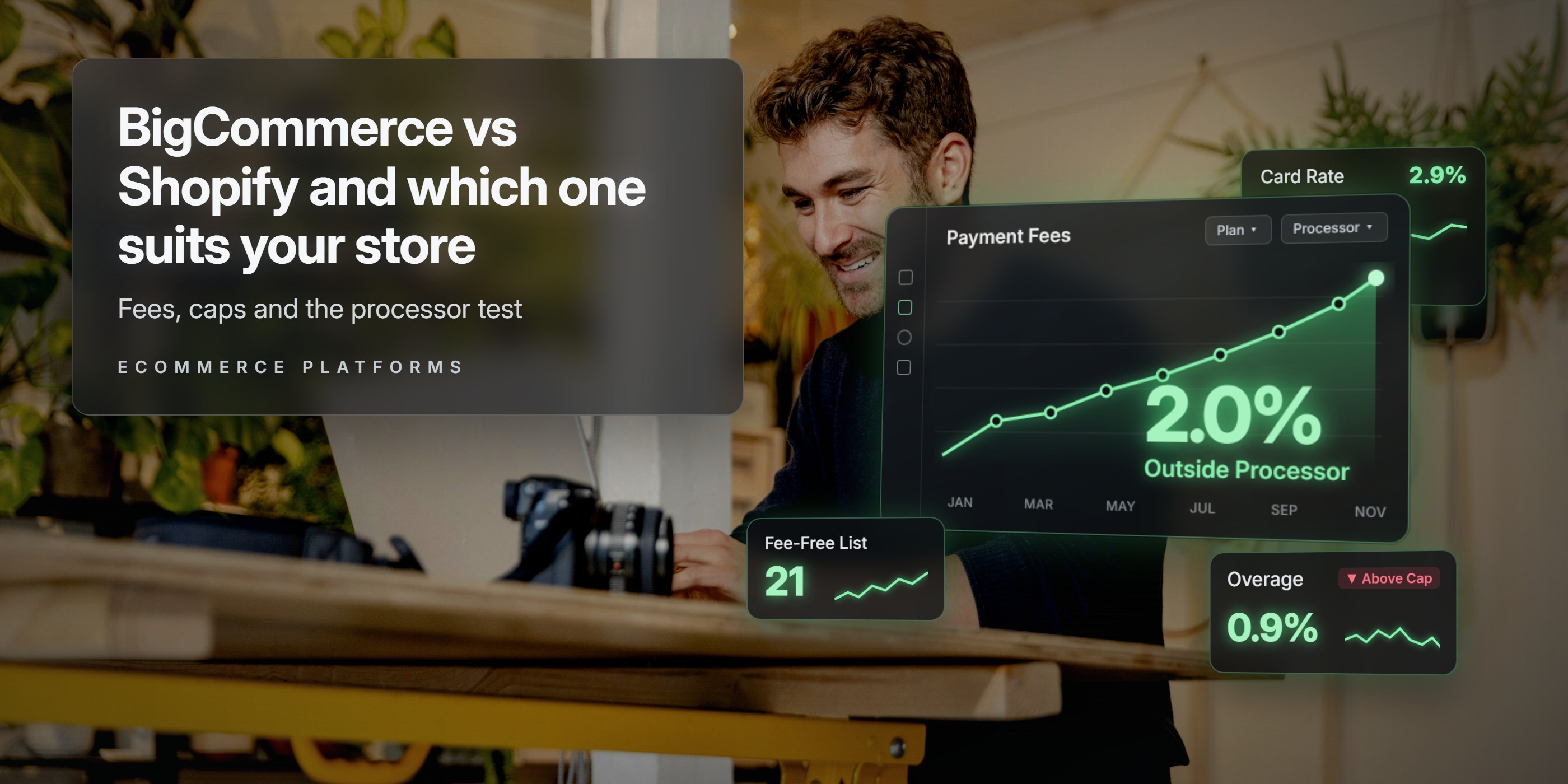
- Both add 2%, 1% or 0.6% for outside processors, but BigCommerce waives it for 21 providers and Shopify for Shopify Payments.
- At $6,000 a month in our example, Shopify costs $64.65 less, but keep an outside processor and BigCommerce wins by $54.
- Shopify now includes B2B on every plan, while BigCommerce reserves price lists for Performance and publishes no B2B Edition price.
BigCommerce vs Shopify is closer than it looks on price, since both list their three main plans at $39, $105 and $399 a month. The real split is in the rules. BigCommerce caps your sales on each self-serve plan but charges no platform fee on a list of 21 payment providers, while Shopify has no sales caps but charges a fee when you use a payment provider other than Shopify Payments.
Get that rule wrong and the platform that looks cheaper can cost you hundreds or thousands of dollars a year more, because fees grow with your sales while plan prices stay put. Switching later means new URLs, redirects and a rebuilt theme, so the choice tends to stick. We build stores on Shopify, Shopify Plus and BigCommerce, so we’re paid to build on either, and this article closes with a link to our BigCommerce service.
How do BigCommerce and Shopify plans compare on price?
On the monthly price, the two platforms match tier for tier. Shopify’s Basic, Grow and Advanced plans cost $39, $105 and $399 a month, and BigCommerce’s Core, Growth and Scale plans cost the same. Both charge less if you pay for a year up front. BigCommerce’s annual rates are $29, $79 and $299 a month, a 25% saving it prints on every self-serve plan. Shopify’s yearly billing costs less too, with Basic at $29 a month.
| Tier | Shopify | BigCommerce |
|---|---|---|
| Entry | Basic, $39 a month ($29 billed yearly) | Core, $39 a month ($29 billed annually) |
| Middle | Grow, $105 a month | Growth, $105 a month ($79 billed annually) |
| Upper | Advanced, $399 a month | Scale, $399 a month ($299 billed annually) |
| Enterprise | Plus, from $2,300 a month | Performance, from $1,499 a month billed annually |
| Free trial | 3 days, then $1 a month for 3 months | 15 days, no credit card |
| Support | 24/7 live chat, enhanced on Advanced, priority on Plus | 24/7 chat and email, phone included from Growth up |
Above the three main tiers, the two part ways. Shopify Plus starts at $2,300 a month, while BigCommerce’s Performance plan starts at $1,499 a month, billed annually, with custom pricing on top. The trials differ more than the prices. Shopify’s pricing page offers 3 days free and then $1 a month for 3 months, and BigCommerce offers a 15-day trial with no credit card. Shopify’s $5 Starter plan, once the cheapest way in, is closed to new stores, according to Shopify’s help center.
Older BigCommerce vs Shopify reviews may still show Standard, Plus and Pro, the plan names BigCommerce retired on June 1, 2026, when they became Core, Growth and Scale. Check the plan names before you trust any figure in a review.
Which platform takes more of each payment?
Both platforms now charge the same percentages for using an outside processor, 2% on the entry plan, 1% on the middle plan and 0.6% on the upper plan. The difference is which processors count as outside.
On Shopify, the fee applies when you use a third-party payment provider instead of Shopify Payments, and Plus cuts it to 0.2%. With Shopify Payments, online card rates are 2.9% + 30¢ on Basic, 2.7% + 30¢ on Grow and 2.5% + 30¢ on Advanced. Premium cards cost more, and international cards add 1%.
On BigCommerce, the open payment provider fee runs 2.0% on Core, 1.0% on Growth and 0.6% on Scale, and it applies only to providers outside its embedded list of 21. That list includes Stripe, Adyen, PayPal Braintree, Checkout.com, Worldpay, Klarna and Afterpay. Orders through those carry a $0 fee on every plan, and Performance stores pay 0.0% under contract. BigCommerce bills the fee monthly as its own line on your invoice, separate from whatever your processor charges. For card processing itself, BigCommerce quotes PayPal Braintree from 2.89% + 29¢ per transaction.
So the useful question isn’t which platform has transaction fees. It’s whether the processor you want is fee-free on that platform. If you’re happy with Shopify Payments, Shopify’s fee never comes up. If you need to keep an existing Stripe or Adyen contract, BigCommerce lets you do it without a platform fee. Every other charge on the Shopify side is in the full list of Shopify fees.
Does either platform cap your sales?
BigCommerce does and Shopify doesn’t. Every BigCommerce self-serve plan is tied to your trailing 12-month GMV, which BigCommerce defines as gross order value minus 10%. Eligible sales include product prices net of discounts, plus tax and shipping. When you cross a ceiling, BigCommerce notifies you and moves you up automatically.
- Core covers up to $30,000 in trailing 12-month GMV, then upgrades to Growth.
- Growth covers up to $100,000, then upgrades to Scale.
- Scale covers $33,333 a month and charges 0.9% on GMV above that each month.
- Performance takes over automatically once trailing 12-month GMV reaches $2 million.
Because of the 10% reduction, your order totals can run a little past each cap. A store taking $6,000 a month in orders, $72,000 a year, has $64,800 in GMV, which is past Core’s $30,000 and lands on Growth at $105 a month. Our breakdown of how BigCommerce bills each plan covers each cap and add-on in detail.
Shopify’s pricing page sets no sales limit on Basic, Grow or Advanced, so the same store can stay on Basic at $39. The nearest Shopify equivalent is on Plus, where Shopify’s help center warns that a variable platform fee tied to revenue might apply to the more complex, higher-volume stores. Below Plus, moving up a Shopify plan is your call, usually made when a higher plan’s lower card rate pays for its price.
What does one store pay each month at three sales levels?
Plan prices tell you little until you add processing, which is the biggest cost for most stores. The table below follows one store’s monthly bill at three sales levels, one under $30,000 a year, one between $30,000 and $100,000, and one well over $100,000, and lets each platform’s own rules pick the plan. It’s our arithmetic, and it assumes steady monthly sales, order totals that include tax and shipping, monthly billing on both platforms, US cards at each platform’s standard rate, a free theme and no paid apps. On Shopify that means Shopify Payments, and on BigCommerce it means PayPal Braintree at the 2.89% + 29¢ BigCommerce quotes.
| Monthly orders | BigCommerce, plan and monthly bill | Shopify, plan and monthly bill | Gap each month |
|---|---|---|---|
| $1,500, 25 orders of $60 ($18,000 a year) | Core, $89.60 | Basic, $90.00 | About even |
| $6,000, 75 orders of $80 ($72,000 a year) | Growth, $300.15 | Basic, $235.50 | Shopify $64.65 less |
| $75,000, 750 orders of $100 ($900,000 a year) | Scale, $3,091.50 | Grow, $2,355.00 | Shopify $736.50 less |
At $1,500 a month the two land within 40 cents of each other. At $6,000 a month, BigCommerce counts $64,800 a year in GMV, past Core’s $30,000 cap, so the store pays for Growth, while Shopify lets it stay on Basic. At $75,000 a month, BigCommerce puts the store on Scale, and $67,500 in monthly GMV sits $34,167 over the $33,333 line, adding $307.50 in overage. On Shopify, Grow is the cheapest plan at that size, because Advanced’s lower card rate saves $150 a month but costs $294 more in plan fees.
What if you keep your own payment processor?
Now change one thing. Say you keep a third-party card processor that Shopify treats as outside and BigCommerce has on its embedded list. Processing then costs the same on both platforms, so only the plan and the platform fees differ, and that single assumption can reverse a BigCommerce vs Shopify decision.
| Monthly orders | BigCommerce, plan and fees | Shopify, cheapest plan and fees |
|---|---|---|
| $1,500 | Core, $39 | Basic, $69 ($39 plus the 2% fee) |
| $6,000 | Growth, $105 | Basic, $159 ($39 plus $120 in fees) |
| $75,000 | Scale, $706.50 ($399 plus $307.50 in overage) | Advanced, $849 ($399 plus $450 in fees) |
BigCommerce now costs less at every level, by $30, $54 and $142.50 a month. Shopify’s cheapest plan changes too. At $75,000 a month, Grow would cost $855 with its 1% fee, so Advanced’s 0.6% rate makes it the better buy for that store, the reverse of the Shopify Payments case.
Which case you’re in comes down to one check before you sign. Find your processor on BigCommerce’s embedded list of 21, then decide whether you’d move to Shopify Payments or keep the processor you have.
How do themes, apps and built-in features compare?
Shopify has the bigger ecosystem, and BigCommerce puts more into the base plan. In its August 2026 comparison, Style Factory counted 24 free and 1,197 paid Shopify themes, priced from $100 to $500, against 12 free and 219 paid BigCommerce themes at $99 to $420. The app gap is wider still. BigCommerce advertises over 1,200 apps, while Shopify’s own comparison with Wix puts its app store at more than 8,000.
BigCommerce answers with features you’d otherwise buy. Its pricing page lists more than 70 discount options built in, real-time shipping quotes from carriers such as UPS, USPS and FedEx on every plan, and payments in more than 100 currencies. Shopify’s calculated third-party shipping rates aren’t on Basic, cost extra on Grow and are included from Advanced up.
The gating runs both ways, though. Shopify includes abandoned checkout recovery on Basic, while BigCommerce’s abandoned cart saver starts on Growth and its product filtering on Scale. Catalog limits also flipped. In October 2025 Shopify raised its limit to 2,048 variants per product, up from 100, while BigCommerce’s own comparison page lists up to 600 variant SKUs per product. Shopify’s help center still caps each product at three options, such as size, color and style. If you’re weighing more than these two, the wider platform comparison puts the other main options on the same terms.
Is BigCommerce or Shopify better for SEO?
Neither platform will rank a store on its own, and both handle the basics for you. Shopify adds canonical tags automatically and generates your sitemap.xml and robots.txt files, and you can edit the title, meta description and URL of each product, collection, page and blog post. BigCommerce includes a built-in blog on every plan. The real differences sit in how much control you get over URLs and crawling.
Shopify’s URLs follow fixed paths. Products live under /products and collections under /collections, and Shopify’s help center notes that you can’t redirect URLs that use those fixed paths. You can change the part of each address after the folder, but not the folder itself. Editing robots.txt means adding a robots.txt.liquid template to your theme, which Shopify calls an unsupported customization that its support team can’t help with. Stores below Plus can hold up to 100,000 URL redirects, and Plus stores up to 20,000,000.
BigCommerce lists customizable URLs and redirects among its built-in SEO features, and Style Factory’s review notes that it doesn’t insert those prefixes, so a product URL can follow your domain directly. The same review gives Shopify the edge on redirects when you change a URL, since Shopify creates one for you on any page type, while BigCommerce does it automatically for products and posts but not for static pages.
For most stores this is a tie. Fixed paths don’t stop a Shopify store from ranking, and short URLs won’t rescue a BigCommerce store with thin product pages. The URL rules matter most on the day you move platforms with years of rankings tied to the old addresses.
Which platform handles B2B and wholesale better?
Shopify closed most of the gap in 2026. On April 2, Shopify opened its foundational B2B features to stores on Basic, Grow and Advanced without an added charge, including company profiles for wholesale buyers, up to three custom catalogs, volume pricing and quantity rules, vaulted cards and payment terms. Plus still adds unlimited catalogs, catalogs assigned directly to a company or location, and deposits and partial payments. Contextual B2B checkout through Shopify Markets needs Advanced or Plus.
BigCommerce splits B2B across its plans and a separate B2B Edition. Customer groups for segmented pricing start on Growth, while price lists, its custom pricing at the SKU level for customer groups, appear only on Performance. B2B Edition adds account pricing, buyer portals, quote workflows and approval controls, purchase orders and net terms set per account, ordering on behalf of a buyer, and a configure-price-quote tool. BigCommerce’s pricing page publishes no B2B Edition price.
If you sell to a handful of wholesale accounts on two or three price tiers, Shopify’s standard plans now cover it. If you run quotes, parent and subsidiary company accounts and approval chains, BigCommerce’s B2B Edition or Shopify Plus is the realistic floor, and neither is priced like the standard plans. Our guide to how the B2B platforms compare sets both next to Salesforce and Adobe.
Which is easier to scale across stores, markets and locations?
BigCommerce lets you run several storefronts from one account long before the enterprise tier. You can add a storefront for $30 a month on Core, up to 3, for $50 on Growth, up to 5, and for $100 on Scale, up to 8, each with its own brand, region or customer segment. Shopify keeps extra stores for Plus, which includes up to 9 free expansion stores. Below Plus, Shopify’s route abroad is Shopify Markets, included on every plan, with translated storefronts, local domains and, if you use Shopify Payments, prices in local currencies.
- Inventory locations. Shopify allows 10 on Basic, Grow and Advanced and 200 on Plus. BigCommerce allows 4, 5 and 8, with a custom number on Performance.
- Staff accounts. Shopify’s Basic plan includes no additional staff accounts, Grow includes 5 and Advanced 15. BigCommerce lists staff accounts on every plan.
- Marketplaces. BigCommerce connects Amazon, eBay and Walmart on every plan. Shopify syncs 50 marketplace orders a month free, then charges 1% up to $99 a month.
- In-person sales. Shopify’s POS Pro costs $89 a month per location. BigCommerce connects to outside POS systems such as Square and Clover.
If you plan to run several brands from one back office without signing an enterprise contract, BigCommerce’s storefront pricing is the clearer path. If you plan one brand selling into several countries, Shopify Markets does it without a second store.
Shopify Plus vs BigCommerce for large stores
At the top end, BigCommerce’s Performance plan starts lower than Shopify Plus. Performance is custom-priced from $1,499 a month, billed annually, which is $17,988 a year at the floor. Shopify’s help center lists Plus at $2,500 a month on a 1-year term and $2,300 on a 3-year term, or $30,000 and $27,600 a year, before any variable platform fee for complex, high-volume businesses. Treat both as starting points, because both vendors price large accounts through a sales conversation.
What the money buys differs. Plus adds unlimited B2B catalogs, full checkout customization, up to 9 expansion stores, 200 inventory locations, 25 headless storefronts and up to 500% higher API call limits. Its online card rates start at 2.25% + 30¢, and its third-party fee drops to 0.2%. Performance adds price lists, advanced promotions management, a dedicated customer success manager, API support and custom payment terms, and it carries no open payment provider fee under contract.
Some large stores also weigh Magento, now sold as Adobe Commerce, at this stage. Our Shopify vs Magento comparison covers that route and what it asks of your team.
Can you switch from one platform to the other later?
Yes, and BigCommerce openly courts the move. Its site invites stores to switch from Shopify, WooCommerce, Salesforce, Magento and more. Products, customers and orders can be moved with import tools or by an agency, but three things don’t come across on their own.
- URLs. Shopify puts product URLs under /products and collection URLs under /collections, so a move in either direction changes most product and category addresses, and each old URL needs a 301 redirect.
- Theme and design. Themes don’t transfer between the two platforms, so you rebuild your design or buy a new theme.
- Apps and built-in features. A discount rule or shipping setup that BigCommerce handles natively may need an app on Shopify, and a Shopify app may have no BigCommerce equivalent.
Plan the redirects before the move, not after it, and keep the old store running until they’re tested. Our guide to how to migrate BigCommerce to Shopify walks through the data, the redirects and the order to do them in.
BigCommerce vs Shopify, who should pick which?
Pick BigCommerce if most of these describe your store.
- You want to keep a processor such as Stripe, Adyen or PayPal Braintree without paying a platform fee.
- You plan two or more storefronts, brands or regions without an enterprise contract.
- You rely on complex discounts, carrier-calculated shipping or many currencies and would rather not pay for apps to get them.
- You want product URLs without fixed folders in front of them.
Pick Shopify if most of these describe your store.
- You’re happy to take payments through Shopify Payments.
- You’re growing past $30,000 a year and don’t want your sales to force a plan change.
- You want the widest choice of themes and apps, or products with more than 600 variants.
- You sell wholesale to a few accounts and two or three price tiers cover it.
If your list splits down the middle, run the cost tables above with your own numbers, because the payment setup usually settles it. Price the plan your sales will reach in 12 months, not the one you start on, since BigCommerce moves you up automatically and Shopify’s card rates fall as you upgrade.
What if neither BigCommerce nor Shopify fits?
If neither list describes your store, the reason usually points to a different kind of platform rather than a third hosted plan.
You may want to own the software. WooCommerce describes itself as a free, open-source ecommerce platform for WordPress, so you pay for hosting and any extensions you add instead of a monthly plan, and the upkeep becomes your job or your developer’s. If that trade appeals, start with BigCommerce vs WooCommerce.
You may be opening a first store on a tight budget. Neither entry plan is the only way in, and our roundup of platforms suited to small stores covers the cheaper routes and what each one gives up.
Or you may want to compare the whole field before you commit. Our broader set of Shopify alternatives lines up the other main options on price and fees. Whichever route you take, carry the same test with you, one month of your real sales priced under each platform’s own rules.
Where we would start on your platform choice
We would start with your payment setup, not the feature lists. Write down the processor you’ll use, your last 12 months of sales and your order count, then price both platforms with the rules above. That one table usually settles it, because fees grow with your sales while plan prices don’t.
Then list the three features you can’t run without, such as B2B price lists, separate storefronts or a specific app, and check which plan on each platform includes them. Use the trials to build one real product page on each platform, with your actual variants, discounts and shipping rules, before you decide. BigCommerce’s trial lets you launch and take payments once you connect a payment provider, so you can see how a live order is billed before you commit. If Shopify’s answer is Plus or BigCommerce’s is Performance, get quotes from both before you sign, since neither publishes its full enterprise price.
If BigCommerce comes out ahead and you’d like help with the build, the migration or the B2B setup, talk to our BigCommerce developers about your store.
Frequently asked questions
Is BigCommerce similar to Shopify?
Yes, both are hosted ecommerce platforms that run your storefront, checkout and hosting for a monthly fee, and their three main plans cost the same $39, $105 and $399 a month. They differ in the rules. BigCommerce caps your sales on each plan and waives its platform fee for 21 payment providers, while Shopify has no sales caps on its standard plans and a much larger app store.
Why BigCommerce over Shopify?
Choose BigCommerce over Shopify if you want to keep a payment provider such as Stripe, Adyen or PayPal Braintree without a platform fee, or run several storefronts without an enterprise contract. BigCommerce charges no platform fee through its 21 embedded providers and sells extra storefronts from $30 a month on Core. It also includes more than 70 discount options and real-time carrier shipping quotes on every plan, while Shopify leaves third-party calculated shipping off Basic.
Is Shopify better for eCommerce?
Shopify is the better choice for stores that will take payments through Shopify Payments, want the widest choice of themes and apps, or expect sales to grow without a forced plan change. Its Basic, Grow and Advanced plans set no sales limit, while BigCommerce moves you up automatically past $30,000 and $100,000 in trailing 12-month GMV. If you need to keep an outside processor or run several storefronts, BigCommerce often costs less.
Is Shopify still worth it in 2026?
Yes, Shopify is still worth it in 2026 for a store that will take payments through Shopify Payments. Its $39, $105 and $399 plans match BigCommerce's prices, it doesn't move you up a plan as sales grow, and in our worked example it cost $64.65 a month less than BigCommerce at $6,000 a month in orders. It's less of a bargain if you keep an outside processor, which adds a 2%, 1% or 0.6% fee.
Who are BigCommerce's main competitors?
Shopify is BigCommerce's most direct competitor, and BigCommerce names it first. Its own site invites stores to switch from Shopify, WooCommerce, Salesforce, Magento and more, which covers hosted, open-source and enterprise rivals. In its annual report for 2025, BigCommerce's parent company also says it competes with custom software that ecommerce businesses build in-house and with niche companies that sell point products.
What big companies use BigCommerce?
BigCommerce's own customer showcase lists stores for brands such as BMW, Nikon, GE Appliances, Harvey Nichols, King Arthur Baking Company and The RealReal. The same showcase includes Oral-B, Old Spice and the Cleveland Cavaliers, sorted by industry from automotive and B2B to fashion and sports. A brand on the list may run one store, product line or region on BigCommerce rather than its whole business, so check the store itself before you treat it as a reference.
What is the stock symbol for BigCommerce?
BigCommerce's parent company trades under the ticker CMRC on the Nasdaq. The symbol changed on or about August 1, 2025, when the company renamed itself Commerce.com, Inc. Before that it traded as BIGC, so older articles, charts and broker screens may still show the old ticker.