In this article
- Basic costs $39 a month or $29 billed yearly, and new stores can no longer choose the $5 Starter plan.
- On a $100 online sale with a standard US card, Basic costs you $3.20 and you keep $96.80.
- Taking cards through a third-party provider instead of Shopify Payments adds Shopify's 2% fee on Basic, on top of the provider's rate.
- Grow pays for itself over Basic at about $33,000 a month in online card sales on monthly billing.
- Two Shopify builders' published guides start theme-based builds in the low thousands and run custom work into five or six figures.
Shopify pricing starts at $39 a month for the Basic plan, or $29 a month if you pay for a full year up front. Grow costs $105 a month or $79 billed yearly, Advanced costs $399 or $299, and Plus starts at $2,300 a month on a contract. On top of the plan, you pay a card processing fee on every sale, and the cost of building the store is separate again.
The plan is usually the smallest number on your bill. On a store selling $5,000 a month online, card processing on Basic comes to $145 plus 30 cents an order, roughly four times the subscription. Pick the wrong plan, the wrong payment setup or the wrong currency settings, and you pay a few extra points on every order for as long as the store runs. Get the build budget wrong, and you either overpay for a theme you could have set up yourself or underfund the pages that actually sell.
How much does Shopify cost per month?
Shopify sells three standard plans to new stores that want a website, and each one has two prices, a month-to-month price and a lower price for paying a year at a time. This is Shopify pricing for US stores, in US dollars, as listed on Shopify’s own pricing page, along with the online card rate and the third-party transaction fee each plan carries. If your business is based outside the US, check your own numbers, because the same page says “pricing and payment options can differ depending on where your business is based.”
| Plan | Billed monthly | Billed yearly, per month | Online card rate | Third-party fee | Added staff accounts |
|---|---|---|---|---|---|
| Basic | $39 | $29 | 2.9% + 30¢ | 2% | None |
| Grow | $105 | $79 | 2.7% + 30¢ | 1% | 5 |
| Advanced | $399 | $299 | 2.5% + 30¢ | 0.6% | 15 |
Paying yearly cuts the subscription by about a quarter. On Basic, that’s $348 for the year instead of $468, a $120 saving. On Grow, it’s $948 against $1,260, and on Advanced, $3,588 against $4,788. Shopify’s help center says annual billing “charges the full year upfront” and describes plan charges as “generally non-refundable” under its terms, so the saving is only real if you’re confident you’ll stay on the same plan for twelve months.
Every plan includes hosting, a free SSL certificate and unlimited products. Shopify’s pricing page also says “There are no setup fees on any of our plans.” Plus sits above all three on a term contract, which has its own section further down.
What happened to the Shopify Starter plan?
Starter was Shopify’s cheapest plan, built for selling through social media and messaging apps with a simplified storefront. Ecommercetrix, which reported the change on August 15, 2026, described it as “Priced at $5 per month” and aimed at very small sellers. It’s closed. Shopify’s help center says the Starter plan “isn’t available to new stores” and Shopify’s pricing page lists Basic, Grow, Advanced and Plus with no Starter option.
If your store is already on Starter, you can keep it. The catch sits in the same help article. Once you change your plan, “you can’t revert back to the Starter plan.” Starter also never included the things most stores grow into. Shopify lists product collections, new page templates, staff accounts, carrier-calculated shipping and the POS Pro subscription as unavailable on it, and the only theme you can use is Spotlight.
So if you see a five-dollar Shopify plan quoted somewhere, it describes Starter, and a new store can’t choose it. For a new store with a full website and checkout, Basic at $39 a month is the entry price, or $29 a month if you commit to a year. The one plan below Basic is Agentic, which has no monthly fee but also no storefront, and the next section explains who it’s for.
Is Shopify free to start?
No, but the first few months cost very little. Shopify’s pricing page offers “Try 3 days free, then $1/month for 3 months.” Its FAQ says “most plans start at just $1 per month for the first 3 months” before switching to standard pricing. If that offer applies to your store on Basic, you’d pay $3 across those three months and $39 a month after that on monthly billing.
Two things catch people out. Apps aren’t part of the offer, and Shopify’s help center says that if you add apps during your free trial, “any app-related charges are included on your next invoice.” And the promotional months only start once you pick a plan. If the trial ends first, Shopify pauses the store until you choose one.
There is one plan with no monthly fee. Shopify’s Agentic plan costs $0 a month, and its pricing page says it lets you add products to Shopify’s Catalog, choose which AI channels to sell in, and pay only when you make a sale, at card rates from 2.9% + 30¢ online. It isn’t a free store, though. Ecommercetrix notes that it “doesn’t let you build a storefront or product pages.” It suits brands that already sell somewhere else and want their products to show up in AI shopping channels. If you want your own website, Basic is still the floor.
Which Shopify plan should you pick?
Start on Basic unless you already know you need something it lacks. Basic sells unlimited products from up to 10 inventory locations, uses the same checkout as Grow and Advanced, and comes with live chat support around the clock. What it doesn’t include is staff accounts, which start on Grow at 5 and rise to 15 on Advanced.
The other reason to move up is the card rate. Grow charges 0.2 percentage points less than Basic on online card sales, 2.7% against 2.9%, and costs $66 more a month on monthly billing or $50 more on yearly. Divide the price gap by the rate gap and Grow pays for itself at about $33,000 a month in online card sales on monthly billing, or $25,000 on yearly billing. Below that, Basic is cheaper even though its rate is higher.
Advanced follows the same math. It costs $294 a month more than Grow on monthly billing and $220 more on yearly, for another 0.2 points off the card rate, so it breaks even near $147,000 a month in online card sales, or $110,000 on yearly billing. Below those numbers, the reasons to buy Advanced are its features, chiefly 15 staff accounts and live third-party shipping rates at checkout, which Grow offers only as an add-on.
The math changes if you don’t use Shopify Payments. Then the gap that matters is the third-party transaction fee, 2% on Basic against 1% on Grow. At that spread, Grow’s extra $66 a month pays for itself once you process about $6,600 a month through your outside provider.
What percentage does Shopify take from each sale?
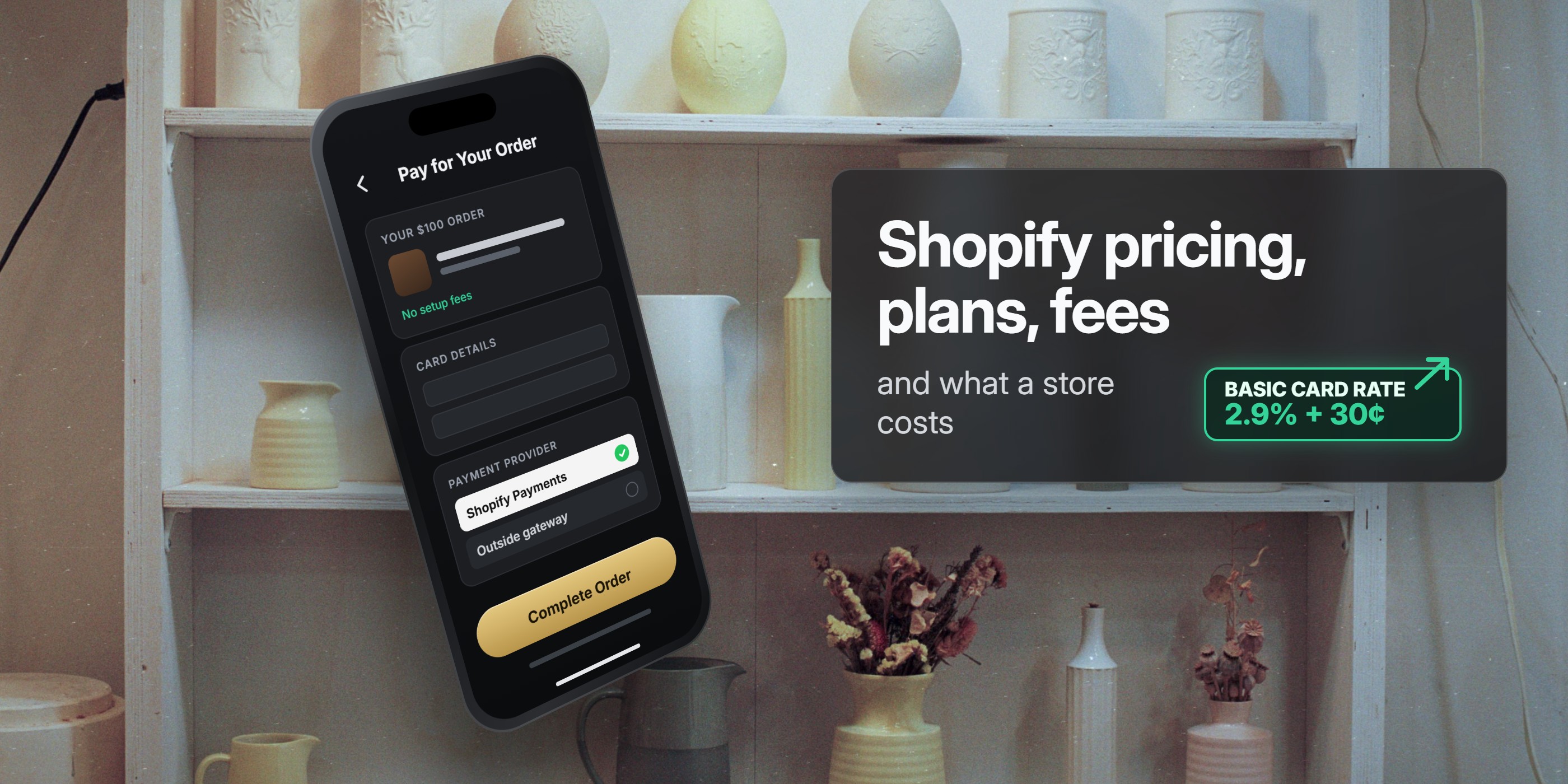
On Basic with Shopify Payments, Shopify takes 2.9% plus 30 cents on an online sale paid with a standard US consumer card. That’s the number most people mean when they ask what Shopify takes per sale. There’s no separate cut on top of it when you use Shopify Payments. Shopify’s help center says that aside from the card rate and your plan, “there are no monthly fees, no hidden fees, and no setup fees for Shopify Payments.”
The rate depends on the card. Shopify’s help center classes domestic business, corporate and commercial cards, plus all domestic American Express cards, as premium, and premium cards cost more. International cards add a percentage point. Here’s what each costs you on a $100 order on Basic.
| How the $100 is paid | Basic rate | Fee | You keep |
|---|---|---|---|
| Standard US consumer card, online | 2.9% + 30¢ | $3.20 | $96.80 |
| Premium card such as Amex or a business card, online | 3.5% + 30¢ | $3.80 | $96.20 |
| International card, online | 3.9% + 30¢ | $4.20 | $95.80 |
| Card tapped or inserted in person | 2.6% + 10¢ | $2.70 | $97.30 |
| Card details entered by hand in person | 3.5% + 10¢ | $3.60 | $96.40 |
Rates drop as you move up a plan. Grow charges 2.7% + 30¢ online and Advanced 2.5% + 30¢, with lower premium and in-person rates to match. One more thing to budget for is refunds. Shopify’s help center says card fees “aren’t returned to you when you issue a refund.” A refunded $100 sale on Basic still costs you $3.20.
When does Shopify charge a transaction fee?
Shopify’s own transaction fee is separate from the card rate, and it only applies in specific cases. It’s 2% on Basic, 1% on Grow, 0.6% on Advanced and 0.2% on Plus. Shopify’s help center lists when you pay it.
- A third-party payment provider. If you take card payments through an outside provider instead of Shopify Payments, Shopify charges the fee, and the provider charges its own processing rate as well.
- Store credit and gift cards. On stores created on or after May 12, 2025, the fee applies to the part of an order paid with store credit or a gift card, even when the rest goes through Shopify Payments.
- A mixed setup. If you keep Shopify Payments on but run cards through a direct third-party provider, the payments Shopify Payments still handles, such as Shop Pay, are charged at its standard rates plus a 1.25% premium.
The fee doesn’t apply to orders paid through Shopify Payments, Shop Pay or Shop Pay Installments, to manual methods such as cash on delivery and bank transfers, or to PayPal when Shopify Payments is your main provider. Shopify works it out on the order total after discounts, with tax and shipping included, so it lands on more than your product price.
Here’s what that does to a single order. Take a $100 sale on Basic through an outside gateway that charges 2.9% plus 30 cents. The gateway takes $3.20 and Shopify adds $2.00, so the order costs you $5.20, against $3.20 through Shopify Payments. That’s why the first fee to cut is this one. Shopify’s pricing page notes that Shopify Payments is available only in certain countries, so if yours isn’t one of them, the fee is part of your plan math and Grow’s lower fee is worth pricing early.
The Shopify fees that aren’t on the plan card
Shopify’s pricing cards show the subscription and the headline card rate. These charges sit further down the comparison table or in the help center, and each one can add a line to your costs once the store is running.
- Currency conversion. If you sell in your customers’ local currencies, Shopify’s help center lists a 1.5% conversion fee for US stores, charged on top of the card rate. A $100 order paid in euros with an international card on Basic costs you $4.20 plus $1.50.
- Sales tax calculation. Shopify Tax is free until a US store reaches $100,000 in sales, then costs 0.35% on Basic, Grow and Advanced for orders where you collect tax, capped at 99 cents an order. Stores created on or after May 13, 2026 count that threshold over their lifetime rather than each year.
- Marketplace orders. Syncing up to 50 marketplace orders a month is free. Past that, the pricing page lists 1% up to $99 a month.
- POS Pro. Running a physical shop on POS Pro adds $89 a month per location on Basic, Grow and Advanced.
- Chargebacks. When a customer disputes a charge, the bank takes the amount and a chargeback fee from you. Shopify’s help center says it might refund that fee if you win, depending on your country or region.
- Your domain. Domains bought through Shopify renew every year, are billed separately from your plan, and are priced by extension.
None of these is large on its own. Together they explain why your first real bill rarely matches the price on the plan card.
What do apps and themes add to your Shopify bill?
A theme is paid once, while an app subscription is paid every month for as long as you keep it. Shopify’s free themes are developed by Shopify, which also supports customization questions on them. Paid themes come from third-party developers. On the Shopify Theme Store’s main listing, the paid themes run from $150 to $500, and 19 of the 24 shown sit between $350 and $420.
You can preview a paid theme in your own store and customize it before you buy. A purchase is licensed to the one store you bought it for, and Shopify’s help center says theme purchases “are considered final sale.” Preview properly before you pay.
Apps are where budgets drift. App subscriptions bill on their own cycle, which Shopify’s help center says “might not always match the billing date” of your plan, so the charges arrive on a schedule you don’t control. They also keep billing if you close the store without canceling them first. Before you add one, check whether your plan already does the job. Basic includes email campaigns, discount codes, gift cards and abandoned checkout recovery. Then compare what’s left against the Shopify apps worth paying for, and price each one per year rather than per month, because $20 a month is $240 a year.
What does it cost to have a Shopify store built?
We build Shopify stores, so we have a stake in this section. We don’t quote our own Shopify prices here. The ranges below come from other firms’ published guides, and we aren’t a Shopify Plus Partner.
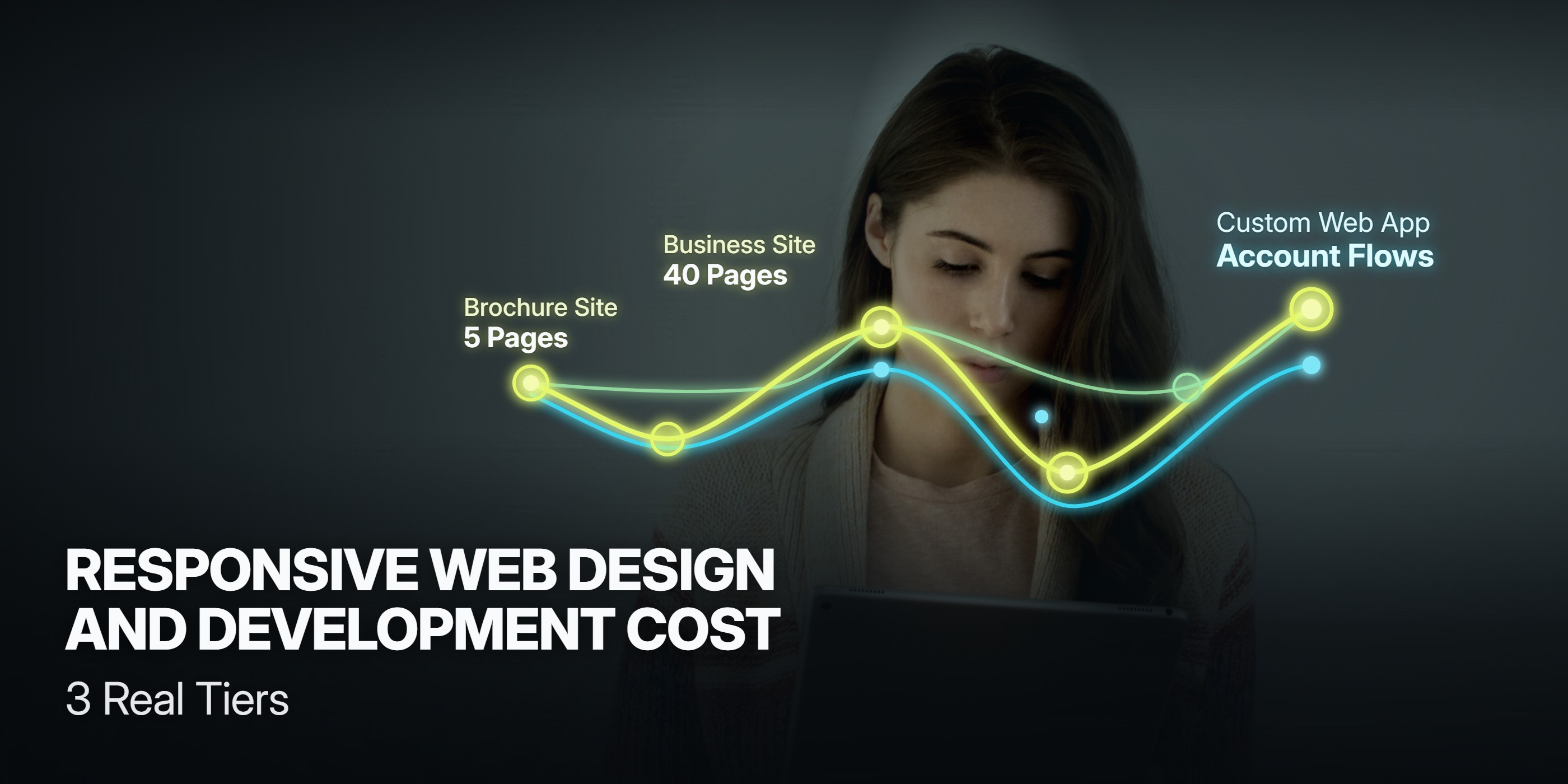
A store on a ready-made theme sits at the low end. ShopCreatify, which describes itself as Shopify B2B experts, says that with a purchased or free theme “you should look somewhere in the region of $1,500 to $5,000.” It puts a mid-level custom store at $5,000 to $25,000, and builds with custom buying journeys and more complex integrations at $25,000 to over $75,000. Loomis Guild’s guide says most projects fall between $3,000 for a simple, theme-based setup and $150,000 or more for a complex custom build, and that “A $10,000 quote and a $40,000 quote can both be legitimate” because they can cover very different work.
The gap between those numbers is scope. The lines that move a quote are custom design against a configured theme, the number of products and variants to migrate, integrations with inventory, ERP or subscription systems, and redirects from an old store. Ask every builder to price those lines separately, and ask what happens after launch, because themes and apps need updates. To see what usually separates one tier of build from the next, read our breakdown of how ecommerce build quotes are tiered.
If you’d rather hand the build to a team, that’s what our Shopify store design services cover, and you can hold our quote to the same line-by-line test as anyone else’s.
When does the Shopify Plus plan make sense?
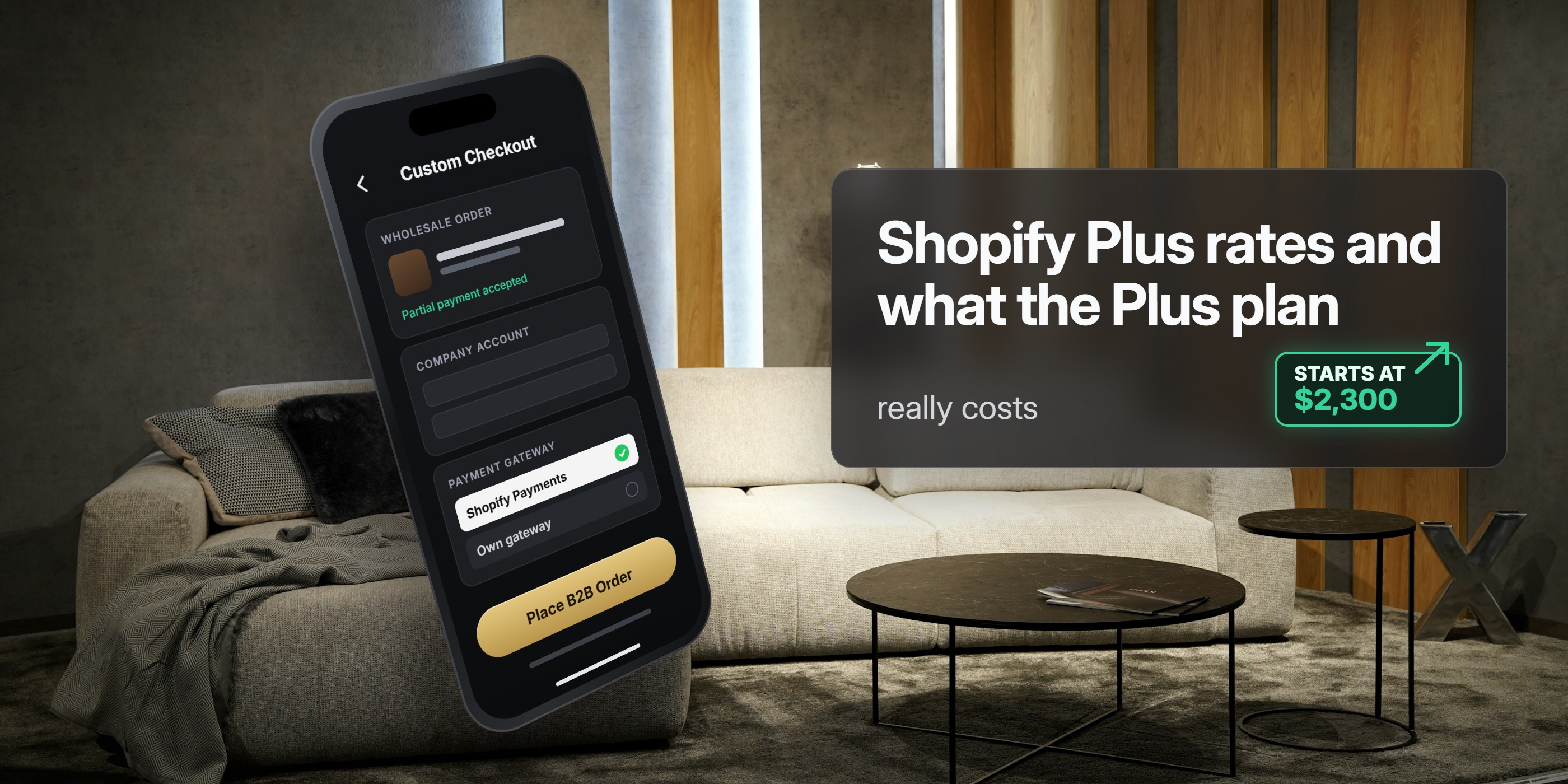
Plus is sold as a contract. Shopify’s help center lists $2,500 a month on a 1-year term and $2,300 a month on a 3-year term, and adds that more complex, higher-volume businesses might pay a variable platform fee based on revenue and business model. Its third-party transaction fee is 0.2%, and the pricing page lists its online card rates from 2.25% + 30¢.
On the published numbers alone, Plus is hard to justify. Even on the 3-year term, it costs about $1,900 a month more than Advanced on monthly billing. Against Advanced’s 2.5%, a card rate from 2.25% saves 0.25 points, which covers that gap only at around $760,000 a month in online card sales. The 0.4-point drop in the third-party fee would need around $475,000 a month through an outside provider.
The reasons to pay for it are features. The pricing page lists fully customizable checkout, unlimited staff accounts, 200 inventory locations, unlimited B2B catalogs, up to 9 free expansion stores and priority 24/7 phone support, against limited checkout customization and 10 locations on the standard plans. If you run several regional stores, sell wholesale at scale or need checkout logic the standard plans can’t hold, those are the deciding lines. For the full breakdown of terms and what moves the fee, read our Shopify Plus pricing guide.
How do Shopify fees compare with other platforms?
BigCommerce now prices almost exactly like Shopify. It lists Core at $39 a month or $29 billed annually, Growth at $105 or $79, and Scale at $399 or $299, the same prices as Shopify’s Basic, Grow and Advanced, with a Performance plan from $1,499 a month billed annually. Its fees mirror Shopify’s as well. Orders through a payment provider outside its embedded list carry an Open Payment Provider Fee of 2.0% on Core, 1.0% on Growth and 0.6% on Scale. The real difference is the sales caps. Core covers businesses with up to $30K in annual sales and Growth up to $100K before the plan upgrades automatically, and Scale adds 0.9% on monthly sales above $33,333. Our BigCommerce pricing plans breakdown goes through it line by line.
WooCommerce has no plan fee at all. The plugin is a free download, and WooPayments advertises “pay as you go, without setup costs or monthly fees.” You pay for hosting, paid extensions and the upkeep that Shopify otherwise bundles into the plan. The fair comparison is total cost over a few years. WooCommerce runs on WordPress, so our guide to what a WordPress build costs is the place to start that math.
Shopify’s case rests on what’s bundled. Its pricing page lists unlimited web hosting and a free SSL certificate on every plan, and says Shopify is certified Level 1 PCI DSS compliant, so card security is handled for you. On WooCommerce, those are yours to buy, set up and keep current.
What does Shopify pricing add up to in year one?
Here’s a worked example for a small store, so you can swap in your own numbers. Say you sell $60,000 online in your first year across 1,000 orders averaging $60, all through Shopify Payments with standard US cards, on Basic billed yearly with a paid theme.
| Cost line | Year one |
|---|---|
| Basic plan, billed yearly | $348 |
| Paid theme, one time | $380 |
| Card rate, 2.9% of $60,000 | $1,740 |
| 30 cents on 1,000 orders | $300 |
| Total before apps and domain | $2,768 |
Processing is $2,040 of that, nearly six times the plan. That’s why the payment setup matters more than the plan choice. Run the same sales through a third-party gateway at the same card rate and Shopify’s 2% fee adds another $1,200 for the year.
Then add your apps, your domain renewal and Shopify Tax fees once you pass $100,000 in sales. Budget for upkeep as well, because someone has to apply theme and app updates, and we’ve broken down what upkeep costs after launch separately. Whether the total is worth it comes down to what you’d give up on another platform, which our Shopify pros and cons guide covers in detail.
Where we would start if this were your store
Start with payments, not the plan. Turn on Shopify Payments if it’s available in your country, because it removes the third-party fee, and that fee is the biggest avoidable cost in this whole guide. Then start on Basic, billed monthly, and run it for a quarter.
At the end of that quarter, pull the Payments report, check your card mix and your monthly online card sales, and only then decide whether Grow’s break-even applies to you and whether yearly billing is safe. Leave local-currency pricing off until international orders are worth the 1.5% conversion fee. Hold off on paid apps until a specific problem shows up in your orders, and price every app per year. Spend the build budget on the pages customers actually use, product pages and the path to checkout, and accept a good theme for the rest.
Your next step is to test Shopify pricing against your own numbers with the break-even math above. Take your expected monthly online sales, multiply by each plan’s card rate, add 30 cents an order and the plan price, and pick the cheapest line. If the build is the part you’d rather not do yourself, that’s work our team takes on, and the questions in the build section are the ones to ask us too.
Frequently asked questions
Is a basic Shopify plan enough?
For most new stores, yes. Basic sells unlimited products from up to 10 inventory locations, uses the same checkout as Grow and Advanced, and includes email campaigns, discount codes and abandoned checkout recovery. It runs short in two places. It has no staff accounts, which start on Grow, and its 2.9% + 30¢ online card rate costs more than Grow once your online card sales pass about $33,000 a month on monthly billing.
Is Shopify $39 a month?
Yes, Shopify's Basic plan is $39 a month when you pay monthly in the US, or $29 a month when you pay for a year up front, which comes to $348 for the year. Eligible new stores can pay $1 a month for their first three months after a 3-day free trial. Card processing is charged on top, at 2.9% + 30¢ for a standard online card payment on Basic.
Why is Shopify charging me $40?
Shopify's Basic plan is $39 a month on monthly billing, so a charge near $40 usually means that price plus something else on the same bill. Shopify adds tax to its invoice where it's required to charge it, based on your billing address, and app subscriptions bill through the same account. Open Settings, then Billing, in your Shopify admin to see every line on the invoice.
Is Shopify really 1 dollar a month?
Only for the first three months. Shopify's offer is a 3-day free trial, then $1 a month for 3 months on most plans, after which the standard price applies, which is $39 a month for Basic on monthly billing. Apps you install are billed separately, and card processing fees apply to every sale from your first order.
Is Shopify 100% free?
No. Every Shopify plan that includes an online store has a monthly price, starting with Basic at $39 a month after a 3-day free trial. The only $0 plan is Agentic, which lists your products in AI shopping channels and charges card rates when you sell, but doesn't give you a storefront. Shopify's free themes do cost nothing, and there are no setup fees on any plan.
Why are Shopify fees so high?
Most of what feels high is card processing, not the plan. The 2.9% + 30¢ on a Basic online sale covers what the card networks charge, since you don't pay Visa or Mastercard separately, along with Shopify's built-in fraud analysis. Fees climb on premium and international cards, third-party gateways and local-currency sales. On a small store, processing can run several times the plan price.
Is Shopify worth the cost?
It's worth it if you would otherwise pay separately for hosting, security, checkout and the time to keep them running. Every Shopify plan includes hosting, an SSL certificate and a PCI-compliant checkout, so the plan price replaces several bills. It's harder to justify when your margins are thin and processing takes a large share, or when you need features only Plus offers. Run your own first-year numbers before you decide.
How many products can you have on a Shopify basic plan?
There's no product limit on Basic. Shopify's pricing page lists unlimited products on every plan, Basic included, so the limits you'll meet on Basic are elsewhere. It allows up to 10 inventory locations, has no staff accounts beyond the store owner, and offers only limited checkout customization. Those are usually the reasons stores upgrade, not catalog size.