In this article
- Honest ecommerce maintenance runs $700 to $8,500 monthly by size band.
- Mid-band DTC stores cluster at $900 to $3,400 monthly across 6 workstreams.
- Zombie apps can drain $340 to $1,600 a month from a store that never audits them.
- Redefine Web retainers bundle hosting at $199, $299, and $499 per month, with Enterprise on custom scope.
- Track 4 cost ratios monthly to catch scope drift 3 to 5 months earlier.
Ecommerce website maintenance cost runs $700 to $8,500 a month, and most DTC stores land between $900 and $3,400 once every line is counted. The number drifts when no one tracks it. A clean baseline budgeted at launch can turn into a mess of tool subscriptions, app add-ons, and agency hours. Add a hosting upgrade a prior developer pushed through without sign-off, and the line keeps climbing. With no line-by-line view, many founders learn the real number when a bookkeeper flags it at quarter close. Mapping the real scope against total cost of ownership shows which spend the store needs and which can go without hurting store health.
This guide walks the maintenance cost question the way our team scopes it during real DTC engagements. Every line item that hits the monthly invoice. The hosting, plugin, and monitoring tool subscriptions that most founders forget to track. The dev retainer hours that quietly grow with app-stack complexity. The seasonal peak overhead. The DIY versus agency cost ranges, plus the specific hidden line items founders discover on their first real incident. Our ecommerce website maintenance plans fold hosting into one fixed monthly line.
What the total ecommerce website maintenance cost covers month to month
The real monthly line covers six recurring workstreams. Hosting and infrastructure. Platform and app subscriptions. Development retainer or in-house dev time. Monitoring and observability tools. Backup and disaster recovery. Security and compliance. Founders budgeting only for the first two usually discover the other four during their first store outage.
The six line items that show up on every honest maintenance invoice
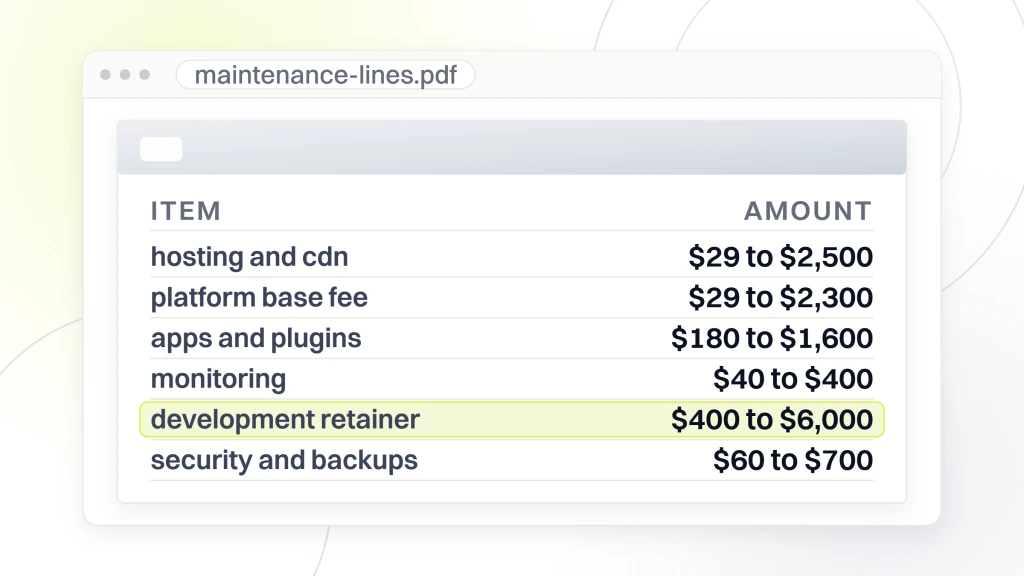
Every honest ecommerce store carries six recurring maintenance lines. Hosting and CDN spend sits between $29 and $2,500 monthly depending on platform and traffic band. Platform base fee runs $29 to $2,300 monthly on Shopify or $0 to $200 on WooCommerce hosting. App and plugin subscription stack runs $180 to $1,600 monthly on a typical mid-band DTC store. Monitoring and observability tools run $40 to $400 monthly. Development retainer or in-house time runs $400 to $6,000 monthly. Security, compliance, and backup tooling run $60 to $700 monthly. Add those six ranges and the honest total ecommerce maintenance cost lands somewhere between $700 and $13,500 monthly across the full DTC size band. The middle 80% of stores cluster between $900 and $3,400 monthly once every line gets accounted for, which is the real range founders should benchmark against instead of the launch-day sticker price they remember from the platform’s marketing page.
Where founders under-count their real monthly maintenance cost
Founders under-count monthly cost by anchoring on the platform base fee and treating everything else as one-off or optional. The Shopify base plan sits at $79 monthly on the standard tier, which reads cheap next to the real $1,900 monthly a growing DTC store spends across the six workstreams above. WooCommerce reads even cheaper on paper since the platform is free, yet stores usually run 22 to 34 paid plugins that add $260 to $580 monthly in subscription lines founders forgot they signed up for. Most founders under-count their monthly maintenance line when asked to estimate it, and the gap only shows up once a bookkeeper reconciles the real charges. The gap is not sloppy accounting. The gap is that no one lays out the six workstreams together in one place at launch time.
Why the six-line frame beats a one-number package quote
A single monthly package number tells you what a vendor charges. It does not tell you what your store actually needs to stay healthy. Two DTC stores at $2M annual revenue can carry maintenance costs of $850 monthly and $3,100 monthly and both be correct, since their app stacks, traffic bands, and compliance scope differ. The six-line frame forces a per-workstream conversation. So you can see which lines are honest and which lines carry vendor markup or forgotten subscriptions. For the wider retainer view, see Ecommerce Maintenance Package Tiers and Pricing. If you run a content site rather than a store, our guide to website maintenance cost shows what a cheap plan leaves out.
Ecommerce website maintenance cost benchmarks by platform and stack
Platform choice sets the floor and the ceiling for monthly maintenance. Shopify carries a higher base fee and lower dev overhead. WooCommerce flips that math. BigCommerce sits between the two. Headless setups on Next.js or Remix carry the highest maintenance number in the range and the highest performance ceiling.
Shopify and Shopify Plus maintenance cost ranges
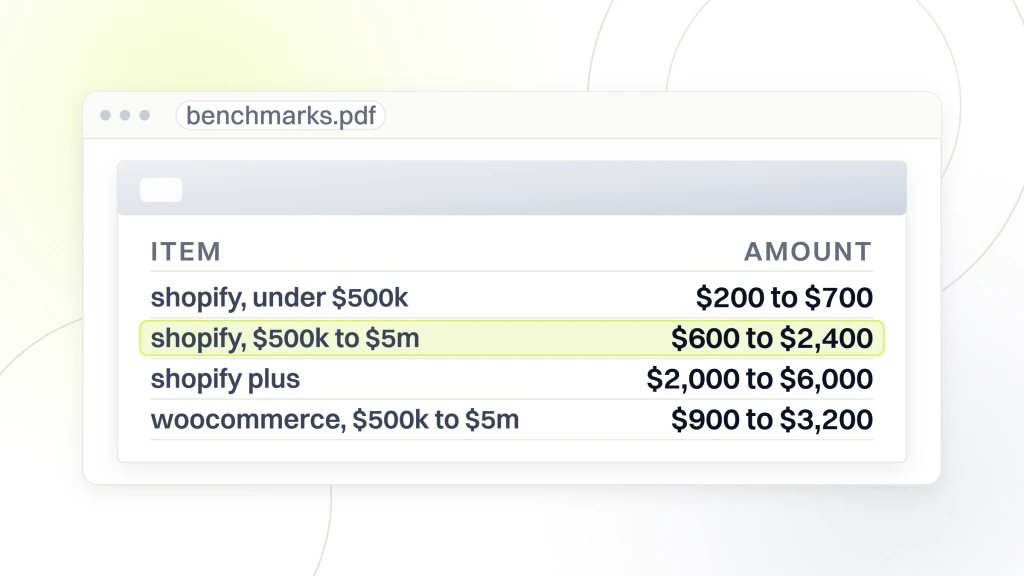
Standard Shopify stores in the $500K to $5M annual revenue band run $700 to $2,400 monthly in total maintenance once every line is counted. The $79 monthly base plan is the visible fee. App subscriptions like Klaviyo at $150 to $900 monthly, Rebuy at $100 to $600 monthly, Judge.me or Yotpo at $50 to $400 monthly, and Gorgias at $50 to $400 monthly usually stack to $600 to $1,600 in monthly app spend alone. Shopify Plus stores at $5M+ annual revenue jump to $2,000 to $6,000 monthly. The $2,300 monthly Plus base fee, deeper app stacks, and dedicated dev retainer hours account for the step up. Founders on Shopify Plus who feel their maintenance number is too high usually have three to five zombie app subscriptions from platform migrations that never got canceled.
WooCommerce, Magento, and headless maintenance cost ranges
WooCommerce stores at $500K to $5M annual revenue run $900 to $3,200 monthly. The platform is free, yet the stack of managed hosting at $150 to $500 monthly, 22 to 34 paid plugins at $260 to $580 monthly, a dev retainer at $500 to $2,000 monthly, and security and backup tooling at $80 to $300 monthly rebuilds the fee back into the invoice. Magento and Adobe Commerce stores run $2,000 to $8,000 monthly at that revenue band on account of the heavier server, license, and dev requirements. Headless setups on Next.js, Remix, or Hydrogen run $1,800 to $5,500 monthly at the mid-band tier since they carry both the Shopify Plus fee and the custom front-end dev retainer at the same time. The tradeoff is a 25 to 45% Core Web Vitals gain (see WP Rocket’s Core Web Vitals guide for context), which is worth the extra spend for stores where paid traffic is more than 40% of revenue. For the deeper stack comparison, see Custom Ecommerce Platform Maintenance Costs vs Shopify TCO, and for the broader industry take on maintenance benchmarks, see Kinsta’s website maintenance guide.
Cost by store size band, not just platform
Platform gives you the floor. Store size sets the actual number inside the range. Under $500K annual revenue, the honest monthly number starts near $700 on either platform, because the six lines’ minimums add up to about that. WooCommerce stores in this band run up to $900. The $500K to $2M band runs $700 to $1,800 monthly. The $2M to $10M band runs $1,400 to $3,600 monthly. Above $10M runs $2,800 to $8,500 monthly. Founders whose real numbers sit outside these bands usually have a scope gap, either an app stack twice as heavy as needed, or a coverage gap where one of the six workstreams is silently missing.
The hidden line items that break ecommerce website maintenance cost budgets
Hidden line items break maintenance budgets. Not the visible ones. The three categories below are where most overruns start.
Zombie app subscriptions and forgotten trials
Zombie apps are the biggest silent cost. On an average $2M Shopify store, 4 to 9 app subscriptions run every month for tools no one uses. A canceled abandoned-cart flow tool at $60 monthly. A retired subscription plugin at $199 monthly. A trial that auto-converted to a $349 monthly plan. Add up 4 to 9 zombie lines and the founder is losing $340 to $1,600 monthly to spend that produces zero store impact. A first audit pass is the fastest way to find and cancel them.
Peak-season hosting overage and traffic-band creep
Peak-season overage is the second silent cost. Black Friday and Cyber Monday traffic spikes push hosting and bandwidth costs 3 to 8x above baseline for the 5-day window. Founders on metered hosting who did not pre-negotiate a peak allowance get invoiced $800 to $4,200 in overage fees in early December. Founders on flat-rate hosting who did not scale up in October get a slow-checkout post-mortem and a 15 to 30% drop in checkout conversion during the highest revenue days of the year. Plan the peak window in September, not the week of.
Emergency dev hours after theme or app updates
Emergency dev hours are the third silent cost. A theme update breaks a checkout customization. An app update conflicts with a Klaviyo integration. A Shopify API change deprecates a webhook the founder did not know existed. Each incident costs 3 to 12 dev hours at $95 to $220 hourly. Across a year, most DTC stores at the $2M+ band absorb 4 to 8 such incidents. The unbudgeted line lands between $1,140 and $21,120 annually depending on stack complexity and dev rate.
DIY, in-house, and agency cost tradeoffs for ecommerce maintenance
DIY maintenance saves cash and burns founder time. In-house is the highest fixed cost. Agency retainers sit in the middle with the widest scope range. The right pick tracks against founder time value and store complexity, not against the raw dollar number.
DIY total time cost for the solo founder
Solo founders running DIY maintenance spend 6 to 14 hours weekly on tasks the six workstreams demand. Plugin updates. Backup checks. Uptime alerts. Manual security patches. App reconciliation. At a founder time value of $75 to $150 hourly, DIY maintenance is not $0 monthly. DIY maintenance is $1,950 to $9,100 monthly in founder opportunity cost. Founders who double as the primary revenue generator (sales calls, creative direction, partnerships) lose 3 to 5x that number in downstream revenue every quarter they spend inside the maintenance workflow instead of the growth workflow.
In-house developer or ops hire cost
A mid-level in-house ecommerce developer runs $85K to $135K annual salary in the US, plus 22 to 30% loaded cost for benefits, taxes, and equipment. That is $105K to $175K annual total cost, or $8,750 to $14,600 monthly. The hire makes sense at $10M+ annual revenue when the store has 3+ concurrent projects, not at $2M when one retainer covers the same scope for a fifth of the cost. Founders who hire in-house too early see the developer spend 50 to 65% of their week on non-billable admin, meetings, and slack triage, which turns the $12K monthly line into $6K of real dev output.
Agency retainer cost and scope
Agency retainers for ecommerce website maintenance run $199 to $499 monthly across the retainer tiers we quote, with Enterprise scoped custom. Redefine Web’s own maintenance tiers land at $199 monthly (Essential), $299 monthly (Growth), and $499 monthly (Scale), with Enterprise ecommerce scope quoted custom. Hosting is bundled into every tier, so external host bills disappear from the invoice. Agency retainers make sense for stores in the $500K to $10M band since the fixed cost buys deeper coverage than any solo dev can offer across the six workstreams, without the loaded cost of a full hire. See our shortlist of the best ecommerce website maintenance services for DTC stores before you sign a retainer.
Benchmark numbers by store size, band, and platform
Benchmarks give founders the yardstick to know if their monthly maintenance line is fair, high, or low. Below are the tightest ranges, split by revenue band and platform.
Under $500K annual revenue benchmark
Stores under $500K annual revenue carry honest maintenance from about $700 monthly on Shopify or WooCommerce, the sum of the six line minimums. WooCommerce lands up to $900 monthly. The founder is the primary operator. Retainer scope stays small (Essential-tier at $199 monthly plus one or two paid app lines). Emergency dev hours are the biggest budget risk. Founders at this band should hold a $600 annual reserve for the one incident that will happen and blow past their monthly retainer scope.
$500K to $5M annual revenue benchmark
The core DTC band runs $700 to $2,400 monthly on Shopify and $900 to $3,200 monthly on WooCommerce. This is where the six-workstream frame earns its keep. Founders who audit their real spend usually find $400 to $1,100 in monthly zombie subscriptions the first time they run the audit. Growth-tier retainers at $299 monthly cover the monitoring, backup, and security workstreams, with hosting bundled in. Recurring dev work is quoted separately, and app spend sits outside the retainer as a pass-through line. Real total lands in the $900 to $2,700 monthly range for the middle 60% of stores at this band.
$5M to $10M annual revenue benchmark
Stores at $5M to $10M annual revenue run $1,800 to $4,800 monthly total maintenance. Shopify Plus, deeper app stacks, and a Scale-tier retainer at $499 monthly are the base. Dev hours grow with the number of custom checkout, product, and shipping workflows the store has built. Every custom workflow adds 1 to 4 dev hours monthly for regression, testing, and integration checks. Founders at this band should track dev hours per custom workflow monthly to see which workflows deliver enough revenue growth to justify their maintenance overhead.
Cutting ecommerce website maintenance cost without breaking the store
Cutting maintenance cost without breaking the store is a scope conversation, not a vendor conversation. The four moves below are the fastest ways to recover 20 to 45% of the monthly line and still keep every workstream healthy.
Zombie app kill and stack consolidation
Kill zombie apps first. Pull the last 6 months of Shopify or platform subscription statements. Every app not touched in 90 days gets a keep-or-kill decision. Every app with feature overlap with another app gets a consolidation decision. Founders who run this pass honestly almost always find subscriptions to cut the first time. Stack consolidation is second. Klaviyo covers email, SMS, and reviews on the higher tier. Gorgias covers customer support, live chat, and social inbox on one seat. Consolidating 3 to 5 single-purpose tools into 2 multi-purpose tools trims the monthly line and reduces integration risk on updates.
Retainer scope right-sizing
Right-size the retainer. A $1,200 monthly retainer with 8 unused hours a month is $600 monthly of paid capacity the store is not using. Downshift a tier. A $499 Scale-tier retainer with real utilization beats a $1,200 tier with slack capacity every quarter. Track retainer hours consumed monthly. Any tier running below 65% utilization for 3 straight months gets a scope-down conversation.
Peak-window planning to avoid overage
Plan Q4 peak in September. Run your top product pages through one of the website speed test sites the same month, so you have a baseline before traffic climbs. Talk to hosting about a 90-day peak allowance in October and November. Lock in creative and dev scope for Black Friday and Cyber Monday by mid-October. Founders who do this cut peak-season overage 60 to 85% every year. Founders who wait until early November get invoiced for both the overage and the emergency dev fee for the last-minute code freeze on the site’s highest revenue week of the year.
What Disciplined Maintenance Scope Looks Like
Disciplined maintenance is a scope habit, not a vendor choice. When every workstream sits under one fixed monthly line, the store stops producing surprise invoices. Scope changes become decisions the founder signs off on, not drift a bookkeeper finds at quarter close. Over a multi-year window, that habit keeps the monthly line close to the honest number.
What a Full Six-Workstream Retainer Covers
A full retainer covers all six workstreams under one fixed monthly line. Hosting and CDN. Platform and app subscription oversight (with a zombie-app audit every quarter). Development retainer hours for feature work, bug fixes, and API regression. Monitoring, uptime, and error alerting. Backup and disaster recovery. Security patching and compliance checks. Peak-season planning gets folded in each August. So the September through January window runs on a locked scope with zero surprise line items.
Quick answers on ecommerce maintenance cost that founders keep asking
The questions below cover the maintenance-cost topics we get most often on scoping calls. Direct answers with real ranges. No filler.
More Questions
What is website maintenance?
Website maintenance is the recurring work of keeping a live site healthy, secure, fast, and current. For a DTC ecommerce store, it covers six workstreams every month. Hosting and infrastructure, platform and app subscriptions, development retainer hours, monitoring and observability tools, backup and disaster recovery, and security and compliance. Real maintenance is not just plugin updates. It is the practice of watching every workstream so a small drift does not become a checkout outage during peak week. Honest ecommerce maintenance sits between $700 and $8,500 monthly depending on store size, platform, and stack complexity, with the mid-band clustered at $900 to $3,400 monthly.
What does Reddit say about cutting ecommerce maintenance cost?
Reddit threads on this topic usually point to three moves. Pull 6 months of subscription statements to find zombie apps. Ask three agencies for line-item retainer quotes rather than package fees. Track dev hours per month against the retainer scope you signed up for. Redditors selling Shopify stores say the number they trust most is not the platform fee, but the app stack invoice, since app spend is where most surprise cost hides. Reddit ranges for larger stores match the ranges in this guide. Mid-band DTC stores run $900 to $3,400 monthly, and Plus-tier stores run $2,000 to $6,000 monthly. Small-store figures there often run below this guide’s six-line floor of about $700. Anything higher usually points to zombie subscriptions or a heavy custom stack.
What maintenance cost ranges do Reddit threads report?
Reddit threads on the DTC store maintenance number consistently anchor at three ranges. Small store maintenance at $195 to $595 monthly, mid-market DTC at $900 to $3,400 monthly, and Plus-tier or headless stores at $2,000 to $6,000 monthly. The most upvoted advice across r/smallbusiness and r/ecommerce is to audit app subscriptions quarterly, ask agencies for line-item quotes, and reserve a $600 to $1,200 annual buffer for the one incident that will blow past monthly retainer scope. Redditors warn against enterprise-tier hosting upgrades pushed by prior developers without founder sign-off, which is the most common source of the surprise $2,500 to $4,000 monthly line item on inherited stores.
Lock in the right monthly maintenance line for your store
The honest monthly maintenance line is not a single number. It is a per-workstream conversation across hosting, apps, dev, monitoring, backup, and security, sized against the store’s revenue band and stack complexity. Founders who run the six-workstream audit quarterly catch scope drift 3 to 5 months earlier and clear out zombie subscriptions on the first pass. If you want our team to run the audit against your live store and quote a real retainer, book a scoping call. We work with DTC stores at every revenue band from $200K to $50M and price against the honest six-workstream number, not a marketing-page package fee. See our full website maintenance packages and pricing, the deeper ecommerce platform maintenance best practices across stacks, our pet-products subscription DTC maintenance guide for a vertical example, the technical SEO for ecommerce architecture and speed walkthrough, another second-opinion resource at Kinsta, or our ecommerce sales funnel retainer page for the full agency retainer scope.
Frequently asked questions
How much does it cost to maintain an ecommerce website?
Honest ecommerce website maintenance cost lands between $700 and $8,500 monthly by store size and platform. Under $500K annual revenue, monthly cost starts near $700 on either platform and runs up to $900 on WooCommerce. Mid-band DTC stores at $500K to $5M pay $700 to $3,200 monthly across both stacks. Shopify Plus and headless stores at $5M+ run $2,000 to $6,000 monthly. Every honest number covers six workstreams. Hosting, platform and app subscriptions, dev retainer hours, monitoring, backup, and security. Redefine Web bundles hosting into every retainer tier so external host bills disappear from the invoice.
How much does website maintenance cost per hour for ecommerce dev work?
Ecommerce dev work billed hourly runs $75 to $250 per hour in the US market. Offshore rates start at $25 per hour but push total cost higher once rework and PM overhead land. Shopify Liquid and Plus specialists sit at the top of the band at $150 to $250 per hour. WooCommerce dev falls at $75 to $150 per hour. Headless and app-integration work runs $125 to $225 per hour. Founders who bundle 8 to 20 hours of monthly dev into a fixed retainer pay 20 to 35% less than the same hours billed ad hoc. Track hours consumed monthly so slack capacity does not quietly become 40% of the invoice.
How much does ecommerce website maintenance cost per month?
Ecommerce website maintenance cost per month runs $700 to $8,500 by store size and platform. Under $500K annual revenue, honest monthly cost starts near $700 on either platform and runs up to $900 on WooCommerce. At $500K to $5M annual revenue, monthly cost sits at $700 to $2,400 on Shopify and $900 to $3,200 on WooCommerce. Shopify Plus at $5M+ runs $2,000 to $6,000 monthly. Retainer tiers at Redefine Web run $199 monthly (Essential), $299 monthly (Growth), and $499 monthly (Scale), with Enterprise scope quoted custom, and hosting is bundled into every tier.
How does WordPress ecommerce website maintenance cost compare to Shopify?
WordPress plus WooCommerce ecommerce website maintenance cost runs 30 to 45% higher than Shopify at the same revenue band. The gap comes from three lines. Managed WordPress hosting at $80 to $580 monthly on WooCommerce versus $0 to $50 monthly on Shopify since Shopify hosts the store. Plugin and app stack cost is roughly flat across both. Dev hours run higher on WooCommerce since core updates, PHP version bumps, and plugin conflicts need active watch. At $500K, a store on either stack starts near $700 monthly once all six maintenance lines are counted, and a WooCommerce store runs up to $900. Shopify Plus at $2,300 monthly platform fee flips the math above $5M revenue.
How much does ecommerce website maintenance cost for a small business?
Small-business store maintenance under $500K annual revenue starts near $700 monthly on either platform and runs up to $900 on WooCommerce. An Essential-tier retainer at $199 monthly plus a small app stack covers most of the recurring workload. Founders should hold a $600 annual reserve for the one incident every year that will blow past monthly retainer scope. Solo founders running DIY maintenance still pay in time. 6 to 14 hours weekly of founder time against a $75 to $150 hourly opportunity cost lands at $1,950 to $9,100 monthly in real lost value, which is often higher than the agency retainer alternative.
How much of ecommerce website maintenance cost is hosting versus apps versus dev?
On a typical DTC store, hosting accounts for 8 to 22% of the total monthly line. App and plugin subscriptions account for 32 to 48%. Development retainer or in-house dev time accounts for 24 to 42%. Monitoring, backup, and security tooling together account for 8 to 18%. Apps are the biggest silent cost driver. Dev is the biggest visible cost driver. Hosting is usually the smallest line but the one most likely to spike during peak. Founders who track these four ratios monthly catch scope creep 3 to 5 months earlier than founders who track only the total.
Does the agency ecommerce website maintenance cost include hosting?
At Redefine Web, hosting is bundled into every retainer tier. Essential at $199 monthly, Growth at $299 monthly, Scale at $499 monthly, and Enterprise on custom scope all include managed hosting, and peak-season scaling is quoted separately. Bundling hosting into the retainer removes the $150 to $500 monthly external host line and gives one throat to choke when a slow-checkout ticket hits at 11 PM on Cyber Monday. Founders who split hosting from maintenance across two vendors usually pay 15 to 30% more for the same coverage.
Which ecommerce website maintenance cost warning signs mean the retainer is wrong?
Three warning signs mean the retainer is wrong. First, monthly cost that grew more than 40% year over year with no matching revenue growth. That points to zombie apps and scope drift. Second, retainer hours consumed under 65% for 3 straight months. That points to a tier that should be downshifted. Third, an emergency dev fee every 4 to 8 weeks. That points to either a stack that needs consolidation or a retainer scope that does not cover the actual store surface. Any two of these three signs should trigger a full six-workstream audit inside the next 30 days.
Omor Sarif founded Redefine Web in 2021 to run websites, SEO, paid media, and marketing automation as one revenue-tied program for growth-stage brands. He is Lead Web Developer at Spicy Pixel since 2022, and holds a Bachelor of Science in Electrical and Electronics Engineering from Bilkent University. Earlier roles include Software Developer at Apple (2012 to 2015), Freelance Translator at Coursera (2014), and Student Ambassador at Student Competitions AB (2014 to 2016). His work has been covered by Business Insider, MSN, Polygon, Popular Mechanics, and MarketWatch.