Ecommerce Website Maintenance That Keeps Your Store Fast and Stable

Managed maintenance and hosting for DTC brands, Shopify Plus stores, and WooCommerce headless setups from $199/mo. Klaviyo and Recharge flow QA and Merchant Center feed diff from Growth up, Core Web Vitals in the weekly report, and a 99.9% written uptime SLA on every plan.

4.9Across 126 reviews on 6 platforms
Care plan
$199 Monthly
Essential, 24/7 uptime monitoring

Where we start Day 1
Sign-off: access + backup
What’s included Essential
  • Core + plugin patching
  • Weekly security scans
  • Weekly backups
SSL monitoring + auto-renewal
Reporting Weekly
Weekly written report

Selected clients we've run full marketing programs for

  • Armanino
  • BSH
  • Delicate Dental
  • Government Legal Department
  • Hightop Health
  • LifeStance Health
  • Marmalade
  • Montegra Capital Resources
  • Noelle Collins Dental Clinic
  • Oxford Capital
  • Paquin & Carroll Insurance
  • PCO Bookkeepers & M&A Specialists
  • Peaceful Mind Psychology
  • Peak Accounting Solutions
  • Pelvic Rehabilitation Medicine
  • RiverSaaS Capital
  • Rosenbaum Personal Injury Lawyers
  • Smile Design Dentistry
  • Stanhope Capital Group
  • Stella Maris
  • Tilghman Builders
  • Toyota
  • Uptime
  • VP Dental & Medical Supplies
  • Wilentz Attorneys at Law

Three ways a generic care plan lets your store leak orders

If any of these looks familiar, the free website audit names the fix and what it's worth before you spend a dollar.
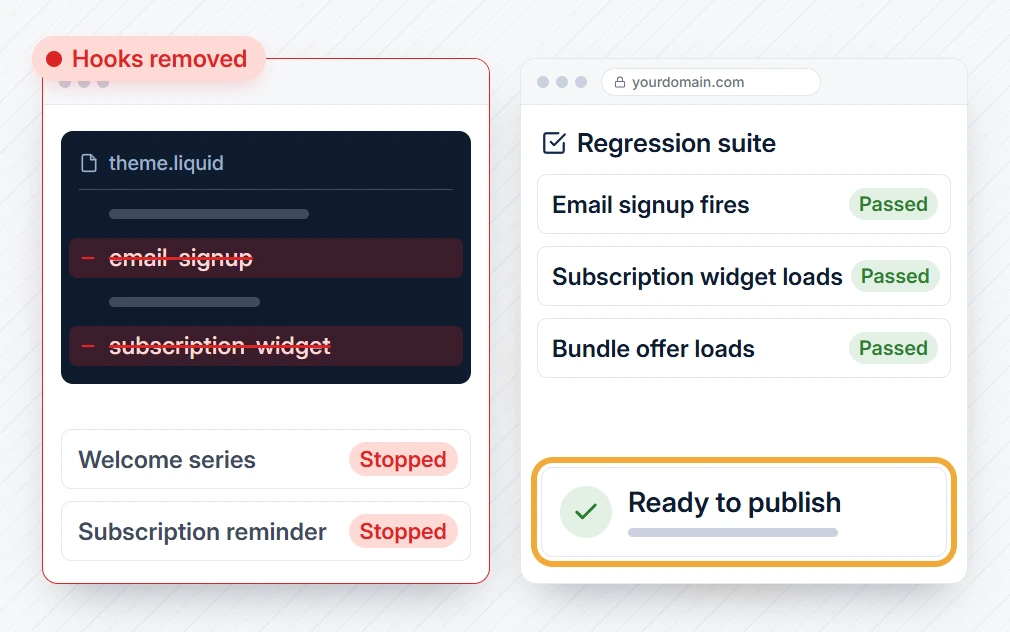
Ecommerce website maintenance theme diff that dropped app snippets, caught by a regression suite before publish
PROBLEM 01 · INTEGRATIONS

Shopify theme updates break Klaviyo, Recharge, and Bold app hooks silently

Shopify theme pushes overwrite the Klaviyo and Recharge snippets. Flows stop firing until sales dip and someone traces it.
THE FIX · APP-HOOK REGRESSION SUITE
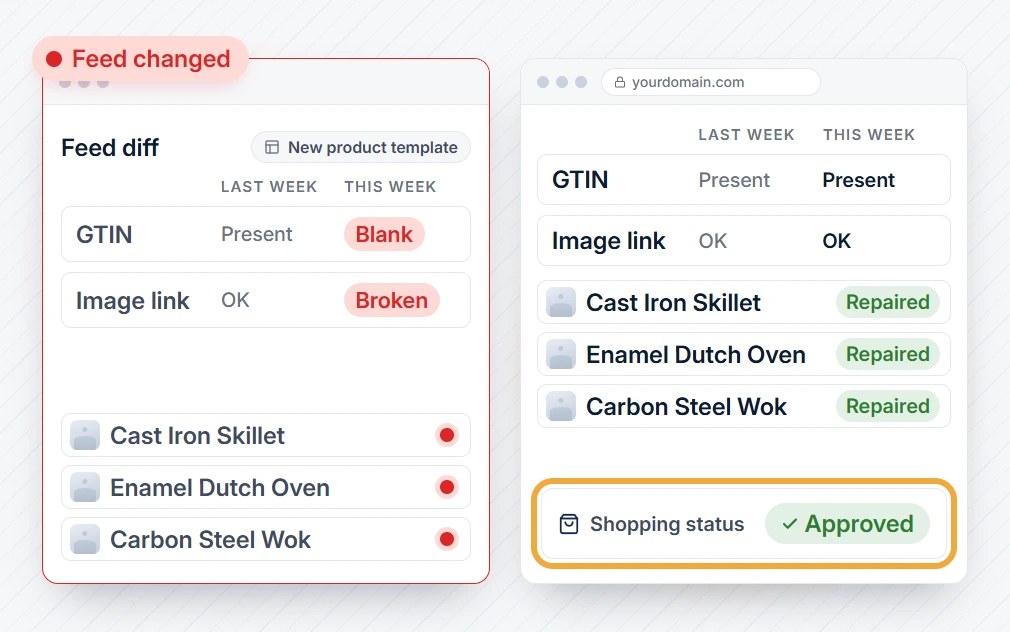
Ecommerce website maintenance feed diff showing GTIN and image fields broken by a template, then repaired
PROBLEM 02 · FEED

Merchant Center disapprovals spike after every theme or app change

New product templates drop GTIN or break image URLs. Merchant Center pauses Shopping 5 to 7 days later. Those products earn nothing from Shopping until the feed is repaired.

THE FIX · WEEKLY FEED DIFF + REPAIR
Ecommerce website maintenance mobile checkout speed sliding as pixels pile up, level again after an audit
PROBLEM 03 · CHECKOUT

Mobile checkout speed drops every time a new app or pixel gets installed

Every Klaviyo, Meta, TikTok, and Attentive pixel adds header script weight. LCP creeps past 4.8 seconds on mobile. Mobile CVR drops 12 to 18% before anyone notices, because desktop looks fine in QA.

THE FIX · MONTHLY PIXEL + SPEED AUDIT

Three outcomes every ecommerce maintenance retainer produces

Three terms in every store plan. RAFZ conversions rose 28% once its rebuilt store loaded in 2 seconds.

Ecommerce hosting uptime tracked and credited monthly

Real humans on call every hour. If your storefront drops, we know before shoppers do. 99.9% uptime SLA on every plan, with service credits when we miss the number.

Firewall on every plan, PCI and consent checks from Growth

Scans for card skimmers on checkout, weekly on Essential and daily from Growth up, plus a firewall at the edge and weekly patches. Growth and up add Consent Mode v2 checks, and quarterly PCI SAQ prep on WooCommerce.

Monthly content edits on every ecommerce tier

Image and CDN work, speed tune-ups from Growth up, plus content edits each month: 1 on Essential, 2 on Growth, 4 on Scale, custom on Enterprise.

Four stages. Every step ends in a sign-off

We start by mapping the store: platform, apps, payment gateway, Shopping feed and who owns each. Your team keeps running promotions while hosting, patching and monitoring happen without a ticket.

DAY 1

Access + baseline scan + first backup

Site admin, hosting, DNS, Shopify collaborator or WooCommerce API keys logged with rotation schedule. Off-site backup taken and restored on staging to prove it works before anything else touches the store.

SIGN-OFF: ACCESS + BACKUP
ONGOING

Managed hosting + CDN + WAF

Managed WordPress or LiteSpeed hosting for WooCommerce and headless. Cloudflare CDN with edge cache. WAF blocking bot and brute-force traffic before it reaches the origin. 99.9% written SLA on every plan with service credits when we miss.

MANAGED + CDN + WAF
WEEKLY

Patches tested on staging first

Core, plugin, and app updates tested on staging before they touch production. Rollback under 5 minutes if a patch breaks checkout. From Growth up, Klaviyo and Recharge hooks are regression-tested on every theme release.

ROLLBACK UNDER 5 MIN
24/7

Uptime + malware + speed watched

Every 60 seconds, 5 global POPs check that your store loads and the checkout webhook answers. Malware scans run daily from Growth up and weekly on Essential. A failed check pages a named engineer inside 30 minutes, nights and weekends included.

30-MIN CRITICAL RESPONSE SLA

What you actually get from our ecommerce website maintenance

Each tab lists the checks your team would otherwise run by hand: checkout, apps, the product feed and hosting.

ONBOARDING

Access, baseline scan, and first backup on day one

Before any change, we take a full backup of products, orders and customers and restore it on staging. The same day we record access to the store, its apps and its gateway, and scan security, speed and accessibility in writing.

Phase Duration: DAY 1 Sign-off: BASELINE SCAN
Ecommerce website maintenance onboarding checklist with products, orders and customers restored on staging
GATE · FIRST BACKUP VERIFIED

Access + credentials logged

Site admin, hosting, DNS, Shopify collaborator, analytics, and CRM API keys all logged with a rotation schedule.

Full site backup (off-site, verified)

Off-site backups from day one, nightly from Growth up and weekly on Essential, so a bad import or app can be undone to the last good catalog.

Baseline scan report

Security posture, Core Web Vitals baseline, plugin and theme health, disk usage, accessibility gaps. All captured before we touch anything.

Support process shared

Who to call, how to file a ticket and what the 30-minute critical-incident response means, sent to everyone who runs the store.

App-stack inventory

A list of every app and plugin with its version and license, and what stops working if it fails.

PCI + consent snapshot

Which gateway takes payment, how the cookie banner behaves and whether Consent Mode v2 reaches GA4 and Google Ads.

Get a free audit of your store's checkout, apps and speed in 24 hours

THREE FIXES YOU CAN APPLY · CHECKOUT, APPS AND FEED REVIEWED · Free, and ready before your next sale.

Get my website audit →

Four ecommerce maintenance tiers for every DTC store size

Choose by order volume and how many apps the store runs. Change tiers with 30 days notice as sales shift. Hover any feature name to see what it means.

Essential

$199MONTHLY

Stable sites that need patching, backups, and uptime

  • 24/7 uptime monitoring
  • SSL monitoring + auto-renewal
  • WordPress core + plugin patching
  • Security scans: Weekly
  • Backups: Weekly
  • Content edits / month: 1
  • Written weekly report
Get the Essential quote

Scale

$499MONTHLY

High-traffic sites and businesses running paid campaigns

  • 24/7 uptime monitoring
  • SSL monitoring + auto-renewal
  • WordPress core + plugin patching
  • Security scans: Daily
  • Backups: Daily + on-demand
  • Content edits / month: 4
  • Booking, scheduling or quote-form integration monitoring
Request a proposal

Enterprise

CustomMONTHLY

Multi-site estates and multi-brand groups

  • 24/7 uptime monitoring
  • SSL monitoring + auto-renewal
  • WordPress core + plugin patching
  • Security scans: Continuous
  • Backups: Custom
  • Content edits / month: Custom
  • Booking, scheduling or quote-form integration monitoring
Request a proposal

6-MONTH MINIMUM · ENTERPRISE 12 MONTHS · ROLLS ON 30 DAYS NOTICE AFTER · HOSTING INCLUDED · YOU OWN SITE, DOMAIN + DATA

Every maintenance feature, tier by tier

SCROLL THE TABLE SIDEWAYS FOR EVERY TIER
Uptime + security
FEATURE
ESSENTIAL
GROWTH
SCALE
ENTERPRISE
24/7 uptime monitoring
SSL monitoring + auto-renewal
WordPress core + plugin patching
Security scans
Weekly
Daily
Daily
Continuous
Backups
Weekly
Daily
Daily + on-demand
Custom
Content + integrations
FEATURE
ESSENTIAL
GROWTH
SCALE
ENTERPRISE
Content edits / month
1
2
4
Custom
Booking, scheduling or quote-form integration monitoring
—
Regulated-data form audit, where HIPAA or PCI applies
—
Schema drift monitoring
—
Performance + reporting
FEATURE
ESSENTIAL
GROWTH
SCALE
ENTERPRISE
Core Web Vitals tune-up
—
Quarterly
Monthly
Monthly
Written weekly report
Analytics + lead tracking health
—
Compliance + enterprise
FEATURE
ESSENTIAL
GROWTH
SCALE
ENTERPRISE
Annual compliance audit
—
—
Multi-site dashboard
—
—
—
Guaranteed support ticket response
48h
24h
Same day
4h
Case studies

Real ecommerce brands, real numbers

Each one includes where the client started, what we changed and what happened.
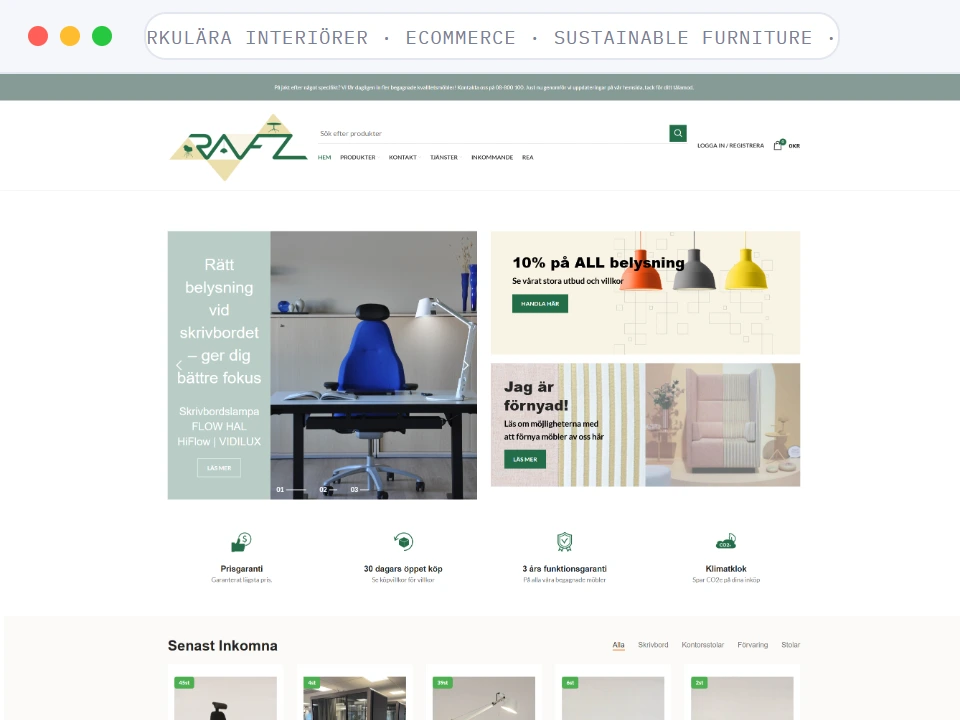
Homepage of RAFZ Cirkulära Interiörer, a Ecommerce · Sustainable Furniture · Sweden business, shown in a browser window Published case study

RAFZ Cirkulära Interiörer

RAFZ.SE

Ecommerce · Sustainable Furniture · Sweden Web Development · WooCommerce Development · API Integration

Grew RAFZ conversions 28% with a rebuild that loads in 2 seconds.

RAFZ Cirkulära Interiörer sells eco-friendly furniture in Sweden. Its site was heavy with plugins and took 15+ seconds to load, and shoppers left their carts. We rebuilt it on a light custom theme, tuned WooCommerce, added the place2place API and a repaint feature, and refocused the homepage on products. The site now loads in 2 seconds, server requests fell 82% and conversions rose 28%.

+28%
Conversions
2s
Page load
-82%
Server requests

Get a free audit of your store's checkout, apps and speed in 24 hours

THREE FIXES YOU CAN APPLY · CHECKOUT, APPS AND FEED REVIEWED · Free, and ready before your next sale.

Get my website audit →

Client words

The team split our national spend by store catchment. Every location got its own landing page and creative. Booked eye exams up 47% inside two quarters with the same media budget.
Karen Williams
Head of Marketing, Vision Express
Verified via NPS survey +47% booked eye exams Per-store attribution
Vision Express website homepage in a browser window, a prescription sunglasses offer above eye exam booking and eyewear
1 / 10

See what one day of downtime actually costs

Move the sliders to your numbers. This is your own revenue, divided by the days it arrives on.

4,000
200 50,000
$120
$20 $2,000
1.5%
0.5% 6%
A day of your own sales, from the traffic and conversion rate above. It does not count the ranking loss or the support hours an outage adds on top.
Revenue at risk per day offline
/day

Free · Written findings · Yours to keep

FAQ

Asked by ecommerce founders, answered

What multi-brand and single-store DTC teams ask most on quote calls, from hosting to Black Friday. Anything else, ask on the strategy call.

What is eCommerce maintenance?
Ecommerce website maintenance is the ongoing work that keeps a store fast, safe, and selling. That means uptime monitoring at 60-second intervals, weekly patches on your platform, app, and plugin stack, security scans, off-site backups, checkout regression tests, integration QA on Klaviyo and Recharge, Merchant Center feed diff, PCI posture, and weekly reporting. On a real DTC or Shopify Plus store, this is where a stray theme push or pixel install stops costing you orders. Generic care plans skip most of the ecommerce-specific pieces. A proper ecommerce plan wires the integrations, the checkout, the tracking, and the compliance into one covered scope with an SLA. Redefine Web runs this from $199 a month, with the Klaviyo, Recharge and feed checks from the $299 Growth tier, on a 6-month minimum term, 12 months on Enterprise, with hosting bundled on WooCommerce and headless setups. See the Shopify Help Center for the platform-side scope. Then map ours on top for the parts Shopify does not cover, like Klaviyo flows and Google feed diff.
How to maintain an e-commerce website?
Run ecommerce website maintenance on a fixed weekly cadence. Patch core, plugins, and apps on staging first, then roll to production once the checkout regression suite passes. Ping uptime every 60 seconds from at least 3 regions. Scan for malware daily. Back up off-site every night and test the restore monthly. Diff the Merchant Center feed every week and fix disapprovals same-day. QA Klaviyo, Recharge, and Bold flows after every theme deploy. Track Core Web Vitals from real Chrome UX Report field data, not lab scores. Review PCI posture and Consent Mode v2 every quarter. Send one clear weekly report every Friday covering uptime, page load, patches applied, tickets closed, and any incidents with root cause and fix. Founders should read it in 90 seconds. Use Google's Core Web Vitals guide for the field-data benchmarks we track against on every store. Anything below the green threshold gets a fix ticket the same week.
Which hosting is best for an eCommerce website?
The best ecommerce website hosting depends on your platform. Shopify and Shopify Plus stores run on Shopify's own infrastructure, and it is already tuned for peak carting traffic. Nothing to migrate. WooCommerce and headless WordPress stores need managed hosting with LiteSpeed or Nginx, isolated resources, an object cache sized to your catalog, and Cloudflare CDN with edge cache on top. Shared budget hosts choke during BFCM, so pick managed hosting with a written uptime SLA and a WAF at the edge. On Redefine Web ecommerce website maintenance plans, hosting is bundled on WooCommerce and headless setups from $199/mo, with a 99.9% uptime SLA on every plan and service credits if we miss the number. Cloudflare handles the DDoS shield, bot filtering, and static asset speed at the edge. See the Shopify developer docs if you are on Shopify and want to compare stack coverage before switching. For WooCommerce or headless, the audit maps your traffic pattern to the right tier.
How much does it cost to host an eCommerce website?
Ecommerce website hosting costs $199 to $499 a month at Redefine Web when bundled inside a maintenance plan. That covers managed WordPress or LiteSpeed for WooCommerce and headless, Cloudflare CDN, WAF, DDoS shield, SSL renewal, image optimization, and Core Web Vitals monitoring. Shopify stores host on Shopify's own infrastructure, which is included in your Shopify subscription, so our fee covers the maintenance work on top rather than the host itself. Standalone managed hosting on other providers runs $20 to $150 a month, but you still need someone to patch, monitor, back up, and secure it. Once you add real security posture, feed diff, checkout QA, and a 30-minute critical-incident response, the standalone approach lands at a higher all-in cost than a bundled plan. See the Merchant Center Help Center for the feed side, which Growth and up cover at no extra cost, along with same-day disapproval fixes.
Do WordPress websites need maintenance?
Yes, every WordPress site needs maintenance, and an ecommerce WordPress site needs it more than a brochure site. Core, PHP, MySQL, and every plugin ship security patches. Unpatched WordPress and WooCommerce plugins are the top vector for card skimmers and admin takeovers. Skipping updates for a quarter puts you one broken checkout away from a full rebuild. On an ecommerce store, the maintenance surface also covers payment gateway health, checkout regression, tax and shipping calculator checks, SSL renewal, subscription plugin QA, and Consent Mode v2 for GA4 and Google Ads. Without a weekly cadence, one plugin update kills the checkout and every hour offline costs 40 to 60 orders. Ecommerce WordPress maintenance runs $199 to $499 a month at Redefine Web with weekly patches on staging first, rollback under 5 minutes, and a written 99.9% uptime SLA on every plan. Backups run off-site, weekly on Essential and nightly from Growth up, with on-demand backups on Scale.
Is WordPress good for eCommerce?
WordPress is good for ecommerce when you run WooCommerce or a headless setup on managed hosting with a real maintenance plan behind it. It gives you full control of the checkout, the tax and shipping logic, subscription plugins, product data, and the CRO surface. That control is worth more than a hosted platform for stores over $500K a year in revenue that need bespoke funnels or B2B pricing tiers. It falls down when the site runs on cheap shared hosting and no one is patching. Then the store is one plugin update away from a broken checkout and lost sales. Shopify is a better fit for smaller stores that want zero infra work. Once the store is on WordPress or WooCommerce, treat ecommerce website maintenance as a fixed monthly cost, not a scramble. Redefine Web runs WooCommerce and headless stores from $199/mo with weekly patches and the uptime SLA on every tier from day one, and integration QA and Merchant Center feed diff from Growth up.
What does it cost to maintain a website monthly?
Website maintenance runs $50 to $2,000 a month depending on scope and stack. A brochure WordPress site with basic backups and updates lands around $50 to $150 a month. An ecommerce plan with the uptime SLA starts at $199 a month, and integration and checkout QA, feed diff, and PCI posture start at $299 on Growth. Stores on the Scale tier with an annual accessibility audit and 4 monthly content edits run around $499 a month at Redefine Web. Custom multi-store or Shopify Plus setups are quoted after a short audit. Cheap plans that only cover core updates fail on ecommerce because every plugin push and pixel install can break the checkout. A real ecommerce website maintenance plan covers the integration surface, the tracking, and the incident response, so a stray push does not cost you a Black Friday. Essential, Growth and Scale run a 6-month minimum term and Enterprise runs 12 months, then each rolls monthly on 30 days notice, so you can move up, down, or out.
How much does ecommerce website maintenance cost per month?
Ecommerce website maintenance at Redefine Web runs $199/mo for Essential, $299/mo for Growth, and $499/mo for Scale. Hosting is bundled on every tier. Multi-store and Shopify Plus setups are quoted after a short audit. Most growth-stage DTC brands land on the $299 Growth tier because it covers Shopify or WooCommerce patching, Klaviyo and Recharge health checks, weekly Merchant Center feed diff, a quarterly Core Web Vitals tune-up, PCI posture, and 2 content edits a month. Scale adds same-day ticket response, an annual accessibility audit, and 4 content edits. Essential, Growth and Scale run a 6-month minimum term and Enterprise runs 12 months, then roll monthly with 30 days cancellation notice. You keep the store, hosting, tracking, customer data, code repo, and app credentials at all times. Nothing gets held hostage on cancel. Move up or down a tier as order volume changes, add ad-hoc project hours for a checkout rebuild or subscription funnel test, or drop to Essential for a slow season.
What is included in an ecommerce website maintenance plan?
Every ecommerce website maintenance plan covers uptime monitoring at 60-second intervals, SSL renewal, Shopify or WooCommerce core patching, app and plugin updates on staging first, off-site backups, malware scanning, and a set block of edit tickets each month. Backups and scans run weekly on Essential and daily from Growth up. From Growth up, ecommerce-specific work sits on top of that: Klaviyo and Recharge flow QA after every theme change, Merchant Center feed diff each week, GA4 and Consent Mode v2 checks, checkout regression tests on iPhone SE and Pixel, and PCI posture reviews each quarter. BFCM prep starts each September. Load testing at 5x summer peak, third-party script audit, war-room rota, and rollback plan documented in writing. A weekly report every Friday covers uptime, average page load, patches applied, tickets closed, and any incidents with root cause. Everything the store needs to keep selling, in one covered scope with a written SLA. No overage bills at month-end and no support tickets that sit for days.
What happens when our ecommerce store goes down?
We usually know before you do. Five global POPs check your storefront, cart and checkout webhook every 60 seconds, so a failed check raises an alert within a minute. A named engineer is on it inside 30 minutes, nights and weekends included. If a patch or app update caused the outage, rollback takes under 5 minutes. If a host, payment gateway or third-party app is at fault, we work the fix with them. The founder and ops lead get updates until orders flow again. On Shopify, where Shopify runs the servers, we watch the same signals and chase the app or theme change behind the break. Within 48 hours you get the root cause and fix in writing. The month's uptime is then measured against the 99.9% SLA, and a miss earns a service credit.
Do ecommerce care plans include content, product, and CRO edits?
Yes. Essential includes 1 content edit a month. Growth includes 2, with ticket response inside 24 hours. Scale includes 4 each month. Edits cover PDP copy changes, hero swaps, promo bar work, product image updates, meta title tweaks, redirect adds, and small feature builds like a size guide or a shipping calculator. Deeper CRO work like a full PDP redesign, checkout rebuild, or a subscription funnel test runs as a separate project scoped from the audit. We do not use up your monthly edits on a project and then bill you for it. Every edit lands in the weekly report with time spent, files touched, and result. Unused edits roll over one month. Two months if you flag it in advance. The Klaviyo blog has good pattern references, see Klaviyo Blog for flow templates worth checking during onboarding and quarterly reviews.
Are ecommerce care plans PCI and accessibility aware?
Yes. PCI compliance sits at the platform level on Shopify and Shopify Plus and gets QA tested on every release. On WooCommerce, every plan enforces HTTPS, and from Growth up we run quarterly PCI SAQ prep and Stripe or Braintree posture checks. A WCAG 2.1 AA accessibility audit runs each year from Scale up. Cookie consent, GDPR, and state privacy banners get monitored as regulations change. From Growth up, Consent Mode v2 on GA4 and Google Ads is validated each quarter so paid tracking does not drift. Scale tier adds a written accessibility statement update each year. Every compliance check lands on the weekly report with pass or fail against the previous quarter. If posture drops on any item, a fix ticket opens the same week with the deadline in writing. On WooCommerce, we log every plugin that touches PII and rotate their credentials on the schedule. Nothing sits stale between quarterly reviews, and every rotation is documented in the audit trail.
Can we cancel or pause the maintenance plan?
Yes. Essential, Growth and Scale run a 6-month minimum term and Enterprise runs 12 months. Leaving inside the minimum term means paying the remaining months of the term. After that, plans roll on a 30-day cancellation window. You keep the store, hosting, tracking, customer data, code repo, and app credentials. Nothing gets held hostage on our side of the retainer. Hosting migration off our stack is straightforward on WooCommerce, and the written migration steps go to the team you move to. Shopify stores just drop the retainer with no extra step. Seasonal brands have an option too. If the store goes quiet from January to April, move down to Essential at $199/mo on 30 days notice, then back up when the season starts. Cancel does not trigger a re-onboarding fee if you come back inside 12 months. Access, credentials, and app inventory stay on file in a secure vault so a restart takes days, not weeks. Every retainer rolls monthly after its minimum term, and every cancel gets confirmed in writing the same day.
How do you prep an ecommerce store for BFCM?
BFCM prep starts every September. Week 1 is a real traffic-load test at 5x the store's summer peak. Week 2 is checkout stress test, third-party script audit, and Klaviyo, Recharge, and Bold flow QA. Week 3 is Merchant Center feed cleanup and GA4 event validation. Week 4 is a war-room dry run. Black Friday through Cyber Monday runs on a named on-call rota. If checkout throws a 500 or Shopify Plus rate-limits an app, we are in the incident before the first customer support ticket lands. Post-mortem inside 5 business days. Rollback paths documented on every release from October 1 forward so a bad push reverts in under 5 minutes. Origin scaled to peak, not average traffic. The prep also covers hero SKU tracking, creative freeze dates, and a named ops lead paged if anything trips overnight. The September prep weeks are quoted separately, and the 30-minute critical-incident response runs on every plan.

Free · Written in 24 hours · No pitch

Get your free website audit.

A written report in your inbox within 24 hours, with three fixes you can ship the same week, whether or not you hire us.

Written in 24 hours · 10,000+ audits run · 300+ clients since 2021