In this article
- Shopify Plus costs $2,300 a month on a 3-year term or $2,500 on a 1-year term, before card fees.
- Shopify doesn't publish its variable platform fee, and outside guides quoting 0.25% to 0.40% of revenue disagree on the threshold.
- Plus cuts the online card rate from 2.5% to 2.25% plus 30 cents, saving $250 per $100,000 in card sales.
- On card savings alone, Plus overtakes Advanced only near $760,000 a month in online card sales.
- The Plus trial costs $399 a month for one to two months, then rolls into a full Plus contract.
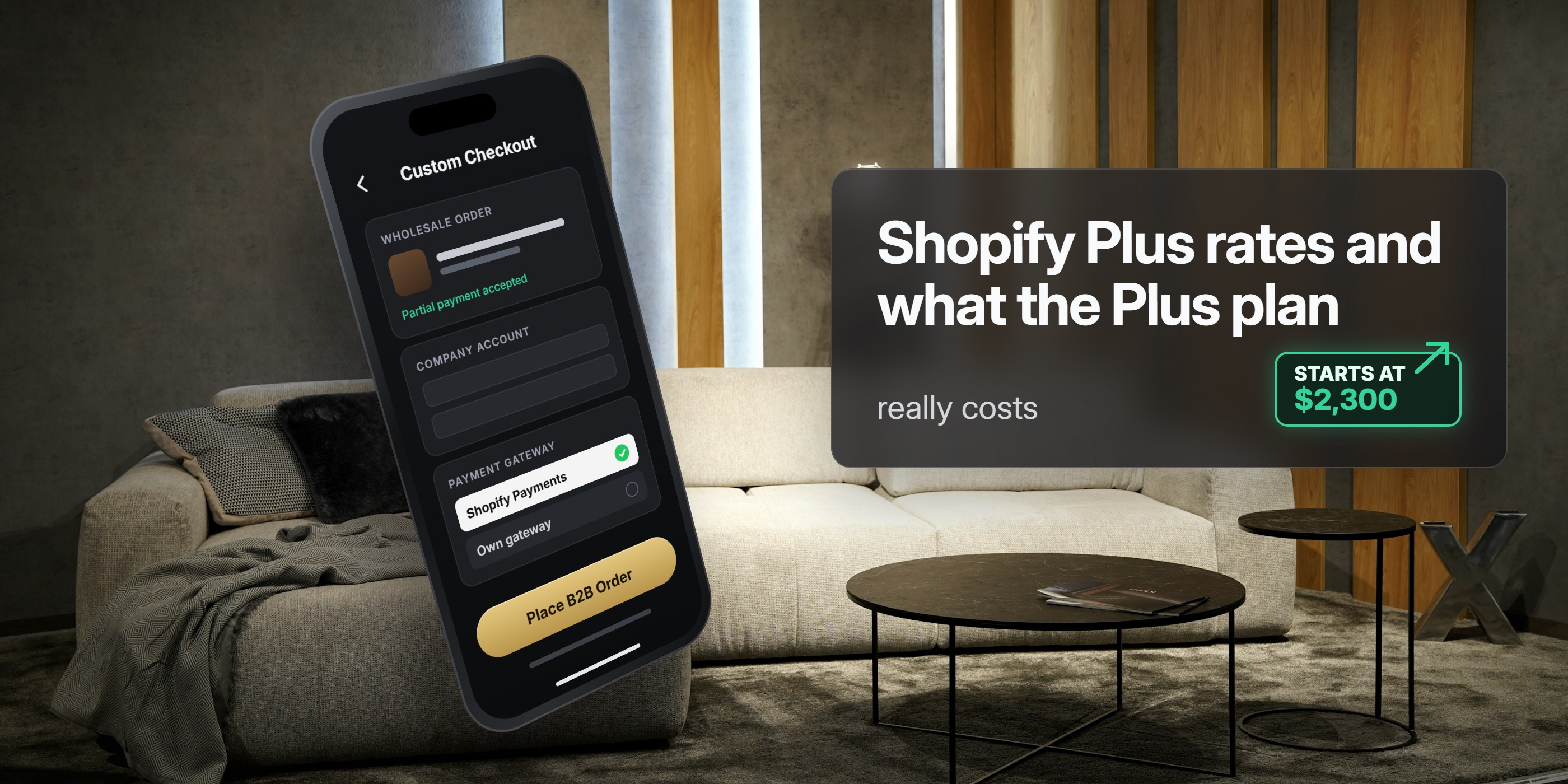
Shopify Plus rates start at $2,300 a month on a 3-year contract or $2,500 a month on a 1-year contract, and stores with more complex setups or higher volume move to a variable platform fee based on revenue. On top of that, Plus charges online card rates from 2.25% plus 30 cents through Shopify Payments, or 0.2% per order if you use your own payment gateway.
That headline number is the easy part. What decides whether Plus saves you money or costs you more than $20,000 a year extra is the contract term you sign, whether the variable fee applies to you, how much of your revenue runs through cards, and how many of Plus’s features you would actually switch on. Sign for three years on the strength of a feature list and you’re locked into the fee until the term ends, whether you use those features or not.
What are the Shopify Plus rates for the platform itself?
Shopify’s Plus pricing page lists two terms. A 1-year term starts at $2,500 a month, and a 3-year term costs $2,300 a month, both in US dollars. Shopify’s help center gives the same figures for the United States and for any country without a supported local billing currency, and its main pricing page shows “Starts at $2,300 USD/mo” in the Plus column.
Over a full contract, that’s $30,000 for the 1-year term and $82,800 across the 3-year term. The longer term saves $200 a month, or $7,200 over three years, in exchange for a much longer commitment. Shopify’s pricing page is direct about what that commitment means. “If you choose a 1- or 3-year Plus subscription, you can cancel when your term commitment expires.”
Both terms cover what Shopify calls “standard setups and integrations.” Your main store and up to 9 expansion stores are included in the monthly fee, along with unlimited staff accounts, up to 200 inventory locations and priority support around the clock. Shopify also says it doesn’t charge you to migrate, though paid services are available if you want help. What the fee doesn’t cover is card processing, apps, themes and any custom development, which the later sections break down.
How does the Shopify Plus variable platform fee work?
Shopify describes it in one sentence on its Plus pricing page. “More complex, higher volume businesses switch to a variable platform fee based on their revenue and business model.” It doesn’t publish the percentage or the revenue level where the switch happens. The page tells you to get in touch with sales, and Shopify’s help center adds that the variable fee “differs for B2B and D2C companies.”
So every number you’ve seen for it comes from someone outside Shopify, and those numbers don’t agree. Fuelmade, a Shopify agency, says the switch happens once monthly sales pass roughly $1 million, at 0.25% of monthly revenue on a 3-year term or 0.40% on a 1-year term. GemFind says the threshold is generally around $800,000 a month, at 0.35% on a 3-year contract or 0.40% on a 1-year contract, with a monthly ceiling of $40,000. Both describe the fee as replacing the flat fee rather than stacking on top of it. GemFind’s own numbers don’t line up, though. At its $800,000 threshold, 0.35% comes to $2,800 a month, already more than the $2,300 flat fee it would replace.
A third guide, from the profit-tracking app TrueProfit, matches GemFind at 0.35% to 0.40% above roughly $800,000 a month with a $40,000 cap. Read all three with care. TrueProfit and Fuelmade both list the Plus online card rate as 2.15% plus 30 cents, while Shopify’s own pricing page shows 2.25% plus 30 cents for Plus. Rates move between when a guide is written and when you read it, and if outside guides can drift from a number Shopify publishes, their figures for one it doesn’t publish are estimates at best. They also disagree on bargaining room. Fuelmade says “The base platform fee is fixed and not negotiable.” Anatta, another Shopify agency, says the contract term, the variable rate and migration credits are all open to negotiation.
Here’s why the gap matters. On $1 million in monthly sales, 0.25% is $2,500 a month and 0.35% is $3,500, a $12,000 difference over a year from the same revenue. If your store is anywhere near those revenue levels, the variable fee is the number to negotiate, so ask Shopify for the rate, the threshold and any cap in writing, and check whether B2B orders are charged differently from your direct-to-consumer orders.
What card rates and transaction fees come with Shopify Plus?
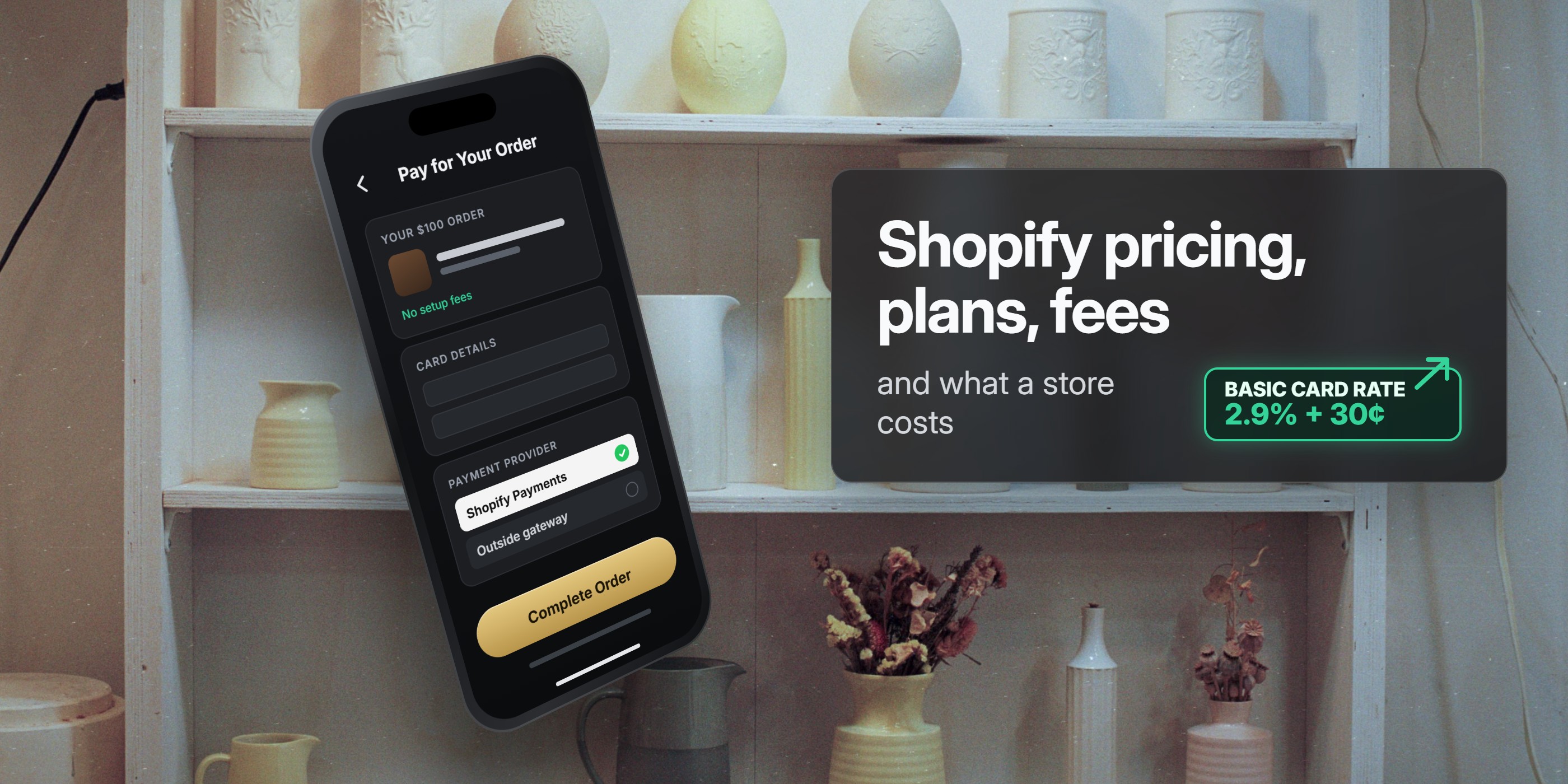
Shopify Plus rates for card payments are the lowest of any Shopify plan. Shopify’s main pricing page lists them for US stores using Shopify Payments, and here they are next to Advanced, the plan most stores move up from.
| Payment type | Advanced | Plus |
|---|---|---|
| Standard US consumer card, online | 2.5% + 30¢ | 2.25% + 30¢ |
| Premium card such as Amex or a business card, online | 3.1% + 30¢ | 2.95% + 30¢ |
| International card, online | Standard rate + 1% | Standard rate + 1% |
| Card in person | 2.4% + 10¢ | 2.3% + 10¢ |
| Card details entered by hand in person | 3.5% + 10¢ | 3.4% + 10¢ |
| Third-party payment provider | 0.6% per order | 0.2% per order |
Orders paid through Shopify Payments carry no third-party transaction fee. If you keep your own processor as the main gateway, the Plus pricing page says you pay your processor’s fees “plus 0.20% per transaction to Shopify for security and compliance costs.” The same page also says “Card rates vary by country.” If your store is billed outside the US, get your rates from Shopify directly.
One fee catches Plus stores that sell made-to-order or preorder items. On Plus, you can hold a card authorization for longer than the standard 7 days, up to 30 days on Visa, Mastercard and American Express. Shopify’s help center says “A 1.75% additional charge applies when capturing after the standard 7-day period.” Capturing a $1,000 order on day 20 costs you an extra $17.50 on top of the card rate.
Shopify Advanced vs Plus, where the math turns
Our guide to Shopify pricing covers Basic, Grow and Advanced in full, so this section looks only at the step from Advanced to Plus. Advanced costs $399 a month on monthly billing, and less if you pay for a year up front. Plus costs at least $2,300, so the gap is about $1,900 a month against Advanced’s monthly price, before card fees.
Lower Shopify Plus rates on card sales earn some of that back. The 0.25-point lower online rate saves $250 for every $100,000 in online card sales. The table shows the monthly cost of each plan at four sales levels, assuming all sales run through Shopify Payments on standard US cards, Advanced billed monthly, Plus on the 3-year flat fee, and 30 cents an order left out because it’s the same on both plans.
| Monthly online card sales | Advanced, $399 + 2.5% | Plus, $2,300 + 2.25% | Difference |
|---|---|---|---|
| $100,000 | $2,899 | $4,550 | Plus costs $1,651 more |
| $250,000 | $6,649 | $7,925 | Plus costs $1,276 more |
| $500,000 | $12,899 | $13,550 | Plus costs $651 more |
| $800,000 | $20,399 | $20,300 | Plus saves $99 |
On card savings alone, Plus overtakes Advanced near $760,000 a month in online card sales, measured against Advanced’s monthly price. That’s close to where outside guides say the variable fee may start, so the flat-fee version of this table may never apply to you. The practical reading is that Plus rarely pays for itself through card rates. Stores move to it for what it lets them do, and if you’re using an outside gateway, the 0.4-point gap in third-party fees moves the crossover down to about $475,000 a month.
What does Shopify Plus include that Advanced doesn’t?
Shopify’s pricing page and help center list the Plus-only items. These are the ones that tend to justify the fee, because each replaces a cost you’d otherwise pay elsewhere or removes a limit Advanced sets.
- Checkout. Full checkout customization on Plus against limited customization on Advanced.
- Stores and storefronts. Your main store plus up to 9 expansion stores, and up to 25 headless storefronts against 1 on Advanced.
- Staff and locations. Unlimited staff accounts against 15, and up to 200 inventory locations against 10.
- Wholesale. Unlimited B2B catalogs against 3, plus deposits, partial payments and direct catalog assignment to companies.
- Custom logic. Custom apps built with Shopify Functions, API rate limits up to 10 times the standard on select APIs against up to 2 times on Advanced, and Launchpad for scheduled and automated promotions.
- Testing room. Up to 100 themes in your account, unlimited staging stores and 1 TB of file storage per store.
- Support. Priority phone and chat support around the clock, against enhanced live chat on Advanced.
The headless allowance is the item most often priced wrong. Plus lets you build up to 25 custom storefronts with Hydrogen and deploy them on Oxygen, and Shopify’s pricing page says the React-based headless stack comes “at no extra cost.” The build itself is not free, though, and a custom front end has to be maintained by someone. Read our guide to headless Shopify before you count it as a reason to upgrade.
What does checkout customization on Plus actually buy you?
Checkout is one of the clearest functional gaps between Advanced and Plus, with full customization on Plus against limited customization on Advanced. Shopify’s help center says Plus gives you the Checkout Branding API for visual changes, checkout extensions for adding your own elements, and the ability to run separate checkout flows for B2B and direct-to-consumer buyers in the same store. You can also create custom shipping discounts with Checkout Blocks.
In cost terms, that changes what you pay apps and developers rather than what you pay Shopify. Shopify’s Plus trial page names third-party checkout apps such as ReBuy and AfterSell among the customizations Plus allows, using app blocks inside checkout. If a checkout change is worth a measurable lift in conversion on your volume, that lift is part of the case for the Plus fee. If you can’t name the change, it isn’t.
Keep the downgrade risk in mind. Shopify’s help center says that if you leave the Plus trial, app blocks you added to checkout pages are removed, while blocks on the Thank you and customer accounts pages stay, so anything you build inside checkout depends on staying on Plus. Our guide to Shopify checkout customization covers what you can change on each plan.
What does wholesale and B2B cost on Shopify Plus?
B2B selling isn’t exclusive to Plus. Shopify’s help center says core B2B features, including companies, up to 3 catalogs, net payment terms and self-serve ordering, stay available on Basic, Grow and Advanced. What Plus adds is unlimited catalogs, direct catalog assignment to companies and locations, deposit requirements, partial payments and payment requests per fulfillment.
Those extras matter if you sell to many buyers on different price lists, or take large orders that need a deposit before production. They matter less if you have a handful of wholesale accounts on one or two price lists. The other cost point is the platform fee itself. Shopify’s help center says the variable platform fee “is different for B2B and Direct to Customer (D2C) orders.” A store with a large wholesale channel should ask how B2B revenue is counted before signing.
If wholesale is the main reason you’re looking at Plus, compare it with the other options first. Our breakdown of B2B on Shopify Plus and the platforms it competes with goes through what each one charges for the same features.
How much do extra stores, locations and staff cost on Plus?
Most of them cost nothing extra up to a limit, and the limits are generous. Shopify’s Plus pricing page says “Your main store and 9 expansion stores are included as part of your monthly platform fee.” Past that, it says additional stores cost “an extra $300 USD per month per store, or a revenue share across all stores.” Staff accounts are unlimited, and Plus supports up to 200 inventory locations.
Two rules change the math for groups with more than one brand. Plus allows unlimited online stores but only one brand per contract, so a company with three brands needs three Plus contracts, and three platform fees. And Shopify’s help center says each live expansion store needs its own theme license, so a paid theme has to be licensed again for every live expansion store that uses it.
Retail is the other line. Shopify’s help center says the first 20 POS Pro locations are included in every Plus plan, and if you run more than 20 with Shopify Payments as your main provider, POS Pro is waived for your first 200 retail locations. On Advanced, POS Pro is $89 a month per location, so a chain with 20 stores would pay $1,780 a month for it on Advanced and nothing extra on Plus. For a retailer with many locations, that one line can cover most of the gap between the two plans.
What does Shopify Plus cost beyond the platform fee?
We work on Shopify Plus stores, so we have a stake in this section. We don’t quote our own Plus prices here. The figures below come from other firms’ published guides, and we aren’t a Shopify Plus Partner.
Shopify’s own pricing page lists the other costs as optional one-time theme purchases, any third-party apps you need, and custom development if your build needs it. The guides that price those lines give wide ranges. GemFind puts a move up from Shopify Advanced at “typically ranging from $10,000 to $30,000” for theme adjustments, checkout setup and an app audit, and a migration from Magento or WooCommerce at $50,000 to $250,000 or more. Fuelmade estimates that a typical Plus store spends $4,000 to $10,000 or more a month all-in, once processing, apps and development are counted.
The spread is scope. A store that already runs on Shopify and needs checkout changes sits at the low end. A replatform with ERP integration, years of order history and thousands of redirects sits at the high end. Ask anyone quoting you, us included, to price the migration, the integrations and the ongoing work as separate lines, and compare them against how build quotes are usually tiered. Then budget for the upkeep, because a Plus store still needs app updates, theme fixes and monitoring every month, and our breakdown of what ecommerce maintenance costs shows how those lines add up.
How much does the Shopify Plus trial cost?
The Plus trial isn’t free. Shopify’s help center says “The Shopify Plus trial is a paid trial.” It costs $399 USD per month for US billing, and it runs 1 to 2 months depending on your store’s status. It gives you most Plus features, including checkout customizations, custom apps with Shopify Functions, headless storefronts, 200 locations, Launchpad and unlimited staff accounts.
The part to plan around is the end. Shopify’s help center says that if you take no action by the end of the trial, “your store is automatically enrolled in a full Plus plan.” The term is the one you picked during trial setup. So choose the term carefully when you start the trial, not when it ends, and put the end date in your calendar.
Leaving the trial has costs of its own. Shopify lists what you lose when you downgrade, including Plus-only B2B features, headless storefronts beyond one, Launchpad events and checkout app blocks. Locations, staff and markets above your new plan’s limits are deactivated automatically. Use the trial to test the two or three features that would justify the fee, and keep a note of everything you change, so a downgrade doesn’t break your store.
How does Plus compare with a custom or enterprise platform?
If you’re weighing Plus against an enterprise platform or a custom build rather than against Advanced, the comparison flips. The Plus fee then has to be set against hosting, security patching, upgrades and the engineering time a self-run platform needs. Shopify’s Plus pricing page frames its fee around that trade, saying Plus lets you use your developers “to drive growth with unique builds, while relying on Shopify for your checkout and platform.”
That claim is Shopify’s, and it holds only if your team actually stops spending time on hosting, security and upgrades once you move. Before you compare a Plus quote with a replatform quote, total what your current platform costs to keep running each year, including developer hours spent on maintenance rather than new work. Our analysis of custom platform maintenance over 36 months lays out the cost lines to count. Plus also brings its own limits, chiefly one brand per contract and a checkout you customize through Shopify’s tools rather than rebuild from scratch.
Where we would start if you’re weighing Plus
Start with the features, not the rates. Write down which Plus-only features you’d switch on in the first 90 days, such as checkout extensions, B2B price lists, expansion stores or POS Pro locations, and put a dollar figure next to each one. If the list doesn’t cover the gap of roughly $1,900 a month over Advanced, stay on Advanced. The card savings won’t close it below about $760,000 a month in online card sales.
If the list does cover it, get three numbers from Shopify in writing before you sign. Ask for the flat fee on each term, the variable fee rate and threshold for your revenue and business model, and your card rates if you’re billed outside the US. Pick the 1-year term unless you’re confident in the next three years of your roadmap, because the 3-year term saves $7,200 but you can only leave when it expires. Then use the paid trial to prove the features you listed actually work in your store.
Your next step is to run your own monthly sales through the Advanced and Plus columns above and see which side of the crossover you’re on. If Plus comes out ahead and you’d rather not run the migration yourself, that’s work our Shopify Plus agency team takes on, and you can hold our quote to the same tests as anyone else’s.
Frequently asked questions
Are Shopify and Shopify Plus the same?
They run on the same platform, but Plus is Shopify's top plan with its own pricing and features. Plus costs $2,300 a month on a 3-year term or $2,500 on a 1-year term, against $399 a month for Advanced on monthly billing. It adds full checkout customization, up to 9 expansion stores, unlimited staff, 200 inventory locations and unlimited B2B catalogs, and lowers the US online card rate to 2.25% + 30¢.
Is Shopify Plus worth it?
Shopify Plus is worth it when the features you would use cover the extra $1,900 or so a month over Advanced. Card savings alone only close that gap near $760,000 a month in online card sales. Stores usually justify it through checkout customization, wholesale price lists, expansion stores for other countries or POS Pro across many retail locations. If you can't name the features you'd switch on, Advanced is the cheaper choice.
What does Shopify Plus include?
Shopify Plus includes your main store and up to 9 expansion stores, unlimited staff accounts, up to 200 inventory locations and priority support around the clock. It adds full checkout customization, custom apps built with Shopify Functions, up to 25 headless storefronts, unlimited B2B catalogs with deposits and partial payments, Launchpad, unlimited staging stores and the lowest card rates of any Shopify plan.
How much does Shopify Plus cost per month?
Shopify Plus costs $2,300 a month on a 3-year term or $2,500 a month on a 1-year term in the US. More complex, higher-volume stores move to a variable platform fee based on revenue, and Shopify doesn't publish that rate. Card processing is extra, from 2.25% + 30¢ on online US card sales, and the paid Plus trial costs $399 a month.
How much does Shopify Advanced cost?
Shopify Advanced costs $399 a month on monthly billing in the US, and less if you pay for a year up front. It charges online card rates of 2.5% + 30¢ through Shopify Payments and a 0.6% fee on orders through an outside payment provider. It includes 15 staff accounts, 10 inventory locations and live third-party shipping rates at checkout.
Is Shopify Advanced worth it?
Shopify Advanced is worth it over Grow when you need its features, mainly 15 staff accounts and live third-party shipping rates, or when your online card sales are high enough for its lower rate to cover the price gap. Advanced costs $294 a month more than Grow on monthly billing and takes 0.2 points off the online card rate, so the rate alone pays for it near $147,000 a month in online card sales.
How do I know if I'm on Shopify Plus?
Check the plan details in your Shopify admin. Go to Settings, then Plan, and the Plan details section names your current plan, including whether you're on the paid Plus trial or the full Plus plan. If you're on the trial, the same section offers an Upgrade early option, which asks you to confirm a 1-year or 3-year term before you subscribe.
Can you have multiple storefronts on Shopify?
Yes. On Shopify Plus, your main store and 9 expansion stores are included in the platform fee, and Shopify charges $300 a month for each additional store or a revenue share instead. Plus also allows up to 25 headless storefronts, against 1 on the other plans. Each Plus contract covers one brand, so a second brand needs its own contract.
What does a Shopify Plus development agency do?
A Shopify Plus development agency plans and builds the parts of a Plus store that the platform leaves to you. That usually means migrating products, customers, orders and redirects, customizing checkout with Shopify's extension tools, building custom apps with Shopify Functions, setting up B2B catalogs and expansion stores, and connecting ERP or inventory systems. Shopify doesn't charge you to migrate, so that work is billed by whoever does it.