In this article
- The Census Bureau counts a sale as ecommerce when the order is placed online, even if payment comes later.
- Retail ecommerce was 16.4% of U.S. retail sales in the third quarter of 2025, seasonally adjusted, so stores still lead.
- At Square's paid-plan online rate, a $50 card order costs you $1.75 before shipping, returns or ads.
- Retailers expected 19.3% of online sales to be returned in 2025, against 15.8% of all retail sales.
- Since the 2018 Wayfair ruling, a state can require you to collect its sales tax with no physical presence there.
What is an ecommerce business? It’s any business that sells products or services where the customer places the order online. That can be a website, an app, a marketplace such as Amazon or Etsy, or a system that passes purchase orders between companies. What you sell matters less than where the sale happens. A bakery shipping cookie boxes ordered on its site is one. So is a parts supplier whose trade customers reorder through an online portal.
If you’re asking, you’re probably weighing a second question too, whether to start one or how to run the one you have. The word online hides most of the work. You still buy or make stock, pay a fee on every card sale, ship by a deadline federal rules set, take returns, collect sales tax in states you may never visit and pay to be found. Each section below takes one of those jobs, with the sourced numbers behind it, so you can judge whether the business fits you.
What is an ecommerce business, by the official definition?
The cleanest definition comes from the U.S. Census Bureau, which measures online sales every quarter. Its reports define ecommerce sales as “sales of goods and services where the buyer places an order, or the price and terms of the sale are negotiated over an Internet, mobile device (M-commerce), extranet, Electronic Data Interchange (EDI) network, electronic mail, or other comparable online system.” The next sentence matters just as much. “Payment may or may not be made online.”
Three things follow from that wording, and each one changes how you see your own business.
- The order decides it, not the payment. A wholesale buyer who orders through your site and pays by invoice a month later is still an ecommerce sale.
- Services count. The definition says goods and services, so a studio selling class passes online and a software company selling subscriptions both qualify.
- A shopping cart is optional. Under that definition, a purchase order sent by email or passed over EDI from one company’s system to another’s counts, with no cart involved.
An ecommerce business, then, is one where that kind of sale is the main way money comes in. A furniture maker with a busy showroom and a few web orders sells online. A furniture maker whose orders mostly arrive through its site is an ecommerce business, and its costs, risks and marketing all follow from that fact.
Ecommerce in business is still a minority of retail sales
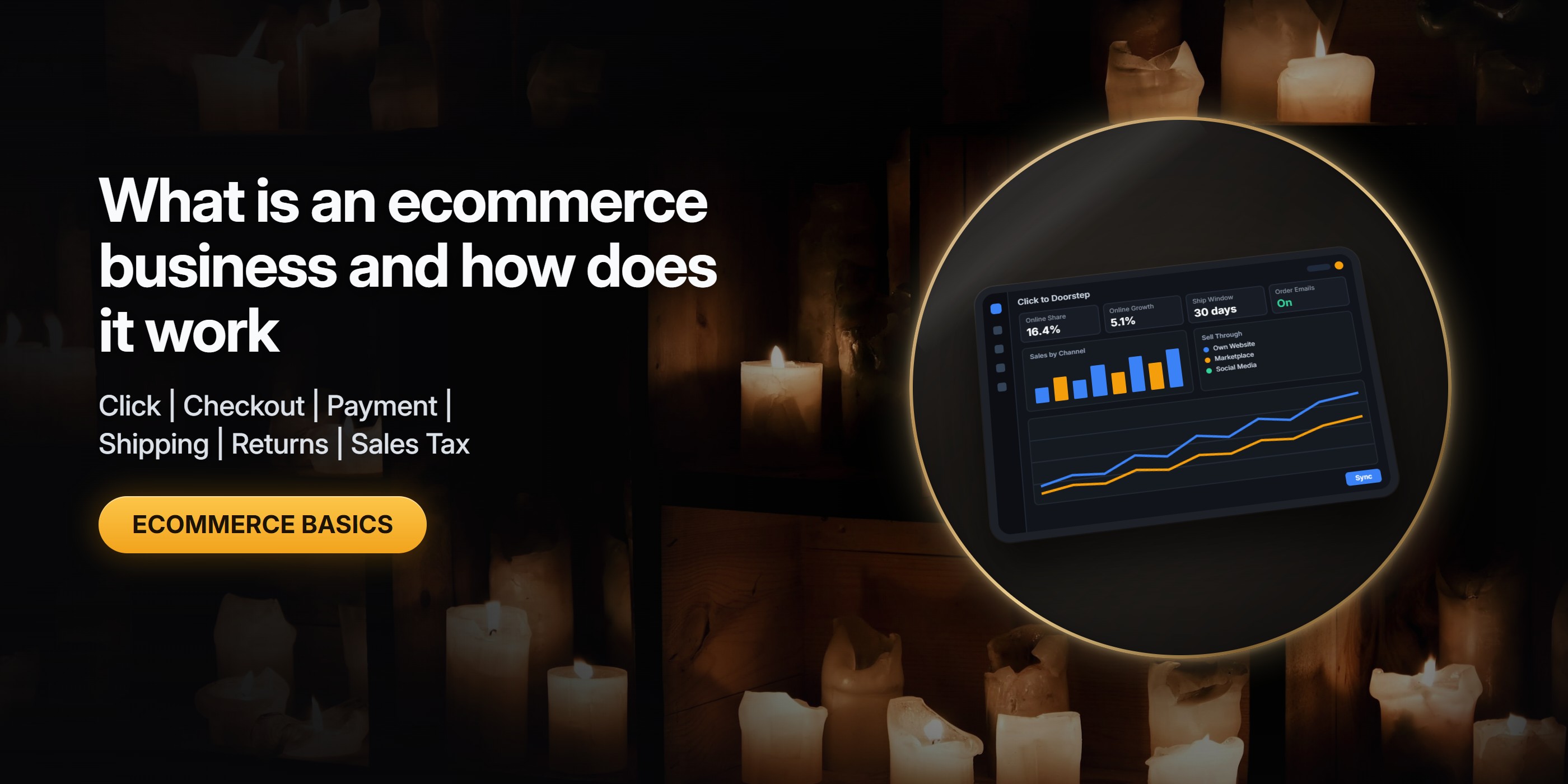
The Census Bureau has measured ecommerce in business since the fourth quarter of 1999, and online sales are still the smaller share of what Americans spend at retail. Its quarterly report released on December 18, 2025 put U.S. retail ecommerce sales for the third quarter of 2025 at $310.3 billion, adjusted for seasonal variation. That was 16.4% of total retail sales of $1,893.6 billion.
The share moves slowly, as the five quarters in that report show.
| Quarter | U.S. retail ecommerce sales, adjusted | Share of total retail sales |
|---|---|---|
| Third quarter 2024 | $295.2 billion | 16.2% |
| Fourth quarter 2024 | $300.4 billion | 16.2% |
| First quarter 2025 | $299.9 billion | 16.1% |
| Second quarter 2025 | $304.5 billion | 16.3% |
| Third quarter 2025 | $310.3 billion | 16.4% |
The growth rate tells you more than the share. Online sales rose 5.1% from the third quarter of 2024, while total retail sales rose 4.1%. Ecommerce is taking share a little at a time rather than replacing stores.
For you, that means most of your customers still shop in stores too. They compare your delivery time and return terms with what a store hands them on the spot, so your offer has to beat walking in, not just match another website.
How does an ecommerce business work from click to doorstep?
Every online sale runs through the same chain, whether you sell candles or valves. Deciding who handles each link is most of what starting an online store actually means.
- A shopper finds you through search, an ad, a marketplace listing, social media or an email.
- The product page makes the case with photos, the price, stock status and a delivery estimate.
- Checkout takes the payment. A payment processor authorizes the card and deposits the money, minus its fee, into your bank account.
- The order goes to whoever ships it, which is you, a fulfillment warehouse or a supplier that ships on your behalf.
- The parcel leaves on time and the buyer gets a tracking email.
- Support and returns close the loop, and how they go decides whether there’s a second order.
Step five carries a legal deadline many new sellers don’t know about. Under the Federal Trade Commission’s Mail, Internet, or Telephone Order Merchandise Rule, you need a reasonable basis to expect you can ship within the time you state. If you state no time, the rule sets it at 30 days after you receive a properly completed order, or 50 days when the buyer applies to you for credit to pay.
Miss that window and the rule requires you to offer the buyer a choice, either to accept the delay or to cancel and get a prompt refund. So your shipping promise is a commitment, and every link in the chain above has to be able to keep it.
What ecommerce website features does a store need?
An ecommerce website is the storefront where those orders are placed, and the business is everything behind it, from stock and shipping to returns and sales tax. An ecommerce business website has a narrower job than a brochure site. It has to turn a stranger into a paid order you can ship, with nobody on hand to help. Check that yours does these things before you launch.
- Product pages with real photos, a clear price, stock status and a delivery estimate you can keep.
- A checkout that takes cards and the wallets your buyers use, and shows shipping and tax before the final step.
- Tax and shipping settings that calculate correctly for every state and zone you sell into.
- Order emails for confirmation, shipment and delays, since the shipping rule above expects you to tell buyers about a delay.
- Policy pages for returns, shipping and privacy, linked from the footer and the checkout.
- Analytics that record orders and revenue, not just visits.
- Pages that load fast and work on a phone, since a checkout that breaks on a small screen loses the sale.
The software comes after the list, not before it. A hosted platform rents you the whole stack for a monthly fee, while open-source software runs on hosting you pay for and maintain. WooCommerce, for example, describes itself as “the open-source ecommerce platform for WordPress” and says its core platform is free, though you pay separately for hosting and for any paid extensions. Our ecommerce platform comparison sets the main options side by side.
What types of ecommerce businesses are there?
Ecommerce businesses are usually sorted by who sells to whom. The type you choose sets your order size, your sales cycle and how you price, so settle it before you design anything. Our guide to ecommerce business models goes deeper into each one, and the short version fits in a table.
| Type | Who sells to whom | What it changes for you |
|---|---|---|
| B2C, business to consumer | A business sells to individual shoppers | Many small orders, card payments and marketing aimed at the public |
| B2B, business to business | A business sells to other businesses | Larger repeat orders, account pricing, invoices and often EDI |
| DTC, direct to consumer | A brand sells its own products straight to shoppers | You keep the retailer’s margin and pay to win every customer yourself |
| C2C, consumer to consumer | Individuals sell to each other on a platform | The platform sets the fees and the rules, and you build little you own |
| B2G, business to government | A business sells to public agencies | Formal bids, contracts and compliance paperwork |
If you’re starting from scratch, B2C is the simplest to test, because you can take card payments from strangers on day one. B2B looks slower from the outside, but trade buyers tend to reorder the same items, and a manufacturer can often open an online ordering portal for its existing trade customers before it sells to the public at all.
The direct to consumer model
Direct to consumer, or DTC, gets the most attention because it changes who earns the margin. A brand that sells through retailers gives up part of every sale in exchange for shelf space and the retailer’s shoppers. A DTC brand keeps that part and takes on everything the retailer did, from the website and fulfillment to the cost of winning each buyer.
It works best when your product’s margin is wide enough to pay for marketing and people have a reason to buy again. For the full picture, including where it breaks down, see how the DTC model works.
Ecommerce business examples, sorted by who holds the stock
The type tells you who buys. The fulfillment model tells you who holds the inventory, what your week looks like and where your cash gets stuck. Any ecommerce business example you’ll find in a guide fits one of these.
| Model | Who holds the stock | Where the risk sits |
|---|---|---|
| Make your own | You make it and store it | Cash tied up in materials and finished goods |
| Buy and resell | You buy in bulk, wholesale or private label, and store it | Unsold stock if you misjudge demand |
| Dropshipping | A supplier holds it and ships for you | Thin margins and no control over delivery times |
| Print on demand | A printer makes each item after the order | Higher cost per unit and quality you never inspect |
| Digital products | Nothing ships | Refund requests and copying, but no fulfillment cost |
| Subscriptions | Depends on what you send | Cancellations and failed card renewals |
| Marketplace seller | You, or the marketplace’s warehouse | Fees and rules the platform sets |
So is ecommerce dropshipping? No. Dropshipping is one way to fulfill orders, not another word for ecommerce. It’s popular because you hold no stock, but the shipping rule covered earlier applies to the seller who took the order, which is you, so a supplier’s two-week delay becomes your problem with your customer.
You can mix models, too. Testing a design through print on demand, then buying stock of the ones that sell, lets you learn what people want before you tie up cash in it. The model can change as the business grows. The question to ask at each stage is where the next order’s risk sits and whether you’re the right one to carry it.
Should your ecommerce store business sell on a marketplace?
As the owner of a new ecommerce store business, you’ll face this choice early. A marketplace brings shoppers who are already looking, while your own site gives you control of price, branding and the customer list. Selling through social media is a third route that works like a marketplace, since the platform owns the audience and sets the rules. The fees show what that reach costs.
- Amazon. Its U.S. seller pricing page listed two plans, Individual at $0.99 per item sold and Professional at $39.99 a month, plus a referral fee on each sale that depends on the category. In Home and Kitchen, the referral fee was 15%, with a $0.30 minimum.
- Etsy. Listing an item cost $0.20 and kept it live for four months or until it sold. When it sold, Etsy charged a 6.5% transaction fee and payment processing of 3% plus $0.25, and it notes that fees vary with the location of your bank account.
The reach is real. In the fourth quarter of 2025, sellers other than Amazon itself accounted for 61% of the paid units sold worldwide in Amazon’s stores, by Amazon’s own count. Shoppers on those platforms trust the platform, which is why a new brand can make sales there in its first week.
The trade is ownership. A marketplace keeps the customer relationship, controls the reviews and decides what you can say to buyers. On your own site, the email list and the repeat order are yours, but nobody arrives by accident. You can run both, using a marketplace for reach and your own store for the customers who come back.
What does an ecommerce online business cost to run?
An ecommerce online business trades rent for a stack of smaller costs, and most of them grow with every order. Budget for each of these lines.
| Cost line | What drives it | What to check |
|---|---|---|
| Product | What you pay a supplier, or for materials | Landed cost per unit, including freight to you |
| Payment processing | Every card sale | Your processor’s online rate, percentage plus fixed fee |
| Platform | A monthly subscription or hosting bill | The plan you’d need at your order volume, not the cheapest one |
| Marketplace fees | Each sale on a marketplace | Referral and transaction fees for your category |
| Shipping and packaging | Weight, size and distance | Rates for your heaviest common order |
| Returns | Your category and returns policy | Who pays for the return label |
| Marketing | Each new customer | The cost of the ads or content that brought the buyer |
Then run the numbers on one order before you run them on a year. Square’s U.S. pricing listed online card payments at 3.3% plus 30 cents on its free plan and 2.9% plus 30 cents on its paid plans. On a $50 order at the lower rate, processing takes $1.75. That leaves $48.25 to cover the product, packaging, shipping, your share of returns and whatever it cost to bring that buyer to your site.
Move the same order to a marketplace and it keeps less. On Etsy, a $50 sale with free shipping pays the $0.20 listing fee, a 6.5% transaction fee of $3.25 and payment processing of $1.75 at 3% plus $0.25, which leaves $44.80 before any ad fees. On Amazon, the 15% Home and Kitchen referral fee takes $7.50 and leaves $42.50, before the $39.99 monthly Professional plan and any fulfillment fees. That gap is what the marketplace’s shoppers cost you.
Returns deserve their own line in that math. The National Retail Federation and Happy Returns reported in October 2025 that retailers expected 15.8% of annual sales to be returned that year, and 19.3% of online sales. The same report found 82% of shoppers cite free returns as a major consideration when they buy, so a strict policy can cost you sales while a free one costs you margin. Decide which before you launch, not after the first wave of returns.
Every online store answers to the same few rules
Selling online doesn’t exempt you from anything a shop deals with, and it adds rules a shop never meets. Three need settling before your first sale, on top of the shipping deadline covered earlier. This is general information rather than legal or tax advice, so confirm the details for your state.
- Your business structure. You can start selling as a sole proprietor without forming anything new. An LLC is a structure set under state law that can separate the business’s debts from yours, and it’s worth deciding on one before you sign supplier contracts or hire help.
- Sales tax in other states. Until 2018, a state generally couldn’t make you collect its sales tax unless you had a physical presence there. The Supreme Court’s decision in South Dakota v. Wayfair, issued on June 21, 2018, ended that and called the physical presence rule “unsound and incorrect.” The South Dakota law in that case reached sellers that delivered more than $100,000 of goods or services into the state, or made 200 or more separate transactions there, in a year. Those were that law’s figures in 2018, not a national rule, and each state sets and revises its own, so track sales by state from day one.
- Your marketing emails. The CAN-SPAM Act requires every commercial email to include “a valid physical postal address of the sender.” The FTC’s rule counts a street address, a Post Office box registered with the U.S. Postal Service, or a private mailbox registered with a commercial mail receiving agency, which matters if you run the business from home.
None of these need a lawyer on day one. They do need a decision, because each one is cheaper to set up before your first sale than to fix after your hundredth.
How do ecommerce businesses find customers?
A note before this section. We’re a marketing agency and we sell this work to online stores, so we have a stake in you thinking it matters. Most of what follows you can start yourself.
New stores get buyers from four places, and each behaves differently over time.
- Search engines. Product and category pages that rank bring buyers who are already looking, and they keep working after you stop paying anyone. They’re also slow to build. Our rundown of SEO tools for ecommerce stores sorts the software by job.
- Paid ads. Shopping ads put your product, price and photo in front of people searching on Google, and the traffic stops when the spending does. Our guide to Google Shopping listings is the place to start.
- Marketplaces. Amazon and Etsy bring their own shoppers, at the fees in the section above.
- Email and repeat buyers. The list you own is the cheapest place your second sale can come from, because you’ve already paid to win that customer once.
The mechanism worth remembering is that paid channels rent attention while owned channels build it. You’ll likely need paid traffic early, while search and email are still small, then you can move budget toward the channels that compound. Plan for that shift from the start, and judge every channel by the orders it brings, not the visits. Our breakdown of SEO and PPC for online stores covers how to split a budget between them.
What should you decide before starting one?
An ecommerce business works when four decisions fit together. Make them on paper before you spend anything on a website.
- What you sell and why someone would buy it from you rather than from a marketplace listing that already exists.
- Who holds the stock, using the fulfillment table above.
- Where you sell first, your own site, a marketplace or both.
- What one order earns after processing, shipping, returns and the cost of winning that buyer.
If the fourth answer is negative at your expected order size, more traffic won’t fix it. Raise the price, raise the average order with bundles, or pick a product with more room in it. Put the answers into an ecommerce business plan template so the assumptions are written down where you can test them.
When the numbers hold, our step-by-step guide on how to start an ecommerce business covers registering the business, building the store and the launch itself. This guide stops at the decision.
Is it worth it? It can be. The Census figures above show online sales growing faster than total retail, and a marketplace lets you test a product for the price of a listing. The catch is that low barriers work both ways, since every competitor can list for $0.20 too.
What we would do first
If we were starting a store tomorrow, we’d sell before we build. We’d list three to five products on a marketplace or a simple hosted store, buy a small batch, and learn what real buyers pay, return and ask about. A month of real orders teaches more than any forecast.
Next we’d run the one-order math with our own supplier and carrier quotes, and refuse to scale anything that loses money per order. We’d set a shipping time we could meet in our worst week, write the returns policy before the first sale, register for sales tax wherever we owed it and track sales into every other state.
Only then would we build the full site, because by then we’d know which product pages matter, which questions belong in the FAQ and which channel brought buyers who came back. Before you pick from any ecommerce business list of ideas, check that a single order of it makes money.
Your next step this week is a one-page answer to the four decisions above, with the per-order math filled in from real quotes. If the numbers work and you’d like help getting found, our ecommerce marketing agency team runs the storefront build, SEO, paid media and email for online stores.
Frequently asked questions
What actually is ecommerce?
Ecommerce is buying and selling where the order, or the price and terms, are agreed through an online system rather than in person. That includes websites and apps, but also email and the Electronic Data Interchange networks companies use to swap purchase orders. The U.S. Census Bureau's definition adds that payment may or may not be made online, so an order placed on a site and paid later by invoice still counts.
Is ecommerce just online shopping?
No. Online shopping is the consumer side of it, but ecommerce covers any sale where the order is placed online. The Census Bureau's definition includes services as well as goods, orders sent between companies by email or Electronic Data Interchange, and sales paid for later, offline. A manufacturer taking trade orders through a portal and an app selling subscriptions are both doing ecommerce, with no shopping cart in sight.
What is meant by e-commerce with an example?
E-commerce means selling goods or services where the buyer places the order online. For example, a candle maker lists a candle on its own website, a shopper adds it to the cart and pays by card, the payment processor deposits the money minus its fee, and the maker packs and ships the order within the time it promised. Everything after the click is ordinary business work.
What are the three types of e-commerce?
Sorted by who is selling, the three families are business-to, consumer-to and government-to ecommerce, which is how Forbes Advisor groups them. Business sellers cover B2C, B2B and B2G. Consumer sellers cover C2C and C2B, such as marketplace resellers and freelancers. Government agencies run the third, with permit and tax payment portals for businesses and citizens. For a store, the business-to family is the one that matters.
Is Amazon an e-commerce?
Yes. Amazon is an ecommerce company and a marketplace at once. Its online stores brought in $83.0 billion in net sales in the fourth quarter of 2025, and its third-party seller services, the commissions and fulfillment fees it charges independent sellers, added $52.8 billion. It also runs the AWS cloud business, so not all of its $716.9 billion in 2025 net sales came from selling goods online.
Is Netflix an ecommerce?
In the broad sense, yes. Netflix sells subscriptions that customers sign up for and pay for online, and the Census Bureau's definition of ecommerce covers services as well as goods. It isn't part of the Census retail ecommerce figures, though, because those cover retailers, and a streaming service isn't classified as retail. Most people would call it a subscription business that runs on ecommerce rather than an online store.
Do e-commerce stores work?
Yes, as a category. The Census Bureau put U.S. retail ecommerce at 16.4% of total retail sales in the third quarter of 2025, seasonally adjusted, and its sales grew 5.1% from a year earlier while total retail grew 4.1%. Whether your own store works is a narrower question. Price one order, subtract processing, shipping, returns and the cost of winning the buyer, and see what's left.
Can I start e-commerce from home?
Yes. An online store needs no storefront, so you can run one from home. Check your city or county's rules for home-based businesses, register for sales tax if your state charges it, and think about your address. Under the CAN-SPAM Act, every marketing email must show a valid physical postal address, and the FTC's rule accepts a registered Post Office box or private mailbox, so your home address can stay off your emails.