In this article
- Write the financial section first, because the per-order math decides whether the other sections are worth writing.
- Size your market from buyers you can reach, such as search demand and presales, not a share of national sales.
- In the illustrative store, repeat orders earn $2,481 of month 12’s $2,862 contribution, so retention carries the plan.
- The SBA says a lean plan is typically one page, while traditional plans for lenders can run to dozens of pages.
- Tie every milestone to a number and a decision, such as pausing a channel that costs too much per first order.
An ecommerce business plan is a short document that says what your online store sells, who buys it, how you’ll reach them, how orders get to their door and whether the numbers add up. The template below takes you through it section by section, from the executive summary to the financial forecast, with prompts you can copy and a worked example, so you finish with a plan you can test rather than a document you file away.
The plan matters most before you spend money. Writing it forces the questions a supplier minimum, a lender or your own savings will ask anyway, and it’s far cheaper to find a gap on paper than in a stockroom. If you haven’t mapped the launch steps yet, our guide to starting an ecommerce business sets out the order. This guide goes deeper on the plan itself.
What goes in an ecommerce business plan template?
The Small Business Administration says there’s no right or wrong way to write a business plan, and it describes two common formats. A traditional plan uses a standard structure, goes into detail and can run to dozens of pages, and lenders and investors commonly ask for one. A lean startup plan sums up only the key points and is typically one page. The template below sits between the two. It follows the traditional sections, adapted for an online store, and keeps each one short.
| Section | The question it answers | What to fill in |
|---|---|---|
| Executive summary | What is this business, and why will it work? | Product, buyer, contribution per order, launch cash |
| Product and offer | What do you sell, at what price, and why from you? | Price, landed cost, reason to buy, reason to come back |
| Market | Who buys it, and how many of them can you reach? | Search demand, reachable audiences, presales |
| Competitors | Who else sells it, and where are they weak? | Prices, shipping and return terms, review complaints |
| Business model | Who makes, holds and ships the stock, and where do you sell? | Stock model, sales channels, revenue streams |
| Marketing and sales | How will buyers find you, and what will each one cost? | Channels, monthly budget, conversion rate, customer acquisition cost |
| Operations | How does an order get from a supplier to a doorstep? | Lead times, fulfillment, returns, platform and payment fees, sales tax |
| Financial plan | What does one order earn, and when does the business pay for itself? | Average order value, contribution per order, monthly forecast, break-even orders |
| Milestones | What will you have done by each date, and how will you know? | Dates, targets, the decision if you miss one |
Copy the headings into a document and answer them in order, except the summary, which you write last. Keep each section to what a stranger would need to judge the business. If a section runs past a page, it’s usually hiding an undecided question.
Need it on one page? Use the lean version
The SBA’s lean startup format fits on one page and covers nine components. Use it to test an idea or to run a store you’re funding yourself, and keep the full plan for a lender or investor. Here’s what each component means for an online store.
| Lean component | For an online store |
|---|---|
| Key partnerships | Your supplier, any fulfillment warehouse and the marketplaces you sell on |
| Key activities | Sourcing, listing, packing and winning first orders |
| Key resources | Stock, product photos, your store and your email list |
| Value proposition | The one reason a buyer picks you |
| Customer relationships | Self-serve checkout, post-purchase emails and support |
| Customer segments | The specific buyer from your market section |
| Channels | Your store, any marketplaces and the two or three ways buyers find you |
| Cost structure | Landed cost, shipping, fees and fixed monthly costs |
| Revenue streams | One-time orders, repeat orders, subscriptions or wholesale |
Write the executive summary last
The summary is the first thing anyone reads and the last thing you should write, because it condenses every other section. Aim for half a page that someone could read in two minutes and repeat back. If you can’t write it yet, one of the sections below isn’t finished.
Copy these prompts and answer each in a sentence or two.
- We sell [product] to [specific customer] who [problem or want].
- They buy from us because [the one reason, such as price, design, speed or specialty].
- We sell through [your own store, a marketplace or both] and reach buyers through [two or three channels].
- Each order earns [contribution per order] before marketing, and we expect a first order to cost [acquisition cost] to win.
- We need [amount] to launch, mostly for [inventory, samples, marketing], and expect to reach [milestone] by [date].
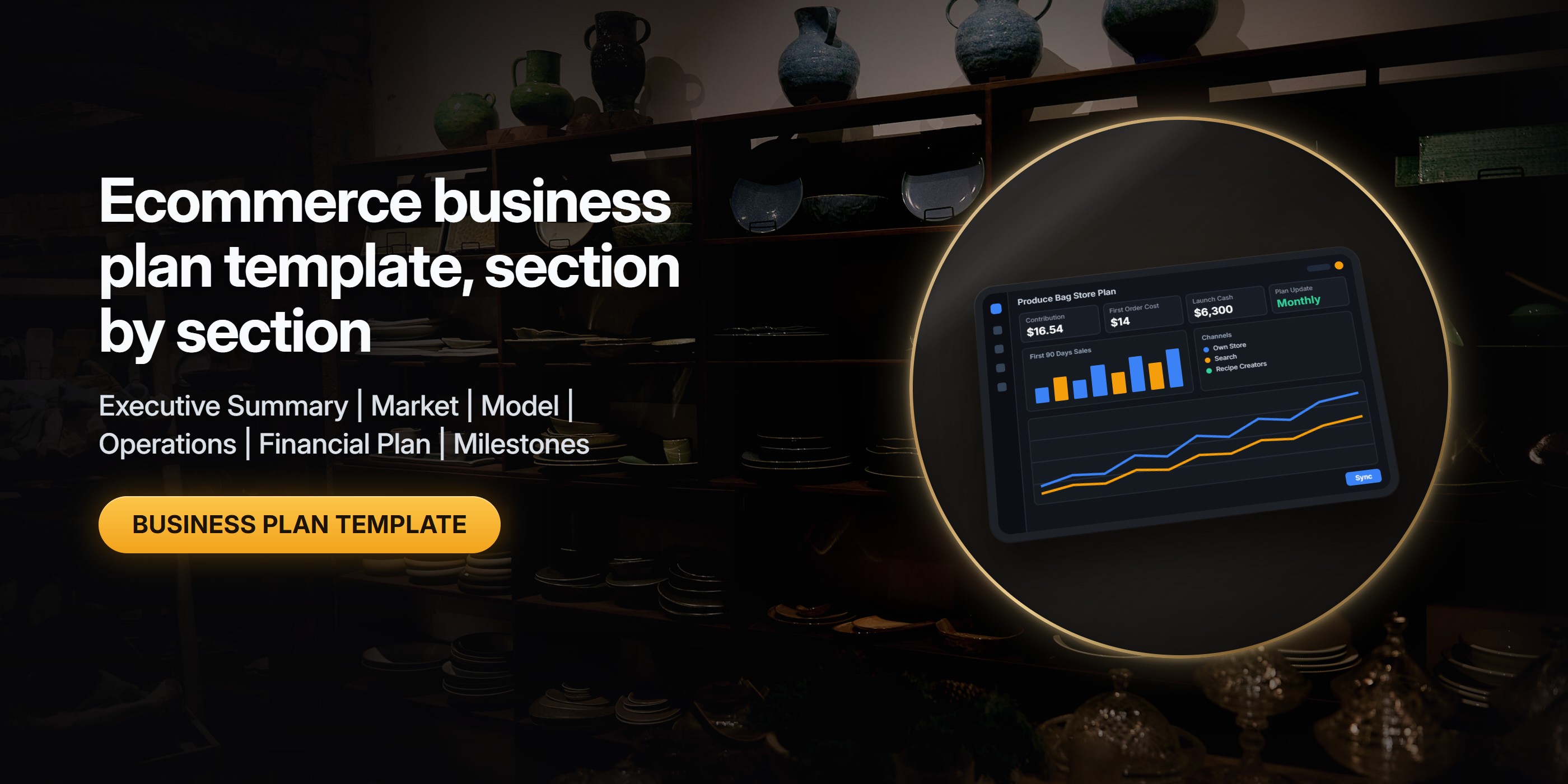
Here’s what a finished summary could look like, for an illustrative store rather than a real one. A two-person shop sells reusable produce bags to home cooks who want less plastic in their kitchen. Buyers choose it for a washable mesh no grocery chain stocks. It sells through its own store and reaches buyers through search and recipe creators. In this example, each order earns $16.54 before marketing, a first order should cost about $14 to win, and the business needs $6,300 to launch, most of it inventory.
Product and offer, what you sell and why from you
This section describes the product as a buyer meets it, then gives the facts your numbers rest on. Be specific about the version you’ll launch with, not the range you hope to grow into.
- The product. What it is, its sizes or variants, and what’s in the box.
- The price. Your selling price and how it compares with the closest alternatives.
- Landed cost. What one unit costs you once it’s on your shelf, including freight and duties.
- The reason to buy. One sentence on why someone picks yours over the alternatives.
- The reason to come back. Refills, consumables, new colors or a subscription, if any.
- Rules that apply. Any labeling, safety or category rules your product has to meet.
Write down what you’ll launch without, too. A short list of the variants you’re deliberately leaving out, such as extra colors or sizes, keeps the first inventory order small and stops the plan from quietly assuming a bigger range than you can afford.
If you’re still choosing what to sell, settle on one product before you start this section. The price line deserves real thought, because it sets every number in the financial section. Work out a cost-plus price and a price set against your closest competitors, then write down which one you chose and why.
Market, sized from the customer up
Describe your buyer before you size the market. Who they are, what they’re trying to do, where they shop now and what makes them switch. A plan that says “everyone who cooks” can’t tell you where to spend the first dollar of marketing.
For context, the Census Bureau’s quarterly estimate put U.S. retail ecommerce sales at $310.3 billion for the third quarter of 2025, seasonally adjusted, or 16.4% of all retail sales. Numbers like these belong in a plan as context, not as your market. Nobody reaches a slice of national retail sales, and a plan that multiplies a big number by a small percentage doesn’t tell a reader how you’ll find a single customer.
Size the market from the bottom up instead, from buyers you can actually reach.
- Search demand. Monthly searches for your product type and its close variants, which keyword research tools for online stores will show you.
- Marketplace activity. How many competing listings exist, and how many reviews the leaders have collected.
- Audiences you can reach. Communities, newsletters and creators your buyers already follow, and what influencer programs for online stores would take to reach them.
- Your own proof. Preorders, waitlist signups or test-batch sales, which beat any estimate.
The SBA’s market research guidance frames this section around a handful of questions, starting with whether there’s a desire for your product and how many people would be interested in it. Answer both with the bottom-up figures above, and note where each figure came from, so a reader can check it and you can update it later.
Competitors, and where they leave a gap
List the five or so sellers a buyer is most likely to compare you with, including marketplace listings and any store chain that carries the same thing. Then fill in a grid like this one for each.
| Competitor | Price | Shipping and returns | What buyers praise | What buyers complain about |
|---|---|---|---|---|
| Name or listing | Their price for the closest product | Delivery time, free-shipping threshold, return window | From their best reviews | From their one-star to three-star reviews |
The complaints column is the useful one. Repeated grumbles about sizing, durability, slow delivery or packaging are a list of things you can promise and keep. Close the section with one sentence on your position, such as “the only washable mesh bag set that ships in two days.” If you can’t write that sentence, you’re entering the market as a cheaper copy, and the financial section has to show you can survive on the thinner margin that brings.
The SBA’s competitive analysis guidance also asks you to note indirect competitors and any barriers to entering the market. For an online store, an indirect competitor is whatever the buyer does instead of buying from your category at all, such as picking up a store’s own-brand version or making do with what they have. Barriers are things like a supplier minimum you can’t meet yet, a category that needs testing or certification, or rivals with years of reviews behind them.
Choose the model that sets your cash needs
This section answers two questions in a few lines each. Who makes, holds and ships the stock, and where do you sell? The answer changes your cash needs more than anything else in the plan, so state it plainly.
- Stock. Make it, buy wholesale or private label, dropship or print on demand.
- Channels. Your own store, one or more marketplaces, wholesale to shops, or a mix, with the share of sales you expect from each.
- Revenue streams. One-time orders, subscriptions, bundles or any wholesale accounts.
- What you hand off. Manufacturing, fulfillment, photography, customer service.
Then state the cash timing your model creates. Buying stock means paying a supplier weeks before a customer pays you. Dropshipping and print on demand reverse that, because the customer pays before the item is made or shipped, but the margin is thinner. One sentence on which way your cash flows tells a lender more than a paragraph of strategy.
If you sell your own products through your own store, the plan has to show how you’ll pay for the jobs a retailer would otherwise do, from product photos to returns. If you’re still weighing several approaches, our guide to ecommerce business models compares them before you commit one to paper.
Marketing and sales, the first 90 days in detail
It’s tempting to list every channel that exists. A useful plan picks two or three and puts a budget and a target against each. Write this section for the first 90 days in detail and the rest of the year in outline, because what you learn in the first month will change the rest.
- Launch audience. Who hears first, such as your waitlist, preorder buyers and your own network.
- Paid acquisition. Which channel, the monthly cap and the most you’ll pay for a first order.
- Search and content. Which product and category searches you’ll target, knowing they take months to build, and how you’re splitting budget between SEO and PPC while they do.
- Retention. The emails that go out after the first order, and when you’ll ask for the second.
- Targets. Store visits, conversion rate, first orders, cost per first order and repeat buyers by day 30, 60 and 90.
Keep the acquisition cost in this section and the financial section identical. If marketing assumes $14 per first order and the financials assume $8, the plan is lying to you. Name an owner for each channel too, even if it’s you for all of them, so no channel is left as a vague intention. For a fuller channel-by-channel version with a launch calendar, use our ecommerce marketing plan template alongside this one.
Operations, from supplier to doorstep
Operations is the easiest section to leave vague and the first place a new store gets stuck. Write down who does each job and how long it takes, so you can see the bottleneck before a customer does.
- Suppliers. Who, minimum order quantity, lead time for a reorder and your backup supplier.
- Inventory. How many units you’ll hold, and the stock level that triggers a reorder.
- Fulfillment. Who packs and ships, which carriers and the delivery time you’ll promise.
- Returns. Your return window, who pays for the label and what happens to returned stock.
- Customer service. Who answers questions and how fast.
- Tools. Store platform and payment fees, email, accounting and anything else you’ll pay for monthly.
- Legal setup and sales tax. Your business structure, tax registrations, where you’ll collect sales tax and any licenses, with dates. The rules depend on your state and where you sell.
The reorder line matters more than it looks. If your supplier needs six weeks to deliver a reorder and you sell through your stock in four, you’ll be out of stock for two weeks of every cycle, right when demand is proven. Put the lead time next to your expected sales rate and the reorder point falls out of the arithmetic. Note, too, which jobs you’ll do yourself at first and what would make you hand them off, such as moving packing to a fulfillment warehouse once it takes more hours a week than you can spare.
The financial plan, with a worked example
The financial section answers three questions. How much cash do you need to launch? What does one order earn? And how many orders, new and repeat, does it take to cover your monthly costs? Everything in the example below is illustrative, round numbers for an imaginary store rather than benchmarks, so replace each one with your own quotes.
Startup cash. In the example, samples cost $300, a first order of 400 units at $12 landed comes to $4,800, packaging stock $400, product photos $500 and registrations and setup $300, for $6,300 in total. Note that $4,800 of that is inventory, which comes back as it sells.
What one order earns. Say the example store sells a $40 product with a $12 landed cost, and every order is one item, so its average order value is $40. Card processing at 2.9% plus 30 cents, the online rate Shopify lists for its Basic plan, takes $1.46. Say packaging and shipping come to $8 on a carrier quote, and you set aside $2 an order for returns. That leaves $16.54 before marketing, and if a first order costs $14 to win, the first sale to a new customer earns $2.54.
| Per order, illustrative | Amount |
|---|---|
| Selling price | $40.00 |
| Landed cost | -$12.00 |
| Card processing | -$1.46 |
| Packaging and shipping | -$8.00 |
| Returns allowance | -$2.00 |
| Contribution before marketing | $16.54 |
| Cost to win a first order | -$14.00 |
| Contribution on a first order | $2.54 |
Where the orders come from. Build each month’s orders rather than guessing them. Orders equal store visits times your conversion rate, and revenue equals orders times your average order value. In the example, month 1’s 50 first orders would take 2,500 visits converting at 2%, an example rate rather than a benchmark, and bring in $2,000 at $40 an order. Replace both inputs with your own as soon as the store has traffic.
The monthly picture. Say the store’s fixed costs, meaning platform, apps, email and bookkeeping, come to $250 a month. In the example, a repeat order brought back by email doesn’t carry the $14 acquisition cost, so it earns the full $16.54.
| Month, illustrative | First orders | Repeat orders | Contribution | After $250 fixed costs |
|---|---|---|---|---|
| Month 1 | 50 | 0 | $127.00 | -$123.00 |
| Month 3 | 80 | 20 | $534.00 | $284.00 |
| Month 6 | 120 | 60 | $1,297.20 | $1,047.20 |
| Month 12 | 150 | 150 | $2,862.00 | $2,612.00 |
Now look at what’s carrying the result. In month 12 of the example, the 150 first orders contribute $381 between them and the 150 repeat orders contribute $2,481. Take the repeat orders away and the same month earns $131 after fixed costs. In this example, the plan only works if customers come back, so the retention line in your marketing section isn’t optional, and automated email flows are one way to earn it.
Then write the same months as cash, not just contribution. Your first inventory order leaves your account weeks before the first sale, and ad spend usually lands before the orders it produces. A simple month-by-month cash line, starting from the launch outlay ($6,300 in the example), shows the lowest point your bank balance reaches. That low point, not the monthly profit, is how much money you actually need to start.
Add two more lines before you finish. A break-even line, starting with break-even orders, which equal fixed monthly costs divided by contribution per order. In the example, $250 divided by $2.54 means about 99 first orders a month cover fixed costs on their own, while 16 repeat orders at $16.54 do the same job, which is why month 1 runs at a loss. Then mark the month in which the running total turns positive. And a sensitivity line, the same table with, for example, acquisition cost 30% higher and repeat orders 30% lower. If the business still survives that version, the plan is sturdy enough to act on.
Milestones, and the numbers that trigger a decision
End the plan with dated milestones, each tied to a number and a decision. A milestone without a decision is just a calendar entry.
| By | Milestone | If you miss it |
|---|---|---|
| Week 4 | Samples approved, business registered, store built and test order passed | Push the launch date, not the checks |
| Day 30 after launch | First orders and cost per first order measured | Change the channel or the offer before adding budget |
| Day 60 | First repeat orders arriving from email | Fix the post-purchase emails before buying more traffic |
| Day 90 | Contribution covers fixed costs in a month | Revisit price, order size or product before reordering stock |
Write the decision rules down now, while you’re calm. It’s much easier to agree with yourself in advance that a channel costing more than your target per first order, $14 in the example store, gets paused than to make that call after a month of hoping it improves.
Add a reorder milestone as well. Once you know your sales rate, the plan should name the date you’ll place the second inventory order and how many units it covers, worked out from the supplier lead time in your operations section. A store that sells out of a proven product has to pause its marketing until stock returns, which wastes the momentum the first months built.
Who reads a business plan for an online business, and what they look for
The same plan serves different readers, and each one reads a different section first. Shape the summary for whoever matters most.
- You. The financial section and the milestones, because they tell you whether to keep going.
- A lender. The financial projections and any funding request. The SBA’s guidance says to give a financial outlook for the next five years, with quarterly or even monthly projections for the first year.
- An investor. The market and the competitors, to judge how big the business could get.
- A partner or supplier. The model and operations, to see whether you’ll be a reliable customer.
Whoever the reader is, show the evidence behind your three biggest assumptions, which are the price buyers will pay, the cost of winning a first order and the share of customers who come back. Those three move the financial section more than anything else, so a reader who sees you’ve tested them will give the rest of the plan more weight.
Don’t confuse the plan with an ecommerce business proposal. A plan describes your own business. A proposal is a pitch to one specific party, such as a retailer you want to stock you or a supplier you want terms from, and it borrows only the parts of the plan that party cares about.
Keep the plan short and update it monthly
If we were writing a plan for a new store, we’d spend most of the time on two pages, the per-order table and the monthly table, and keep everything else brief. Those two pages decide whether the business works. The other sections mostly explain the assumptions behind them.
Then we’d treat the plan as a working document. Each month, put actual visits, conversion rate, cost per first order and repeat orders next to the forecast, and replace the illustrative numbers with real ones, starting with cost per first order and repeat rate, because those are the two you can’t know until real customers arrive. A plan updated once a month is worth more than a perfect one written once.
Start with the financial section, using real supplier and carrier quotes, then write the rest around it. If the numbers work, you have an ecommerce business plan you can act on. We work with online stores for a living, so we have a stake in this part. If you’d like a second pair of eyes on the numbers before you commit money, look at our ecommerce business consulting service.
Frequently asked questions
How to write a business plan online?
Start from a template in a shared document and keep the numbers in a spreadsheet beside it. Write the financial section first, because it decides whether the rest is worth writing, then fill in the product, market, competitors, model, marketing, operations and milestones, and write the summary last. The SBA says there's no right or wrong way to write one, so keep the sections that fit your business and drop the ones that don't.
How do I plan my small business?
Start with market research, then write the plan. The SBA's ten steps to start a business put market research first and the business plan second, ahead of funding, location, structure, name, registration, tax IDs, licenses and a bank account. It describes the plan as a roadmap for how to structure, run and grow the business. For an online store, add a small paid test to the research step, because real orders tell you more than any survey.
How do you write up a business proposal?
Write it for one reader and one decision. Open with what you're asking for, such as shelf space, wholesale terms or an investment. Then explain what it solves for them, what you'll deliver, the numbers that matter to them, a timeline and the terms. Borrow those numbers from your business plan rather than writing new ones, and keep it to the few pages that reader needs to say yes or no.
What are the 7 main components of a business plan?
The seven usually listed are an executive summary, a company description, a market analysis, organization and management, the product or service line, marketing and sales, and financial projections. The SBA's traditional format adds a funding request and an appendix, for nine common sections in all. An online store can fold organization into operations, as the template above does, and should give the financial section the most care.
Can ChatGPT write a business plan?
It can draft one. The SBA lists drafting a business plan among the jobs AI tools can help with, and advises having another person review what they produce. What it can't know are your supplier quotes, shipping costs, conversion rates or what a first order will cost to win, and those numbers decide whether the business works. Use it to outline sections and tighten your writing, then replace every figure it suggests with one you can trace to a quote or to your own sales.
Is there a free business plan template?
Yes. The template in this guide is free to copy, section by section, and the SBA's business plan guide includes sample plans in both the traditional and lean formats. Whichever you start from, the template matters less than the numbers you put in it, so fill in the financial section with real supplier and carrier quotes before you polish the wording.
What is the simplest format for a business plan?
The lean startup plan. The SBA says it's typically only one page and can take as little as an hour to make. It covers nine components, including your value proposition, customer segments, channels, cost structure and revenue streams. A one-page plan suits a simple store you're funding yourself. If you'll ask a lender for money, expect to need the longer traditional format as well.
What is business strategy in e-commerce?
It's the set of choices about how your store will win. That means which customers you serve, what you sell them, why they'd pick you over a marketplace listing, which channels you rely on and how each order makes money. Strategy is the part of the plan you can say in two sentences. Tactics, such as which ads to run next, should follow from it rather than stand in for it.