In this article
- Keystone pricing doubles the wholesale cost, a 50% gross margin before card fees, shipping, ads and returns come out.
- Retailers expected 19.3% of online sales to be returned in 2025, so price returns in from the first order.
- ThredUp's CEO said U.S. secondhand clothing grew nearly four times faster than retail clothing in 2025.
- On a $40 sale, Shopify's online card rate of 2.9% plus 30 cents takes $1.46 before any other cost.
- Etsy's rules count only items 20 or more years old as vintage, so modern secondhand stock needs another outlet.
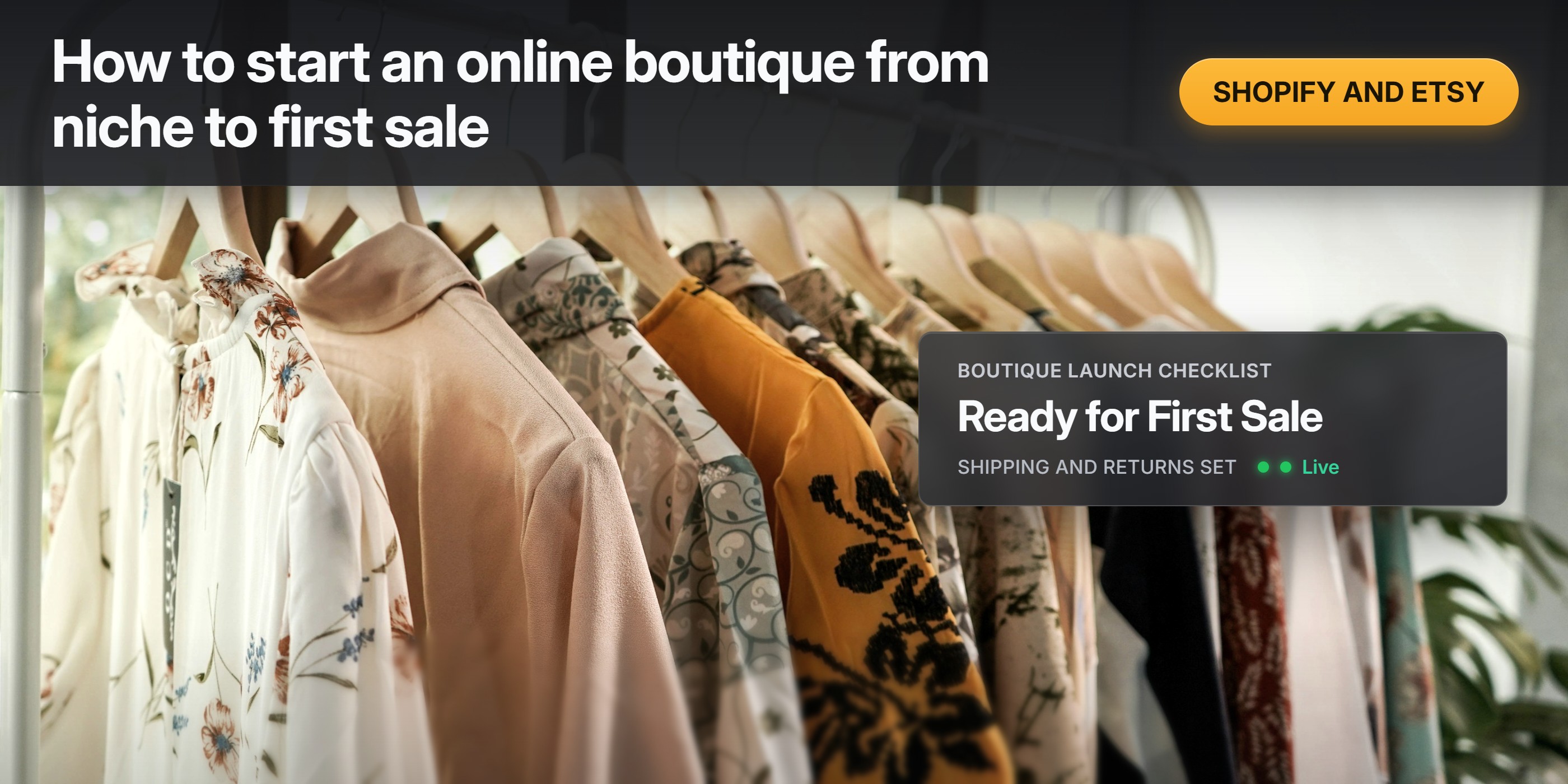
Here’s how to start an online boutique in one paragraph. Pick a narrow customer, source stock you can sell for about twice what you paid, build a simple store with strong photos, and set your shipping and returns rules before the first order. Then win your first buyers from people who already follow you, and grow from there. If you’re still choosing between a boutique and other ideas worth starting, compare them first.
Clothing is a big online category and a hard one. Adobe counted $49.0 billion in online apparel sales in the 2025 holiday season alone, and the National Retail Federation and Happy Returns estimated that 19.3% of all online sales would be returned in 2025. Clothing that doesn’t fit gets sent back, so plan for returns from the start. The steps below follow the order the decisions depend on each other.
How to start an online boutique around one customer
Start with one customer, not a category. “Women’s clothing” is a department store. “Workwear for petite women in their thirties” or “vintage denim for men who hate fast fashion” is a boutique. The narrower the customer, the easier every later decision gets, because you know what to buy, how to photograph it and where that person spends time online.
Define the customer on three lines before you buy anything.
- Who she or he is, by age range, size range, budget and what they wear the clothes for.
- What they can’t find, such as a size, a style, a price point or a way of shopping, like modest cuts or secondhand designer pieces.
- Where they already look, such as a social app, a community, a local event or a marketplace.
Then check the gap is real. Search for your customer’s exact need the way they would phrase it, and look at who’s already selling to them. Two or three small sellers is a good sign, since it suggests demand. A wall of large retailers at low prices means you need a sharper angle. Your niche also decides your sourcing, because a petite workwear boutique and a vintage denim shop buy from completely different places.
Wholesale and private label mean buying stock up front
The simplest route is to buy finished pieces at wholesale from brands and distributors, then resell them. You find suppliers at trade shows, through brand line sheets and on online wholesale marketplaces. Faire, for example, described its marketplace on its homepage as a place to order from thousands of independent wholesale vendors “with net 60 terms & free returns.”
Ask every supplier the same questions before your first order. What’s the minimum order per style and per size? How long from order to delivery? Can you reorder a style that sells, and can you return what doesn’t? Wholesale works when you can test small quantities and reorder winners, so a low minimum is often worth more than a slightly lower price. Keep a simple sheet for every supplier, with minimums, lead times, payment terms and how each order sold. After two or three buying rounds, it tells you who to reorder from and who to drop.
A wholesale vendor may also ask for your resale certificate. In states with a sales tax, it’s the document that lets you buy stock for resale without paying sales tax on it, because you’ll collect tax from your own customers when you sell. You get it through your state’s tax agency, usually once you register to collect sales tax, and the forms and rules differ by state. Whether a vendor will sell to you without one is that vendor’s call, so check your state’s rules before your first order.
Private label is the next step up. A manufacturer makes a garment and puts your label on it, sometimes with changes to fabric, color or fit that you specify. You own the brand, nobody else sells the same piece, and your margin can be wider. The trade is commitment. Factories set minimum order quantities, samples take rounds of revisions, and you pay for production before a single customer has seen the product. It usually pays to earn your way to private label by learning which shapes and sizes sell through wholesale first.
Own label or wholesale for an online clothing business
If you’re working out how to start an online clothing business rather than a boutique, you face the same choice in a different order. A boutique sells other brands’ pieces and wins on its edit. A clothing brand sells its own label and wins on design, so it has to reach private label sooner. Here’s how the two compare on the questions that decide your first year.
| Question | Buying wholesale | Your own label |
|---|---|---|
| What you sell | Finished pieces from other brands | Garments made to your spec, with your label |
| Cash before the first sale | A small test order at each vendor’s minimum | Samples and a factory minimum, paid before any customer sees the product |
| What you control | The edit, the photos and the price | Fabric, color, fit and the brand itself |
| Who else sells it | Other stores can carry the same piece | Nobody else sells the same piece |
| Margin | Keystone, about double the wholesale cost | Can be wider once a run sells through |
| Reorders | Reorder winners from the vendor | Each reorder is a new production run |
If you want to start a clothing brand online, the safer order is still wholesale or consignment first, then your own label. A season of sales shows which shapes, sizes and colors your customer buys. Your first factory order is then a bet on proof rather than taste. You can run either model from home at the start. A small first range fits in a spare room. The store, the photos and the shipping all work from one desk until orders outgrow it.
Consignment and secondhand let you start with less cash
Consignment means you list someone else’s clothing and pay them only when it sells, keeping an agreed share of the sale. You hold no cash in stock, which makes it one of the cheapest ways to open. Put the split, the selling period, what happens to unsold items and who pays for damage in a written agreement signed before you accept a single piece.
Secondhand and vintage means buying used pieces, from thrift stores, estate sales or your own network, and reselling them. It’s a growing market. ThredUp released its 2026 Resale Report, produced with GlobalData, in April 2026, and its chief executive said the U.S. secondhand market grew nearly four times faster than the broader retail clothing market in 2025.
Both models trade cash for time. Every piece is a one-off, so you inspect, clean, photograph, measure and list each item, and you can’t reorder a bestseller. That suits a boutique built on a sharp eye, such as designer resale, vintage denim or a single decade. Check where you’re allowed to sell it. Etsy’s rules count only items 20 or more years old as vintage, and resold items newer than that don’t qualify. For vintage that does, its seller page listed a $0.20 listing fee, a 6.5% transaction fee on the sale price including shipping, and payment processing of 3% plus $0.25, with rates that vary by the location of your bank account.
Resale buyers search by brand, size and era, so write titles the way they type. Our guide to SEO keywords for fashion resale covers the terms worth targeting.
Build the brand around your customer, not your logo
A boutique’s brand is the reason a buyer picks you over a bigger store with the same jeans. That reason comes from your edit, your voice and how buying from you feels, far more than from a logo. Write one sentence that says who you dress and why, and let every decision answer to it.
- Name. Pick one that’s short, easy to spell and free as a domain and social handle. Search it before you fall for it, so you don’t build a following under a name someone else already uses.
- Look. Choose two or three colors, one or two fonts and one photo style, and use them everywhere, from product pages to packing slips.
- Voice. Write product descriptions the way you’d talk your customer through a fitting room. Mention fit, fabric and what to wear it with.
- Packaging. A tissue wrap, a sticker and a handwritten note cost little and turn an unboxing into something people post.
Keep the brand flexible enough to grow. A name tied to one product, such as a single dress style, gets awkward when you add accessories six months later.
Which platform should your boutique run on?
You have two routes, and you can use both. A marketplace brings shoppers who are already browsing, and your own store gives you control of your brand, prices and customer list.
- Your own store. On Shopify, for example, the U.S. pricing page listed the Basic plan at $39 a month billed monthly, or $29 a month billed yearly, with online card rates from 2.9% plus 30 cents. Other hosted builders work too, and the deciding questions are the same, how it handles variants for size and color, how it shows inventory, and what it charges per sale.
- A marketplace. Etsy suits handmade pieces and vintage that’s at least 20 years old, at the fees in the section above. Social-first resale apps suit secondhand stock aimed at younger buyers, though each sets its own fees and rules on what you can sell.
Whatever you pick, check four things before you commit. Can each product carry size and color variants with their own stock count? Can you add a size chart to every product page? Can shoppers filter by size? And can you export your customer list if you ever move? A platform that fails the last one owns your business more than you do.
Your first-month budget then comes down to a few lines, and you set most of them yourself.
| Cost line | What sets it | Figure to use |
|---|---|---|
| Store plan | The platform and billing you choose | Shopify Basic at the price above, or your builder’s plan |
| Card processing | Every online sale | 2.9% plus 30 cents on Shopify Basic |
| Marketplace fees | Each listing and sale | Etsy, $0.20 a listing, 6.5% of the sale and 3% plus $0.25 processing |
| Opening stock | Vendor minimums times wholesale cost | Your vendors’ line sheets |
| Packaging and shipping | Your packed weight and carrier | Your carrier’s rates |
| Registration | Your state and city | Your state tax agency and your city or county |
Add them up from your own quotes rather than from a range someone else published, since your stock budget is the line that moves the total.
Set up the store with the pages that sell clothes
A boutique store needs fewer pages than you think and more detail on each one. Launch with these.
- Product pages with several photos, measurements for each size, fabric content, care instructions and a fit note such as “runs small, size up.”
- A size guide linked from every product, with garment measurements rather than a generic chart.
- Collections your customer would shop by, such as occasion, fit or new arrivals, not just by garment type.
- Shipping and returns pages written in full, linked from the footer and the cart.
- An about page that says who runs the boutique and who it’s for.
Leave the rest until you have sales. Blogs, lookbooks and loyalty programs can wait, while a product page that answers “will this fit me?” can’t. If you build on Shopify, our guide to setting up a Shopify clothing store walks through themes, variants and the apps worth adding, so this guide doesn’t repeat it.
Before launch, place a test order on your phone with a real card, from product page to confirmation email. It’s the quickest way to catch a broken size selector or a missing shipping rate, and phones are where most orders now happen. Adobe found 56.4% of online transactions in the 2025 holiday season took place on a smartphone. The legal side, registering the business and getting a sales tax permit, works the same as for any online store, and our guide on how to start an ecommerce business covers it.
Photograph and list every piece so it sells without a fitting room
Your photos do the job of the fitting room, so they decide both sales and returns. Shoot every piece the same way, against the same background, in the same light, so your store looks like one boutique rather than a pile of listings. A phone camera, a window with soft daylight and a plain wall are enough to start.
For each item, take a front and back view, a close-up of the fabric and any details, and at least one photo on a person so the buyer sees how it drapes. Shopify’s help center says product images can be up to 5000 x 5000 px and that “For square product images, a size of 2048 x 2048 px usually displays best,” so shoot large and crop consistently.
Then write the listing for the person who can’t touch it. Give the garment’s measurements, not just its size label, the model’s height and the size she’s wearing, the fabric content and how it feels, and any flaw on a secondhand piece. Every question you answer in the listing is one less reason to hesitate, and one less return when the item arrives different from what the buyer pictured.
Price for margin after shipping, fees and returns
The usual starting point in clothing is keystone pricing, which Shopify describes as setting the retail price at double the wholesale price. A top that costs you $20 sells for $40, a 50% gross margin. Shopify also warns that keystone pricing doesn’t account for competition, demand or perceived value, so treat it as a floor to test against, not a rule.
Now take the costs out of that $40 sale. At Shopify’s online card rate of 2.9% plus 30 cents, processing costs $1.46. Spread the Basic plan’s monthly fee over 50 orders a month, as an example, and it adds $0.78 an order, so $17.76 of the $20 gross margin is left. Packaging, shipping you don’t charge for and the ad that brought the buyer come out of that, and returns come out last. The NRF and Happy Returns estimated that 19.3% of all online sales would be returned in 2025, and a returned piece can come back worn or too late in the season to sell at full price.
So work out your real margin on a typical order before you set prices for the store, and keep the numbers in an ecommerce business plan template where you can test them. If doubling the wholesale cost leaves too little after those costs, you have three levers. Buy better, by negotiating or moving to private label. Charge more, which works when your edit and photos justify it. Or raise the order value with sets, bundles and accessories. Price secondhand pieces from the condition and the brand’s resale demand rather than from what you paid, since your cost per piece varies widely.
Plan shipping and returns before your first order
Clothing is light and soft, which makes it cheap to ship in poly mailers rather than boxes. Weigh your most common orders packed, then look up rates for your carrier so your shipping charges match what you actually pay. A free shipping threshold set just above your typical order value nudges buyers to add a second item.
Ship on the timeline you promise. The FTC’s mail order rule says a seller needs a reasonable basis to ship within the time it states, or within 30 days if it states none, and if you can’t, it requires you to offer the buyer the choice to accept the delay or cancel for a prompt refund. Preorders and late wholesale deliveries are where boutiques trip over this, so state realistic dates.
Returns need a written policy before launch, covering the return window, the condition items must be in, who pays return shipping and whether you refund or give store credit. Free returns sell. In the NRF and Happy Returns report, 82% of shoppers cited free returns as a major consideration when buying. They also cost you on every item that comes back, so one middle ground is free exchanges with paid returns, or free returns as store credit. Whatever you choose, inspect each return before you restock it.
Then track why each item comes back. Ask for a reason on every return request, such as too small, too big, not as pictured or changed mind. The answers tell you whether to fix a size chart, a photo or a supplier, and two returns for the same reason on the same style point to a listing problem you can fix that week.
Add accessories and jewelry to lift each order
Accessories solve two boutique problems at once. They don’t come in sizes, so there’s no fit for a buyer to get wrong, and they’re easy add-ons that raise the value of an order you’ve already paid to win. Bags, belts, scarves, hats and jewelry all style the clothes you already sell, which makes the outfit photo your best cross-sell.
Jewelry also follows the gifting calendar. Adobe reported that online sales of bracelets rose 335% and earrings 275% during the 2025 holiday season, measured against October levels. That’s a seasonal peak rather than a year-round rate, so buy and photograph jewelry ahead of the holidays and expect a quieter start to the year.
Start with a small edit that matches your clothing, not a separate jewelry business. If accessories start to outsell clothes, that’s a signal worth following, and our guide to building a Shopify jewelry store covers what changes when jewelry becomes the main line, from photography to pricing.
Show accessories on the outfit pages, not only in their own collection. A dress page that suggests the belt and earrings in its photo turns one item into a set, and a small saving on the set gives the buyer a reason to take all three.
How do you find your first customers?
Your first buyers will come from people who already know you, then from people who find you on social media. Build both before launch day, not after.
- A waitlist. Collect emails for a few weeks before you open, with a preview of the first collection. Launch to people who asked to hear from you.
- Social video. Try-ons, styling one piece three ways and new-arrival drops show fit better than any product photo. Adobe found social media’s share of online holiday revenue reached 4.6% in 2025, up 40.3% from the year before, and ThredUp reported nearly half of secondhand shoppers now discover finds through social media, creators and influencer feeds.
- Collaborations. Work with people your customer already follows, such as a local stylist, a photographer or a small creator in your niche, and pay in clothing or commission rather than flat fees until you know what brings orders.
- Local reach. Pop-ups, markets and events let people touch the clothes, and every buyer there can join your email list.
- Repeat buyers. A new-arrivals email to past customers is the cheapest sale you’ll make, so ask for the email at checkout and send something worth opening.
Measure every channel by orders, not followers. For the first three months, ask each new customer how they found you, and put your time where the answer keeps coming back. When you’re ready to spend on ads, our playbook on marketing an apparel brand online covers the channel mix.
What we would do first
If we were opening a boutique tomorrow, we’d write the one-sentence customer first, then buy a small first collection, around a few dozen pieces across a handful of styles, from suppliers with low minimums or on consignment. Small first buys keep cash free for the reorders that matter.
We’d spend more on photos and listings than on the store design, start a waitlist before the stock arrives, and launch on a simple store, with a marketplace alongside it for vintage or one-off pieces. We’d price from keystone, then check every price against the real margin after card fees, shipping and a share of returns, and we’d write the returns policy before the first sale.
Then we’d watch two numbers, which styles sell through first and which come back, and buy the next collection from that. Your next step is the one-sentence customer and a list of three suppliers who sell what that customer can’t find, with your first-month numbers beside them. When you’re ready for a store designed around your collection, our Shopify website designers can build it with you.
Frequently asked questions
Where do boutiques get their inventory from?
Boutique inventory comes from four sources. Wholesale brands and distributors, found at trade shows, on brands' own wholesale pages and on marketplaces such as Faire. Private-label manufacturers that put your label on their garments. Consignment, where you sell someone else's pieces and pay them when they sell. And secondhand or vintage stock bought from thrift stores, estate sales and individual sellers.
How to find wholesale vendors for boutiques?
Start where your customer's favorite brands sell. Check each brand's website for a wholesale or stockist page, browse online wholesale marketplaces such as Faire, which advertised net 60 terms and free returns to retailers, and walk apparel trade shows. Ask every vendor for its line sheet, minimum order per style and size, delivery time and reorder policy before you place an order.
How much do you mark up boutique clothing?
The usual starting point is keystone pricing, which Shopify describes as setting the retail price at double the wholesale price. A $20 top sells for $40, a 50% gross margin. Then check what is left after card fees, shipping, ads and returns, and raise prices or the average order if it is too little. Price secondhand pieces from condition and brand demand instead.
Is an online boutique profitable?
It can be, if your margin survives returns and the cost of winning customers. Keystone pricing gives a 50% gross margin on paper, but card fees, shipping, ads and returns come out of it, and the NRF and Happy Returns estimated that 19.3% of online sales would be returned in 2025. Buy small, reorder what sells and look after repeat buyers to protect it.
How much is it to start an online boutique?
It depends mostly on your first inventory buy, which you control. The fixed costs can be small. Shopify's U.S. Basic plan listed $39 a month billed monthly, or $29 a month billed yearly, and Etsy charged $0.20 per listing. Consignment and secondhand stock let you open with very little cash, while wholesale and private label need money for stock before your first sale.
What platform is best for boutiques?
The best platform for a boutique gives each size and color its own stock count, shows a size chart on every product, lets shoppers filter by size and lets you export your customer list. Test those in a trial store before you commit. Shopify's U.S. Basic plan listed $39 a month billed monthly. Etsy suits handmade pieces and vintage at least 20 years old, and it can run alongside your own store.
How do I market my boutique?
Start before you open. Build a waitlist with a preview of your first collection, post try-on and styling videos, and sell at local pop-ups where every buyer can join your email list. Adobe found social media's share of online holiday revenue rose to 4.6% in 2025. After launch, email past buyers about new arrivals and track which channel each order came from.
How do I start my own boutique with no money?
Start with stock you don't pay for up front. Consignment lets you sell other people's clothing and pay them only after it sells, and secondhand pieces can come from your own closet, friends and thrift stores. Sell on a marketplace that accepts your kind of stock rather than paying for a store, and put early profits into your first small wholesale order.