One monthly retainer
$750
Monthly
Foundation, quarterly strategy calls

One retainer that runs geo-farming SEO, GBP, IDX content, review requests, and CRM tracking for solo agents, teams, and brokerages, with Google Ads from Growth and Meta from Scale. Real estate marketing plans and packages from $750 per month with quarterly reviews built in, a 6-month minimum term (12 months on Enterprise), then 30 days notice.
Selected clients we've run full marketing programs for


If any of these looks familiar, the free SEO audit names the fix and what it's worth before you spend a dollar.
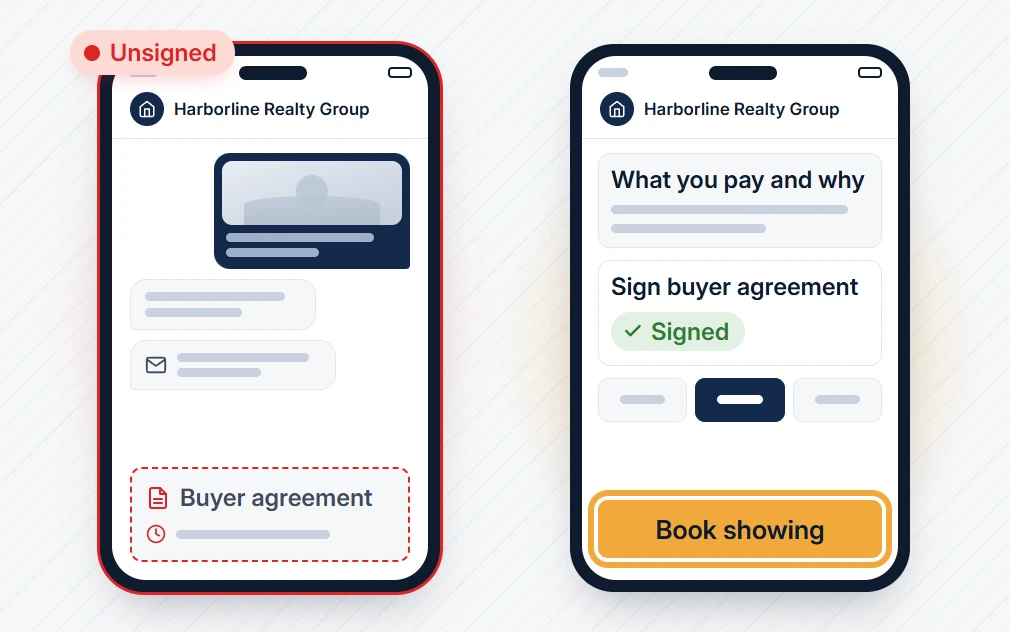
Post-NAR buyers need a signed written representation agreement before an agent can show a property. Buyer compensation is now negotiated separately from the listing side. Agents without a public-facing explanation of the fee, the value, and a friction-free DocuSign flow lose the buyer at first inquiry. A signed buyer agreement funnel cuts drop-off and books the showing on the same visit.
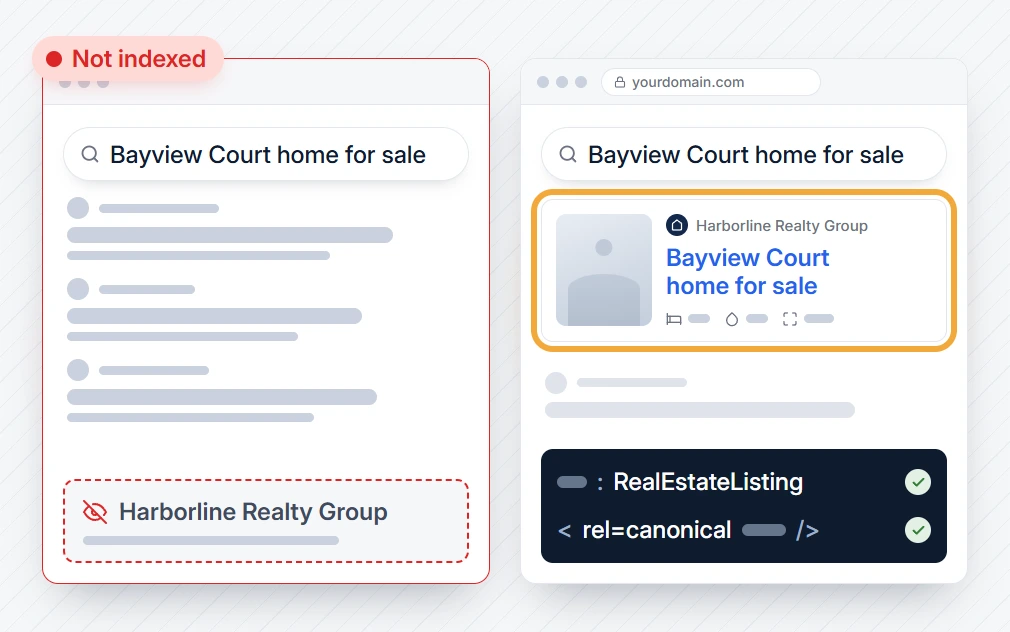
Buyers see your $1.2M listing on Zillow, Google the address, and land back on Zillow. Your IDX pages never get indexed. RealEstateListing schema plus a canonical on every active listing plus per-neighborhood pages fix the click-back loop so your farm territory shows up as your territory in organic search.
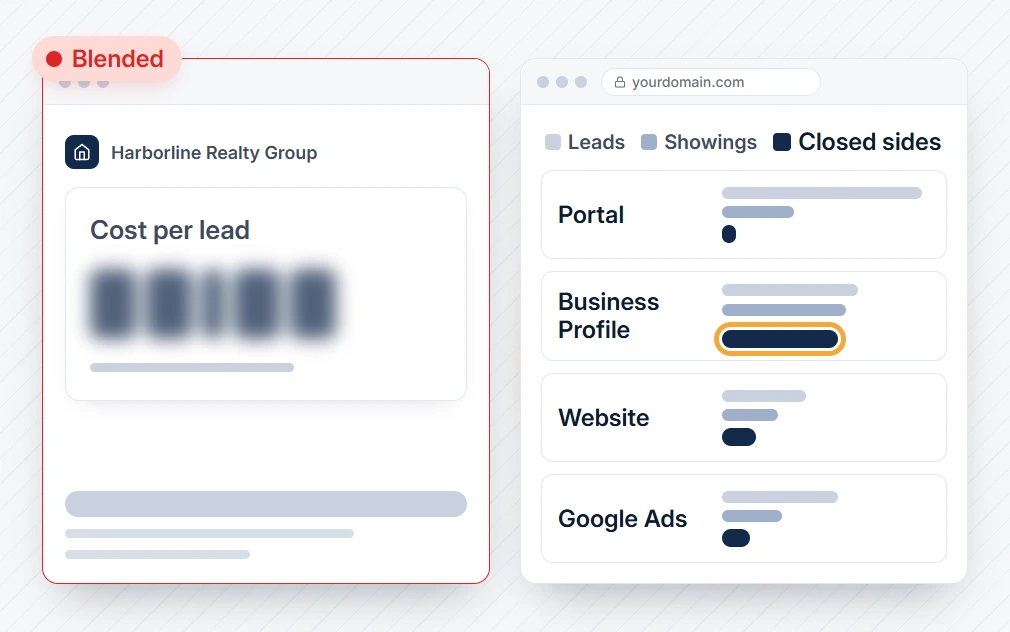
One blended "CPL" hides Zillow Premier Agent at $180 per lead closing 0.6% next to GBP at $12 per lead closing 6%. Follow Up Boss or kvCORE tagged by source plus closed-side attribution back to the CRM tell you which channel is renting your leads and which channel is compounding.
Three results we report every Friday. Abels Residential gets 20+ qualified leads a month from organic search.
SEO and GBP run as one program, with paid ads from Growth up. Seller inbounds and buyer consults trace to source in Follow Up Boss, so you fix the right channel fast.
Per-neighborhood pages, school-district content, and market-update posts target your farm ZIPs. GBP posts, reviews, and schema make you the default agent.
Separate campaigns and landing pages for buyer and seller intent. One team owns the split and reports on what moved, with a dedicated retainer lead from Scale up.
Each stage ends with a sign-off from the broker and ops lead. Seller campaigns start in late winter, so your farm hears from you before the spring listing rush.
Site, IDX feed, ad accounts, Follow Up Boss or kvCORE data flow, review flywheel, and content library all audited against showings booked and closed sides. Written report with the top 3 revenue-moving fixes signed off by broker + ops lead before we spend a dollar.
Quarterly roadmap sized against your farm territory and agent roster. Higher-margin listing sides lead over buyer-only work when GCI supports it. Every quarter has a written pipeline projection so you know what should hit the showings calendar.
One team runs farm-area SEO, GBP, and IDX pages on every tier, Google Ads from Growth, and Meta from Scale, where a dedicated lead owns the account. A new listing, its ads, its open house invite, and its just-sold post are planned together, so no step waits on another vendor.
Test cycles tied to Follow Up Boss-verified showings booked. Quarterly review with broker + ops lead showing what showings drove, what closed-side GCI looks like, what next-quarter budget should be.
Five phases, from the week-one Follow Up Boss audit to the quarterly GCI review. Each ends in a broker sign-off.
Week one. Site, IDX feed, ad accounts, Follow Up Boss or kvCORE data flow, review flywheel, and content library all audited against showings booked and closed sides. Written report with the top 3 revenue-moving fixes signed off by broker + ops lead before we spend a dollar.

Google Ads, Meta, geo-farming SEO, GBP, IDX, email, and review flywheel all scored against showings booked and closed-side GCI impact.
Follow Up Boss, kvCORE, CINC, BoomTown, or Chime pipeline and closed-side data captured as day-one baseline for attribution.
Each finding and fix in writing, with its expected effect on showings and listing appointments. Broker and ops lead sign the scope first.
Three fixes ranked by GCI at stake and days to ship, like unindexed IDX pages or seller leads lost before Follow Up Boss.
The top three competing agents or teams in your farm zip codes benchmarked on GBP presence, review count, and per-neighborhood content depth.
Where Follow Up Boss loses first-touch, where Zillow Premier Agent hides source data, where the 60-to-180-day cycle costs closed sides.
Weeks 2 and 3 build a 12-month quarterly roadmap sized against your farm territory and agent count. Listing-side work leads where GCI supports it. Every quarter has a written pipeline projection so you know what should hit the showings calendar.

Q1 to Q4 planned by campaign, neighborhood cluster, and market-update calendar; every quarter has an explicit sign-off gate on scope.
Higher-GCI farm zip codes and price bands lead. Lower-margin buyer-only work layered as base load, not headline focus.
Q1, Q2, Q3, Q4 showings and closed-side targets sized against real MLS turnover plus your agent capacity for the year.
How much goes to Google Ads, Meta, geo-farming SEO, and Zillow Premier Agent each month; adjusted quarterly based on what performs against closed sides.
Which past clients, referral partners, and lenders most drive downstream sphere-of-influence referrals into your pipeline.
Cold leads segmented by last-touch date and buyer or seller intent; nurture cadence written up front for email, SMS, and Follow Up Boss workflows.
From month 1, geo-farming SEO, GBP, IDX content, and review requests run on every tier, Google Ads joins on Growth, and Meta on Scale, where a dedicated real estate lead owns the account. No handoffs between agencies. No cross-team blame.

Google Ads from Growth and Meta from Scale, run by the same team; closed-side attribution built once across buyer-intent and home-value keywords, not fought across two vendors.
Per-neighborhood pages, school-district content, market-update posts, and directory citations on Zillow, Realtor.com, Homes.com, and Redfin agent profiles all coordinated as one program.
Monthly IDX audit tied to Showcase IDX, iHomefinder, IDX Broker, or Realtyna; RealEstateListing schema, canonicals, and just-sold write-ups your farm actually wants indexed.
Post-close review requests wired to Follow Up Boss, kvCORE, or BoomTown on every tier. Home-anniversary sequences and market-update newsletters are quoted separately.
Ad copy and keywords from Growth, landing pages and Meta creative from Scale; every test measured against a booked-showing number, not clicks.
From Growth up, every Google, Zillow, and Realtor.com review answered inside 24 hours in a voice matched to your brokerage tone and neighborhood expertise.
Testing runs against Follow Up Boss-verified showings booked and closed sides. Ad copy and keyword targeting from Growth, landing page CRO tests monthly on Scale and weekly on Enterprise, and review request timing on every tier, all measured against the number that pays your bills.

Every showing and closed side tagged to the click, keyword, or Meta touch that drove the buyer or seller in.
A three-line note in each weekly pipeline report, on every tier: what we tested, what won, and what goes live next.
From Scale up, A/B tests on hero, home-valuation lead magnet, buyer form, and CalendarBridge slot picker; measured against booked showings only, not clicks.
If geo-farming SEO is compounding faster than Zillow Premier, budget moves; every shift signed off in the weekly retainer report.
Two new ads per campaign each month, written apart for buyer searches and "what is my home worth" searches. Losing ads come off within 14 days.
From Growth up, negatives and farm-zip geo caps tuned weekly, with saved-audience layering on homeowner lists from Scale, aimed at the searches that book higher-GCI listings.
Every 90 days, broker and ops lead review what showings drove, what closed-side GCI looks like, what next-quarter budget should be. Scale decisions grounded in your Follow Up Boss data and agent capacity, not agency spend targets.

Showings booked by channel, closed sides from marketing, cost per closed side; all Follow Up Boss-verified numbers net of dead leads and disqualified inquiries.
Ad spend and content velocity sized against your agent roster capacity; no pipeline you cannot service, no overspend that burns leads.
The broker signs next quarter's split across channels and farm ZIPs, with spring listing spend set before the market turns.
Rolling 12-month view of pipeline growth, cost per closed side trend, and per-agent GCI growth; broker-first metrics.
When a team is ready for a new farm zip code or a second office, prep runs in parallel with current retainer, no re-onboarding tax.
Roadmap for pushing higher-GCI listing sides up in the mix as agent capacity opens each quarter.
3 FARM AND IDX FIXES TO SHIP · No card needed. No sales call required.
Solo agents start on Foundation, teams adding Google Ads on Growth, and multi-office brokerages on Scale or Enterprise. Foundation, Growth and Scale run a 6-month minimum term and Enterprise runs 12 months. After that, 30 days written notice applies, and tiers change on 30 days notice. Ad spend is billed at pass-through. Hover any feature to see what it means.
THE FOUNDATION: Solo operators starting structured marketing
EVERYTHING IN FOUNDATION, PLUS: Established operators wanting steady new-customer flow
EVERYTHING IN GROWTH, PLUS: High-growth businesses; adds Meta ads and a dedicated account lead
EVERYTHING IN SCALE, PLUS: Multi-location, multi-brand or group operators
6-month minimum term, 12 months on Enterprise, then 30 days written notice. Google and Meta ad spend passes through at cost.
Each one includes where the client started, what we changed and what happened.
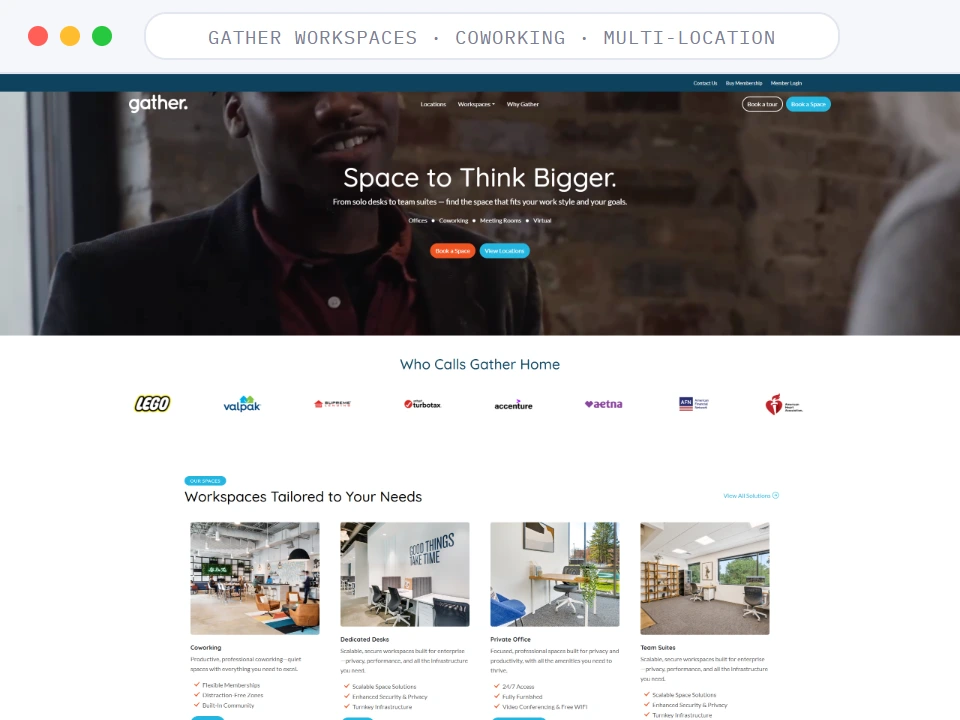 Published case study
Gather Workspaces
GATHERWORKSPACES.COM
Gather Workspaces grew from three to seven coworking locations. But its funnel only chased tour-ready leads, and COVID cut tours sharply. We set up HubSpot CRM with automated nurturing, widened the funnel to earlier-stage prospects and added high-intent paid search. Tours rose 67%, and inbound marketing returned 12× with $950K in attributable annual revenue.
 Published case study
McCarthy Court
MCCARTHYCOURT.SENIORLIVINGNEARME.COM
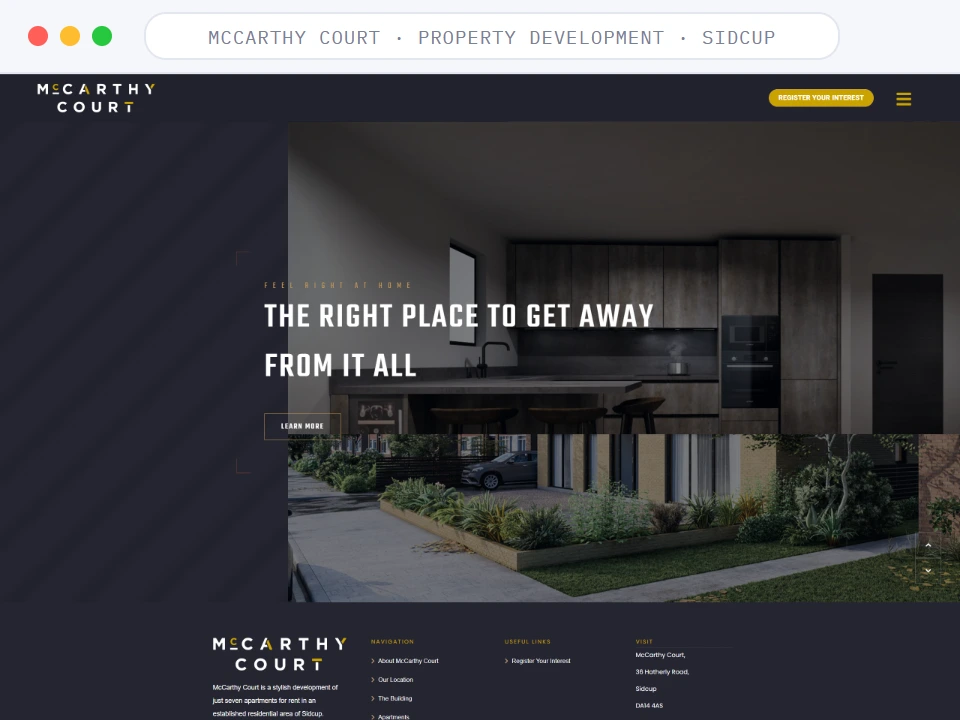
McCarthy Court is a Sidcup development of seven high-spec apartments for rent. It had to let while the building was still going up, with no in-person tours. We built a custom property website with a virtual showroom, its green features, local lifestyle stories and lead capture. The site drew 60+ qualified renter leads from 10K campaign visits, and the development was fully occupied within 3 months of completion.
 Published case study
Abels Residential
ABELSRESIDENTIAL.COM
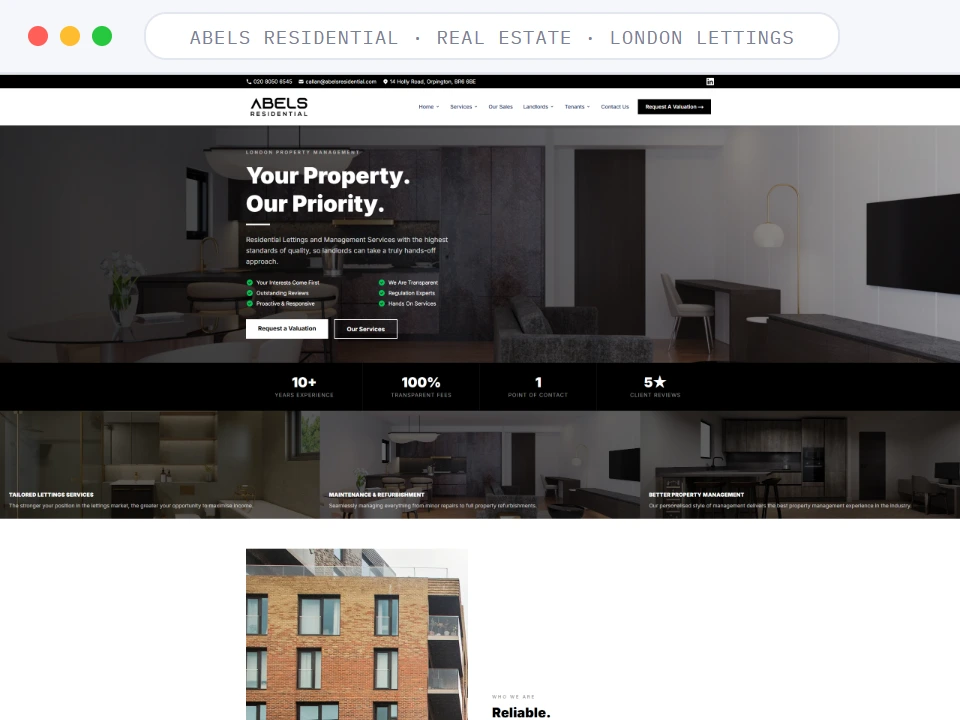
Abels Residential, a London rental and property management firm with 10+ years of experience, had no online presence against much larger agencies. We built a fast website made to convert, with a mobile-friendly rental search, and ran on-page and off-page SEO for London rental keywords. The site now ranks for 280+ keywords, loads in 2 seconds and brings in 20+ qualified leads a month from organic search.
3 FARM AND IDX FIXES TO SHIP · No card needed. No sales call required.
Vendor and buyer leads went from unpredictable to a monthly forecast we could staff against. First agency that treated the CRM as the scoreboard, not the ad account.

Move the sliders to your numbers. One team across search, ads and the site, measured on the same conversion rate.
Free · Written findings · Yours to keep
From real quote calls with brokerages, team leads, and solo agents. Anything else, ask on the strategy call and get an answer in the recap.
A marketing retainer is a fixed monthly fee that covers a defined scope of ongoing marketing work. In real estate, a marketing retainer typically bundles local SEO, Google Business Profile management, paid ads, IDX content, and CRM automation into one predictable monthly bill. Instead of paying per project or per hour, a broker or team lead pays a flat rate and gets a written scope of deliverables every month. The retainer model works because real estate marketing compounds. Geo-farming SEO, review flywheels, and past-client nurture flows all pay off over 6 to 12 months, not in a single sprint. A real estate marketing retainer at Redefine Web runs from $750 per month at Foundation tier up to $3,000 and above for Enterprise, with a written scope, KPIs on showings booked and closed sides, and a 6-month minimum term, 12 months on Enterprise. After that, the retainer rolls month to month with 30 days written notice, and every ad account, CRM, and content library stays inside your brokerage. If the account ever ends, the pipeline data goes with you.
A real estate marketing retainer at Redefine Web runs $750 to $1,999 per month on Foundation, Growth, and Scale, with a fourth tier, Enterprise, starting at $3,000 for multi-office brokerages and top-100 teams. Foundation at $750/mo fits solo agents with one farm running geo-farming SEO, GBP posts, and a monthly market-update page. Growth at $1,250/mo is where most 2-to-5 agent teams land once they add Google Ads on buyer-intent and home-value keywords and two new neighborhood pages a quarter. Meta saved-audience retargeting starts on Scale. Scale at $1,999/mo fits 5-to-15 agent teams layering multi-farm content, IDX listing schema, Meta ads, and monthly landing-page tests. The tier moves with agent count and farm count, not with your ad spend. We do not skim a percentage of media. Ad accounts stay in your brokerage or personal name. Foundation, Growth and Scale run a 6-month minimum term and Enterprise runs 12 months, then the plan rolls with 30 days notice. Ad spend is billed at pass-through, and there are no hidden pod rotations mid-quarter. Every retainer includes a written pipeline report every Friday, plus strategy calls, quarterly on Foundation and monthly from Growth, so budget and scope decisions are logged before any shift takes effect.
A realtor marketing retainer fee ranges from $750 per month for solo agents up to $3,000 and above for multi-office brokerages. Redefine Web publishes four tiers. Foundation at $750/mo covers a solo agent on one farm. Growth at $1,250/mo suits 2-to-5 agent teams adding Google Ads. Scale at $1,999/mo fits 5-to-15 agent teams with multi-farm content and IDX schema. Enterprise starts at $3,000/mo for top-100 teams and multi-office brokerages that need custom Follow Up Boss integration and BigQuery reporting. Some agents also charge their own retainer fee to buyers or sellers under new NAR rules, which is a separate topic. For agent-side buyer representation fees under the settlement, the National Association of Realtors publishes practice guidance. Marketing retainer fees paid to an agency are a marketing cost, billed separately from any client-side buyer fee. The tier you land on tracks agent count and farm count, not the media budget. Every tier includes a written monthly scope and a strategy call at least once a quarter, and Scale and Enterprise add a dedicated account lead.
Most working agents budget 5 to 10 percent of gross commission income on marketing. An agent on a growth curve or fighting for share in a competitive metro often runs 10 to 15 percent, provided every campaign is tracked back to appointments, closings, and cost per closed side. A team producing $500,000 in GCI a year at 10 percent puts $50,000 into marketing, split as $1,250 to $1,999 in retainer plus $2,000 to $3,000 per month in Google Ads media on Growth, with Meta added on Scale. Multi-office brokerages on Scale or Enterprise usually run flat retainer plus per-office ad budgets in the $1,500 to $4,000 range. Every retainer opens with a written media plan mapping spend to farm and expected cost per showing by month. Broker owners approve the split by quarter before a dollar goes to media, and shifts between channels are logged in the weekly report.
Every retainer delivers four things a solo agent or team cannot easily run in-house. At least one market-update post a month and one new neighborhood page a quarter, GBP posts tied to real sold data, automated review requests wired to Follow Up Boss or kvCORE, and technical SEO fixes on your IDX pages. CRM nurture flows are quoted separately. Growth adds Google Ads on up to $3,000 in monthly spend, review response management, and competitor tracking. Scale layers multi-farm content, IDX listing schema on Showcase IDX or IDX Broker, Meta saved-audience homeowner retargeting on your farm polygon, and monthly landing-page tests. Scale and Enterprise include a dedicated real estate retainer lead who owns the account end to end. On every tier there are no handoffs between an SEO team, an ads team, and a content team. GBP setup follows Google Business Profile guidelines so the profile stays compliant. Every deliverable is scoped in writing and logged in a shared weekly report, so the broker owner sees every asset that shipped before the invoice lands.
Google Ads on the Growth tier usually books its first qualified buyer consultation inside 14 to 21 days from launch, once conversion tracking and the landing page are live. Geo-farming SEO and GBP compound slower. Per-neighborhood pages ranking on queries like "Astoria condo for sale" or "Bergen County ranch homes" tend to move in weeks 8 to 14. Steady organic showing flow lands by month 4 to 6. Listing appointments from sphere-of-influence and past-client campaigns run on their own clock since the average seller decision cycle is 60 to 180 days. Every retainer reports on showings booked and closed-side GCI separately so long-cycle listing pipelines do not look broken when they are just delayed. Broker and ops lead see week-1 through month-6 milestones in writing before the first invoice, so timeline expectations match how each channel actually compounds. Your pipeline report flags when a channel is 2 weeks behind curve so budget can be re-sized before the quarter closes.
Every buyer-facing asset runs through settlement-compliant review before publish. Since the NAR settlement went into effect August 17, 2024, every buyer needs a signed written representation agreement before an agent can show a property. Buyer compensation is now negotiated separately from the listing side. Redefine Web assigns a settlement-aware content editor on every real estate retainer. Every landing page, ad, and CRM sequence is reviewed for prohibited language and mandatory disclosures before it goes live. A DocuSign-driven signed buyer agreement funnel cuts drop-off and books the showing on the same visit. Ad accounts stay in your brokerage name so the audit trail is yours. Full compliance guidance is published by the National Association of Realtors, and every buyer agreement flow is re-audited each quarter against updated state and MLS bulletins. When state associations issue new disclosure language, the CRM sequences update inside 7 business days, and every impacted ad set is paused until the new copy is reviewed.
Yes, on Growth tier and above. Multi-office brokerages need per-office GBP management, per-farm landing pages, and agent recruiting content that speaks to top producers in the market. Foundation covers a solo agent or one-farm team but does not scale to multi-office or multi-farm work. Scale at $1,999/mo runs per-office GBP, dedicated per-neighborhood landing pages, and a recruiting-content layer that separates paid buyer leads from agent-recruiting inbounds. Enterprise starts at $3,000/mo for top-100 teams and multi-office brokerages with 15-plus agents, custom Follow Up Boss or CINC integration, and BigQuery pipelines for firm-wide reporting on GCI, split, and cap. Scale and Enterprise include a dedicated account lead who owns the roll-up across offices, plus a weekly pipeline report for the broker owner, covering what tested, what won, and what shifted between farms. Larger brokerages get a quarterly on-site or video review with the leadership team plus a written scale plan that maps next-quarter budget to per-office capacity.
Yes. Follow Up Boss, kvCORE, CINC, BoomTown, Chime, Real Geeks, Sierra Interactive, LionDesk, Wise Agent, and Realvolve are all supported for showing attribution, buyer agreement workflow, and closed-side conversion imports. The engineering lead maps your CRM in week 1 so Meta saved-audience lists, GA4 closed-side imports, and the reporting dashboard all pull from the same source. HubSpot and Salesforce are supported for brokerages running a non-real-estate-native stack. Enterprise adds custom BigQuery pipelines when a multi-office brokerage needs to roll spend, showings, and closed-side GCI into one view. Every retainer keeps CRM ownership and API keys inside your brokerage, so if the account ever ends, the pipeline and data go with you. Attribution stays cleanly wired to Google Search Central guidance for canonical and event tracking. Migration between CRMs mid-retainer is supported once per year without extra fees, and every migration is logged in a written 5-step checklist covering data export, field mapping, dedupe, dry run, and cutover so no closed-side history is lost.
The practical floor for real estate Google Ads is $1,500 per month in most markets, and $3,000 per month if luxury, new construction, or waterfront keywords are in the mix. Under those numbers, Google Smart Bidding cannot get enough conversion signal to optimize and cost per showing stays noisy. Most Growth tier teams spend $2,000 to $3,000 per month in Google Ads media, and Scale covers management up to $8,000. Typical cost per qualified buyer consultation lands in the $60 to $180 range for standard resale markets and $200 to $600 for luxury or new-construction farms. Scale tier teams layering Zillow Premier Agent usually add another $1,500 to $5,000 in portal spend. Every retainer opens with a written media plan mapping spend to farm zip code and price band. Ad spend is billed at pass-through, not marked up, and the account always stays in the brokerage name. Two ad copy variants get tested per campaign per month, and losing creative is rotated off within 14 days of first read.
Yes. Every tier covers IDX indexation as part of its on-page SEO and technical fixes, and a new IDX feed is included with every real estate website build we deliver. You pay the IDX vendor's feed fee directly to the vendor. On a retainer alone, setting up a new feed is quoted separately. Supported feeds include Showcase IDX, iHomefinder, IDX Broker, Realtyna, and direct RETS or RESO Web API pulls from the local MLS. Every active listing gets an indexable URL with RealEstateListing schema so buyers who land on Zillow can be won back to your site on the second click. Outbound syndication to Zillow, Trulia, Realtor.com, Redfin, and Homes.com runs through your broker ListHub or ListTrac connection. Inbound leads from those portals route back into Follow Up Boss or kvCORE tagged by source, so Zillow Premier at $180 per lead can be measured next to organic at $12 per lead without hiding the truth in one blended CPL. Every retainer audits IDX indexation weekly for broken canonicals or stale sold pages. Sold listings get a permanent 301 to the neighborhood page after 30 days off market so the equity stays with the farm URL, not lost in the feed.
Neither answer is universal. The retainer runs alongside a Zillow Premier Agent, Realtor.com Connections, or Homes.com Elite lead-buy account. You do not have to cancel it. Zillow Premier buyer leads close at 0.4 to 1.5 percent industry-wide and cost $30 to $200 each depending on ZIP. An owned SEO and paid-driven pipeline closes at 3 to 8 percent because the intent quality is higher since the buyer already picked you. Most teams run portal leads and owned pipeline in parallel for the first two quarters, then shift budget toward owned once cost per closed side favors the retainer. Every quarterly review shows Zillow Premier Agent cost per closed side next to owned pipeline cost per closed side so the shift is a data call, not a guess. Broker owners typically cut portal spend once the owned pipeline is proven and the review flywheel is compounding on GBP. Portal spend never goes to zero for most teams, because the top-of-funnel volume from Zillow still fills the CRM even as owned pipeline takes over on close rate.
A working real estate marketing plan starts with 4 inputs. First, your farm territory defined as 2 to 5 zip codes with the price band you can service. Second, your agent capacity, meaning how many buyer or seller sides your team can close per month without burning leads. Third, your annual GCI goal split by listing side and buyer side. Fourth, your marketing budget, typically 5 to 15 percent of GCI. From those inputs, build a quarterly channel roadmap. Q1 focuses on geo-farming SEO and GBP setup. Q2 layers Google Ads on buyer-intent and home-value keywords. Q3 adds Meta saved-audience retargeting and a review flywheel. Q4 reviews cost per closed side by channel and shifts budget. A working retainer replaces the DIY plan by executing all 4 phases against a written scope with weekly reporting on showings booked and closed sides. Broker sign-off gates every quarter, and no channel expands until the prior quarter hits its written pipeline projection.
The 80/20 rule, also called the Pareto principle, says 80 percent of results come from 20 percent of effort. In real estate, top-producing agents find that 80 percent of closed-side GCI comes from 20 percent of their marketing channels. For most brokerages, that 20 percent is past-client referrals plus sphere-of-influence and geo-farming SEO on 2 to 3 core zip codes. Portal-bought leads and cold Facebook ads usually fall in the 80 percent effort side with lower closed-side yield. A working retainer applies the 80/20 rule by measuring cost per closed side by channel every quarter and shifting budget toward the 20 percent of channels driving 80 percent of GCI. The channels that keep compounding, geo-farming SEO, GBP, and past-client review flywheel, are where owned pipeline lives long term. Retainer reports call out which 20 percent of campaigns produced 80 percent of showings, so broker owners can double budget on winners without guessing. Losers get paused inside 30 days, not left running for the full quarter, so budget concentrates where the closed sides actually land.
Free · Written in 24 hours · No pitch
A written report in your inbox within 24 hours, with three fixes you can ship the same week, whether or not you hire us.
Written in 24 hours · 10,000+ audits run · 300+ clients since 2021


