In this article
- Ecommerce PPC strategies compound only when 9 core decisions run weekly.
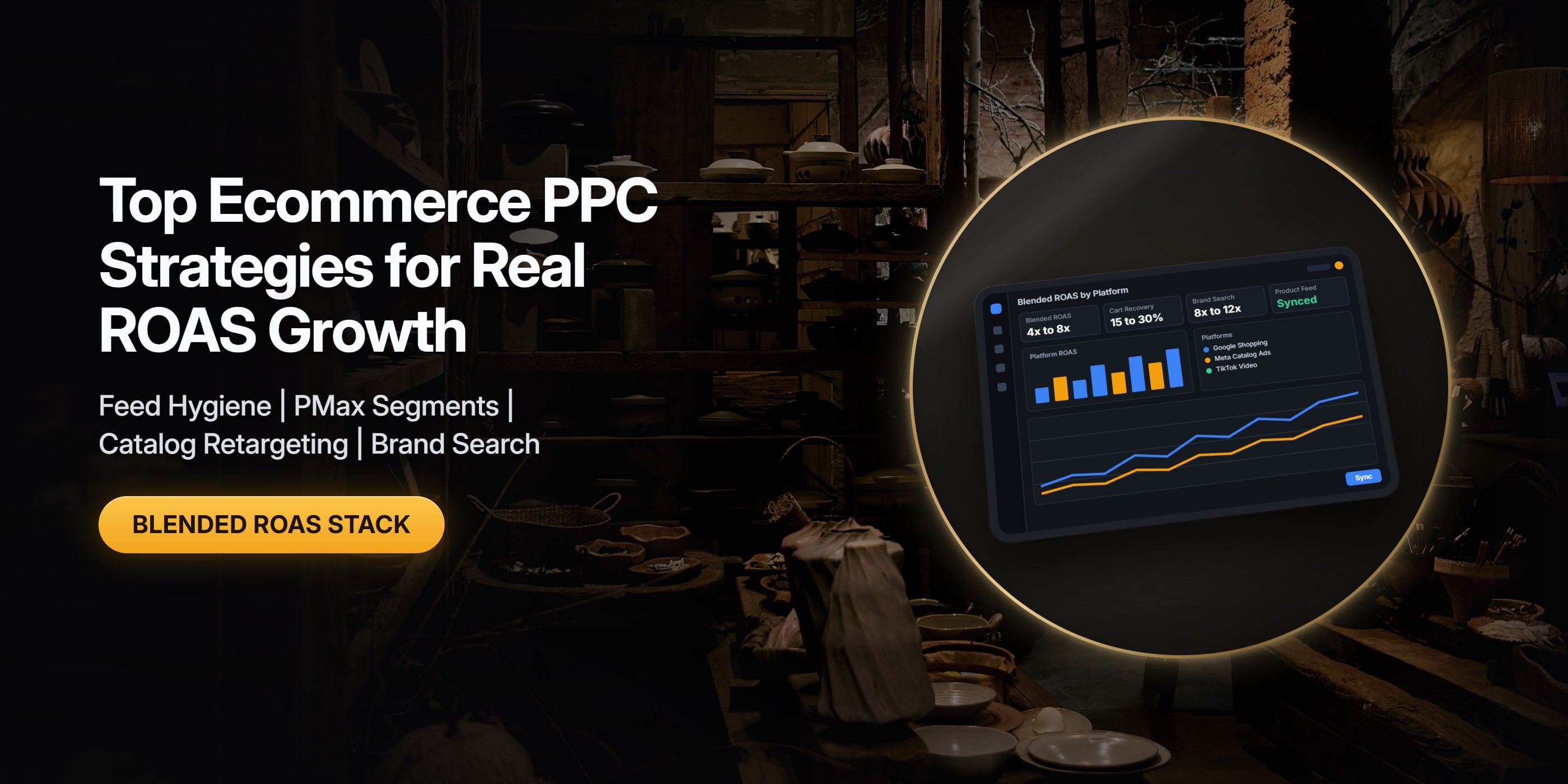
- Blended ROAS climbs 30 to 60 percent above baseline inside 6 months.
- Brand Search costs 2 to 5 percent of budget and returns 8x to 12x.
- Catalog retargeting recovers 15 to 30 percent of abandoned carts in 7 days.
- RAFZ Cirkulara Interiorer grew conversions 28 percent after a faster site rebuild.
E-commerce ppc strategies for 2026 are less about clever bid tricks and more about a small set of decisions that compound. Product feed hygiene. PMax asset group segmentation. Creative refresh cadence. Blended ROAS attribution. Catalog retargeting flows for cart and browse abandon. Every store past $15,000 a month in ad spend that hits 4x to 8x blended ROAS in a competitive category runs some version of the same 9 or 10 decisions. The list is boring in the best possible way.
You’ll get the working 9 e-commerce ppc strategies with the math behind each one, how they layer, when to add a fifth channel, and how RAFZ Cirkulara Interiorer, a Swedish sustainable furniture store, pushed conversion rate up 28 percent through a site rebuild that cut page load to 2 seconds. Read this before you sign a new retainer promising ppc e-commerce advertising strategy benefits without naming the platform-level bid rules.
Product feed hygiene wins Shopping bids
Every Shopping campaign lives or dies on the feed. Google reads product titles, GTINs, brand, product type, color, size, and roughly 30 other attributes to decide which query your ad shows against. A clean feed can hit 60 to 80 percent Shopping impression share on core keywords. A messy feed caps at 25 to 40 percent and burns budget on wrong-intent queries.
Rewrite the top 100 product titles first
The template that wins in 2026 is brand plus product type plus 2 attributes, front-loaded. A title like “Boogie Board Blackboard 8.5 Inch Reusable Notepad” matches far more buyer queries than “Reusable Writing Tablet.” Move brand and product type into the first 40 characters. Add color, size, or material as the third and fourth tokens. Fill every optional attribute Google offers. GTINs alone qualify you for Rich Product Results and grow Shopping impression share 15 to 30 points inside 14 days.
Fix out-of-stock waste
Roughly 8 to 15 percent of Shopping spend on a mid-size DTC store gets wasted on out-of-stock SKUs when the feed refresh lags real-time inventory. Wire up a supplemental feed on a 4-hour refresh, or use a Merchant Center integration with your Shopify inventory API. This one fix pays back inside the first week and stops the most common Shopping waste in the ecommerce PPC stack.
Catalog retargeting rules e-commerce ppc strategy work
Every e-commerce site loses 60 to 80 percent of add-to-cart sessions to abandon. Catalog retargeting on Meta and Google Display recovers 15 to 30 percent of those abandoned carts inside 7 days at a cost per acquisition 3x to 5x lower than cold prospecting. Every serious top ppc strategies for e-commerce sites plan runs at least 3 retargeting flows.
Three retargeting flows every store needs
Cart abandon flow retargets users who added to cart but did not check out inside 3 days, showing the exact SKU they left. Browse abandon flow retargets users who viewed a product but did not add to cart, showing the SKU plus 2 similar SKUs from the same collection. Post-purchase upsell flow retargets recent customers with complementary SKUs. Each flow runs on Meta catalog ads and Google Display remarketing. Together they recover 20 to 40 percent of what would otherwise leave.
Post-purchase flows drive LTV
Post-purchase retargeting is the most under-invested piece of e-commerce paid media in 2026. Every purchased customer is worth 3x to 5x more than a cold prospect. Retargeting them with a 30-day window on complementary SKUs at a low daily budget compounds lifetime value inside 90 days. Beauty and skincare stores routinely see 6x to 10x LTV ROAS on post-purchase flows once subscription and refill sequences work. Skip this flow and the store leaves the highest-return channel on the table for months.
Brand Search inside effective ppc campaigns for e-commerce
Every store that has run any organic marketing needs a brand Search campaign defending brand queries. Competitors bid on your store name and pull 10 to 20 percent of your branded traffic away at cost per acquisition 5x to 10x higher than your own bid. Running brand Search at a low bid ceiling costs 2 to 5 percent of total ad budget and returns 8x to 12x on ad spend. This is the easiest win in the paid stack.
Setting the brand campaign structure
One campaign, one ad group, exact match plus phrase match on brand terms and brand plus product terms. Low bid ceiling since Quality Score on brand is 10 and the ad rank is high without needing to overspend. Sitelinks pointing to top 4 collection pages. Callouts naming delivery speed, return policy, and any brand differentiator. Ad extensions carry 15 to 25 percent of the click-through on brand ads, so wire every extension in on setup.
Why brand Search still makes sense
Some founders argue brand Search cannibalizes organic clicks. The evidence says the opposite on any competitive category. Google’s own studies show 89 percent of paid search visits are incremental when the brand is not already the number one organic result, and 50 percent are incremental when the brand is number one organic. See the Google incremental paid search study for the full data set. On competitive categories with active competitor bids, brand Search returns 8x to 12x on ad spend and protects 10 to 20 percent of the branded revenue from getting siphoned off.
PMax segmentation for cleaner bid math
Performance Max is the default Shopping campaign type in 2026, so segmentation is the single biggest lever for ecommerce PPC strategies on Google. One catch-all PMax campaign for the entire catalog blends high-margin winners with low-margin fillers and forces the algorithm to average bid signal. Splitting by margin band or shopper intent gives Google cleaner data and pushes blended ROAS up 20 to 40 percent inside 60 days.
Split by margin band
Group SKUs into 3 asset groups. High-margin above 60 percent gross gets aggressive target ROAS. Mid-margin 30 to 60 percent gets moderate. Low-margin under 30 percent gets defensive target ROAS or moves to a manual Shopping campaign. On a 50,000-dollar-a-month spend, this split alone recovers $3,000 to $6,000 of wasted budget monthly. At that spend the account sits in our Enterprise tier, from $3,000 a month, so the recovered budget alone can cover the management fee.
Layer shopper intent asset groups
Add a separate asset group for new-customer acquisition using Google’s new-customer acquisition goal at a soft target. Add another for repeat customers with a lower target ROAS since AOV runs higher. Feed each asset group creative that matches the audience. This 5-asset-group structure is what serious ecommerce PPC strategies use to squeeze another 15 to 25 percent out of the Shopping stack.
Budget mix across ppc for e-commerce channels
Every store past $10,000 a month in ad spend faces a budget allocation call across Google, Meta, TikTok, Amazon, and sometimes Microsoft Ads. The wrong allocation wastes 20 to 40 percent of budget. The right allocation compounds. There is no universal split. There is a math per store shaped by margin, average order value, brand equity, and audience.
Starting allocation by store type
| Store type | Meta | TikTok / Other | Brand Search | |
|---|---|---|---|---|
| Lifestyle and apparel | 45% | 35% | 15% | 5% |
| Home decor and furniture | 55% | 30% | 10% (Pinterest) | 5% |
| Beauty and skincare | 30% | 40% | 20% (TikTok) | 10% |
| Consumer electronics | 60% | 25% | 10% (Amazon) | 5% |
| B2B parts and industrial | 75% | 10% | 5% (Microsoft) | 10% |
Monthly rebalance rule
Every 30 days pull blended ROAS by platform from Triple Whale or Northbeam and move 10 to 20 percent of budget from the worst-performing platform to the best. Not more than 20 percent since bigger shifts reset learning phases. Not less than 10 percent since smaller shifts do not move the needle. The 10 to 20 percent monthly rebalance is what keeps blended ROAS climbing 30 to 60 percent above the pre-engagement baseline inside 6 months.
Watch for the seasonal exception. Q4 shifts the math on every category. Apparel and home decor should pull budget into Meta and TikTok video assets in early October to build audiences before the November peak. Beauty pulls into TikTok in mid-September so the platform’s learning phase warms up 4 to 6 weeks before Cyber Week. Consumer electronics shifts hard into Google Shopping across November and December as query volume spikes. Sitting on a static allocation into Q4 leaves 20 to 40 percent of the seasonal upside on the table.
Every rebalance is a specialist call, not an AI call. Smart Bidding and Advantage+ do not read your seasonal calendar or your inventory position. The specialist checks the site inventory report, the seasonal calendar, and the last 30 days of blended ROAS every Monday before touching a bid. That single 30-minute review each week is what separates a compounding account from a drifting one. Every working Ecommerce Marketing Agency for DTC and Shopify Brands engagement bakes that review into the retainer as a non-negotiable line.
Tracking QA is the ecommerce ppc strategies foundation
Bad tracking makes every downstream ecommerce PPC strategy read a false signal. GA4 misfires. Meta CAPI drops 30 percent of events without a warning. Server-side conversion tagging on Google loses 15 to 25 percent of matched revenue. Every net-new engagement starts with a week of tracking QA before a single bid moves.
The 4-check tracking audit
Run this alongside a full ecommerce PPC audit to catch the wider set of leaks.
Check 1: fire a test purchase from a fresh browser and confirm the event lands in GA4, Meta, TikTok, and Google Ads inside 5 minutes. Check 2: match the last 30 days of Shopify revenue against blended ROAS reporting to find gaps over 5 percent. Check 3: verify server-side conversion tagging is on and hashed customer data is flowing. Check 4: run Meta Events Manager’s Test Events tool and confirm CAPI delivers over 90 percent match quality. Skip any of these 4 and the numbers you optimize against are fiction.
Common mistakes inside e-commerce ppc strategies
Every store owner running paid media makes some of the mistakes below. Every specialist auditing a new account finds 5 or 6 of them. Naming these upfront saves 30 to 60 days of budget waste.
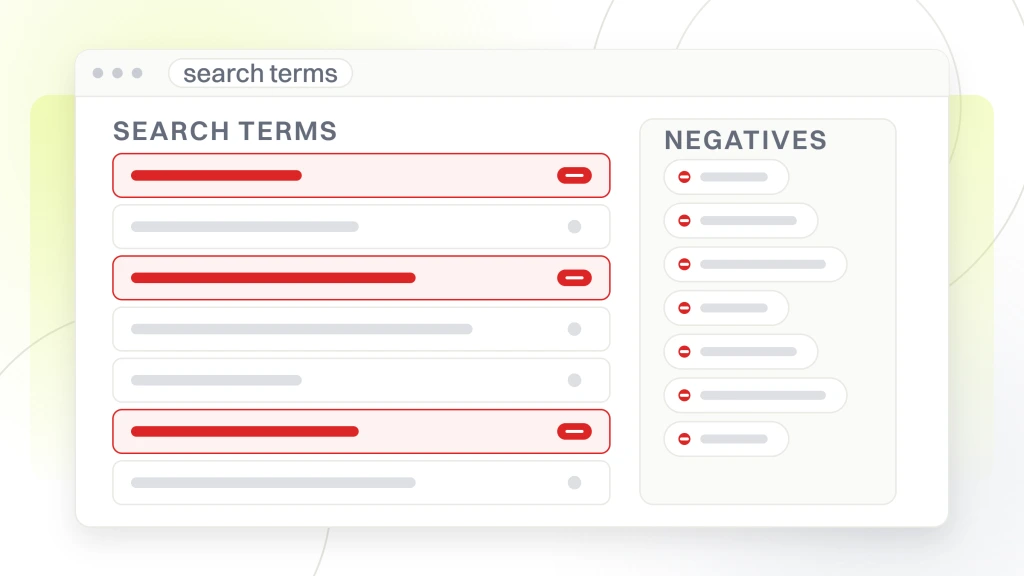
- One PMax campaign for the entire catalog. Split by margin or intent for cleaner bid math.
- No brand Search campaign. Competitors pull 10 to 20 percent of branded traffic away at higher cost.
- Meta creative refresh cadence of once a quarter. Performance decays inside 14 days on stale creative.
- No catalog uploaded to Meta Business Manager. Advantage+ Shopping delivery drops 40 percent.
- Last-click ROAS treated as truth. Blended ROAS almost always tells a different story.
- Product feed with generic titles and no GTIN. Shopping impression share caps below 40 percent.
Fixes that pay back inside 30 days
Split PMax by margin or intent. Wire up brand Search at a low bid ceiling. Rewrite the top 100 product titles in the Merchant Center feed. Upload the product catalog to Meta Business Manager. Install Triple Whale or Northbeam. Set a creative refresh cadence of 4 to 6 assets per week on Meta and TikTok. Every fix pays back inside 30 days on a store spending over $5,000 a month in ads.
Timeline for e-commerce ppc strategies to compound
Store owners arrive at new e-commerce ppc strategies expecting the results next week. Real outcomes sit in a narrow window shaped by category, ad spend, and how clean the tracking wired up. The bands below are typical for ecommerce accounts with clean tracking.
Month-by-month math
Month one covers tracking QA, feed audit, campaign restructure, and first creative refresh. Blended ROAS often dips 10 to 20 percent as learning phases reset. Month two shows the first real signal on cleaner data. Month three is where most stores hit break-even against ad spend plus retainer. Months four through six are where compounding kicks in and blended ROAS climbs 30 to 60 percent above the pre-engagement baseline. Skip the tracking and feed audit in month one and every downstream number lands 3 to 5 months late.
Returns by category
Apparel and lifestyle. 3x to 5x blended ROAS by month 6. Home decor and furniture. 4x to 8x by month 6 given higher average order value. Beauty and skincare. 2.5x to 4x on first purchase, 6x to 10x on lifetime value once subscription flows work. Consumer electronics. 3x to 5x on high-margin SKUs, 1.8x to 2.5x on commodity items. Per Think with Google’s paid search benchmarks, ecommerce accounts running Smart Bidding on clean tracking outperform industry averages by 40 to 60 percent on cost per acquisition.
Case study proof from Boogie Board and RAFZ
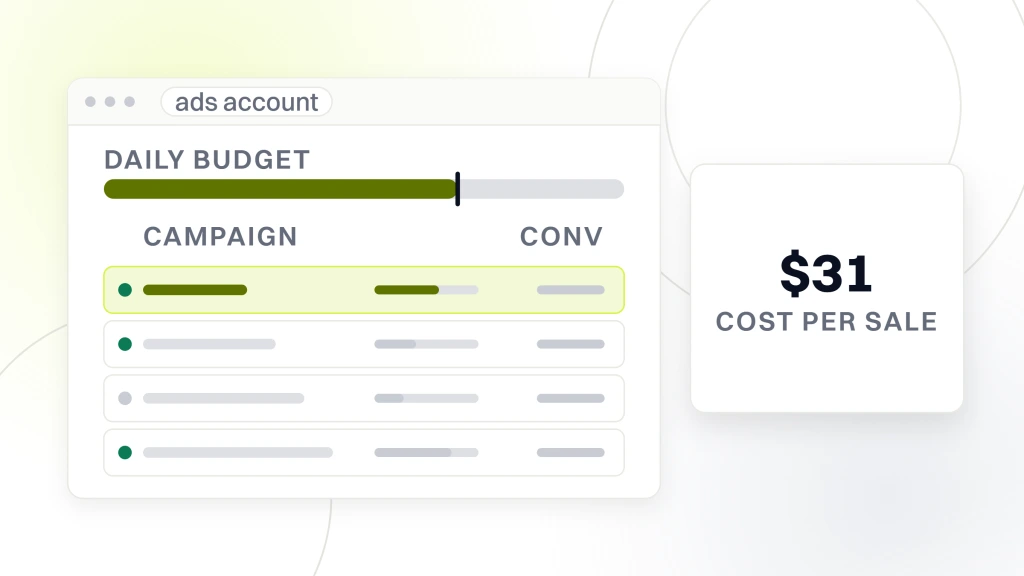
Two of our ecommerce clients show what tight paid media and a fast site each add. Boogie Board, a reusable writing tablet brand, ran Google Ads and LinkedIn Ads with us. We managed $650,000 in ad spend, lifted conversion rates over 11 percent through optimized landing pages and sharper ad targeting, and brought cost per sale to $31. Read the full Ecommerce Marketing Agency for DTC and Shopify Brands writeup for the campaign structure.
RAFZ Cirkulara Interiorer, a Swedish sustainable furniture store, pushed conversion rate up 28 percent through a site rebuild. Fully loaded page time dropped from over 15 seconds to 2 seconds, and server requests fell 82 percent. The lesson carries straight into paid media. Pagespeed under 2 seconds on mobile is a bid signal in Google Ads Quality Score and a landing page score input on Meta. Every ecommerce PPC strategy you run stacks on the site’s ability to convert the click.
Scaling ecommerce ppc strategies past 100K per month
Every account past $100,000 a month in ad spend needs a different playbook than the starter stack above. The 9 core strategies still apply, but the specialist adds 3 more layers to keep blended ROAS from decaying as the account scales past the easy demand. When home demand tops out, our guide to ecommerce market expansion strategies covers opening one new country at a time.
Layer 1. Incrementality testing
Run a 4-week geo holdout test on brand Search and post-purchase retargeting to measure true incrementality. Pause the flow in 30 percent of DMAs and compare revenue against control markets. Most stores find brand Search is 60 to 80 percent incremental and post-purchase retargeting is 40 to 60 percent incremental. This one test reallocates 10 to 15 percent of budget out of low-incremental channels every quarter.
Layer 2. First-party audience seeding
Upload high-LTV customer lists to Meta and Google as seed audiences for lookalikes and Customer Match. First-party seeds outperform generic interest targeting by 30 to 50 percent on CPA at the 100K-per-month scale. Refresh the seed list every 30 days as new high-LTV cohorts come through.
Layer 3. Creative production velocity
Scale accounts need 15 to 25 fresh Meta and TikTok assets per week to stop CPMs climbing. In-house production or a dedicated UGC creator network is the bottleneck at this stage. Every scaled ecommerce PPC account past 100K should carry a weekly creative shoot as a line item on the retainer.
Wrapping up ecommerce ppc strategies
Ecommerce PPC strategies for 2026 are a small set of decisions the specialist runs weekly. Feed hygiene. PMax segmentation. Creative refresh. Blended ROAS attribution. Brand Search defense. Catalog retargeting flows. Budget rebalancing every 30 days. Tracking QA. Site speed under 2 seconds on mobile. Every one of these compounds on the others. Skip one and the paid stack drifts.
Real accounts see 3x to 8x blended ROAS inside 6 months when every strategy above shows up every week. RAFZ Cirkulara Interiorer pushed conversion rate up 28 percent through a site rebuild that dropped fully loaded page time from 15+ seconds to 2. Boogie Board hit a 31-dollar cost per sale on $650,000 in managed spend. Ask three vendors for line-item scopes, look for the campaign structure and creative cadence they name in writing, and pick the one that names each of the 9 strategies above with a specific weekly action. Redefine Web offers a fixed-scope Ecommerce PPC Agency for DTC Brands package with Google Shopping and Performance Max on every tier and Meta from Scale, plus a broader Ecommerce Marketing Agency for DTC and Shopify Brands retainer and a Google-first Google Ads Management Services program. PPC tiers run $500 a month for Launch, $750 for Growth, $1,250 for Scale, and from $3,000 for Enterprise accounts. TikTok and creative production are quoted separately. Ad spend is billed separately.
For DTC founders buying paid search for the first time, our beginner walkthrough of what is ppc in ecommerce covers the auction, the channel mix, and the first budget math before any of the tactical playbooks above apply.
Frequently asked questions
What are the benefits of PPC advertising?
PPC pays only when a shopper clicks, so budget maps to intent. You reach exact-match search demand on Google, category browsers on Meta and TikTok, and past visitors through retargeting. Targeting layers include device, location, income band, and shopper stage. Reporting shows revenue per campaign, per SKU, and per creative asset, so you can rebalance every 30 days. Real ecommerce accounts see 3x to 5x blended ROAS by month 6 and 4x to 8x on higher-AOV categories like home decor. The 9 ecommerce PPC strategies covered in this guide are the working set that produce those results week after week.
How effective is PPC advertising?
Visitors who click a paid ad convert at roughly 50 percent higher rates than organic visitors on the same store, per Arise Digital Marketing research. Google's own incremental studies show 89 percent of paid search visits add net-new revenue when the brand is not the top organic result, and 50 percent stay incremental even when it is. Blended ROAS on a well-run ecommerce PPC stack typically hits 3x to 8x inside 6 months, with beauty and skincare compounding to 6x to 10x on lifetime value once subscription flows warm up. Effectiveness tracks tightly with feed hygiene, tracking accuracy, and creative refresh cadence.
What are the advantages and disadvantages of PPC?
The advantages of PPC are speed, precision, and measurability. Campaigns can go live in 48 hours, targeting is granular down to zip code and device, and every dollar ties to a revenue number. The disadvantages come in competitive categories where CPCs climb past $5 and poorly optimized accounts drain budget fast. A store spending $5,000 a month with a broken feed and last-click reporting can waste 30 to 50 percent of that on the wrong SKUs inside 30 days. The fix is disciplined weekly management, not more budget.
How much do ecommerce ppc strategies cost to run monthly?
Ad spend for a working stack starts at $5,000 a month for a small DTC store and scales past $100,000 for 8-figure brands. Management retainer sits alongside that. Redefine Web's ecommerce PPC tiers run $500 a month for Launch, $750 for Growth, $1,250 for Scale, and from $3,000 for Enterprise accounts. The tiers manage ad spend under $2,000, $2,000 to $5,000, $5,000 to $10,000, and above $10,000 a month. Ad spend is billed separately and paid to the ad platforms directly, and TikTok management is quoted separately. A store spending $20,000 a month on ads sits in the Enterprise tier, a flat fee from $3,000 a month, never a percentage of spend.
Which ecommerce ppc strategies should a new store run first?
Start with 4 moves inside week 1. Wire up brand Search at a low bid ceiling to defend branded queries. Split PMax into 2 asset groups by margin band. Upload the product catalog to Meta Business Manager for Advantage+ Shopping. Install Triple Whale or Northbeam for blended ROAS reporting. These 4 moves alone grow blended ROAS 20 to 40 percent inside 60 days without changing ad budget. Retargeting flows and TikTok video assets come in month 2 once the base account has clean data to bid against and creative cadence stabilizes on Meta.
How long do e-commerce ppc strategies take to compound?
Month 1 covers tracking QA, feed audit, campaign restructure, and first creative refresh. Blended ROAS dips 10 to 20 percent as learning phases reset. Month 2 shows first signal on cleaner data. Month 3 hits break-even on ad spend plus retainer. Months 4 through 6 are where compounding kicks in and blended ROAS climbs 30 to 60 percent above baseline. Skip the month-1 tracking and feed audit and every downstream number lands 3 to 5 months late. Site speed sets the ceiling too. RAFZ Cirkulara Interiorer grew conversions 28 percent after a rebuild cut page load from over 15 seconds to 2.
Do brand Search campaigns cannibalize organic traffic?
No on any competitive category. Google's incremental paid search study of 700+ accounts found 89 percent of branded paid clicks are net-new when the brand is not the top organic result, and 50 percent stay net-new when it is. Competitors bid on your store name and pull 10 to 20 percent of branded traffic away at CPAs 5x to 10x higher than your own bid. Running brand Search at a low ceiling costs 2 to 5 percent of total ad budget and returns 8x to 12x on ad spend. It is the cheapest defensive move in the ecommerce PPC stack.
What ecommerce ppc strategies work best for TikTok in 2026?
TikTok rewards native creative and hates repurposed Meta assets. The working stack starts with 3 to 5 UGC-style hooks per week filmed vertical at 15 to 30 seconds, spark ad amplification on the best-performing organic posts, and Advantage+ Shopping catalog delivery on beauty, apparel, and lifestyle categories. Budget 15 to 20 percent of total ad spend on TikTok for beauty and skincare, 10 to 15 percent for apparel, and 5 to 10 percent for home decor. Warm-up needs 4 to 6 weeks before Cyber Week peaks, so start budget shifts in mid-September for Q4 planning.
Tim Fux co-founded Redefine Web in 2023 to run websites, SEO, paid media, and marketing automation as one revenue-tied program for growth-stage brands. He is Chief Technology Officer / Chief Marketing Officer at Solar Alliance since 2025, and Co-Founder of Fux Marketing. His work focuses on Google Ads at scale across the solar, home services, and DTC verticals, with published tutorials and case studies showing 4x to 6x return on ad spend on multi-market accounts.