Ecommerce PPC Services That Grow Profitable DTC Orders

Ecommerce PPC for DTC brands, Shopify stores, and multi-SKU retailers. Google Shopping and Search on every tier and Meta from Scale, all reported to contribution margin, not last-click. TikTok and Bing are quoted separately. Flat monthly fee.

4.9Across 126 reviews on 6 platforms
Management fee
$500 Monthly
Flat fee, not a % of ad spend

Where we start Week 1
Sign-off: 20-page audit report
What’s included Launch
  • Google Ads (Search)
  • Call tracking + recording
  • Negative keyword sculpting
Ad spend managed up to $2K on Launch
Channels Grows with you
Local Services Ads from Growth, Meta from Scale

Selected clients we've run full marketing programs for

  • Armanino
  • BSH
  • Delicate Dental
  • Government Legal Department
  • Hightop Health
  • LifeStance Health
  • Marmalade
  • Montegra Capital Resources
  • Noelle Collins Dental Clinic
  • Oxford Capital
  • Paquin & Carroll Insurance
  • PCO Bookkeepers & M&A Specialists
  • Peaceful Mind Psychology
  • Peak Accounting Solutions
  • Pelvic Rehabilitation Medicine
  • RiverSaaS Capital
  • Rosenbaum Personal Injury Lawyers
  • Smile Design Dentistry
  • Stanhope Capital Group
  • Stella Maris
  • Tilghman Builders
  • Toyota
  • Uptime
  • VP Dental & Medical Supplies
  • Wilentz Attorneys at Law

Three ways your ecommerce PPC is losing orders

If any of these looks familiar, the free Google Ads audit names the fix and what it's worth before you spend a dollar.
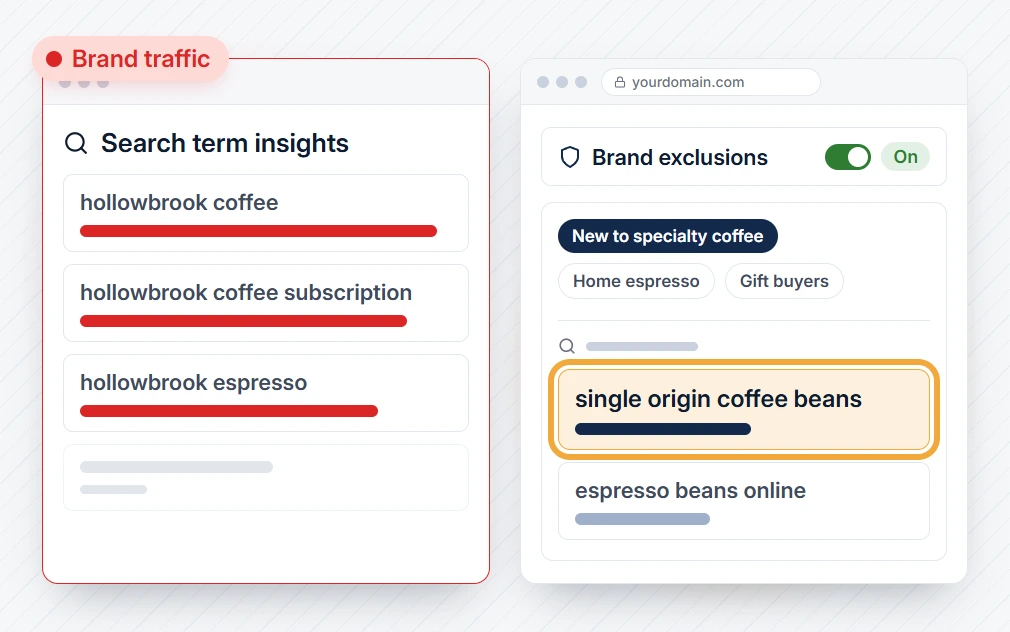
Ecommerce PPC services Performance Max terms full of brand searches, then split into prospecting asset groups
PROBLEM 01 · PMAX WASTE

Performance Max eats your brand search and calls it new revenue

PMax auto-includes brand keywords by default, so 25 to 38% of the spend fires on orders you already had. The fix is brand exclusion lists plus separate asset groups per audience so PMax only bids on real prospecting queries.
THE FIX · BRAND EXCLUSIONS + ASSET GROUP SPLIT
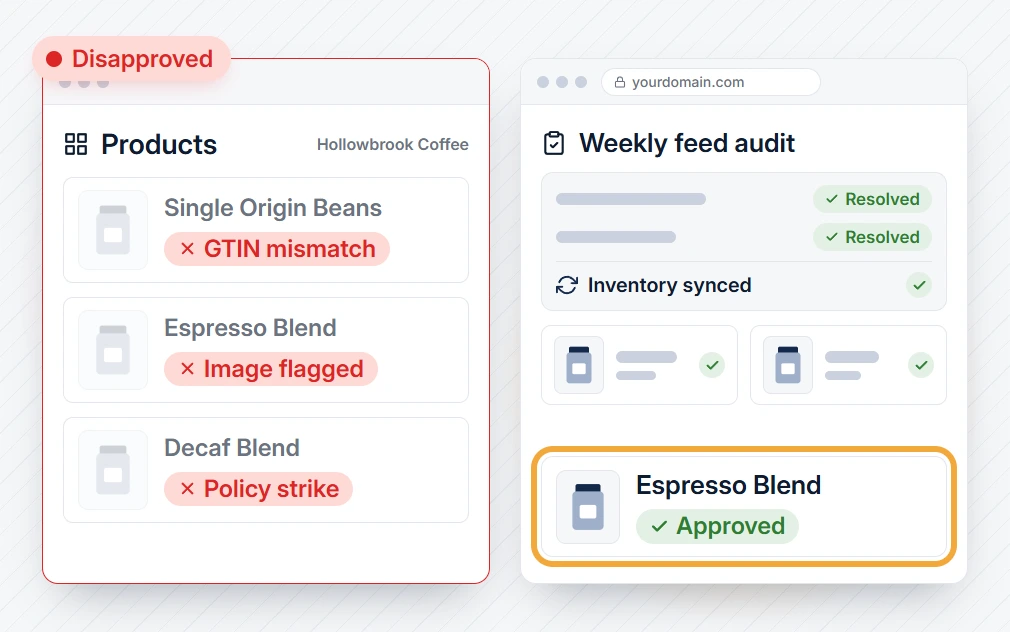
Ecommerce PPC services product grid with disapproved coffee tiles, resolved in a weekly feed audit
PROBLEM 02 · FEED DRIFT

Merchant Center disapproves a fifth of your catalog on any given day

GTIN mismatches, image flags, and policy strikes drop 15 to 22% of SKUs from Shopping. Thirty days of drift ignored kills top-line by double digits. The fix is a weekly feed audit plus policy triage tied to Shopify inventory sync.
THE FIX · WEEKLY FEED AUDIT + POLICY TRIAGE
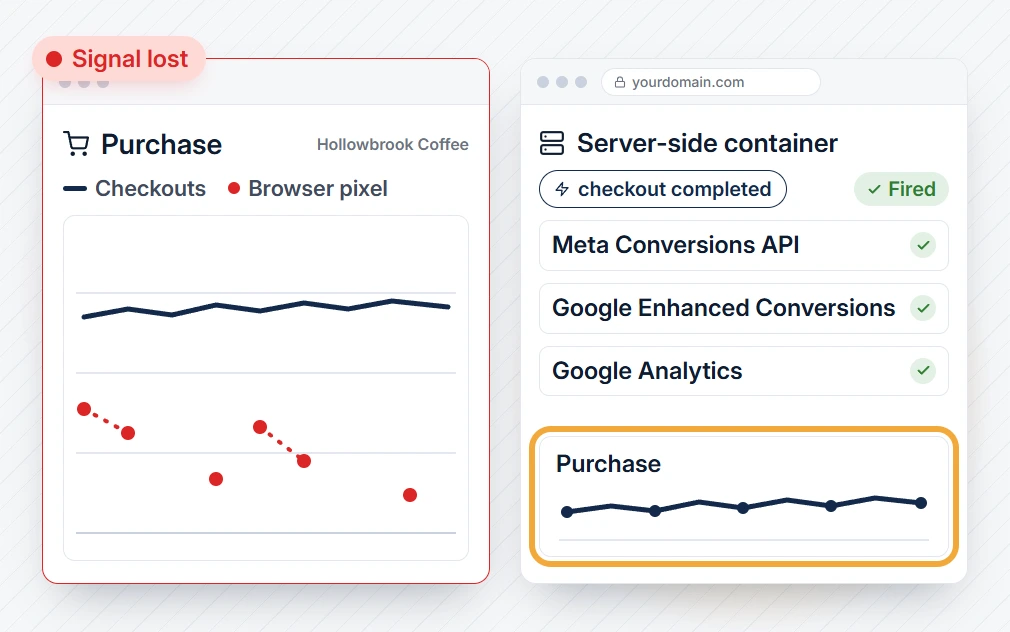
Ecommerce PPC services purchase signal lost from the pixel, restored by server-side tags on checkout
PROBLEM 03 · SIGNAL LOSS

iOS 14.5 gutted pixel signal and your bidders are flying blind

Without CAPI or Enhanced Conversions, iOS erases 30 to 40% of conversion signal. CAC climbs 20% on the same order volume. The fix is Meta CAPI plus Google Enhanced Conversions plus server-side GTM wired to Shopify checkout events.

THE FIX · CAPI + ENHANCED CONVERSIONS + SERVER-SIDE GTM

What every ecommerce PPC retainer delivers

What every ecommerce PPC retainer works toward, reported in writing every Friday.

Lower cost per new customer

Tight campaign structure, aggressive negatives, and conversion-optimized product pages drop cost per new customer inside 30 days.

Same-session checkout flow

Every Google Shopping click, and every Meta click from Scale up, lands on a product or category page wired for one-tap checkout and Shop Pay, with Klaviyo cart recovery quoted separately. No dead-end contact forms, no drop-off between ad and add-to-cart.

Weekly written performance report

On every tier, not a monthly PDF: a written report every Friday from your lead media buyer that says what launched, what moved on orders placed, and what is next. Owned by the person running your account.

Four stages, every step ends in a sign-off

Fixed scope, fixed timeline, fixed outcomes. Nothing moves to the next stage until your leadership signs off on the gate deliverable.

WEEK 1

Audit that exposes wasted spend + broken tracking

Full campaign audit surfacing wasted spend, missing negatives, misconfigured conversions, and untracked order-placed events. Written up in a 20-page report.

SIGN-OFF: 20-PAGE AUDIT REPORT
WEEK 2

Campaigns rebuilt around ecommerce intent

Higher-margin SKUs get a higher target ROAS than commodity items. SKAG-lite structure with match-type discipline, Performance Max layered where your feed qualifies, and negative keyword sculpt to strip waste before it starts.

SIGN-OFF: SKAG-LITE + PMAX LAYERED
WEEKS 2-4

First paid order inside 14 days, guaranteed

Landing pages built to your tier (1 on Launch, 3 on Growth, 6 on Scale) with checkout flow, trust badges, and review proof. Every ad tracked through to a Shopify-verified order placed. If we do not hit a paid order inside 14 days, your first month is free.

GUARANTEE: 1ST PAID ORDER IN 14 DAYS
WEEK 4+

Optimize weekly, scale against real revenue

From Growth up, ad copy A/B tests and bid strategy tuning run weekly, and Scale adds product page CRO tests. From Scale up, Meta is layered as retargeting once search demand is captured, and Google Display and remarketing are quoted separately.

CADENCE: WEEKLY FROM GROWTH

What you actually get from our ecommerce PPC services

Five workstreams, every item listed. Nothing lives in a proposal appendix.

AUDIT

Audit that exposes wasted spend + broken tracking

Full campaign audit surfacing wasted spend, missing negatives, misconfigured conversions, and untracked order-placed events. Signed off before we touch structure.

Phase Duration: 20-PAGE WRITTEN REPORT Sign-off: BEFORE REBUILD
Ecommerce PPC services audit review as two people go over a printed report together at a table
GATE · WASTED SPEND MAPPED

Wasted spend + query mining

every search term with spend reviewed; off-category, brand-competitor, and irrelevant queries surfaced for negative-keyword sculpt.

Conversion setup audit

are conversions counting clicks (wrong), add-to-cart (better), or order placed (right)? Fixed at the root before any bid change.

Product page + CVR audit

product page conversion rate benchmarked against ecommerce avg. Every ad group mapped to its landing page with a CVR score.

Written 20-page report

founder + ops lead review and sign off before we rebuild. No changes without a written go-ahead.

Competitor auction insight

top DTC and category competitors in your niche pulled from Auction Insights and priced against your target ROAS ceiling.

Baseline Shopify + GA4 reconciliation

last 90 days of orders mapped by source so the audit report starts with a real blended CAC and ROAS number.

Get a free ecommerce PPC audit. Written fix plan in 24 hours

DTC PPC AUDIT · 3 ACCOUNT FIXES · MONTH-ONE 14-DAY GUARANTEE · No card needed. No sales call required.

Get my Google Ads audit →

Four ecommerce PPC tiers for every DTC stage

Flat monthly fee. Every workstream listed, the quote you get is the invoice you pay. Ad spend billed by the networks directly.

Launch

$500MONTHLY (MGMT FEE)

A first paid channel; ad budgets under $2,000/mo

  • Google Ads (Search)
  • Managed monthly ad spend up to: $2K
  • Campaign builds: Up to 3
  • Dedicated landing pages: 1
  • Call tracking + recording
  • Negative keyword sculpting
  • Geo and audience targeting, ZIP level where the service area is local
Get a Launch quote

Scale

$1,250MONTHLY (MGMT FEE)

Aggressive growth; $5,000–$10,000/mo ad budgets

  • Google Ads (Search)
  • Local Services Ads (LSA), for local service businesses
  • Meta ads (Facebook/Instagram)
  • Managed monthly ad spend up to: $10K
  • Campaign builds: Unlimited
  • Dedicated landing pages: 6
  • Call tracking + recording
Get a Scale quote

Enterprise

Starts at $3,000MONTHLY (MGMT FEE)

Multi-location or multi-region programs; $10,000+/mo managed spend

  • Google Ads (Search)
  • Local Services Ads (LSA), for local service businesses
  • Meta ads (Facebook/Instagram)
  • Managed monthly ad spend up to: Unlimited
  • Campaign builds: Unlimited
  • Dedicated landing pages: Custom
  • Call tracking + recording
Request a proposal

EVERY TIER: FLAT MONTHLY FEE · 14-DAY GUARANTEE · YOU OWN AD ACCOUNTS + DATA

Every PPC feature, tier by tier

SCROLL THE TABLE SIDEWAYS FOR EVERY TIER
Platforms + spend
FEATURE
LAUNCH
GROWTH
SCALE
ENTERPRISE
Google Ads (Search)
Local Services Ads (LSA), for local service businesses
—
Meta ads (Facebook/Instagram)
—
—
Managed monthly ad spend up to
$2K
$5K
$10K
Unlimited
Campaigns + landing pages
FEATURE
LAUNCH
GROWTH
SCALE
ENTERPRISE
Campaign builds
Up to 3
Up to 6
Unlimited
Unlimited
Dedicated landing pages
1
3
6
Custom
Call tracking + recording
Landing page CRO tests
—
—
Optimization
FEATURE
LAUNCH
GROWTH
SCALE
ENTERPRISE
Negative keyword sculpting
Geo and audience targeting, ZIP level where the service area is local
Weekly optimization cycle
—
CRM offline-conversion sync
—
Reporting + team
FEATURE
LAUNCH
GROWTH
SCALE
ENTERPRISE
Monthly performance review
Weekly written report
Live spend + lead dashboard
—
Dedicated PPC manager
—
—
Case studies

Real DTC brands, real order numbers

Each one includes where the client started, what we changed and what happened.
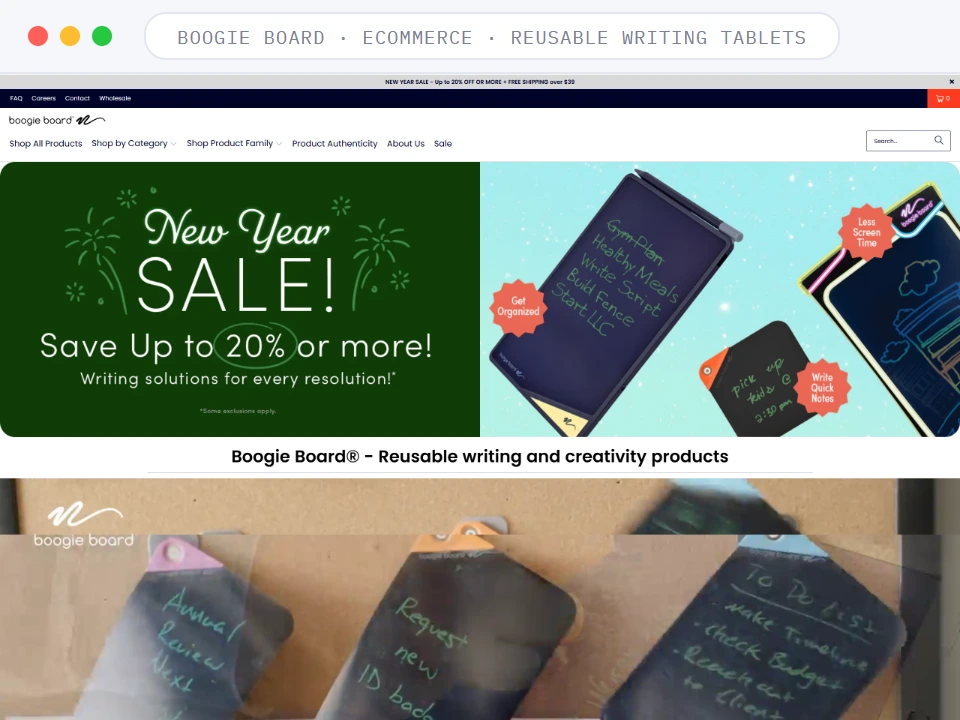
Homepage of Boogie Board, a Ecommerce · Reusable Writing Tablets business, shown in a browser window Published case study

Boogie Board

MYBOOGIEBOARD.COM

Ecommerce · Reusable Writing Tablets Google Ads Management · Strategy · Campaign Buildout

Drove sales for Boogie Board at a $31 cost per conversion, at scale.

Boogie Board, the brand behind the first reusable writing tablet, had loosely targeted Google Ads. Its landing pages undersold the product, and it had no follow-up for repeat buyers. We sharpened keyword targeting, added LinkedIn Ads, optimized landing pages and set up lead magnets and automated follow-ups. Conversion rates rose 11% and cost per conversion reached $31 across $650K in managed ad spend.

11%
Conversion rate
$31
Cost per sale
$650K
Managed budget

Get a free ecommerce PPC audit. Written fix plan in 24 hours

DTC PPC AUDIT · 3 ACCOUNT FIXES · MONTH-ONE 14-DAY GUARANTEE · No card needed. No sales call required.

Get my Google Ads audit →

Client words

Catalog ads at 5.8x where our old agency plateaued at 2x. Weekly notes tell us exactly what changed and what is next.
Josh Gingrich
CEO, Printed Mint
Verified via Clutch 5.8x catalog ROAS 3.4x return vs prior agency
Printed Mint website homepage in a browser window, personalized blankets above its product collections
1 / 10

See what your current ad spend could be earning

Move the sliders to your numbers. The estimate assumes recovered wasted spend plus a conversion improvement on what you already buy.

$5,000
$1,000 $50,000
$800
$100 $10,000
1.5%
0.5% 6%
Recovered ad waste plus conversion lift. The audit is free, no card, no commitment.
Projected monthly recovery
+$/mo

Free · Written findings · Yours to keep

FAQ

Common ecommerce PPC services questions, answered

From real quote calls. Anything else, ask on the call and get an answer in the first 5 minutes.

What is PPC in eCommerce?
PPC in ecommerce is a paid model where online stores bid on keywords and audiences and pay only when a shopper clicks the ad. Ads run on Google Search, Google Shopping, Meta, TikTok, Pinterest, and Bing, and route traffic to product or category pages inside a Shopify or BigCommerce storefront. Well-run ecommerce PPC services tie every click back to a checkout-verified order so bidders optimize for gross profit, not last-click revenue. The right structure segments campaigns by margin, uses Shopify order data for offline conversion imports, and rebuilds the Google Shopping feed inside Merchant Center every week to keep 15 to 22% of the catalog from dropping out of eligibility on any given day. The channels layer differently by funnel stage. Google Search and Shopping capture buy-now demand at the top of the funnel. Meta and TikTok warm up new audiences and retarget site visitors who abandoned cart. Bing quietly picks up mid-funnel shoppers most agencies ignore. Blended CAC across all channels should come in at 15 to 25 percent of average order value for a healthy DTC brand.
How much do ecommerce PPC services cost per month?
Ecommerce PPC services at Redefine Web start at $500 per month for the Launch tier and run to $750, $1,250, or from $3,000 per month for Enterprise DTC programs. Ad spend on Google and Meta is billed by the networks directly, not by us. Every tier includes campaign management, Google Shopping feed hygiene, and the 14-day first-paid-order guarantee. Every tier gets a written report every Friday from your lead media buyer. Scale and Enterprise add a dedicated PPC manager. Larger DTC brands also get quarterly ROI reviews with leadership and a spend-to-inventory model that caps ad spend at what your fulfillment capacity can actually service. You own every ad account and every dollar of first-party data from day one. Launch, Growth and Scale run a 6-month minimum term and Enterprise runs 12 months, which lines up with the time it takes machine bidders to gather enough conversion signal to stabilize CAC. Cancellation returns full ad account access, your creative library, and all reporting inside 5 business days.
What does a PPC agency do?
A PPC agency runs paid-search and paid-social advertising for you across Google Ads, Meta, TikTok, and Bing so your team can focus on product, fulfillment, and customer service. Day to day the work covers keyword and audience research, ad copy and creative production, Google Shopping feed builds, bid strategy tuning, negative keyword sculpting, landing page conversion tests, and weekly performance reporting against orders placed. A good ecommerce PPC agency also owns the tracking stack. Google Enhanced Conversions, Meta CAPI, and server-side GTM tied to your Shopify checkout events keep bidders learning after iOS 14 stripped signal from browser pixels. The output is lower CAC per new customer, higher blended ROAS, and a written recap of what changed and why every single week. The wrong PPC agency touches campaigns once a month, reports last-click revenue in a PDF, and never opens Merchant Center. That agency will hold your CAC flat at best. Ask any agency you talk to what they did in your feed last week, and how many negatives they added to your search-term report. If the answer is vague, walk.
What is PPC management?
PPC management is the day-to-day work of planning, launching, and optimizing pay-per-click campaigns so ad spend produces profitable orders. It covers keyword and audience research, campaign structure, bid strategy selection, creative testing, negative keyword sculpting, feed hygiene inside Google Merchant Center, landing page conversion iteration, and weekly reporting on cost per order and blended ROAS. Ecommerce PPC management differs from lead-gen PPC because the conversion is a checkout-verified order, not a form fill. That means bidders need offline conversion imports from Shopify, margin-adjusted conversion values, and a feed that clears policy every day so shopping ads keep serving. Good ecommerce PPC management operates on a weekly cadence. Search-term reports get reviewed every Monday, negatives added, product page conversion rates checked, quality scores audited, and creative refreshed on a 4-week rotation. The Friday report rolls up ad spend, orders placed, cost per order, revenue from paid, blended ROAS, and next week's plan against your inventory throughput.
What is a good ROAS in PPC for ecommerce?
Target ROAS depends on contribution margin. If your CM3 per order is 30 percent, you need blended ROAS above 3.3 to break even on the first purchase. If margin is 60 percent, break-even is 1.7 and 3x ROAS is genuinely profitable. Bidders should be fed margin-adjusted conversion values so they optimize for gross profit, not top-line revenue. Many ecommerce PPC accounts chase the wrong number: a 4x ROAS on a low-margin SKU can still lose money once returns, shipping, and payment processing are subtracted. From Growth up, we rewire bidding on day one against contribution margin per order using Shopify offline conversion imports, then set target ROAS floors per SKU cluster instead of one blended target for the whole account. Repeat-buyer LTV changes the math further. A brand with a 3-month repurchase cycle can afford break-even ROAS on first order because LTV pays back the acquisition cost inside 90 days. New-brand accounts without repeat data should target profitable ROAS from click one.
What is PPC vs SEO?
PPC buys ranked traffic today; SEO earns compound organic traffic over 6 to 18 months. Both feed the same funnel, but they solve different problems for a DTC brand. PPC gets you paid orders in the first 7 to 14 days, which is how new campaigns fund themselves. SEO builds a moat that keeps producing free traffic long after ad spend gets paused. Running only PPC caps your CAC once auction prices climb. Running only SEO leaves 12 to 18 months of revenue on the table during the ranking wait. The math favors running both as soon as a store clears $30K per month in blended revenue. Our ecommerce PPC services and SEO retainers share the same tracking stack so blended CAC stays honest across paid and organic. The best DTC brands treat PPC as a demand-capture engine and SEO as a demand-generation engine. PPC ads capture shoppers already searching for what you sell. SEO content, product schema, and category page optimization create demand from people who did not know your brand existed yet.
Which channels do ecommerce PPC management retainers cover?
Google Search, Google Shopping, and Performance Max run inside Google Ads on every tier, and Meta prospecting and retargeting start on Scale. YouTube, Google Display and remarketing, TikTok, Pinterest, and Bing are quoted separately, and Amazon Advertising, also quoted separately, is handled through a co-managed specialist partner so blended CAC across DTC and marketplace stays honest. From Growth up, every channel reports back to Shopify order data through offline conversion imports so target ROAS gets set against real gross profit, not last-click revenue. Klaviyo email and SMS flows are wired into the same first-party pixel stack via the Klaviyo API so retargeting audiences update in near real time based on shopper behavior on your storefront. Channel mix gets rebalanced quarterly against your margin, inventory throughput, and creative bandwidth. Brands with strong creative production go heavy on Meta and TikTok. Brands with a wide, feed-friendly catalog lean into Google Shopping and Performance Max. Every scaling decision is tied back to a written recap so leadership sees which channel each dollar bought.
How fast do ecommerce PPC services produce orders?
Ecommerce PPC services produce first orders in 7 to 14 days from campaign launch once tracking, feed hygiene, and creative are in place. Google Shopping usually delivers first orders inside a week. Meta prospecting warms up in week 2 as pixels gather signal. TikTok takes 3 to 4 weeks to hit stable CAC because the platform needs more creative iterations to learn. If the 14-day first-paid-order mark gets missed, your first month is free. We have applied that guarantee across DTC brands to date. The critical piece is having Google Enhanced Conversions and Meta CAPI wired before launch. Without that, iOS 14 strips 30 to 40 percent of the conversion signal and bidders spend 60 days training on noise. Beyond first orders, real scale kicks in around week 8. Bidders finish their learning phase and negatives cut off the wasted-spend queries. From there, optimization compounds, weekly from Growth up.
Do ecommerce PPC services include Google Shopping feed work?
Yes. Google Shopping feed hygiene, GTIN attribution, custom labels for margin segmentation, feed rules for out-of-stock handling, and category attribution are all included in every ecommerce Google Ads engagement. Feed quality is the single biggest lever on Shopping performance and most brands under-invest in it. On any given day, 15 to 22 percent of a typical Shopify catalog is disapproved inside Merchant Center for image flags, GTIN mismatches, or policy strikes. Left ignored for 30 days that costs double-digit percentages of top-line revenue. Our team runs a weekly feed audit tied to Shopify inventory sync so out-of-stock SKUs get paused before spend fires and disapproved items get triaged inside 48 hours. Product titles, descriptions, and custom labels get rewritten for margin segmentation so high-margin SKUs bid into their own campaign at a higher target ROAS floor. That per-SKU control is how blended CAC stays low while competitors flat-line.
Is Google Ads good for ecommerce?
Yes. Google Ads is the highest-intent paid channel available to a DTC store because shoppers on Google Search and Google Shopping are actively trying to buy the thing you sell. For most DTC brands, Google Shopping alone drives 40 to 60 percent of paid revenue, with Performance Max and branded Search filling most of the remainder. The channel works best when contribution margin per order is at least $30 and monthly ad spend clears $3,000 so machine-learning bidders have enough conversion data to optimize on. Below those thresholds, Google Ads is fine as a proof-of-demand test but should be paired with organic content and email flows for full-funnel economics. Where Google Ads underperforms is with pure impulse-purchase categories, where TikTok and Meta creative wins the click before the shopper ever searches. For considered purchases, planned replenishment, and category-defining products, Google Ads is almost always the first channel we build and the last we scale down.
What is the 80 20 rule in ecommerce?
The 80/20 rule (Pareto principle) in ecommerce is the observation that roughly 80 percent of revenue comes from 20 percent of your SKUs and 20 percent of your customers. On the ad side, the same rule holds: 80 percent of profitable paid orders typically come from 20 percent of campaigns, keywords, or audiences. Ecommerce PPC services should be structured around finding that 20 percent quickly, scaling spend into it aggressively, and stripping budget from the low-return long tail. In practice that means margin-first campaign structure with higher target ROAS on top-margin SKUs, negative keyword sculpts that kill off-category queries, and weekly search-term reports that promote winning terms and pause losers before they eat budget. Custom labels inside Google Merchant Center let you segment the top 20 percent of SKUs into their own Performance Max asset group so those items get bid protection when auction pressure climbs. Ignore the other 80 percent at your peril: they still need feed hygiene and disapproval triage, just not premium ad spend.
Is $20 a day good for Google Ads?
$20 a day (about $600 per month) is a real starting point for a Google Ads test if your average CPCs are under $2 and contribution margin per order is at least $30. At that spend, you get roughly 10 clicks a day, which is enough to prove demand on 1 or 2 tightly scoped Search campaigns or a small Google Shopping test. It is not enough to seriously feed Performance Max or Smart Bidding, both of which need 30 to 50 conversions per month to learn. For most DTC brands we take on, a serious Google Ads test starts at $3,000 per month across Search and Shopping. Below that, the platform under-optimizes and you pay a beginner-tax on every click while machine bidders wait for enough signal. If $20 a day is what your unit economics support today, use it for one clearly defined test with tight negatives and a single landing page. Scale the budget only after you see a repeatable ROAS above your margin break-even.
What is a PPC for Amazon sellers?
PPC for Amazon sellers is paid advertising inside Amazon Ads, primarily Sponsored Products, Sponsored Brands, and Sponsored Display. Ads are keyword-targeted or product-targeted and appear in search results, on product detail pages, and inside category browse pages. Amazon Ads is separate from Google Ads: it uses first-party purchase data from inside Amazon, so ROAS numbers reported there are checkout-verified but do not include off-Amazon behavior. Our ecommerce PPC agency co-manages Amazon Ads through a specialist partner, quoted separately from the PPC tiers, so blended CAC across DTC and marketplace stays honest and inventory forecasts get built against the combined pipeline instead of two separate silos. The tactical stack differs from Google Ads: Amazon rewards catalog completeness, review count, and Buy Box ownership more than creative or landing page CVR. A tight Sponsored Products campaign structure with negative ASIN targeting and dayparted bids is usually the fastest path to profitable Amazon revenue for a DTC brand already running Shopify.
What is the difference between Google Shopping and Google Ads?
Google Ads is the whole platform. It runs Search, Shopping, Display, Video, Performance Max, and Demand Gen campaigns. Google Shopping is one campaign type inside Google Ads that pulls product data from a Merchant Center feed and shows product image, price, and store name in the ad slot. For most DTC brands Shopping is 40 to 60 percent of paid revenue. Setting up Shopping the right way starts with a clean product feed inside Merchant Center: accurate GTINs, high-resolution images at 1200 pixels or wider, and product titles that lead with the keyword shoppers actually search. The feed is the single biggest lever on Shopping performance, ahead of bid strategy or budget allocation. Standard Shopping and Performance Max both draw from the same feed but bid differently. Standard Shopping gives manual control over match types and negative keywords. Performance Max hands campaign optimization to Google Smart Bidding and layers in Display, YouTube, and Discover placements automatically.

Free · Written in 24 hours · No pitch

Get your free Google Ads audit.

A written report in your inbox within 24 hours, with three fixes you can ship the same week, whether or not you hire us.

Written in 24 hours · 10,000+ audits run · 300+ clients since 2021