In this article
- SaaS PPC pricing runs $500 to $3,000 plus per month across 4 tiers, media billed separately.
- Flat retainer wins for accounts spending under $80K per month on media, hybrid fits above.
- Hidden costs stack $400 to $2,200 monthly in third-party tools and $3,000 setup fees.
- Automation Anywhere cut CPL 97% from $1,936 to $63 and grew monthly leads from 150 to nearly 8,000.
- Ask for the all-in cost at three spend scenarios before you sign any SaaS PPC contract.
SaaS PPC pricing sits between $500 and $3,000 plus per month for the retainer alone. Media spend is paid to the ad platforms on top, and some agencies also take a 10 to 20% management fee on it. A $1,499 retainer at Agency A buys a senior operator running one channel deep. The same $1,499 at Agency B buys a mid-level team running three channels shallow. This guide walks the bands tier by tier, weighs flat fee against percentage of spend, and flags the hidden line items that surface at quarter-end.
Most readers arrive here with a proposal in hand and no clean way to size it against the market. Others are drafting an RFP and want to peg the right retainer band before it goes out. The ranges, model comparisons, hidden-cost flags, and negotiation levers below routinely save teams 12 to 18% on the same nominal scope. Read it through, keep the comparison table nearby for your next agency call.
SaaS PPC management services pricing bands
SaaS PPC management services pricing splits into four retainer tiers from $500 up past $3,000 per month. Under $500 you are usually paying a solo freelancer with no reporting layer. Above $3,000 you are paying for named channel leads and warehouse-grade reporting. The two middle tiers cover the bulk of growth-stage SaaS accounts running one to three channels.
Pricing bands tell you what you are buying, not what you are paying. A $1,499 retainer at Agency A might buy a senior operator running one channel deeply. The same $1,499 at Agency B buys a mid-level team running three channels shallowly. Neither is inherently right. Which one fits your account depends on where the paid channel bleeds efficiency right now. If Google Ads is a mess and LinkedIn is untouched, the single-channel senior operator wins. If execution is decent everywhere and you need multi-channel coordination, the three-channel team wins. Read the scope, not the retainer.
| Retainer band | What the retainer buys | Best fit stage |
|---|---|---|
| $500 per month (Launch, ad spend under $2,000) | Google Ads Search, up to 3 campaigns, weekly report | Seed to Series A, single-channel test |
| $750 per month (Growth, ad spend $2,000 to $5,000) | Google Ads with weekly optimization, CRM offline-conversion sync, live dashboard, weekly report | Series A to early B |
| $1,250 per month (Scale, ad spend $5,000 to $10,000) | Dedicated PPC manager, Google Ads plus Meta ads, live dashboards, weekly optimization | Series B to C, mid-market SaaS |
| From $3,000 per month (Enterprise, ad spend above $10,000) | Dedicated PPC manager, Google and Meta at any spend, other platforms quoted separately, CRM-tied MRR reporting | Series C and up, complex ICP |
| Ad spend | Paid to Google and the other ad platforms, separate from the flat fee | All bands |
Callout. The retainer number tells you nothing about what you are buying. Force every proposal to list channels, hours, and reporting cadence line by line before you compare prices.
What the $500 band really delivers
The $500 retainer band delivers a solo operator managing one paid channel with a weekly report and one working session per month. That operator can run Google Ads competently at ad spend under $2,000 per month. Working sessions are monthly at this band. Reporting is a Google Sheet or Data Studio snapshot. If your SaaS needs multi-channel coordination or weekly optimization, this band underdelivers. If your SaaS is testing paid for the first time and wants to prove viability on one channel, this band is the right entry point. Founder time replaces some of what a senior operator would bring at a higher band.
What the $1,250 band really delivers
The $1,250 retainer band delivers a dedicated PPC manager running Google Ads and Meta ads with a live dashboard and a weekly optimization cycle. LinkedIn and Microsoft Ads are quoted separately. Cadence includes a weekly written report, a monthly performance review with your marketing leader, and a quarterly business review with pipeline math and rescope proposal. This is the shape most Series B SaaS accounts land at, since the operational depth pays back through better bid strategy and cleaner reporting. Below Series B, the band is overkill. Above Series C, the band is undersized.
Flat fee vs percentage SaaS PPC pricing models
Flat fee vs percentage SaaS PPC pricing models is the argument every proposal review comes back to. Flat monthly retainers tie agency incentives to your outcome. Percentage of spend ties them to your budget, and the recommendations drift toward larger media plans quarter over quarter. Between $30K and $300K in monthly ad spend, flat retainer wins almost every review.
The pricing model matters since it decides where the friction lands during quarterly rescope. Under flat retainer, you rescope by adjusting deliverable counts and cadence. Under percentage of spend, you rescope by adjusting the media budget, which flows straight to the agency’s revenue. That structural bias appears subtly in strategy recommendations. Agencies on percentage of spend more often suggest adding a new channel or raising budget on an existing channel. Agencies on flat retainer more often suggest optimizing what already runs. Neither model is inherently good or bad. Both fit different SaaS shapes.
When flat retainer is the right choice
Flat retainer is the right choice for SaaS accounts between $8K and $300K monthly ad spend. In that band, the operational work stays roughly constant regardless of media budget within the band. A flat retainer prices that work directly. Percentage of spend at 15% on $50K monthly spend costs $7,500 in agency fees, which is roughly what a flat retainer would bill for the same scope. The difference is that flat retainer stays flat as you optimize spend down. Percentage drops proportionally, which pushes the agency against optimization gains that reduce spend without hurting results.
Pro tip. If a proposal quotes percentage of spend on media below $10K per month, ask for a flat retainer number too. The two numbers put together tell you the real floor.
When percentage of spend earns its keep
Percentage of spend fits above $300K monthly ad spend, where the media buying complexity scales with budget and the agency’s operational cost grows with the spend size. At that scale, a hybrid model with a base retainer plus a small percentage above a threshold works well. Base retainer covers strategy, reporting, and the first $200K monthly spend. Percentage kicks in at 8 to 12% above that threshold. That structure keeps incentives aligned and still covers the real cost of managing a large media budget.
Compare the prices of SaaS PPC management services
To compare the prices of SaaS PPC management services on level ground, normalize across three axes. Total monthly cost with the media fee folded in. Deliverable counts by channel. Reporting depth. Once you normalize, the same headline retainer can buy 40% more real work at one shop than another.
Price comparison for SaaS PPC pricing needs apples to apples, and most proposals are structured to make apples to apples impossible. Some proposals bury the media buying fee inside the retainer number. Some list deliverables in marketing language without counts. Some skip reporting depth entirely. Force normalization on every proposal by asking three specific questions. What is the all-in monthly cost at my expected media spend. How many ad variants, landing page tests, and reporting cycles are included per month by channel. What tools does the reporting stack use, and when does live dashboard access go live. Real proposals answer all three. Vague proposals dodge them.
Callout. The right SaaS PPC pricing comparison spreadsheet has three columns, not one. All-in cost, deliverable count, and reporting depth. Every proposal that ducks a column is hiding something.
Normalize on total monthly cost
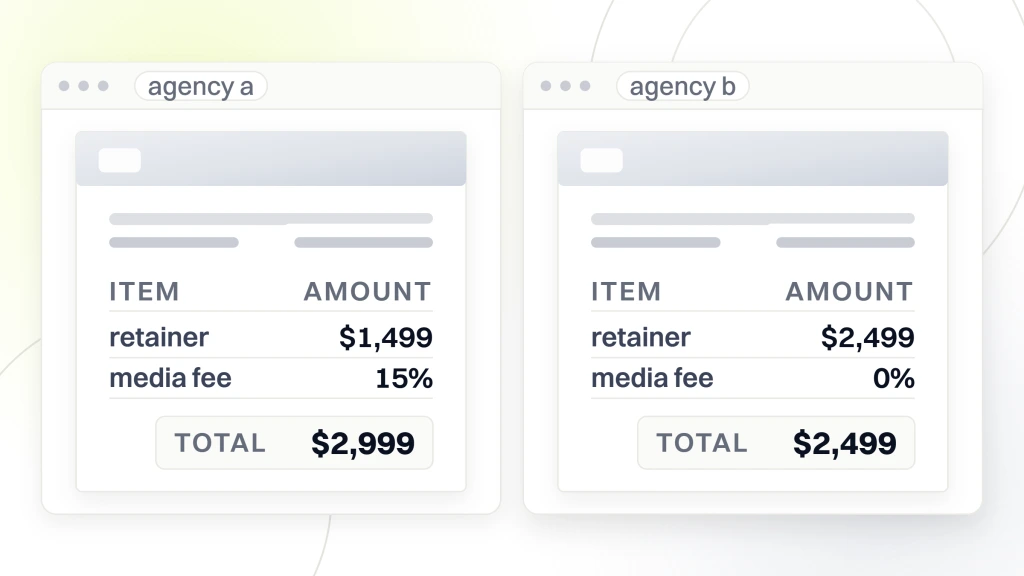
Total monthly cost normalization means adding retainer plus media fee plus any pass-through platform costs, at your expected ad spend. A $1,499 retainer with 15% media fee at $10K monthly spend costs $2,999 all-in. A $2,499 retainer with 0% media fee at the same spend costs $2,499 all-in. The lower-retainer shop ends up more expensive once you normalize. Force every proposal to state the all-in number at three spend scenarios. Current spend, plus 30%, plus 60%. The comparison becomes clear inside five minutes of proposal review.
Normalize on deliverable counts by channel
Deliverable count normalization means listing per month per channel. Number of new ad variants tested. Number of landing page tests. Number of new campaigns launched. Number of hours of optimization work. Frequency of search-terms report review. Frequency of creative rotation. Reporting cadence. Real proposals list all seven with numbers. Vague proposals say “ongoing optimization” and “continuous improvement.” Normalize every proposal to the same deliverable count grid before comparing prices. The exercise takes 20 minutes and reveals which shops overpromise the scope.
Best SaaS PPC agencies with transparent pricing no hidden costs
The best SaaS PPC agencies with transparent pricing and no hidden costs rarely brand themselves that way. Transparent pricing simply means the retainer, the media fee structure, and every pass-through platform cost are stated in the proposal at your specific spend level before signature. Hidden costs stack up at quarter-end and quietly turn a $1,499 retainer into a noticeably larger all-in bill.
Transparent pricing shows up in five specific proposal choices. The retainer is stated as a fixed number, not a range. The media buying fee is stated as a percentage or a flat number, not left ambiguous. Third-party tools like call tracking, landing page builders, or analytics platforms are itemized with cost estimates. Overtime or scope creep triggers are defined with rates. And termination fees are itemized. Proposals that state all five build trust. Proposals that leave any of the five ambiguous are hiding cost that surfaces later.
Pro tip. Ask for a sample first-quarter invoice before you sign. Any agency confident in its SaaS PPC pricing sends one on request in under a business day.
The five hidden-cost categories to check
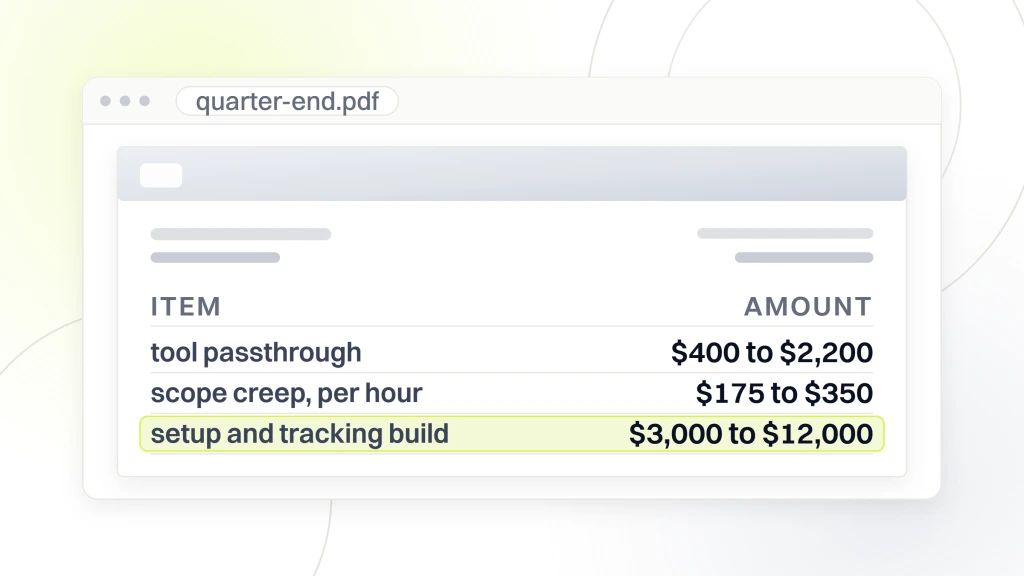
Five hidden-cost categories surface at quarter-end on non-transparent proposals. Media buying fee stated as a range instead of a fixed percentage. Third-party tool passthrough for call tracking, landing page platforms, or analytics platforms that adds $400 to $2,200 monthly. Scope creep fees for out-of-scope work at $175 to $350 per hour. Setup fees for onboarding, tracking build, or landing page development that add $3,000 to $12,000 in the first month. And termination fees that lock you into 90 days notice with cure periods. Ask about all five during proposal review. Real answers are specific dollar amounts. Vague answers are hidden costs waiting to surface.
What transparent looks like in a proposal
Transparent proposals list the retainer as a fixed monthly number. They state the media buying fee as 0, 10, 12, 15, or 20%, not a range. They itemize third-party tools with pricing. They state overtime rates and scope creep thresholds. They state the termination clause with notice period and any cure periods. And they include a sample invoice for the first quarter showing the all-in cost. Any proposal that skips two or more of these choices is opaque by design. Push back or move on.
For a deeper agency selection framework, our guide on how to choose a SaaS PPC agency covers the operator-level questions that surface real specialists from generalists. And if you are still building a shortlist, the roundup of best SaaS PPC agencies maps each shop by focus, retainer band, and reporting depth.
PPC management cost for SaaS companies 2025
The PPC management cost for SaaS companies 2025 has drifted upward 8 to 15% versus 2023, driven by talent cost, tooling investment, and increased reporting complexity from privacy changes. Expect proposals from strong specialists to run 10 to 20% higher than they would have two years ago for the same nominal scope.
The 2025 cost drift traces to three real forces. Talent cost went up as SaaS growth marketers with server-side tracking experience became scarce. Tooling investment went up as agencies stood up server-side tracking, warehouse-level analytics, and CRM integration to survive privacy changes. And reporting complexity went up as Safari ITP, iOS 17 privacy, and cookie deprecation force agencies to rebuild attribution stacks. Any agency still quoting 2023 prices is either working with outdated tools or absorbing the cost drift into thinner margins, which usually shows up as junior operators on your account.
Callout. Ask every proposer who owns the day-to-day by name and pull the LinkedIn tenure. If the operator has 18 months of history, you pay senior for mid.
Talent cost drift and account staffing
Talent cost for SaaS PPC operators drifted up 12 to 22% between 2023 and 2025. Operators with server-side tracking chops now pull $140K to $210K base at agencies, before benefits and equity. That drift flows straight into retainer pricing. Any agency still quoting 2023 numbers with experienced staffing either ate the margin or quietly downgraded the operator on your account. Ask who owns the day-to-day and check the LinkedIn tenure. If the named operator has 18 months of paid search experience, you are paying senior prices for a mid-level seat.
Tooling and privacy compliance cost drift
Tooling cost drift for a SaaS PPC agency stack runs another 8 to 18% between 2023 and 2025. Server-side GTM setups, CAPI implementations for Meta and LinkedIn, and warehouse-level analytics platforms all cost money. Agencies that pass through some of that tooling cost keep their base retainer flat but add itemized platform fees. Agencies that raise the retainer number absorb it directly. Either approach is fine as long as it is transparent in the proposal.
Pricing model tradeoffs at each SaaS spend tier
Pricing model tradeoffs at each SaaS spend tier follow a fairly clean pattern. Under $10K monthly spend, flat retainer wins on incentive alignment. From $10K to $80K, flat retainer still wins but percentage closes the gap. Past $80K, a hybrid of base retainer plus a small percentage above a threshold is the cleanest fit.
Model tradeoffs matter since the wrong model produces predictable friction at rescope. A SaaS at $12K monthly spend on flat retainer can optimize down to $8K without agency pushback, since the retainer stays flat. The same SaaS on percentage of spend faces implicit resistance to spend optimization since it reduces the agency’s revenue. That structural bias plays out subtly across quarters, and by month twelve the difference between the two models can be significant. Match the model to your growth trajectory, not to the sticker price on the first proposal.
Below $10K monthly spend
Below $10K monthly spend, flat retainer is the right structure almost always. Percentage of spend at 15 to 20% on that ad budget totals $1,500 to $2,000, which ties the fee to the budget instead of the work. Agencies that offer percentage only at this spend tier are either running a very light service or charging separately for setup and reporting. Force a flat retainer proposal at this tier and negotiate the scope down to a single channel focus.
Above $80K monthly spend
Above $80K monthly spend, hybrid retainer plus percentage becomes optimal. Base retainer covers strategy, reporting stack, and the first $200K monthly spend at a flat rate. Percentage of 8 to 12% applies above the threshold. That structure covers the real operational cost of managing large media budgets without over-rewarding budget increases. Enterprise SaaS at $500K plus monthly spend often runs custom hybrid structures with tiered percentages that decline as spend grows past defined thresholds.
Real example of SaaS PPC pricing playing out
Real SaaS PPC pricing plays out in the gap between the proposal number and the outcome that shows up on the MRR chart. A well-priced engagement produces MRR growth that dwarfs the retainer. A poorly-priced engagement produces flat MRR yet the retainer creeps up quarter over quarter.
Automation Anywhere is the pattern we point new SaaS clients to. The account came to Redefine Web paying $1,936 per lead, with campaigns chasing conflicting KPIs and a simple contact form as the main conversion. The work covered a strategy audit, campaigns split by goal, ads rewritten around buyer problems, landing pages localized by region, a free-trial offer, and bidding for conversions instead of rank. Cost per lead dropped 97% to $63. Monthly leads grew from 150 to nearly 8,000. Ad impressions grew 300% across key markets. That is what well-priced SaaS PPC looks like. Judge the fee against the leads and pipeline it produces, not against the sticker price.
Pro tip. Track retainer to sourced MRR ratio every quarter. Below 3x, escalate. Above 20x, expect a rescope at renewal. The band you want is 5x to 12x sustained.
Retainer to MRR delivered ratio
Retainer to MRR delivered ratio is the metric that decides whether the pricing was right. A specialist engagement should deliver 5x to 20x retainer in sourced MRR growth annually. Below 3x, something is wrong upstream or the account is genuinely small. Above 20x, the retainer is underpriced and the agency will rescope up at renewal. Aim for the 5x to 12x band at Series B, the 8x to 20x band at Series C. Track the ratio quarterly and use it to guide rescope conversations. The ratio grounds pricing discussions in delivered outcome instead of negotiation posture.
Ramp period before ratio locks in
The ramp period runs 90 to 120 days for a SaaS PPC engagement. Learning phases inside Google’s bidding, sales cycle length between click and closed-won revenue, and time to seed CRM offline conversions push the ratio flat in Q1. Do not judge SaaS PPC pricing in the first 90 days. Judge it in months four through nine, once campaigns exit learning and conversions round-trip through the CRM.
Real SaaS PPC benchmarks are worth reading against your own numbers, and Google Ads billing documentation covers the platform side of media spend math.
Negotiation levers that lower SaaS PPC pricing without cutting scope
Negotiation levers on SaaS PPC pricing exist at every retainer band, but most buyers never pull them since proposal reviews focus on the sticker price alone. Small structural asks at contract signing routinely save 12 to 18% of annual spend without cutting deliverable count or reporting depth.
The four levers that move the number without cutting scope are quarterly rescope clauses, media fee caps at scale, third-party tool passthrough versus retainer inclusion, and prepaid quarterly billing at a small discount. Any experienced agency has these levers baked into its own internal proposal templates. Buyers who ask get better SaaS PPC pricing. Buyers who do not ask pay list.
Quarterly rescope clauses
Quarterly rescope clauses let you adjust deliverable counts and cadence every 90 days without renegotiating the master agreement. A rescope clause with a 30-day notice period gives both sides room to scale up when a channel hits or scale down when a channel plateaus. Include a rescope clause in every SaaS PPC contract and use it every quarter. Agencies that resist quarterly rescope clauses are protecting fixed staffing plans at your expense.
SaaS PPC pricing versus full retainer marketing
SaaS PPC pricing on its own runs 40 to 65% below a full-service SaaS marketing retainer that bundles paid search, paid social, SEO, and content. For SaaS accounts that already have SEO and content in place, PPC-only pricing is the right shape. For SaaS accounts starting from scratch or rebuilding, a bundled retainer often prices better and coordinates better.
The bundled retainer conversation is easier once you know the PPC-only number. Use the bands in this guide as the anchor and compare bundled proposals against a stack of specialist proposals for each channel. If the bundled number is below the stack of specialists, the bundle is priced fairly. If the bundled number is above the specialist stack, you are paying for coordination overhead that you may or may not need. Our SaaS marketing retainer page covers the bundled scope and the crossover point where bundling pays back.
Bundled versus specialist tradeoffs
Bundled retainer wins on coordination and single reporting layer. Specialist stack wins on channel depth. A Series A SaaS is usually better served by a bundled retainer. A Series B SaaS with a mature growth team is better served by a specialist stack, one shop per channel. Match the shape to your growth stage. Read our SaaS PPC services scope for the specialist side.
When to walk away from a proposal
Walk away when a proposal quotes a range instead of a number at your spend level. Walk away when the operator on the day-to-day is not named. Walk away when the reporting stack cannot show cost per opportunity by channel by week. Walk when the termination clause hides the exit cost or stacks cure periods on top of the notice. Two or more of these signals together is a walkaway.
Get SaaS PPC pricing that matches your growth stage
SaaS PPC pricing is a function of retainer band, model, and scope, not sticker price. Match the band to your growth stage, match the model to your spend tier, and force scope transparency across every proposal you review. That process turns SaaS PPC pricing from a black box into a benchmarkable number you can defend to your CFO. Redefine Web runs SaaS PPC across every band above, with retainers starting at $500 per month and scaling to $3,000 plus per month for Enterprise accounts above $10,000 in monthly ad spend. Book a scoping call to size the right retainer band and model for your account. We will walk through the same normalization process, three-scenario cost math, and rescope levers this guide covers, applied to your real numbers.
Frequently asked questions
How to set pricing for SaaS?
SaaS pricing usually maps to a value metric your buyer already tracks, like seats, active users, API calls, or records stored. Pick one metric, tie tiers to it, and let each tier add capacity plus a few gated features. Anchor the middle plan at the price you actually want most accounts to land on, then set a low entry tier that removes objections and a high tier that signals room to grow. Publish the numbers on the site so paid search visitors can self-qualify before they click a demo button. Review pricing every 6 to 9 months against churn, expansion revenue, and win rates from sales calls. Small changes to packaging often move CAC payback faster than any ad tweak.
How much does PPC usually cost?
SaaS PPC costs sit higher than most verticals. Google Ads clicks in software categories often run $8 to $60, with crowded terms like CRM, project management, and HR software pushing $80 plus. Total monthly spend for a growth-stage SaaS company usually falls between $8,000 and $60,000, split across Google, Bing, LinkedIn, and retargeting. Many agencies add a management fee of 12 to 20 percent of spend. Redefine Web charges a flat fee of $500 to $3,000+ per month instead, never a share of spend. See our full breakdown on how PPC budgets are set and measured. Start with a 90-day test budget, watch cost per MQL, and scale only when payback stays under 12 months.
Why is PPC so expensive?
SaaS PPC gets expensive for three reasons. First, keyword auctions include venture-funded competitors who bid past healthy CAC, dragging CPCs up for everyone. Second, buyer journeys are long, so one click rarely closes. You pay for many touches per deal. Third, quality score punishes generic landing pages, and most SaaS teams point ads at their homepage instead of a matched category page. Costs drop fast when you narrow match types, split brand from non-brand, write copy against buyer pain rather than feature lists, and send traffic to intent-matched pages. Read our guide on lowering PPC costs without losing lead volume for the account structure that gets there.
How to charge for PPC services?
Agencies use four pricing models for PPC. Flat retainer is a fixed monthly fee tied to scope, common at $1,499 to $4,500 per month. Percent of spend is 10 to 20 percent of media budget, best for accounts spending $20,000 plus per month. Performance based ties fees to leads, MQLs, or pipeline, and needs clean attribution to work. Hourly is rare in SaaS PPC and usually a red flag for scope creep. Redefine Web uses flat retainers at $500, $750, $1,250, and from $3,000 per month, with ad spend billed separately. See how service businesses structure their PPC agreements for a side-by-side comparison.
What is the PPC cost formula?
The core formula is CPC times clicks equals ad spend, then ad spend divided by conversion rate equals cost per lead, then CPL divided by lead-to-customer rate equals customer acquisition cost. For SaaS, layer in payback period, which is CAC divided by monthly gross profit per account. A healthy SaaS PPC channel keeps CAC under one third of first-year contract value and payback under 12 months. Track all five numbers in the same sheet so you can spot which lever is broken. Our PPC budgeting breakdown walks through each variable with sample numbers. Recalculate the full stack monthly, not just spend, or you will scale a channel that looks fine at the top of the funnel and bleeds at the bottom.
What is PPC software?
PPC software covers three groups of tools. Bid and budget managers like Optmyzr, Marin, and Skai automate rules across Google, Bing, and Meta. Call and form tracking tools like CallRail, Invoca, and HubSpot attribute leads back to keywords. Landing page and testing platforms like Unbounce, Instapage, and Mutiny let you spin up matched pages without engineering time. For most SaaS teams under $50,000 per month in spend, native platform tools plus one attribution layer are enough. Our guide to SaaS PPC services lists the five attribution layers a paid program needs in place. Software helps, but it will not fix a weak offer, thin landing pages, or a sales team that does not follow up on leads within an hour.
Is SaaS PPC pricing based on ad spend or a flat fee?
Both models exist and both work at different scales. Flat fee pricing suits SaaS accounts spending under $20,000 per month in media. It keeps the agency neutral about pushing more budget and makes forecasting easier for finance. Percent of spend pricing starts to make sense above $30,000 per month when the workload scales with account complexity, not just campaign count. Some SaaS teams run a hybrid, a small base retainer plus a performance bonus tied to MQL or SQL targets. With Redefine Web, Automation Anywhere cut cost per lead from $1,936 to $63, a 97 percent drop, and grew monthly leads from 150 to nearly 8,000. The account restructure behind those numbers mattered more than any fee model.
How much should an early-stage SaaS company spend on PPC per month?
Early-stage SaaS founders often over-invest in PPC before the funnel is ready. A useful floor is $3,000 to $5,000 per month for 90 days, enough to test three ad groups, two landing pages, and two offers with real statistical signal. Anything under $2,000 per month spreads thin across auctions and reads as noise. Above $10,000 per month before product-market fit usually funds learning you could get cheaper through outbound or founder-led sales. Set a hard test budget, define one primary metric such as cost per demo booked, and set a kill switch at 150 percent of target CPL. If the channel hits payback under 15 months at the end of 90 days, scale. If not, pause and fix the offer or the page before spending more.
What is the typical SaaS PPC pricing range in 2025?
SaaS PPC pricing in 2025 runs from $500 per month for Google Ads Search on one account to $3,000 plus per month for a dedicated PPC manager on Google and Meta at any spend, with other platforms quoted separately. The middle tiers, $750 and $1,250, cover most Series A through Series B accounts, with Meta ads added at $1,250. Media spend is billed separately. Some agencies add a 10 to 20% management fee on top of the retainer. A flat-fee agency like Redefine Web does not. Ask for the all-in monthly number, not just the retainer sticker.
Is flat fee or percentage of spend better for SaaS PPC pricing?
Flat fee wins for SaaS PPC pricing at monthly ad spend between $8K and $300K. In that band, the operational work stays roughly constant, so a flat retainer prices the work directly and does not penalize you for optimizing spend down. Above $300K monthly spend, a hybrid of base retainer plus small percentage above a threshold fits better. Below $8K monthly spend, percentage of spend ties the fee to the budget instead of the work, so flat wins there too by default.
What hidden costs surface in SaaS PPC pricing after signing?
Five hidden-cost categories surface in SaaS PPC pricing after a non-transparent proposal signs. Third-party tool passthrough for call tracking, landing pages, and analytics adds $400 to $2,200 monthly. Setup fees for tracking build and landing page development add $3,000 to $12,000 in month one. Scope creep fees for out-of-scope work run $175 to $350 per hour. Media fee stated as a range instead of a fixed percentage adds 2 to 5% of media spend. Termination fees can lock you into 90 days notice with cure periods.
How does SaaS PPC pricing compare to full retainer marketing?
SaaS PPC pricing on its own runs 40 to 65% below a full-service SaaS marketing retainer that bundles paid search, paid social, SEO, and content. For SaaS accounts that already have SEO and content covered, PPC-only pricing is the right shape at $500 to $3,000 plus. For SaaS accounts starting from scratch, a bundled retainer often prices better since it removes coordination overhead between separate specialist shops. Compare the bundled number against a stack of specialist proposals to size the tradeoff.
What retainer band fits a Series B SaaS with $50K monthly ad spend?
Ad spend sets the tier on our ladder, not funding stage. A Series B SaaS with $50K monthly ad spend is above the $10,000 line, so it fits the Enterprise tier, from $3,000 per month. That retainer covers Google and Meta ads at any spend with CRM-tied MRR reporting, and LinkedIn or Microsoft Ads are quoted separately. The fee stays flat, never a share of spend, and the $50K goes to the ad platforms, not to us. A Series B account spending $5,000 to $10,000 a month fits the $1,250 Scale tier instead.
How long before SaaS PPC pricing shows its ROI?
SaaS PPC pricing shows its ROI in months four through nine of an engagement, not in the first 90 days. Ramp period covers learning phases inside Google's bidding, sales cycle length between click and closed-won revenue, and time to seed CRM offline conversions. Judging SaaS PPC pricing in the first quarter leads to bad rescopes on both sides. The retainer to sourced MRR ratio locks in around month six and should hit the 5x to 12x band at Series B, 8x to 20x at Series C.
Can SaaS PPC pricing be negotiated without cutting scope?
Yes, SaaS PPC pricing can be negotiated 12 to 18% lower without cutting scope by pulling four levers at contract signing. Quarterly rescope clauses with 30-day notice. Media fee caps at scale, capped at a fixed dollar amount above a media spend threshold. Third-party tool passthrough at cost instead of bundled into the retainer. And prepaid quarterly billing at a 5 to 8% discount. Any experienced SaaS PPC agency has these levers baked into internal templates. Ask and you save. Do not ask and you pay list.
Tim Fux co-founded Redefine Web in 2023 to run websites, SEO, paid media, and marketing automation as one revenue-tied program for growth-stage brands. He is Chief Technology Officer / Chief Marketing Officer at Solar Alliance since 2025, and Co-Founder of Fux Marketing. His work focuses on Google Ads at scale across the solar, home services, and DTC verticals, with published tutorials and case studies showing 4x to 6x return on ad spend on multi-market accounts.