
In this article
- PPC management cost runs $500 to $10,000 a month for most small-to-mid accounts.
- Four pricing models. Flat, percent of spend, performance, hybrid. Match model to spend curve.
- In house wins above $50,000 monthly spend. Below that, an agency retainer is cheaper.
- Ask for a separate first-90-days audit quote to see if the agency read your account.
- A three-tier package with a middle-priced obvious pick closes the most deals.
How much does PPC management cost. It’s the first question you ask when you start shopping agencies, and the answer nobody wants to give you straight. Most quotes come back as “it depends on your budget,” which tells you nothing about what you’ll actually pay or what you’re getting for it. This guide answers the number question first, then walks through the pricing models, fee structures, and packages that shape the final invoice. You’ll leave with a working range for your business size, a clear read on which pricing model fits your account, and the questions to ask before you sign anything.
The short version on PPC management cost. Solo consultants charge $500 to $1,500 a month for basic single-platform work. Small agencies run $1,000 to $3,500 for stable small business accounts. Mid-market and specialist agencies land between $2,500 and $10,000 for growing multi-platform programs. Enterprise programs go higher and shift to percent-of-spend pricing. What sits inside those numbers, and which one fits your account this year, is what the rest of this guide covers.
What PPC management cost looks like in 2026
PPC management cost in 2026 lands between $500 and $10,000 a month for the small-to-mid-market accounts most agencies serve. The spread is that wide for a reason. The work at $500 is almost nothing like the work at $10,000. Both are legitimate offers that serve different accounts.
At the low end, ask what the fee buys in writing. Some retainers cover only a monthly check-in and a couple of hours of hands-on time, while others include campaign builds, call tracking, and a weekly written report. A $10,000 retainer buys a dedicated account lead, creative iteration, landing page optimization, and full-funnel tracking. Your ad spend is the other variable. A $2,000 ad budget managed at a $1,500 fee means the agency takes 75% of your total investment before a single click. That math works for testing or launching. It stops working past the first quarter, which is why most managed accounts start at $3,000 to $5,000 in ad spend to keep the fee-to-spend ratio reasonable.
Baseline ranges by account size
- Very small local businesses under $2,000 monthly ad spend. $400 to $1,000 fee, or a solo freelancer.
- Small businesses at $3,000 to $10,000 ad spend. $1,000 to $2,500 fee, typical small agency.
- Growing businesses at $10,000 to $30,000 ad spend. $2,000 to $5,000 fee, mid-market agency.
- Established businesses at $30,000 to $100,000 ad spend. $4,000 to $10,000 fee, specialist agency.
- Enterprise accounts above $100,000 ad spend. 8 to 15% of spend, dedicated pod of specialists.
What the money actually buys
At $1,500 a month you get about 8 to 12 hours of agency time. That covers keyword monitoring, negative-keyword additions, a small round of ad copy tests, and a one-page report. At $5,000 a month you’re paying for 30 to 40 hours, which buys landing page work, creative iteration, conversion tracking audits, and an account lead who reads your business, not just your account.
Third-party benchmarks land in the same zone. HawkSEM reports client PPC management fees at $1,500 to $10,000 monthly. WebFX pegs professional management at $1,000 to $3,000 a month or 10% to 20% of spend. Read those ranges as directional, not gospel. Your actual PPC management cost depends on account complexity, not on a headline average.
PPC management pricing models explained
PPC management pricing shows up in four models, and every agency uses one of them, sometimes two stacked together. Knowing which model an agency runs on tells you how they’ll behave when your budget changes, when performance dips, or when you want to test a new channel. Pick the wrong model and you’ll fight over invoices six months in.
Flat monthly retainer
A flat monthly retainer is one number you pay every month regardless of ad spend. $1,500. $3,500. $8,000. It’s the cleanest structure for both sides. There’s no math on the invoice. You know what you’re paying. The agency knows what they’re getting. Best fit for accounts with stable ad budgets and predictable workloads. Weak fit for accounts that scale spend up and down by season, since the agency work grows with spend but the fee doesn’t.
Percent of ad spend
Percent of spend charges you a fixed percentage of what you push through the ad platforms. Typical range is 10% to 20%, with smaller accounts at the higher end. Spend $10,000 at 15% and your fee is $1,500. Spend $50,000 the next month and the fee jumps to $7,500. This model ties agency incentive to your growth but punishes you during slow months. It also rewards agencies for spending more, which is not always the right move for the account.
Performance-based pricing
Performance-based pricing ties the fee to a KPI, most often cost per lead or cost per acquisition (CPA). You pay per lead, or you pay a bonus when the agency beats a target CPA. Sounds great on paper. In practice it works for lead-gen accounts with clean attribution and clear lead definitions. It falls apart for ecommerce, brand accounts, or anywhere the lead-to-revenue path is fuzzy. Ask hard questions about what counts as a lead before you sign.
Hybrid pricing
Hybrid pricing stacks a base retainer with a variable component tied to ad spend or performance. For example, a $2,000 base fee plus 8% of ad spend above $20,000. This is what most mid-market agencies actually run. It protects them at low spend and rewards them at high spend. It’s more complex to read on the invoice, and it’s usually the fairest structure for accounts that grow over the retainer window.
PPC campaign management pricing vs building in house
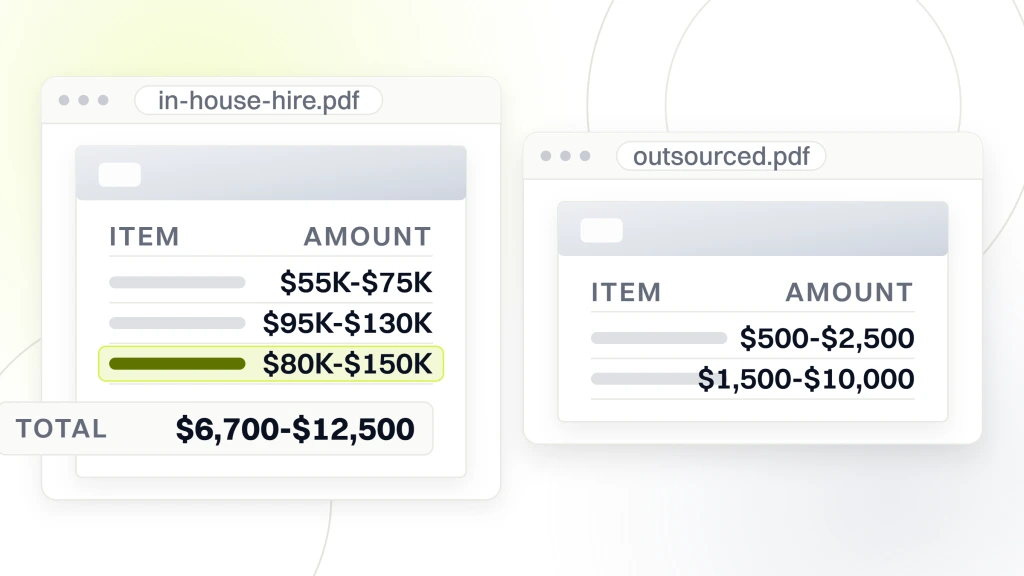
Before you sign a retainer, run the math against building in house. A junior PPC manager costs $55,000 to $75,000 a year plus benefits. A mid to senior PPC manager runs $95,000 to $130,000. Add tooling, training, and platform certifications, and the true cost of a single hire lands between $80,000 and $150,000 fully loaded. That works out to $6,700 to $12,500 a month for one person who takes vacations and gets sick.
When in house makes sense
You build in house when your ad spend exceeds $50,000 a month across at least four platforms and you plan to hold that level for two years. At that scale, in-house PPC campaign management pricing beats agency retainers. Above that spend level, PPC campaign management fees paid to an outside team stop pulling their weight. You’re paying for one full-time expert instead of a fractional slice of an agency team. Below that scale, the fixed cost of a hire is worse than the flexible cost of a retainer.
When an agency retainer wins
An agency retainer wins under $40,000 in monthly spend, across most business sizes. You get access to a team with cross-account experience, fresh benchmarks from other verticals, and a bench that scales when campaigns get complex. You also get to fire the agency in 60 days if the work goes sideways. Firing an employee is slower, more expensive, and more disruptive to the rest of the team.
The hybrid that most growing companies use
Most companies scaling past $30,000 in monthly ad spend end up hybrid. A mid-level in-house PPC manager owns the day-to-day, and an agency handles the strategic layer, the creative production, and the cross-channel work the in-house person doesn’t have time to lead. Combined cost sits at $8,000 to $12,000 a month, similar to a specialist agency retainer alone but with more capacity and a second set of eyes on every campaign.
What drives PPC management costs up
PPC management costs go up for reasons that have less to do with the platforms and more to do with your account, your business, and the scope of the work. Here are the seven drivers that push a $1,500 quote to $5,000 in the first meeting.
- Multi-platform scope. Google Search plus Display plus YouTube plus Meta plus Microsoft is five accounts of daily work, not one.
- Ecommerce complexity. Shopping campaigns, feed management, and product-level bidding add hours no lead-gen account requires.
- Creative production in scope. Video ads, display banners, and ad copy iteration add a design layer to the retainer.
- Landing page work in scope. Building or optimizing landing pages against ad creative is a separate discipline agencies charge separately for.
- Conversion tracking audit. Cleaning up Google Analytics 4, GTM containers, and enhanced conversions can eat 15 hours of setup alone.
- International or multi-location accounts. Every new geo adds keyword lists, translated ad copy, and separate reporting cadences.
- Reporting cadence. Monthly reporting is baseline. Weekly is a real jump. Real-time dashboards with custom KPIs push the fee another tier.
The one driver most agencies bury
Agencies rarely name the biggest driver on the intake call. That driver is how bad the current account is. A well-organized account with clean conversion tracking, sensible campaign structure, and a functional landing page takes half the time to manage. A neglected account with 400 broken ad groups and no working conversion tracking takes three months of cleanup before you can even measure performance. Ask any agency to quote your first 90 days separately from the ongoing retainer. That number tells you whether they’ve actually looked at your account.
The average PPC management fee is a moving target
People ask for an average PPC management fee like it’s a fixed number. It isn’t. Vendor surveys land between $1,500 and $5,000 monthly for small to mid accounts, and $5,000 to $10,000 for growing programs. Google Ads publishes billing documentation that walks through platform fees. That documentation does not replace a scoped quote for your account. Treat headline averages as sanity checks, not budgets.
How much does a PPC manager cost
How much does a PPC manager cost depends on whether you’re hiring a person or buying agency hours. As a solo hire, a competent PPC manager costs $65,000 to $110,000 a year in the United States, with a heavier premium in high-cost metros. As agency hours, an experienced account lead bills between $150 and $250 an hour.
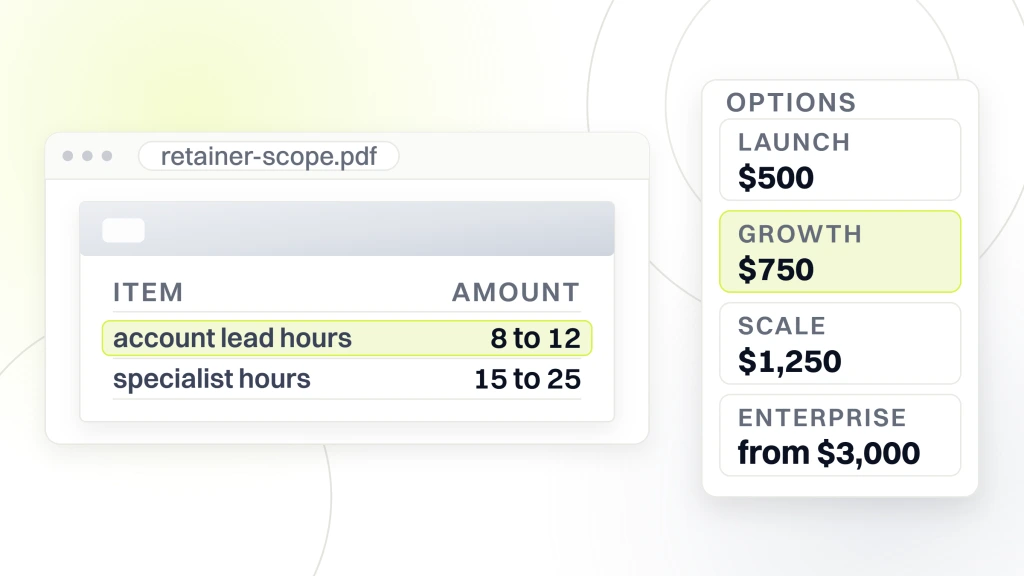
Agency retainers typically bundle 8 to 12 hours a month of account lead time and another 15 to 25 hours of coordinator or specialist work. The blended cost per hour on a retainer is lower than an hourly consultant, which is why most small-to-mid accounts pick a retainer over point-project billing once the scope stabilizes.
Solo consultant pricing
Solo consultants price at $75 to $200 an hour or $500 to $2,500 a month on retainer. They’re the right choice for small accounts under $5,000 in spend where you need one experienced person to steer the wheel without the overhead of an agency wrap. The downside. No bench when the consultant gets sick, and no team behind them when the account needs creative, landing pages, or a fresh set of eyes.
Agency team pricing
Agency teams price at $1,500 to $10,000 a month depending on the size and complexity of the account. What you’re buying is not one person’s time. You’re buying an account lead, an account manager, an analyst, and access to a design team when the account needs new creative. That layered team is what handles the work a solo consultant can’t scale to for accounts past $10,000 in monthly spend.
Freelancer vs consultant vs agency
Freelancers run $30 to $80 an hour and work best for defined project scopes. A one-time audit, a campaign build, a report. Consultants run $100 to $250 an hour and work best for strategic direction where you have an in-house team executing. Agencies run flat retainers or hybrid pricing and work best when you want ongoing execution without hiring anyone. Match the tier to the work you actually need done, not to the vendor’s marketing.
How much to charge for PPC management as an agency
If you’re on the agency side wondering how much to charge for PPC management, price for the work you actually do, not the ad spend you sit next to. Charge between 40% and 60% of the equivalent in-house cost and you’re competitive without underselling the team.
The two-question test to set the number. What does 30 days of your best work look like on this account, and what would that cost to hire in house. That in-house equivalent number sets your ceiling. Your quote sits at 40% to 60% of that figure to leave the client with real savings and still fund the work.
Pricing floors that keep the agency alive
Set a floor below which the account is not worth running. Most healthy small agencies floor at $1,500 a month per account, which covers eight to ten hours of real work at billable rates. Below that the account cannot get enough attention to move the needle, the client gets frustrated, and both sides lose. A polite floor at intake is a better business decision than a cheap yes and a churned client six months later.
PPC management packages that close deals
PPC management packages work best in three tiers, clearly named, with the middle tier priced to be the obvious choice. Core at $1,500. Plus at $3,500. Pro at $7,500. Most prospects pick the middle. Some pick the top. Almost none pick the bottom, which is by design. If half your closes land at the bottom tier, your PPC management pricing packages are priced wrong or your prospect list is wrong.
Bill for the audit up front
The first 30 days of most retainers are actually an audit and rebuild that costs the agency more than the fee covers. Bill that work separately as a paid discovery or onboarding fee. $1,500 to $3,500 for the intake, then the ongoing retainer starts month two. Clients who won’t pay for the audit are almost always the clients who will fight the ongoing retainer three months in. If your agency charges for its audit, that fee is the cleanest client filter you have.
How PPC Management Fees Play Out on Real Accounts
Fee models are easier to judge on real accounts than in a table. At Redefine Web, PPC management is a flat monthly fee set by your ad spend band, never a percentage of spend. The bands run $500 under $2,000 a month, $750 for $2,000 to $5,000, $1,250 for $5,000 to $10,000, and from $3,000 above $10,000. Ad spend is paid to Google, not to us. Two home services accounts from our case studies show why the fee should pay for the work, not grow with the spend.
A Renovation Contractor Over Nine Years
A family-owned Pennsylvania renovation contractor scaled annual revenue from $1.5M to $6.8M over a nine-year partnership, up 353%. Paid ads ran alongside a rebrand, a new website, HubSpot and content. On a percentage fee, every rise in ad spend would have raised the fee too. A flat fee by spend band moves only when the account crosses into a new band.
A Plumbing Company Rebuilding Its Ads
A local plumbing company came to us with a one-page site and ads that brought costly clicks and leads that did not fit. We rebuilt its Google Ads and Local Services Ads and built service pages. Over the first 12 months, Google Ads conversions rose 99%, cost per acquisition fell 67% and organic users grew 75%. A falling cost per acquisition is the result a flat fee rewards. A percentage fee pays the agency more only when spend goes up.
What both accounts prove
The fee should pay for the work, not grow with the spend. Whatever model an agency offers, ask what the fee does when your spend rises, falls or swings by season, and get the answer in the scope. Read our related notes on PPC campaign management and what is PPC management for the underlying work these fees pay for.
Mistakes you’ll make buying PPC management
PPC management prices are only half the buying decision. The other half is what you sign, and this is where most first-time buyers get burned. Here are the four mistakes we see most often when a new client shows up carrying a bad prior contract. Any one of them can eat six months of your first year with an agency.
Signing without a scope document
You sign a $3,000 monthly retainer and the SOW is one paragraph long. Three months in you ask for a landing page revision and the agency quotes $2,000 as “out of scope.” A real scope names the platforms managed, the reporting cadence, the number of ad copy variations per month, the landing page hours included, and what triggers a change order. If those specifics aren’t in writing, they’re not included.
Not owning your ad accounts
Some agencies build campaigns inside their own MCC or Business Manager and hand you view-only access. When you leave they keep the account, the historical data, and the conversion tracking. Insist on owning the Google Ads account, the Meta Business Manager, the GTM container, and the GA4 property from day one. Grant the agency admin access. Do not grant them ownership.
Missing the exit clause
Long lock-ins with no stated exit cost are common in this space, and they punish the client when performance disappoints. Ask how long the first term is and what leaving early costs before you sign. Anything longer than 12 months with no written exit cost is a red flag. Good agencies write the term down and keep clients through performance.
Confusing fee for total investment
The agency fee is one line. Ad spend is another. Landing page work, tracking setup, creative production, and platform tools can each be another. First-time buyers often quote the retainer to their CFO and forget the ad spend, then panic when the total monthly outlay is triple the number they mentioned. Build the total-cost model up front so nobody gets surprised in month two. If cost is your top constraint, our notes on affordable PPC management services and AI PPC management show where automation and lean scope reduce fees.
Pick the right PPC management package for your account
PPC management cost is a math problem before it’s a vendor problem. Solve the math first, then pick the vendor whose model matches. At Redefine Web our retainer tiers run $500, $750, $1,250, and from $3,000 a month. Ad spend is billed separately and lives in your ad accounts, not ours. If you want help pressure-testing a quote or building the retainer scope, our team runs PPC management services across every tier, and the first audit of your account is free.
Frequently asked questions
What is the PPC cost formula?
The PPC cost formula is total ad spend divided by clicks, which gives you cost per click (CPC). Take it one step further and divide total ad spend by conversions to get cost per acquisition (CPA), the number that actually matters for return on investment (ROI). A $3,000 spend that produced 2,000 clicks and 40 conversions runs at $1.50 CPC and $75 CPA. Both numbers tell you different stories. CPC tells you what the auction charges, CPA tells you what the funnel earns. Track both weekly and cut keywords, ads, or landing pages that push CPA past your target. That is the loop every profitable PPC account runs on.
How do you manage a PPC budget?
Set a PPC budget in three passes. First, pin down the pipeline goal for the quarter in booked leads or closed revenue, then work backward through your close rate and lead-to-appointment rate to a target CPA. Second, size a daily spend that lets you clear the auction on your core keywords without pacing out by 3 pm. A rough rule is 10 to 20 times your target CPC as a daily floor. Third, run a weekly pacing report that tracks spend to date, conversions to date, and forecasted month-end. Adjust bids, dayparts, and negatives when the forecast drifts more than 10% off plan. That rhythm keeps the budget aimed at revenue, not just clicks.
How much does PPC usually cost?
PPC usually costs $500 to $10,000 a month all-in for small and mid-market accounts, split between ad spend and management fees. On the ad side, small local accounts spend $500 to $2,000, mid-market accounts spend $3,000 to $30,000, and enterprise programs push past $100,000. On the fee side, small-agency retainers run $1,000 to $2,500, mid-market retainers run $2,500 to $8,000, and percent-of-spend agreements sit at 10 to 20% of ad budget. Where you land depends on industry CPC, geography, and how many platforms you run. Legal, insurance, and B2B SaaS sit at the top end. Local services and DTC ecommerce sit in the middle.
Why is PPC so expensive?
PPC feels expensive when your CPC or CPA jumped without a matching lift in conversion rate. Three drivers explain most of it. High-intent keywords in crowded verticals push CPCs to $10, $20, even $50 in legal, insurance, and B2B SaaS auctions. A weak landing page or checkout drops conversion rate 30 to 60% below what the traffic could earn, so every click costs more per booked lead. And Quality Score misses cost real money, with poor ad relevance and slow page speed inflating your bid by 20 to 40%. Fix landing page speed, tighten ad-to-keyword-to-page match, and prune junk keywords weekly. Cost comes down every time.
How to charge for PPC services?
Charge for PPC services on one of four models. Flat retainers work when the scope is predictable and both sides want a clean invoice, typical range $1,500 to $10,000 a month. Percent of ad spend works when spend scales fast, typical 10 to 20% of budget for small accounts and 8 to 12% for large ones. Performance pricing works when the funnel is mature and CPA is measurable, priced per lead or as a CPA-target bonus. Hybrid stacks two of the above, most often a flat base plus a smaller performance kicker. Pick the model that matches account size and data maturity, then defend the price with a case study that shows the revenue your work produced.
How expensive is PPC?
PPC costs $500 to $10,000 a month for most small and mid accounts once you add management fees to ad spend. Solo consultants run at the low end for basic single-platform accounts. Small agencies charge $1,000 to $3,500 for stable local and DTC programs. Mid-market and specialist agencies charge $2,500 to $8,000 for multi-platform, multi-region programs. Enterprise accounts pay a percent of spend, usually 8 to 15%, on top of six-figure ad budgets. Layer on click costs of $0.11 to $50 depending on industry, and you get the full-load number. Ask any prospective agency for a scoped quote against your ad spend, not a generic price sheet.
Is PPC marketing worth it?
PPC marketing is worth it when your target CPA leaves margin at your close rate and average order value or lifetime value. Run the math before you buy. If you sell a $2,000 service, close 20% of leads, and set a $200 target CPA, PPC prints $2 in revenue for every $1 in ad spend. If you sell a $50 product with a 5% conversion rate and no repeat purchase, a $30 CPA barely breaks even. PPC pays off on speed too. Google Ads and Microsoft Ads deliver traffic in hours, not months, which is real value when you need pipeline this quarter. Match the channel to a real unit economic, and it works.
Omor Sarif founded Redefine Web in 2021 to run websites, SEO, paid media, and marketing automation as one revenue-tied program for growth-stage brands. He is Lead Web Developer at Spicy Pixel since 2022, and holds a Bachelor of Science in Electrical and Electronics Engineering from Bilkent University. Earlier roles include Software Developer at Apple (2012 to 2015), Freelance Translator at Coursera (2014), and Student Ambassador at Student Competitions AB (2014 to 2016). His work has been covered by Business Insider, MSN, Polygon, Popular Mechanics, and MarketWatch.