In this article
- Rotate 7 video formats weekly. Format variety trains the algorithm on wider intent.
- Hold watch time above 60% average completion. 3 to 6x the distribution follows.
- Cinematic walk-throughs pull 3 to 7x the engagement of a straight MLS slideshow.
- Tier 1 gear runs under $600. Phone footage beats DSLR on Reels and TikTok.
- CRM first-touch attribution proves video ROI. Last-touch fields hide 60 to 90% of it.
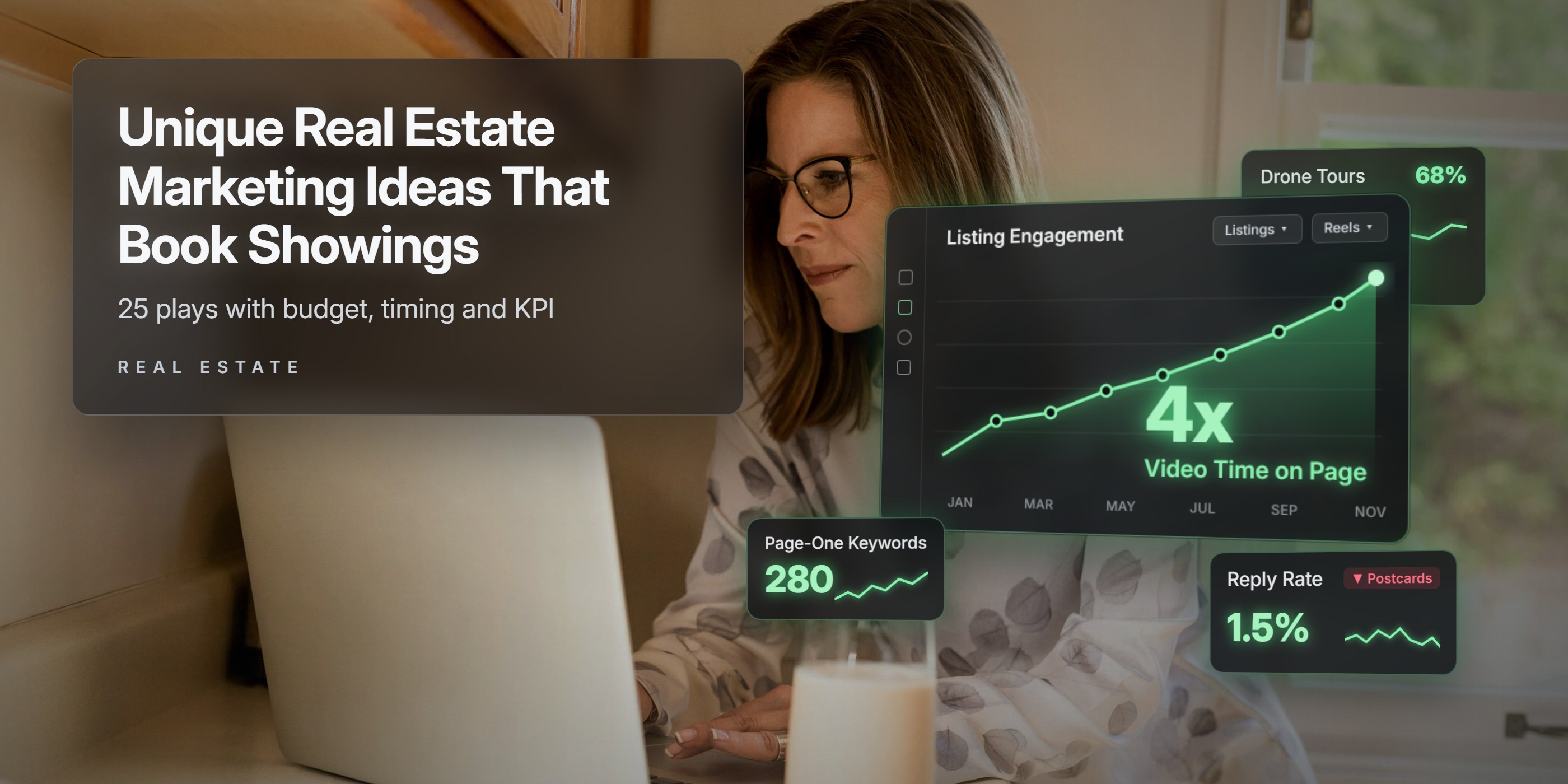
Real estate video marketing decides whether a listing sits 42 days or goes pending in 9. It decides whether a buyer scrolls past your Reel or stops on it. And it decides whether a for-sale-by-owner picks their neighbor’s cousin or picks you. A disciplined video program pulls 4 to 8x the engagement of static photos, cuts days-on-market 30 to 50% on active listings, and books 8 to 24 buyer or seller conversations a month at a fully loaded cost under $80 per booked call.
This guide walks through the 7 video formats every agent needs in rotation, the exact 45-second script structure that pulls the highest watch time, the gear stack at 3 budget tiers, the editing workflow that cuts production time 60%, distribution across YouTube plus Instagram plus TikTok, and the tracking that ties a Reel view back to a signed listing agreement.
The 7 real estate video formats that book calls
Most agents film one format on loop and wonder why reach flatlines by month 3. The algorithm rewards format variety inside the same niche. Rotate through 7 patterns each week and the account trains on a wider slice of buyer, seller, and neighborhood intent at once.
1. Cinematic listing walk-throughs
60 to 90 seconds. Golden-hour exterior shot, a slow push into the entry, 4 to 6 room reveals with 2-second cuts, and a closing wide of the best-in-house feature. No agent on camera. Music sets the tone. Overlay copy carries the address and the price bracket. Cinematic walk-throughs pull 3 to 7x the engagement of a straight MLS video slideshow, and they double as the hero asset for a paid Meta boost when the listing sits 14 days.
2. Neighborhood tours in long-form on YouTube
6 to 12 minutes. Agent-led walk of the retail strip, a coffee stop, a school drive-by, the closest park, and one honest downside of the area. Long-form neighborhood tours are the single highest-intent asset in real estate video marketing. A Silver Lake tour published in month 2 keeps pulling buyer inbound 18 to 36 months after the upload since relocation searches don’t decay.
3. Agent Q and A talking heads
45 to 75 seconds. One question per clip. “How much do I need to put down on a $900,000 house?” Answer the question in the first 6 seconds. Add 2 supporting points. Close with a soft CTA to DM the word “guide” for a free download. Q and A talking heads carry the top-of-funnel discovery load on Reels and TikTok. Publish 3 a week and the algorithm surfaces them to lookalikes of your existing follower base.
4. Behind-the-scenes agent life
30 to 60 seconds. Truck-cam drive to a showing, a 5-second peek at a listing prep, a text-thread screenshot of a buyer’s reaction. These clips break the polished-listing pattern and pull 2 to 4x the saves of a straight listing video. Saves are the metric the algorithm reads as “this is worth resurfacing.”
5. Market update explainers
60 to 90 seconds. One chart on screen. Median price this month, days-on-market this month, one takeaway. Publish the same day the local MLS or the Case-Shiller report drops. Market updates are the format agents dread and the format brokers reward. They read as authority to sphere-of-influence viewers and they turn into a monthly newsletter clip that stretches beyond the original post.
6. Client testimonials cut two ways
The full 3-minute testimonial lives on YouTube and in the paid ad rotation. A 30-second cut runs on Reels and TikTok as social proof. Ask the client 4 questions on camera. “Why us over the other agent you interviewed. What surprised you about the process. What almost broke the deal. What would you tell a friend thinking about listing.” Cut around the answers. Testimonials convert cold DM traffic 2 to 3x better than any polished agent-generated clip.
7. Educational carousels stitched to Reels
15 to 25 seconds. Text-heavy explainer with a spoken hook and a swipe-through summary. “5 things every first-time buyer misses on the pre-approval.” These are your low-effort filler that keeps cadence up on the days a listing shoot got rescheduled. Educational carousels save 6 to 10x the average clip since viewers screenshot them for later.
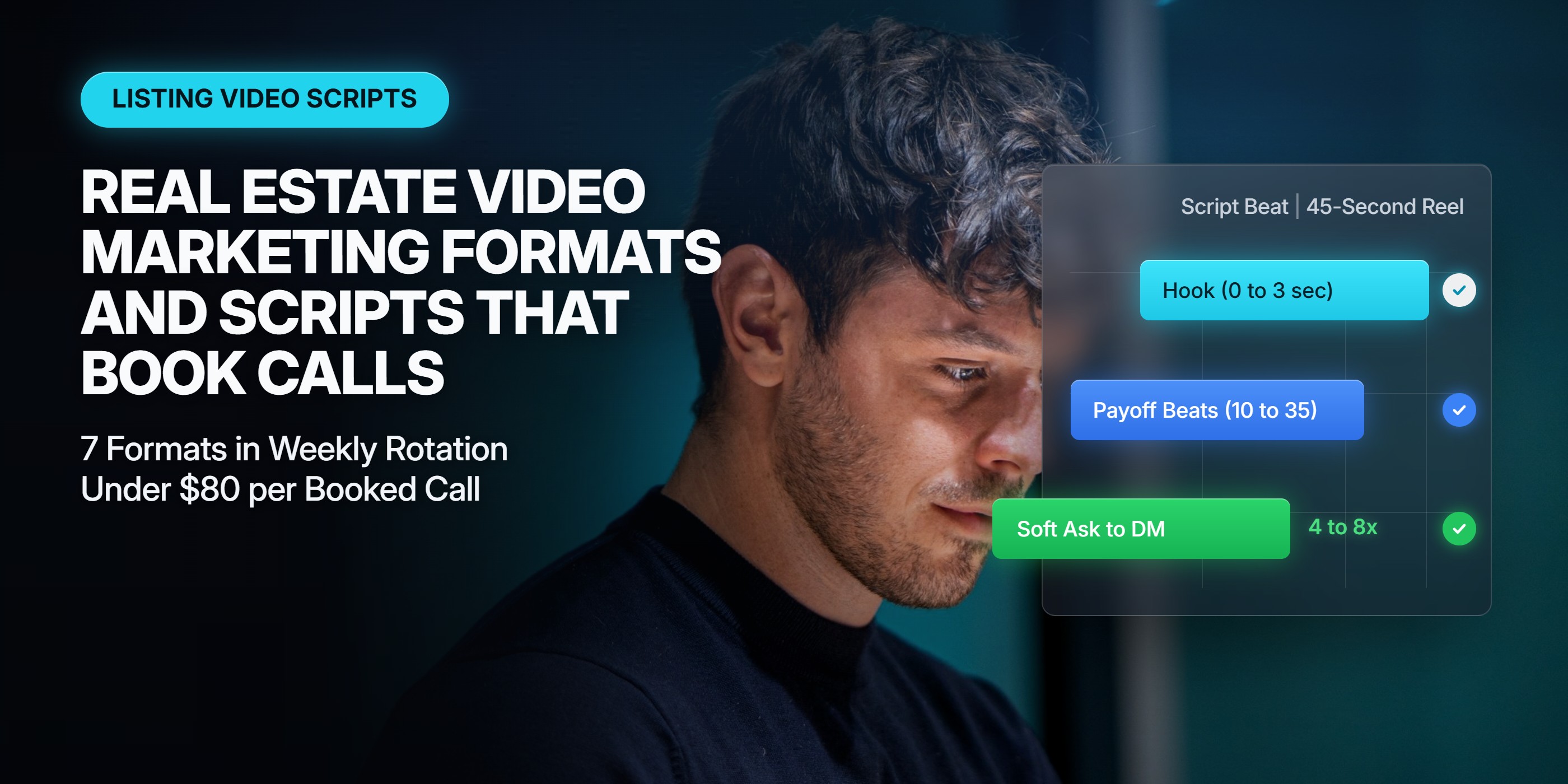
The 45-second script structure that keeps watch time above 60%
Watch time is the single metric that decides whether a clip breaks out or plateaus. A Reel or a TikTok at 60% average completion gets 3 to 6x the distribution of the same clip at 30% completion. The script structure below is the one we use, and it is built to hold average completion above 60%.
Seconds 0 to 3. The visual and audio hook
Start with movement. A drone pushed toward a house. A door swinging open. A stat card that reads “$1.2M asking, $1.35M offer, 7 days.” Say the hook in the first 3 seconds and the retention curve holds the first cliff. Static open shots kill retention before the algorithm ever gets to test the clip on a lookalike.
Seconds 3 to 10. The specific promise
Tell the viewer exactly what they get if they keep watching. “I’ll show you 3 things every buyer in Bel Air is asking about the property tax reassessment right now.” Specific promises hold 20 to 30% more mid-clip retention than vague setups like “today we’re going to talk about real estate.”
Seconds 10 to 35. The 3 payoff beats
3 fast beats. Each 6 to 10 seconds. Each with its own visual. Cutting a clip into 3 payoff beats trains the viewer to expect the next reveal and holds retention through the middle sag where 40 to 60% of clips lose their audience.
Seconds 35 to 45. The soft ask
End on a single soft ask. “DM me the word tour and I’ll send the private walk-through.” Soft asks convert 4 to 8x better than hard-sell CTAs like “call me for a free consultation.” The soft ask reads as a favor from a friend. The hard sell reads as an ad.
Real estate video scripts. 3 copy-ready templates
Script templates cut writing time from 30 minutes per Reel to 5. Use the 3 templates below and mix in your own voice, your local slang, and your specific numbers. Templates aren’t a substitute for original thought. They’re a scaffold that lets you spend the writing time on the specific insight instead of the structural framing.
Template A. Listing walk-through voiceover
“This is [address] in [neighborhood]. Asking [$X]. Built in [year]. What most people miss when they walk in is [specific feature]. The kitchen was renovated [year] and it flows straight into [outdoor space]. Upstairs you get [X] beds and [X] baths. What sold me on this one is [emotional payoff]. Showings start [day]. DM tour to book a private walk-through.”
Template B. Neighborhood tour intro
“Thinking about moving to [neighborhood]. Here’s what I’d want to know before I signed a lease or wrote an offer. Median home price sits at [$X]. Property tax runs [X]%. Schools rank [X]. The one honest downside no realtor will tell you is [specific issue]. And the one thing that makes it worth it anyway is [specific upside]. Full walk of the retail strip, the parks, and my favorite coffee spot is next.”
Template C. Q and A talking head
“How much do you need to put down on a [$X] house in [market]. Short answer, [X]%. But here’s what nobody tells you. Add [Y] for closing costs, [Z] for inspection contingencies, and a [W] cushion for the first month of ownership surprises. Real number you need liquid is closer to [total]. DM guide and I’ll send the pre-approval checklist.”
Gear stack at 3 budget tiers
Gear won’t save a bad script. And no gear tier under $600 will hold a candle to a good script shot on a 3-year-old iPhone. That said, the right kit at the right tier cuts production time and pushes baseline quality enough that your best script beats every other agent in the market who is still fighting shaky handheld footage.
Tier 1. Under $600 for solo agents
Current-generation iPhone or Pixel. DJI Osmo Mobile 6 gimbal at $150. Rode VideoMic Me-L lav at $79. A ring light at $45. A 128GB SD card for the phone at $30. Total under $600. This kit shoots every format above at professional watch-time quality. Skip the DSLR argument. Phone footage outperforms DSLR on Reels and TikTok since the native aspect ratio and the color science match what the algorithm expects.
Tier 2. About $2,600 for boutique teams
Sony ZV-E10 II at $1,000. Sigma 16mm f1.4 lens at $400. Rode Wireless Go II at $299. DJI Mini 4 drone at $760. LED panel key light at $150. Total about $2,600. This is the kit for teams that need 4K delivery for high-end listings and drone coverage for aerial exterior work.
Tier 3. About $9,700 for brokerages
Sony FX3 cinema camera at $3,900. 24-70mm f2.8 lens at $2,300. DJI Mavic 3 Pro at $2,200. Zoom H6 audio recorder at $400. Aputure 300D II light at $895. Total about $9,700 street kit. This is the tier where a videographer becomes a full-time hire or a dedicated freelance retainer, and where cinematic listing videos start winning the seller pitch against the local competition.
Editing workflow that cuts real estate video marketing production time 60%
Editing is where most video operations quietly die. A 60-second Reel that ate 3 hours last week eats 3 hours again this week if the workflow skips templates. Batch shooting, template libraries, and automated caption tools cut editing time from 3 hours to 45 minutes at the same output quality. Workflow discipline matters more than the software choice.
The batch shoot Saturday plus template Sunday model
Saturday afternoon. 3 to 4 hour batch shoot producing raw footage for 10 to 14 pieces across the next 10 days. Sunday morning. 4 to 6 hours of editing through CapCut Pro or Descript templates. Import into Later or Metricool for scheduling across 4 platforms. Monday through Friday. 15 minutes a day on DM management and engagement. Teams on this weekly rhythm cut production from 18 to 22 hours down to 7 to 10 hours at the same output. Other local service businesses batch the same way, as our guide to video marketing strategy for chiropractors shows.
Software stack that keeps costs under $100 monthly
CapCut Pro at $8/mo for phone-native Reel editing. Descript at $24/mo for talking-head captions plus filler-word removal. Later at $18/mo for cross-platform scheduling. Canva Pro at $15/mo for thumbnails and template design. Total. $65/mo. Add Adobe Premiere Pro at $22/mo if the team needs advanced color grading for luxury listings. Software costs stay under $100/mo at solo scale and under $250/mo at team scale with advanced editing tools included.
How Real Estate Video Marketing Builds on SEO
Video works best layered on top of an existing SEO and IDX foundation. The video layer drives the algorithmic amplification that pulls cold discovery traffic into the long-form neighborhood-insight article funnel, and the site converts it.
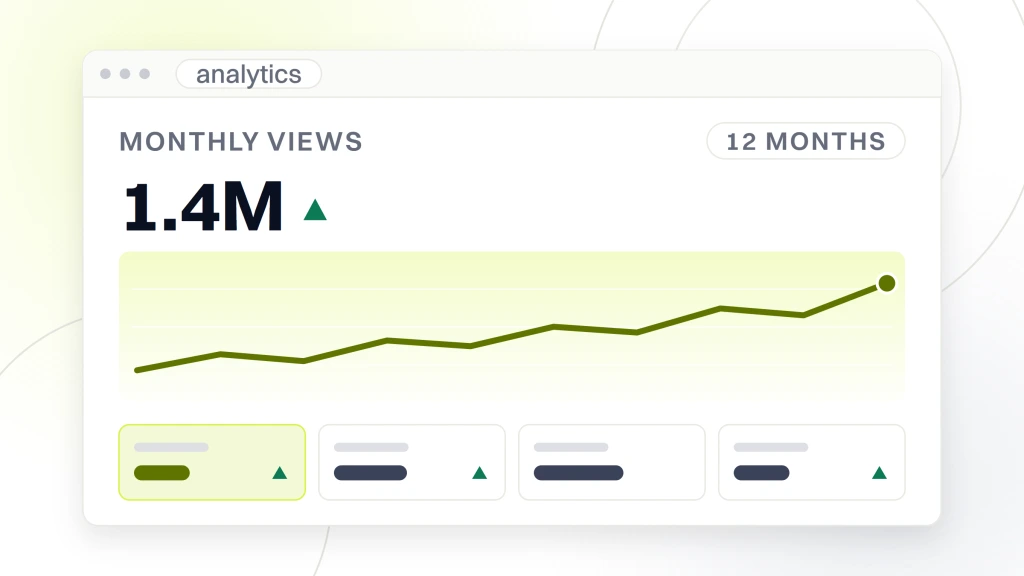
For a luxury team, the calendar rotates 4 core formats. Cinematic listing walk-throughs shot at golden hour. Neighborhood-tour long-form on YouTube for the team’s core neighborhoods. Agent Q and A talking heads answering luxury relocation questions. And behind-the-scenes footage from private showings during off-market opportunities. Engagement holds when the production respects the platform-specific length and pacing rules.
What a Video Program Looks Like at Month 3
By month 3, a team calendar can run a dozen or more pieces a week. Instagram Reels, YouTube Shorts, a YouTube long-form neighborhood tour, TikTok talking-head Q and A clips, Facebook behind-the-scenes segments, a LinkedIn text-plus-clip post, and a daily Story sequence. Production runs through a freelance videographer, an editor, and the platform stack, and every booked conversation gets tagged to the video layer.
What the Program Looks Like at Month 12
By month 12 the library compounds. Hundreds of pieces keep pulling views across the 4 platforms, and the cost per booked conversation falls as the archive keeps working with no new production cost. The Real Estate Marketing Agency for Brokerages program brings the same video-plus-website integration to solo agents, boutique teams, and brokerages.
A Data Point From a London Lettings Brand
Abels Residential, a London rental agency with 10+ years of experience, came to us with no online presence. We built a fast website and ran on-page and off-page SEO for London rental keywords. The site now ranks for 280+ first-page keywords, loads in 2 seconds, and brings in 20+ qualified rental leads a month, all from organic search. That is the foundation a video program needs, since video pours top-of-funnel fuel on a site that already ranks. Video on top of a site that doesn’t rank is a slower path.
Video SEO on YouTube for agent-run channels
YouTube is a search engine. The channel ranks or doesn’t rank on the same on-page fundamentals as Google search. Title, description, tags, thumbnail, and watch time. Miss any of the 5 and the video stays under 500 views for good. Nail all 5 and the same video hits 3,000 to 25,000 lifetime views and keeps booking conversations 18 to 36 months after posting.
Title and description patterns that rank
Title. Primary keyword plus specific location plus year. “Moving to Silver Lake in 2026. What You Should Know Before Buying.” Description. The first 150 words contain the primary keyword 3 times, include a link to the buyer consultation calendar, and list timestamps for chapter navigation. Tags. 8 to 12 tags mixing exact keyword, related keyword, and location modifier. Thumbnail. Agent face plus one visual anchor at 1280×720. After watch time, thumbnail click-through rate is one of the biggest ranking drivers.
Watch time and audience retention
YouTube ranks videos at 55 to 70% average completion above videos at 25 to 40%. The ranking gap is bigger than the raw view count gap. Accounts that dial in hook plus pacing plus payoff hit the 55% threshold every week and their videos compound. Videos that miss the threshold plateau at the initial subscriber base view count and never break into search discovery even when on-page SEO is dialed in.
Common mistakes that quietly kill agent video programs
Every account we audit shows the same 7 mistakes on intake. Fix them and reach doubles inside 60 days. Skip them and the account keeps posting into a void at 200 to 400 views per Reel and 3 to 8 views per YouTube long-form, whereas the account down the block pulls 15,000 per Reel and 4,000 per long-form on the same weekly cadence.
- Overproducing content that looks like a TV commercial performs 40 to 60% worse than phone-shot takes.
- Skipping captions on video posts costs 25 to 40% of watch time as silent scrollers move past.
- Cross-posting the same Reel to TikTok with the Instagram watermark tanks TikTok reach by 80%.
- Filming vertical for YouTube long-form or horizontal for Reels wastes 50% of the frame on either side.
- Using trending audio 5 days after it broke cuts algorithmic reach in half.
- Publishing only listing videos ignores 60% of the top-of-funnel discovery opportunity.
- Skipping thumbnails on YouTube long-form drops click-through rate 50 to 70% versus a designed thumbnail.
The vendor red flag list for agent video pods
Some content agencies pitch an agent video package at $599/mo. Pull the cover off and the deliverable is 4 cinematic listing videos a month, shot by a videographer who films 30 agents on Saturdays out of a rented studio. Real production of a full video pod runs 12 to 30 hours a week of shooting plus editing plus scheduling. That puts most agency fees between $2,800 and $8,400/mo depending on scope, format count, and platform coverage.
Green flags in a real content-pod proposal
Green flags. Named videographer on the account. Weekly cadence spelled out per platform. Native-format rendering built into the scope (horizontal plus vertical plus square). Thumbnail production included for YouTube. Monthly analytics tied to booked conversations rather than vanity metrics. And a clear scope of work spelled out per platform per month. Pair the video pod with the Sales Funnel Services · Done-For-You program so the DM-to-CRM handoff is wired up before the first Reel launches.
Tracking video work back to closed transactions
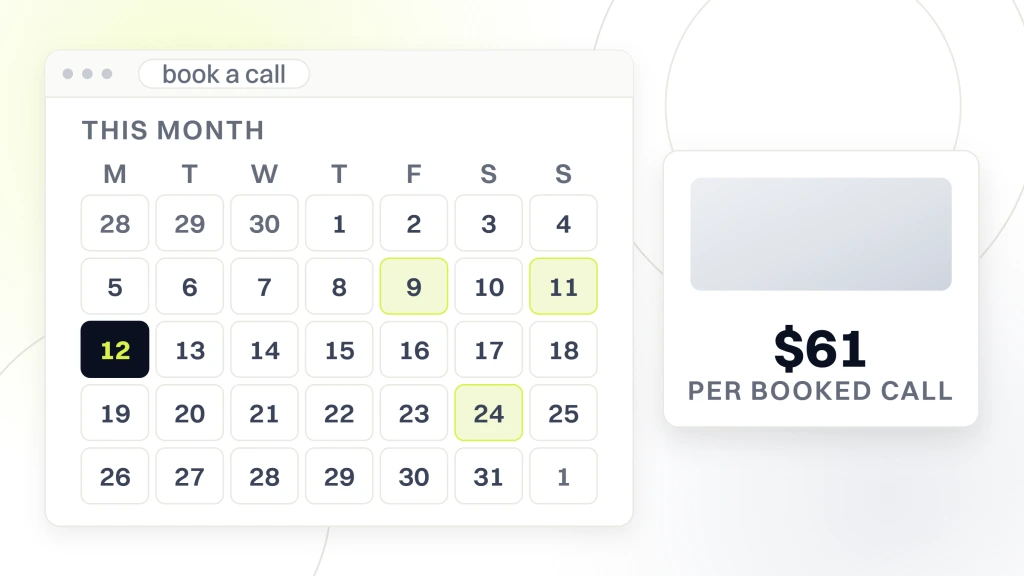
Views are vanity. Watch time is directional. Booked conversations and closed deals are the only metrics that count. The tracking stack needs 3 layers. Platform analytics, funnel analytics, and CRM revenue attribution. Miss a layer and the ROI conversation collapses when the market softens and the broker cuts video first, since nobody proved the dollars produced deals.
Platform analytics that matter
Watch time per post, saves per post, shares per post, and profile-visits-to-DM ratio. These 4 metrics track directional health. Vanity metrics like total views and total follower count deceive since they inflate with viral flukes that never convert to conversations. Accounts that report on watch time and saves rather than views produce 3 to 5x the booked-conversation output since the team optimizes for the metrics that predict conversion.
CRM attribution on closed deals
Tag every closed transaction with a first-touch source and a last-touch source in the CRM. Video-driven deals rarely show up in last-touch (that field usually reads “referral” or “website form”). Video-driven deals show up in first-touch 6 to 14 months earlier as the buyer or seller watched 20 to 40 videos over months before reaching out. According to the Think with Google research on the messy middle of purchase decisions, video content dominates the exploration phase for high-consideration purchases like real estate.
Building your first 90-day plan
The first 90 days set the trajectory for the year. Rush the setup phase and the video program flatlines by month 4 with reach stuck at 300 views per Reel. Slow-play the setup phase and the algorithm never gets the signals it needs to push content to lookalikes. A disciplined 90 days runs 3 phases. Weeks 1 to 4 for setup and library seeding, weeks 5 to 8 for cadence lock-in and template refinement, and weeks 9 to 12 for conversion optimization and paid amplification.
Weeks 1 to 4. Setup and content library seeding
Buy the Tier 1 gear kit if starting from scratch. Set up Later or Metricool for scheduling. Build 3 dedicated landing pages behind the link-in-bio. Batch shoot 40 pieces across the first 2 Saturdays. Publish on the 4-to-6 slot weekly grid. Ignore vanity metrics for the first 30 days. Watch saves, shares, and DM volume as leading indicators. Accounts that survive week 4 without abandoning the cadence hit compounding by week 10 and never look back. Pair the video program with the PPC Management Services · Flat-Fee US Team program so paid amplification layers on top of the strongest organic pieces once the library has 30 days of data.
Weeks 9 to 12. Conversion optimization and paid amplification
Add UTM tags to every link-in-bio destination. Wire scheduling links into DM saved replies. Add a text automation to every landing page form fill. Boost the top 3 to 5 organic videos from weeks 1 through 8. Run a Meta lead ad on the best-performing hook angle. By end of week 12 the account should hit 12 to 30 booked conversations per month at a cost per booked conversation of $28 to $85 depending on market and platform mix.
Bringing the program live as a repeatable system
Real estate video marketing is the highest-ROI channel available to agents willing to commit to weekly cadence and platform-specific format discipline. The library compounds. The cost per booked conversation drops month over month. The paid layer amplifies the winners. The YouTube archive keeps pulling search discovery views 18 to 36 months after posting. CRM attribution ties video back to closed transactions inside the ROI conversation with your broker. Every layer runs together as one live program.
If you spend more than $1,500/mo on real estate marketing today, video done right pays for itself inside 4 months. Redefine Web builds and runs video pods for real estate agents and brokerages, quoted separately from the Real Estate Marketing Retainer from $750/mo program. Book a discovery call and we’ll walk through your account line by line, with the cadence and gear stack it needs.
Frequently asked questions
What are the different types of real estate videos?
Seven formats cover 95% of what a real estate video marketing plan needs to publish. Listing walk-throughs at 60 to 90 seconds. Neighborhood tours at 4 to 8 minutes on YouTube and 45 to 90 seconds on Reels. Agent Q and A talking heads at 30 to 60 seconds. First-time buyer education at 40 to 90 seconds. Market data updates at 45 to 75 seconds. Behind-the-scenes closing content at 30 to 60 seconds. Client testimonial interviews at 60 to 180 seconds. Rotating all seven produces 3 to 5 times the reach of accounts that only publish listing videos and each format hits a different intent tier of viewer.
What gear do I actually need for real estate video marketing at solo agent level?
A mid-range kit at about $1,570 is the sweet spot for solo real estate video marketing. Sony ZV-E10 mirrorless camera at $698 with 16-50mm kit lens included. Rode Wireless GO II microphone at $299. Aputure Amaran 200 LED light at $299. Manfrotto tripod at $180. SanDisk 128GB SD card at $32. Small camera bag at $60. Add a $500 backup card and battery kit. This setup handles listing walk-throughs, neighborhood tours, and talking-head Q&A at YouTube long-form quality that ranks in Google search results. Solo agents starting from zero should stay at the Tier 1 phone kit, about $300, for the first 90 days before spending more.
How long should real estate video marketing videos actually be for each platform?
Length sweet spots vary by platform. Instagram Reels: 25 to 55 seconds pulls the highest completion rate. TikTok: 20 to 45 seconds performs best for talking-head content and 30 to 60 seconds for walk-throughs. YouTube Shorts: 30 to 60 seconds. YouTube long-form: 4 to 8 minutes for neighborhood tours and 3 to 5 minutes for Q&A content. Facebook video: 60 seconds to 3 minutes. Real estate video marketing videos that run 3 minutes on TikTok lose 70% of viewers by the 45-second mark. Videos that run 90 seconds on YouTube long-form fail to accumulate enough watch time to trigger algorithmic amplification. Match the length to the platform.
How to write scripts for video?
A real estate video script needs a strong hook, a clear structure, and a direct call to action. Open with a 3 to 5 second hook that names the neighborhood, price band, or buyer pain point. Move into the middle with 3 talking points at 8 to 12 seconds each covering location, standout feature, and price value. Close with a 5 to 7 second call to action asking viewers to text a keyword or click the link in bio to book a showing. A 45 second Reels script runs 90 to 110 words. A 90 second YouTube walk-through runs 180 to 210 words. Rehearse twice, shoot 3 takes, keep the strongest one.
How often should I post real estate video marketing content to actually see results?
A solo agent can sustain 4 pieces per week across two platforms with a Saturday batch shoot plus 6 hours of Sunday editing. A team account with a content pod producer can sustain 12 to 20 pieces per week across four platforms with two 3-hour shoot blocks and 15 hours of weekly editing. Real estate video marketing cadence math is what separates accounts that book 6 conversations a month from accounts that book 30. The algorithm rewards frequency inside a narrow window and reach drops 40 to 70% when the account posts the same format 5 days in a row or skips 3 consecutive days without new content.
How much does a professional real estate video marketing pod cost?
Professional real estate video marketing pods run $2,800 to $8,400 monthly depending on scope, format count, and platform coverage. That covers a named videographer with named editor on the account, weekly cadence spelled out per platform, native-format rendering across horizontal plus vertical plus square, thumbnail production for YouTube, monthly analytics tied to booked conversations rather than vanity metrics, and contract terms with the minimum term and exit cost written down. Anything below $600 monthly is 4 cinematic listing videos a month shot by a videographer who films 30 agents on Saturdays out of a rented studio. Solo agents doing video themselves with Tier 2 gear plus a $65 monthly software stack still produce meaningful output at 6 to 10 hours weekly.
How long before real estate video marketing shows booked conversations?
Weeks one through four show almost no return as the algorithm learns the account and the library builds up. Week five starts showing algorithmic amplification on the strongest content. By week ten the compounding hits and booked-call cadence stabilizes at 12 to 30 conversations per month for a solo agent running a 4-to-6 piece weekly cadence across two platforms. Teams running a content pod hit 30 to 60 booked conversations monthly by week 14. The 90-day ramp is non-negotiable. Any vendor promising real estate video marketing results inside 30 days is either running boosted posts on top of a thin organic layer or reporting on vanity metrics that never predict conversions.
What are examples of video formats?
Vertical short-form runs at 9 by 16 for Reels, TikTok, and YouTube Shorts at 15 to 60 seconds. Horizontal long-form runs at 16 by 9 for YouTube at 6 to 12 minutes. Square 1 by 1 runs at 60 to 90 seconds for Facebook and legacy Instagram feed. Cinematic listing videos run at 60 to 90 seconds in 9 by 16 or 16 by 9 depending on the primary platform. Talking-head Q and A runs at 45 to 75 seconds. Neighborhood tours run at 6 to 12 minutes on YouTube and get sliced into 30 to 60 second vertical clips for social. The 3 aspect ratios matter more than the 7 formats when it comes to platform-specific reach.
How much do real estate videographers get paid?
Basic walk-through videos run $200 to $500 per shoot. Specialty options like drone footage or agent-led cinematic tours run $800 to $2,500 per production. Urban markets carry a 20 to 40% premium over suburban rates on higher operating cost and demand. Full-time in-house real estate videographers on brokerage teams earn $55,000 to $90,000 base salary depending on market and portfolio. Retainer freelancers producing 12 to 20 pieces a month invoice $2,500 to $6,000/mo. A full video pod at brokerage scale, covering videographer plus editor plus scheduling plus analytics, runs $4,800 to $8,400/mo when built to actually drive booked conversations rather than fill a content calendar.
How do beginners start real estate video marketing?
Buy the Tier 1 gear kit for under $600. Pick the 3 formats you can commit to weekly, which are cinematic listing walk-throughs, agent Q and A talking heads, and behind-the-scenes clips for beginners. Set up Later or Metricool for scheduling. Batch shoot every Saturday for 3 hours. Edit every Sunday for 4 hours. Publish 4 to 6 clips a week across Instagram, TikTok, and YouTube Shorts. Ignore view count for the first 30 days. Watch saves, shares, and DM volume as the metrics that predict future compounding. By month 3 you should hit 8 to 15 booked buyer or seller conversations a month at a fully loaded cost per booked call under $80. Skip the DSLR gear-hunt loop that kills 40% of beginner programs before publish 1.
Tim Fux co-founded Redefine Web in 2023 to run websites, SEO, paid media, and marketing automation as one revenue-tied program for growth-stage brands. He is Chief Technology Officer / Chief Marketing Officer at Solar Alliance since 2025, and Co-Founder of Fux Marketing. His work focuses on Google Ads at scale across the solar, home services, and DTC verticals, with published tutorials and case studies showing 4x to 6x return on ad spend on multi-market accounts.