In this article
- Set a price floor from your full landed cost and percentage fees before you choose any strategy above it.
- At a 40% margin, a 20% discount means selling twice as many units just to earn the same profit.
- A 10% price rise at a 40% margin still pays if you lose fewer than a fifth of your units.
- Under the FTC's pricing guides, a former price you advertise must be real and offered for a reasonably substantial period.
- Test new prices on profit per visitor, not conversion rate, because a higher price can convert worse and earn more.
Pricing in ecommerce is how your online store sets and changes what it charges, and it works best when you set a floor from your full cost per order, then pick the strategy that decides how far above that floor each price sits. The floor protects your margin. The strategy, whether value-based, competitive, psychological or dynamic, decides how many shoppers buy.
That order matters because a price change lands on profit directly. Every dollar you add drops straight to profit if volume holds, and every dollar you cut comes straight out of it. If you’ve ever searched is ecommerce profitable, the honest answer turns on margin, and price is the part of margin you set yourself.
What does pricing in ecommerce actually decide?
Your price does three jobs at once. It sets the margin on every order, decides how many visitors buy, and tells shoppers what kind of brand you are. A change aimed at one of those moves the other two, so a cut that wins orders also tells shoppers the product is worth less.
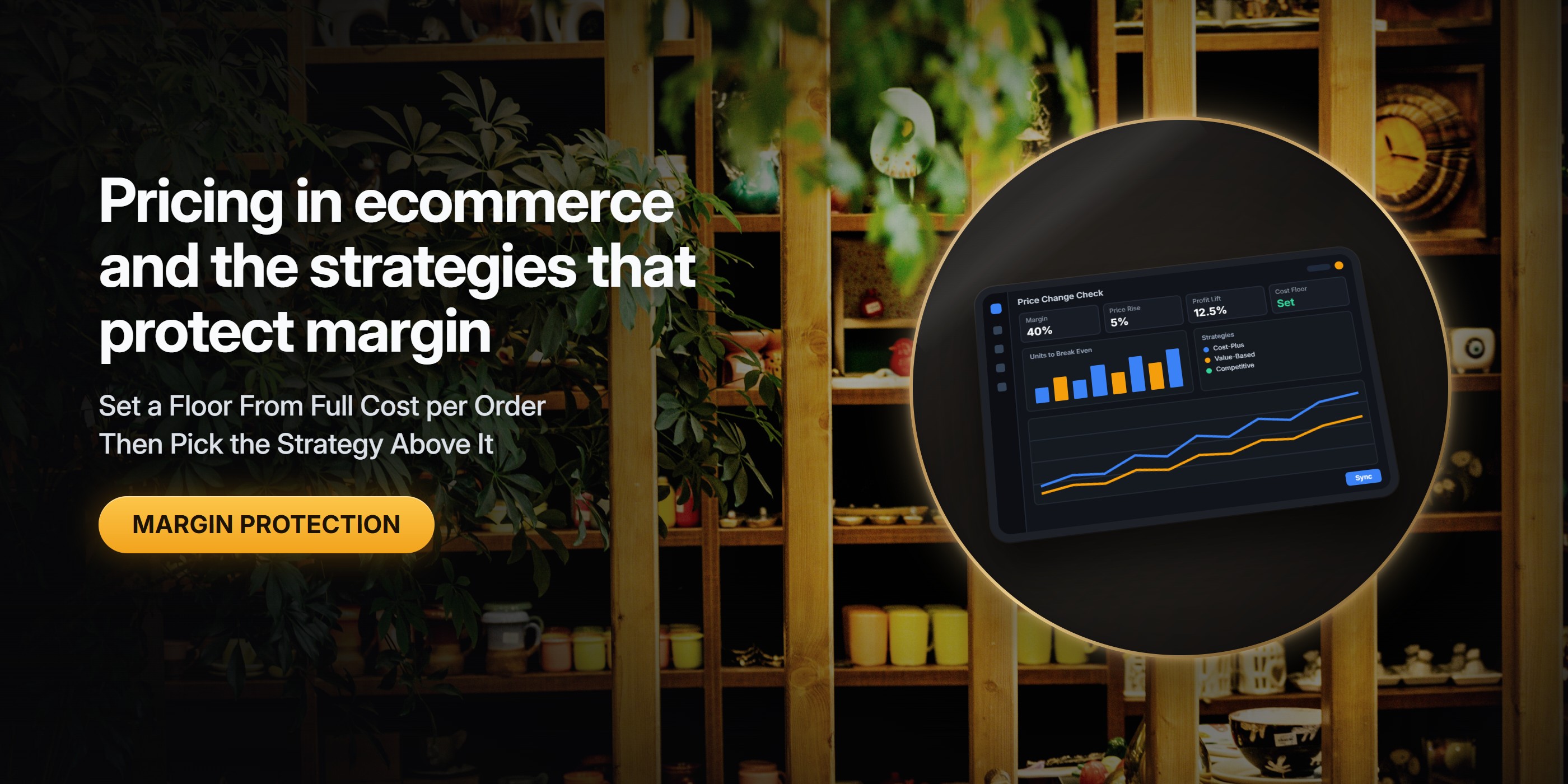
The margin effect is the easiest to underrate. Say a product sells for $50 and leaves you $20 after every variable cost, a 40% margin. Raise the price 5%, to $52.50, and the same order leaves $22.50, which is 12.5% more profit per unit from a 5% change.
A 5% cut removes the same 12.5%, and the thinner your margin, the bigger that multiplier gets. Every input here is an example, so replace each one with your own.
Shoppers notice, too. In the Capgemini Research Institute’s 2026 consumer trends report, based on a survey of 12,000 consumers in 12 countries in late 2025, 74% said they would switch brands for a lower regular price. Price too far above a comparable rival and you risk losing the sale.
Which ecommerce pricing strategies should you know?
Guides list anywhere from three to ten strategies, but they come down to three ways of setting a number, plus tactics that adjust it. Cost-based pricing starts from what the product costs you. Value-based pricing starts from what a buyer thinks it’s worth. Competitive pricing starts from what similar products sell for elsewhere.
Faire’s guide widens that to five C’s, “cost, customers, competitors, channels, and company objectives.” Everything else is a tactic layered on one of those three, changing how a number reads, what’s being priced, how often it moves or what the shopper actually pays.
| Strategy | Where the price comes from | Fits best when | Main risk |
|---|---|---|---|
| Cost-plus | Landed cost plus a target margin | Many products needing a fast floor | Ignores what shoppers would pay |
| Value-based | What buyers think it’s worth | Products that are hard to compare | Takes research, not guesses |
| Competitive | Prices for similar items elsewhere | Branded goods shoppers can compare | A race to the bottom |
| Psychological and charm | How shoppers read the digits | Almost any store, as a finish | Can cheapen a premium brand |
| Bundles | One price for items bought together | Products used together | Discounting items that sell anyway |
| Tiered | Steps by version or quantity | Product ranges and wholesale | Too many tiers stall the decision |
| Dynamic | Rules that reprice with demand, stock or rivals | Large catalogs and seasonal stock | Lost trust and state disclosure rules |
| Penetration or skimming | A low launch price to win share, or a high one for early buyers | New products | Hard to reverse once shoppers anchor on it |
Pick a lead strategy, not a single one. Run a cost floor under every product, lead with value or competitive pricing depending on how comparable each item is, and finish with presentation tactics.
How do you build a cost-plus price without leaving money behind?
Cost-plus pricing adds a target margin to what each unit costs you, and every price should start there, even if it ends up higher. The trap is the word “cost.”
Your landed cost is the supplier price plus inbound freight, duties, packaging and an allowance for returns and damage. Fees that scale with the price, such as payment processing and marketplace commissions, come on top. Our line-by-line Shopify cost breakdown shows how those stack up on one platform.
The second trap is confusing markup with margin. Markup is profit as a share of cost, while margin is profit as a share of price. A 50% markup on a $10 item gives a $15 price, which is a 33% margin, not 50%. To price to a margin, divide your cost by one minus the margin you want, after taking any percentage fees off that margin first.
Here’s a worked example. Treat every figure as a placeholder for your own.
| Line | Example input |
|---|---|
| Supplier price | $12.00 |
| Inbound freight and duties | $1.50 |
| Packaging | $1.20 |
| Returns and damage allowance | $0.80 |
| Landed cost per unit | $15.50 |
| Payment fees, as a share of price | 3% |
| Target margin after those costs | 50% |
| Floor price, $15.50 divided by (1 minus 0.50 minus 0.03) | $32.98 |
A 50% markup on the same $15.50 would have priced it at $23.25 and kept about 30% once fees came out. Never price below the floor unless you’ve chosen a loss leader and know what it has to sell alongside it. The same logic works across a whole range, and the break-even by product mix table in our pet store plan shows how a higher-margin mix lowers the sales a store needs.
Should value-based or competitive pricing set your price?
Let comparability decide. If a shopper can find your exact product elsewhere, as with branded goods you resell, competitive pricing sets your ceiling whether you like it or not. If the product is your own, or hard to line up against a rival, value-based pricing lets you charge what it’s worth to the buyer instead of what it cost you.
Competitive pricing works best as a rule, not a reflex. Pick the few competitors your shoppers actually compare you with, check their prices on a schedule, and decide in advance whether you’ll match them, sit slightly above with a better offer, or go below on a few traffic items. Matching every cut hands your margin to whichever rival cares least about theirs. If you resell a brand, check your supplier agreement for a minimum advertised price policy before you undercut its list price.
Value-based pricing needs evidence of what buyers will pay. Ask a sample of recent customers four questions about a product.
At what price would it seem so cheap you’d doubt the quality? At what price would it feel like a bargain? When would it start to feel expensive? When is it too expensive to consider?
Test inside the range between “bargain” and “expensive,” and check which products sell out at full price and which only move on sale.
Service sellers face the same choice. Our dog walking plan shows pricing a walk from your route, then checks the result against market rates, which is cost and value pricing working together.
Does charm pricing still work for online stores?
Charm pricing means ending a price just below a round number, such as $19.99 or $39, and field evidence says it can lift sales. A 2003 study by Eric Anderson and Duncan Simester, published in Quantitative Marketing and Economics, ran three field experiments with two mail-order clothing catalogs and found that “use of a $9 price ending increased demand in all three experiments.” The estimated lift was about 35%, 15% and 7% across the three studies.
The effect was stronger for new items than for ones the retailer had sold in earlier years, and there was some evidence the endings worked less well alongside “Sale” cues.
That pattern makes sense. A shopper who doesn’t know what a product should cost leans on cues, and the left digit is the first one they read. A shopper who already knows the price, or sees a sale badge, has a better cue.
So use charm prices on new products, everyday items and prices just over a round number, where $49 reads differently from $50. On a premium product you may prefer a round price, which reads as deliberate rather than discounted. Pick one ending style and keep it, because a catalog that mixes $19.99, $24.50 and $30 looks unplanned. The study is more than two decades old, so treat it as a reason to test, not a guarantee.
Price anchoring works on the same instinct. You show a higher price first, such as a premium version or a compare-at price, so the main price looks reasonable beside it. Compare-at prices carry legal limits, covered in the FTC section below.
How much volume does a price change need to pay for itself?
Every price change trades margin against volume, and you can work out the break-even before you touch a price. For a cut, divide the cut by the margin left after it. A 10% cut on a 40% margin leaves 30 points, so you need 10 divided by 30, or 33% more units.
For a rise, divide the rise by the new margin, so a 10% rise on a 40% margin lets you lose 10 divided by 50, or 20% of units. Every margin below is an example input, so run your own.
| Price change | At a 30% margin | At a 40% margin | At a 50% margin |
|---|---|---|---|
| 10% cut | Sell 50% more units | Sell 33% more units | Sell 25% more units |
| 5% cut | Sell 20% more units | Sell 14% more units | Sell 11% more units |
| 5% rise | Can lose 14% of units | Can lose 11% of units | Can lose 9% of units |
| 10% rise | Can lose 25% of units | Can lose 20% of units | Can lose 17% of units |
The table shows the asymmetry. A cut needs a lot of new volume just to break even, while a rise survives a real drop in orders. At a 40% margin you can raise prices 10% and lose up to a fifth of your units before you’re worse off.
That doesn’t make every rise safe. Shoppers who can find the same item cheaper leave faster than the table assumes, so rises work best on products you make or bundle yourself. Volume is still the other half of growth, and our guide on how to increase ecommerce sales covers the traffic and retention side. Before you cut a price to win orders, check that the orders you’d need are realistic, and before you rule out a rise, check how many you could lose and still come out ahead.
What does a discount really cost your margin?
A discount is a price cut aimed at a moment, so it costs what the table above says, plus more. At a 40% margin, 20% off means you must sell twice as many units to earn the same profit, because each sale now leaves half as much. At 30% off you’d need four times as many. At a 30% margin, a 30% discount leaves nothing at all.
Here’s what that looks like on one product, with inputs that are yours to replace. It sells for $50 with a $20 margin per unit, and you’d sell 100 in a normal week, for $2,000 of profit. Run 20% off and each unit leaves $10. If the promotion lifts sales to 150 units, you’ve moved half again as much product and made $1,500, which is $500 less than doing nothing.
The hidden costs sit on top of that.
- Shoppers who would have paid full price get the discount too.
- Public codes spread to coupon sites, where shoppers already in your checkout find them.
- Codes stack with sitewide sales, free shipping and loyalty points unless you set rules against it.
- Frequent sales teach your list to wait for the next one.
Protect margin by targeting. Give lapsed customers a deeper offer than loyal ones, attach discounts to slow stock rather than bestsellers, and prefer a gift or bundle that costs you less than its face value. If your biggest discount of the year lands in November, plan it as part of a Black Friday strategy that sets which products go on sale and what margin each must keep. For loyal repeat buyers, a subscription can replace one-off codes, and our guide to choosing a subscription model compares the options.
How should you price bundles and tiers?
A bundle sells two or more items at one price, and it works when the items are used together and the bundle lifts the value of the average order. Price it from the margin of the whole bundle, not each item. A bundle that discounts items shoppers already buy together cuts price for no gain, so build bundles around a bestseller paired with something that sells slowly.
Bundles also make direct price comparison harder and give value without lowering any single product’s visible price. Watch the word “free” if you use it. The FTC’s guide on free offers says a shopper told an item is free with a purchase has a right to believe you won’t recover its cost “by marking up the price of the article which must be purchased.”
Tiered pricing comes in two kinds. Good, better, best tiers offer one product line at three levels. Make the middle tier the one you most want to sell, since the options on either side frame it. Quantity tiers lower the unit price at higher volumes, such as 10% off three or more, so show the unit price at each step.
If you sell wholesale, tier with care. The FTC says “a seller charging competing buyers different prices for the same ‘commodity’ may be violating the Robinson-Patman Act,” and it lists defenses such as a price difference “justified by different costs incurred by the seller in manufacture, sale, or delivery.” Base wholesale tiers on order size and your real cost to serve, and offer the same terms to every reseller who qualifies.
Where should your free shipping threshold sit?
Shipping is the cost shoppers most often meet late, and showing it early is a checkout job, covered in our guide to fixing checkout drop-off. Setting the threshold is a pricing job.
A threshold pays when the items shoppers add to reach it earn more margin than the shipping you now absorb. That gives you a floor. Divide your average shipping cost by your margin, and the answer is how much a shopper has to add to cover it.
Take an example with inputs that are yours to replace. Your typical order is $40, your margin is 50% and shipping costs you $7 an order. A shopper has to add $14 to cover that $7, so a threshold of $54 or more pays on stretched orders. Set it at $45 and a shopper who adds $5 to qualify brings you $2.50 of margin while costing you $7.
Then count the orders that already clear the line. Each of those now ships free and buys you nothing, so pull a year of order history and see what share sits above the threshold you’re weighing. If a third of orders already clear $54, the threshold has to win enough extra orders and add-ons to pay for that third as well. If it can’t, build shipping into product prices instead.
When does dynamic pricing make sense for a small store?
Dynamic pricing changes prices automatically in response to demand, stock, competitor prices or time. It makes sense for a large catalog, marketplaces where rivals reprice constantly, or seasonal stock that loses value if it doesn’t sell. For a store with 40 products and loyal repeat buyers, it’s more likely to confuse customers than earn its keep.
If you use it, write the rules before you switch anything on.
- A floor for every product, from the cost-plus math above, that no rule can cross.
- A ceiling, so a stock shortage never produces a price you’d be embarrassed to defend.
- A limit on how far and how often a price can move in a day.
- A record of every price and the dates it applied.
- Product feeds to marketplaces and shopping channels that update as fast as your pages.
That record matters legally as well. Under the FTC’s guide on free offers, the regular price of a product whose price fluctuates is “the lowest price at which any substantial sales were made” during the previous 30 days.
Personalized pricing, set from data about the individual shopper, draws more scrutiny. In January 2025, the FTC released initial findings from its surveillance pricing market study, reporting that “details like a person’s precise location or browser history can be frequently used to target individual consumers” with different prices. New York’s General Business Law section 349-a requires a business that shows New York shoppers a price set by an algorithm using their personal data to display the notice “THIS PRICE WAS SET BY AN ALGORITHM USING YOUR PERSONAL DATA,” with civil penalties of up to $1,000 per violation. Emergencies set another limit, since California’s Penal Code section 396 prohibits raising the price of many goods and services by more than 10% after an emergency is declared, generally for 30 days.
What pricing claims can get you in trouble with the FTC?
Your strategy is your call, but what you claim about a price is regulated. The FTC’s Guides Against Deceptive Pricing, at 16 CFR Part 233, set out how the agency reads the most common price claims.
- Was prices. A former price must be “the actual, bona fide price at which the article was offered to the public on a regular basis for a reasonably substantial period of time.” The guides describe a retailer who lists a $7.50 pen at $10 for a few days, then advertises “Were $10, Now Only $7.50!” and call it “obviously a false claim.”
- Token reductions. Claiming an item was “Reduced to $9.99” when the former price was $10 misleads, according to the same guides.
- Comparisons with other sellers. A compare-at or “price elsewhere” figure shouldn’t “appreciably exceed the price at which substantial sales of the article are being made in the area.”
- Manufacturer list prices. A cut from a suggested retail price can mislead when few sales actually happen at that list price.
- Free offers. Under 16 CFR Part 251, conditions must appear “clearly and conspicuously at the outset of the offer,” and a footnote reached by an asterisk doesn’t count. A free offer on a single size of a product shouldn’t run in one trade area “for more than 6 months in any 12-month period.”
Fees are the other risk. California Civil Code section 1770(a)(29), in effect since July 1, 2024, makes it illegal for most businesses to advertise a price that leaves out mandatory fees, other than government taxes and reasonable shipping. The state attorney general says it “applies equally to online and brick-and-mortar businesses,” and that shipping can be excluded “but not handling charges.” The FTC’s own fees rule, in effect since May 12, 2025, covers only live-event tickets and short-term lodging.
This is a summary, not legal advice, so have a lawyer review your reference prices, free offers and any personalized pricing before they run.
How do you test a new price without losing customers?
Test on profit per visitor, not conversion rate. A higher price will often convert a little worse, and that’s fine if each order earns enough more to cover the gap. Profit per visitor is the total margin from a test period divided by the visitors in it, so it captures both effects in one number.
Pick a method that suits your traffic.
- Before and after. Run the current price for two full weeks, the new price for two, then the old price again for two. Switching back shows whether a change in results came from the price or the season.
- New products. A product with no price history is the safest place to test, because no shopper has a reference price for it yet. That’s also where the 2003 study found charm endings did best.
- Offer structure. Test a bundle, a quantity tier or a shipping threshold instead of the list price. Each shopper sees one offer at a time, so nobody finds a cheaper version of the same item.
- Split tests. Two prices shown to two random groups at once give the cleanest read, but shoppers compare notes, so decide in advance whether you’ll refund anyone who paid more.
Whatever the method, change one thing at a time, keep promotions out of the test window, and fix the test’s length before you start, so you don’t stop it the day the numbers look good. A store with few weekly orders needs longer tests or bigger price differences, so start with your best sellers.
What we would do first
Start with the floor. Work out the landed cost and percentage fees for your top 20 products by revenue and check each price against the floor formula. Anything selling below its floor gets fixed first, through a price rise, a cheaper supplier or a decision to stop selling it.
Then audit your discounts. Pull the last six months of codes, see what margin each promotion actually left, and retire any code that’s turned up on a coupon site.
Next, test one price rise on a product you make or bundle yourself, using the before and after method. Set your free shipping threshold from the shipping math, not from a competitor’s round number. Only after those are working would we look at dynamic pricing, and then only where rivals reprice daily.
Pricing in ecommerce rewards the store that knows its numbers. Set a floor for every product, pick a lead strategy by how comparable each item is, price discounts and shipping from margin, and test every change on profit per visitor. If you’d like an outside view of your margins and price structure, an ecommerce consultant can work through the floor, discount and threshold math with your own data.
Frequently asked questions
What are the 7 pricing strategies?
Lists differ, but a common set of seven is cost-based, value-based, competitive, penetration, skimming, bundle and dynamic pricing, the seven Faire's guide lists. The first three set your number. The rest adjust it for a launch, a combined offer or changing demand. In practice, start with a cost floor, lead with value or competitive pricing, and add bundles or charm prices on top.
What are the three C's of pricing strategy?
The three C's of pricing are costs, customers and competitors. Costs set the lowest price you can charge and still make money. Customers set the highest price they'll accept, based on the value they see. Competitors shape where you sit between those two, depending on how easily shoppers can compare your product with theirs. A good price respects all three at once.
Does the .99 trick actually work?
Often, yes, though not everywhere. A 2003 field study in Quantitative Marketing and Economics, run with two mail-order clothing catalogs, found that $9 price endings increased demand in all three of its experiments, with a stronger effect on new items and some evidence of a weaker one alongside sale cues. It works best when shoppers don't know what a product should cost, so test it on your own store first.
What are the 5 C's of pricing?
The five C's of pricing are usually given as cost, customers, competitors, channels and company objectives, the list Faire uses. They extend the three C's by asking whether a price works in every place you sell, such as your site, marketplaces and wholesale, and whether it supports your margin, positioning and growth goals. Run a new price past all five before you publish it.
What are some pricing tactics?
Pricing tactics are the adjustments you make on top of a pricing strategy to change how a price reads or what a shopper pays. Common ones are charm endings such as $19.99, anchoring with a premium version or a genuine compare-at price, bundles, quantity tiers, free shipping thresholds and targeted discounts for lapsed customers. Test each one on profit per visitor, not conversion rate alone.
What is predatory pricing?
Predatory pricing is pricing below cost to drive rivals out of a market, then raising prices once they're gone. The FTC says that generally, low prices benefit consumers, and that harm comes only when below-cost pricing lets a dominant competitor knock its rivals out and later recover its losses through much higher prices. A small store running a loss leader or clearance sale isn't in that position.
Is dynamic pricing legal in the USA?
Yes, dynamic pricing is generally legal in the United States, but some uses carry rules. New York requires a disclosure when an algorithm sets a price using a shopper's personal data. California bars raising prices on many goods and services by more than 10% after a declared emergency. Every advertised price must also be honest. Before you personalize prices, ask a lawyer to check the rules in the states you sell to.
How do I calculate the price of my product?
Add up your landed cost per unit, then divide it by one minus the margin you want, after subtracting any fees charged as a share of the price. A product that lands at $15.50, with 3% payment fees and a 50% target margin, comes to $15.50 divided by 0.47, or about $32.98. That's your floor. Check it against competitors and what customers will pay before you set the final price.
What is an example of deceptive pricing?
A classic example is a fake former price. The FTC's pricing guides describe a retailer who usually sells a pen for $7.50, lists it at $10 for a few days, then advertises it as reduced from $10 to $7.50. Because $10 was never a real, regular price, the bargain is false. Hidden mandatory fees and free gifts paid for by a marked-up main item are other examples.