Fixed price
$2,500
One-time project
Starter, up to 8 pages

Real estate website design for brokerages, agent teams, and franchise offices. Every build launches WCAG 2.1 AA verified, with IDX integration wired to Follow Up Boss or kvCORE and neighborhood pages built to outrank Zillow and Realtor.com on local intent. From Growth up, mobile Core Web Vitals are green on day one.
Selected clients we've run full marketing programs for


If any of these looks familiar, the free website audit names the fix and what it's worth before you spend a dollar.
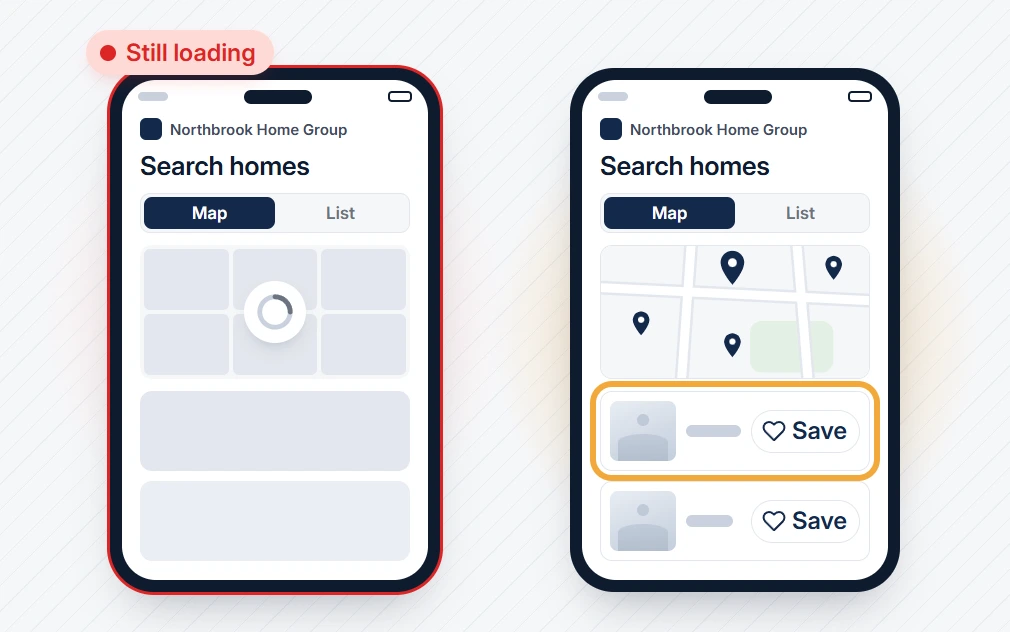
Most brokerage sites embed an iframe IDX widget that loads a second stylesheet, blocks the main thread, and drags mobile Time to Interactive past 4 seconds. Buyers on a phone at an open house tap the search, wait, and bounce back to Zillow inside 8 seconds. Every dropped session is a buyer registration that never happened and a Follow Up Boss record that never got created. Portal traffic wins by default.
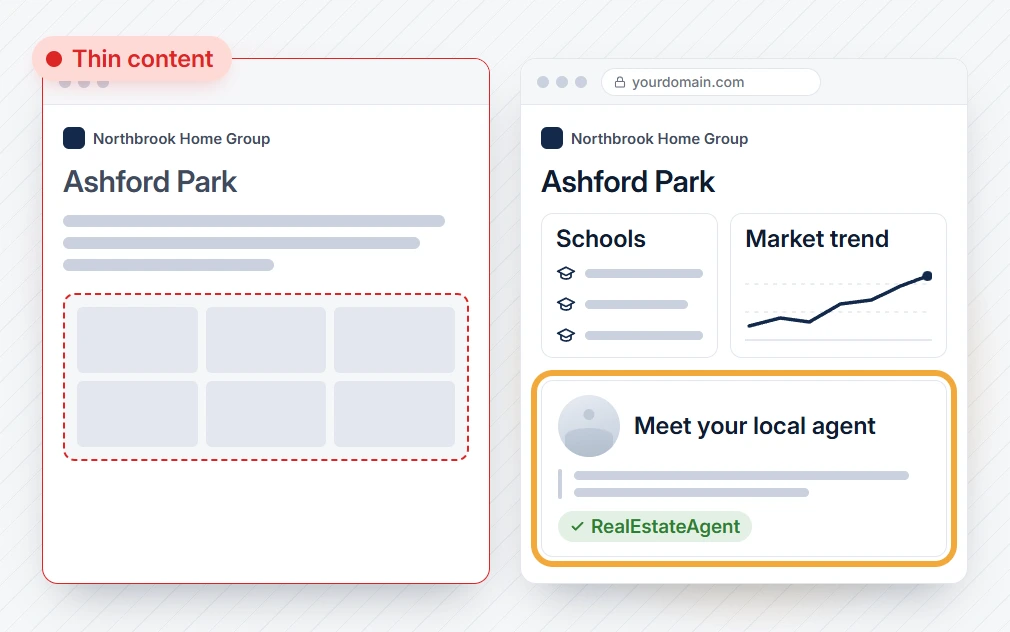
Generic real estate templates deliver neighborhood pages that read like a paragraph of filler plus an IDX embed. No school district data, no median-price trend, no local agent quote, no RealEstateAgent schema. Google reads that as thin content and hands the SERP to Zillow, Redfin, and Realtor.com. Your brokerage owns the local reputation but not the local search result.
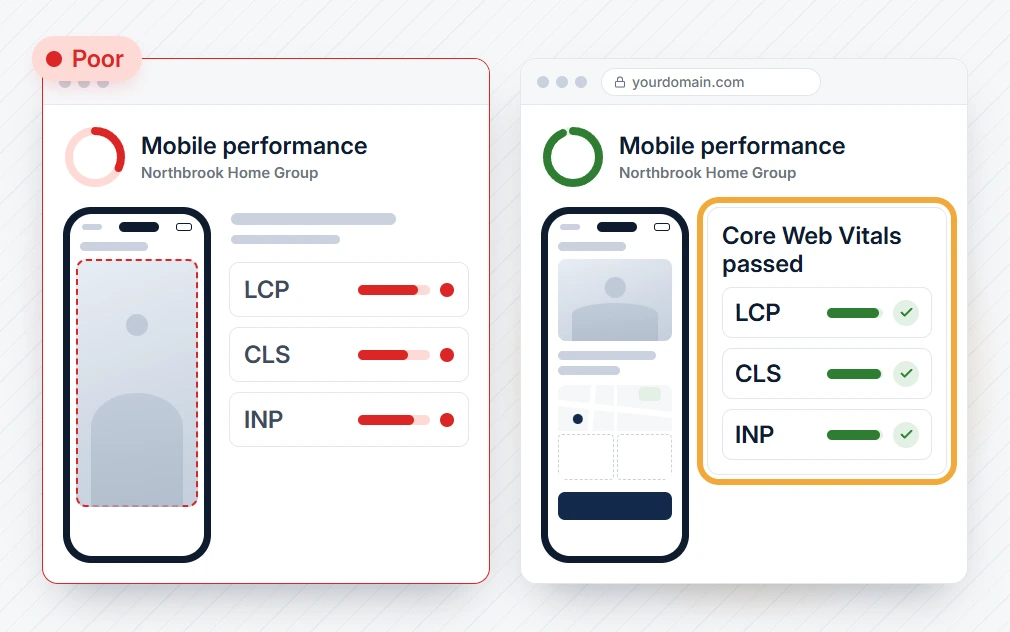
Unoptimized HDR listing photos, unlazyloaded map tiles, and a heavy portal-lookalike theme push mobile Lighthouse under 40. Google demotes the site out of the local pack, Google Ads landing page quality drops to below-average, and CPC on buyer keywords like homes-for-sale-brooklyn climbs 30 to 60%. The portal ad spend keeps winning because your landing pages fail the mobile bar.
Three targets written into the build contract. McCarthy Court was fully occupied within 3 months of completion.
Server-side RESO feed cache, mobile-first pattern, and lazy-loaded map tiles cut LCP under 1.8s so mobile buyers finish the property search on your site.
School data, median-price trends, agent quotes, and RealEstateAgent schema push your neighborhood pages above Zillow and Redfin on local buying-intent queries.
Follow Up Boss, kvCORE, and Sierra Interactive webhooks fire on every registration and valuation so your agents work fresh leads inside 5 minutes flat.
Discovery gets the brief, positioning, and information architecture locked in writing before design starts. From there, design, engineering, and launch run against a written milestone tracker with owner names and calendar dates. Every sign-off is on the calendar before design work starts.
Broker interview, top-producer agent interview, and marketing lead interview. Buyer and seller path mapped from Zillow arrival to Follow Up Boss record. IDX feed provider, MLS board, CRM stack, and pixel setup audited. Neighborhood, school-district, and property-type page inventory locked. Buying-intent slug list finalized. Signed brief before design starts.
Mobile-first design system built in Figma. Listing detail page pattern with HDR photo optimization, virtual tour embed, mortgage calculator, and buyer registration CTA above the fold. Neighborhood page pattern with school-district data, median-price trend chart, and lead-capture form. Agent bio page pattern. Home valuation lead magnet.
WordPress custom theme, Webflow, or Next.js headless build depending on stack. IDX integration wired via Showcase IDX, iHomeFinder, IDX Broker, Realtyna, or RESO Web API. Follow Up Boss, kvCORE, or Sierra Interactive webhook. Lead routing rules. RealEstateAgent and RealEstateListing schema. GA4 conversion events with server-side backup. Consent Mode v2.
From Growth up, a full 301 redirect map from the existing site keeps neighborhood and agent bio pages ranking. WCAG 2.1 AA verified with Axe DevTools plus manual NVDA and VoiceOver passes. Fair housing disclaimer placement checked. Mobile CWV green in Lighthouse and CrUX. Off-hours DNS cutover with Search Console watched hourly. 30 days of post-launch monitoring on every tier.
Five phases, from the MLS board rules check to the 301 map that keeps your neighborhood pages ranking. Each phase ends with a signed deliverable and a calendar date.
Broker interview, top-producer agent interview, marketing lead interview, technical audit of your current site, IDX feed and CRM inventory, competitor benchmark against Zillow and Realtor.com, and a written brief that gets signed by every stakeholder before design work starts.

Three to four working sessions with broker, top-producer agent, and marketing lead. How buyers and sellers currently find you, which neighborhoods drive the most closed deals, and which agents get the most repeat business.
Current site, IDX plugin, MLS board rules, CRM (Follow Up Boss, kvCORE, Sierra Interactive, BoomTown), Zillow and Realtor.com sync, ad accounts, GA4, pixel setup, and performance baseline all mapped before design starts.
Side-by-side comparison of Zillow, Redfin, or Realtor.com plus two local brokerages on mobile IDX search, buyer registration flow, neighborhood page depth, and agent bio pattern. Every gap flagged in writing.
MLS board rules per feed (disclosure, branding, refresh cadence, permitted display), IDX plugin choice locked (Showcase IDX, iHomeFinder, IDX Broker, Realtyna, or RESO direct), and lead routing rules mapped by neighborhood, price range, or team assignment.
Full page inventory with URL structure. Buying-intent slugs (homes-for-sale-park-slope, condos-for-sale-chelsea, brooklyn-heights-real-estate), agent bio slugs, and neighborhood pages sized against local search volume before build.
A document. Broker, marketing lead, and top-producer agent sign the brief before design work starts. Every scope item lives inside the signed brief.
Mobile-first design system with listing detail page pattern, neighborhood page pattern, agent bio pattern, home valuation lead magnet, and buyer registration flow. Every pattern built in Figma, every state accounted for, and every component handed over as an editable file. Starter runs on a template base, and custom design starts on Growth.

HDR photo gallery with lazy load, virtual tour embed, mortgage calculator, school-district ratings, and buyer registration CTA above the fold on mobile. RealEstateListing schema on every page, canonical hygiene against IDX-generated URLs.
School-district data, median-price trend chart, walk score and transit score, local agent quote, featured listings, and lead-capture form. Written for E-E-A-T so Google surfaces you above Zillow on hyper-local intent queries.
From Growth up, every agent gets a profile with a real headshot, neighborhoods served, closed-deal count, five-star review pull, direct phone and email, and a Calendly link that writes into Follow Up Boss or kvCORE on submit. Video intro slot for top producers.
Seller-side lead capture with property address auto-complete, three-step form, and instant estimate powered by RPR or ATTOM data. Every submission writes into your CRM tagged as seller intent for the drip trigger.
Full component library, design tokens, and page templates handed over. Your marketing lead swaps featured listings, agent photos, and neighborhood covers without agency help.
Verified buyer and seller testimonials surfaced on agent bio, home page, and neighborhood pages. Star ratings pulled from Google Business Profile per office and Zillow agent reviews with source attribution.
WordPress with custom theme by default, Webflow for luxury brokerages with simpler IDX needs, or Next.js headless for larger brokerages with an in-house engineering team. Every stack launches WCAG 2.1 AA verified with Fair Housing disclaimer placement checked, and from Growth up, with mobile Core Web Vitals green.

Default stack for most brokerages. Fastest launch, tight IDX plugin integration, and the widest CRM webhook coverage. Your marketing lead edits neighborhood pages and agent bios without engineering help.
For luxury brokerages with a design-heavy brand and simpler IDX embed needs. Same speed and Core Web Vitals bar, tighter design control, less content-editing surface for large teams.
Quoted separately for brokerages with 25+ agents or multi-office scope. Server-side RESO feed cache, native URLs on every listing, and full schema control on every page.
From Growth up, the speed budget is LCP under 1.8s, CLS under 0.05, and INP under 200ms on mobile. Verified in Lighthouse and CrUX field data before DNS cutover. No launches on red mobile numbers.
Axe DevTools scan, manual keyboard audit, NVDA and VoiceOver screen-reader passes before go-live. After launch, the Scale maintenance plan and above add an annual compliance audit. Fair Housing disclaimer placement verified on every neighborhood page.
RealEstateAgent schema on every agent bio, RealEstateListing schema on every property, Organization schema on the home page, and Place schema on every neighborhood page. Canonical hygiene against IDX-generated URLs.
IDX plugin, MLS board rules, Follow Up Boss or kvCORE webhook, Zillow and Realtor.com sync, GA4, Meta CAPI, Google Ads pixel, and Consent Mode v2. Every integration wired with a documented layer so your marketing lead can trace every buyer registration back to the source click.

Showcase IDX and iHomeFinder for 1 to 20 agent WordPress sites, IDX Broker for wide MLS board coverage, Realtyna for RETS or RESO Web API direct, or a headless RESO feed, quoted separately.
Follow Up Boss, kvCORE, LionDesk, Sierra Interactive, BoomTown, CINC, Real Geeks, or HubSpot webhook. Round-robin routing by neighborhood, price range, or team. Enhanced Conversions for Google Ads quoted separately.
Seller-side home valuation lead magnet powered by RPR, ATTOM, or Housecanary data. Property address auto-complete, three-step form, and instant estimate. Every submission tagged seller intent inside your CRM.
Agent profile parity across Zillow, Realtor.com, and Homes.com so review counts, closed-deal counts, and headshots stay in sync. Portal profile audits after launch are quoted separately.
GBP per office wired to the neighborhood pages and agent bios. Weekly GBP posts and per-office local pack tracking after launch are quoted separately.
GA4 conversion events, Meta CAPI, Google Ads pixels with server-side backup. iOS-17 attribution recovered where possible. Consent Mode v2 wired so paid-channel attribution survives the cookie banner.
Off-hours DNS cutover, uptime and Core Web Vitals monitoring live, a full 301 redirect map from the old site from Growth up, and 30 days of daily traffic and ranking watch on every tier. Search Console watched hourly for 48 hours post-cutover so any drop surfaces before it compounds.

Whole team on a bridge for cutover. Search Console, error logs, and Follow Up Boss lead volume watched hourly for the first 48 hours. Rollback path automated if anything trips the IDX feed or the CRM webhook.
From Growth up, every legacy URL mapped before cutover. Neighborhood pages, agent bio pages, and city landing pages that already rank get mapped to new equivalents so organic traffic survives the redesign.
Core Web Vitals, Search Console rankings, GA4 conversions, and error logs reviewed every business day for 30 days on every tier.
Pingdom, Better Uptime, or your tool of choice wired to Slack or SMS with 60-second checks. IDX feed endpoints, home valuation form, and CRM webhook monitored the same way.
30 days on every tier, from Starter to Enterprise. All bug fixes, minor content updates, IDX feed monitoring, and analytics QA included.
Design files, WordPress admin, IDX plugin license, Follow Up Boss keys, GA4 property, Search Console, and repo all in your name at handoff. Agency access only. If you leave, you leave with everything.
THREE FIXES YOU CAN APPLY · NO SALES DECK · IDX + CRM CHECK INCLUDED · No card needed. No sales call required.
Pick the tier that matches your brokerage stage. Every project is a fixed-price quote, not a monthly bill. IDX feed licensing and MLS access fees are billed by your MLS or IDX provider directly.
THE FOUNDATION: New businesses that need a credible, fast site on a template base
EVERYTHING IN STARTER, PLUS: Single-location businesses replacing an underperforming site
EVERYTHING IN GROWTH, PLUS: Larger sites with more page templates and integrations
EVERYTHING IN SCALE, PLUS: Large site estates, multi-brand or multi-location
EVERY BUILD: FIXED-PRICE · LAUNCH DATE IN THE SOW · 30-DAY LAUNCH MONITORING · IDX + CRM KEYS IN YOUR NAME
Each one includes where the client started, what we changed and what happened.
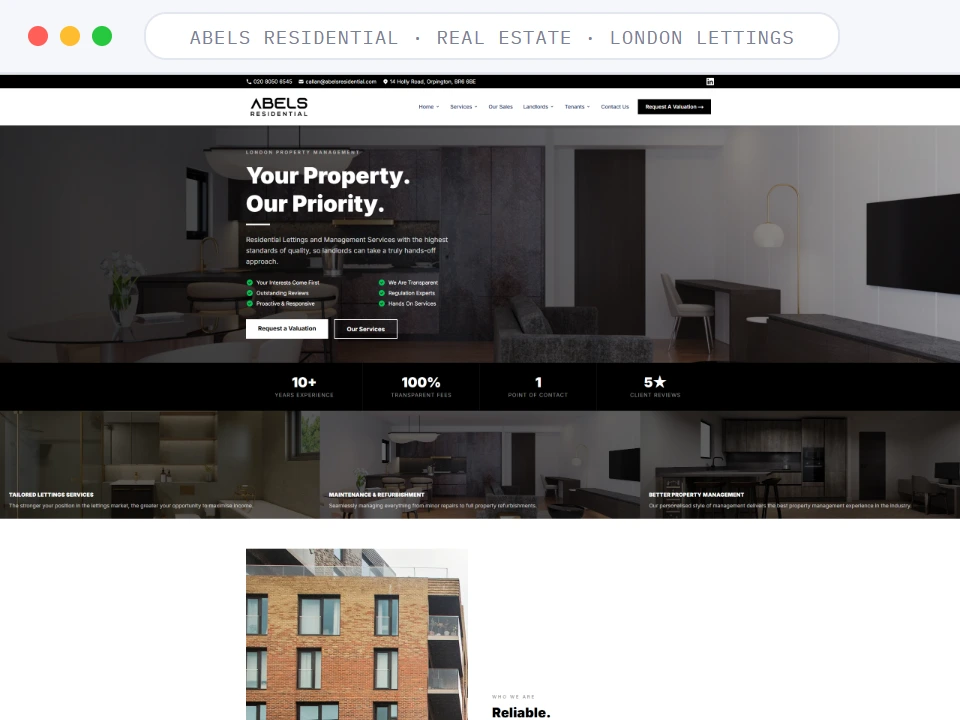 Published case study
Abels Residential
ABELSRESIDENTIAL.COM
Abels Residential, a London rental and property management firm with 10+ years of experience, had no online presence against much larger agencies. We built a fast website made to convert, with a mobile-friendly rental search, and ran on-page and off-page SEO for London rental keywords. The site now ranks for 280+ keywords, loads in 2 seconds and brings in 20+ qualified leads a month from organic search.
 Published case study
McCarthy Court
MCCARTHYCOURT.SENIORLIVINGNEARME.COM
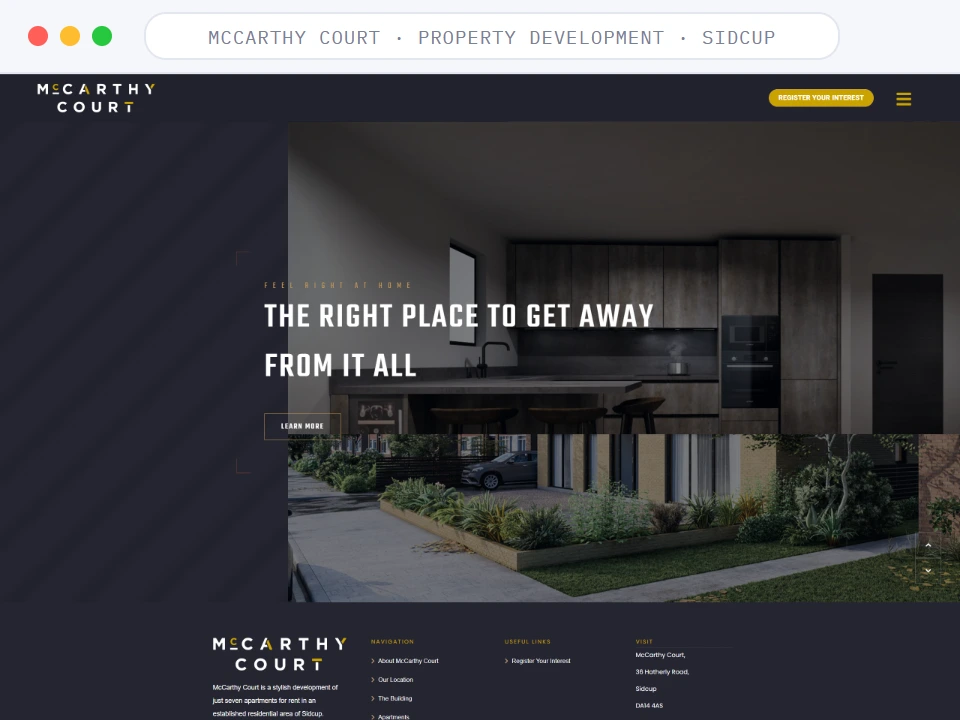
McCarthy Court is a Sidcup development of seven high-spec apartments for rent. It had to let while the building was still going up, with no in-person tours. We built a custom property website with a virtual showroom, its green features, local lifestyle stories and lead capture. The site drew 60+ qualified renter leads from 10K campaign visits, and the development was fully occupied within 3 months of completion.
 Published case study
Gather Workspaces
GATHERWORKSPACES.COM
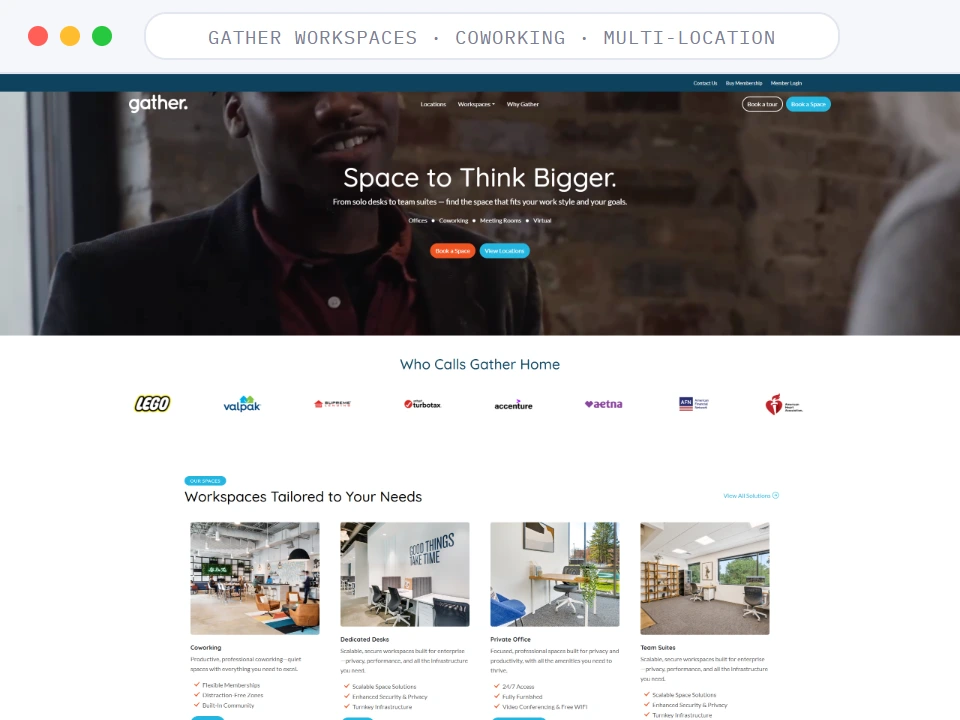
Gather Workspaces grew from three to seven coworking locations. But its funnel only chased tour-ready leads, and COVID cut tours sharply. We set up HubSpot CRM with automated nurturing, widened the funnel to earlier-stage prospects and added high-intent paid search. Tours rose 67%, and inbound marketing returned 12× with $950K in attributable annual revenue.
THREE FIXES YOU CAN APPLY · NO SALES DECK · IDX + CRM CHECK INCLUDED · No card needed. No sales call required.
Demos doubled in a quarter after the funnel rewrite. Nothing about the traffic changed. The pipeline math finally works.

Move the sliders to your numbers. A redesign earns its cost from the visitors already landing on the site, before it wins a single new one.
Free · Written findings · Yours to keep
Straight answers on cost, timeline, IDX platform choice, CRM integration, conversion rate, compliance, redesign risk, and tech stack. Call or email if we missed yours.
Real estate web design at Redefine Web starts at $2,500 on Starter and runs to $12,000+ on Enterprise across four fixed-price tiers. Starter is a WordPress build for solo agents on a template base, with up to 8 pages, an IDX embed, an agent bio, and a CRM webhook. Growth fits small teams and boutique brokerages with custom design, up to 15 pages, team profile pages, neighborhood-focused conversion pages, and Follow Up Boss or kvCORE wiring. Scale fits multi-office brokerages with up to 25 pages, per-office SEO architecture, and local citation setup. Enterprise fits $10M+ brokerages with unlimited pages, portfolio brand systems, and advanced CRM integration.
Every project is fixed-price, not a monthly bill. Payment runs 40% at kickoff, 40% at design approval, 20% at launch. IDX feed licensing and MLS access fees are billed by your local MLS or IDX provider directly, and NAR and local board rules govern permitted display. Ongoing real estate SEO or PPC retainer is separate and starts at $500/mo. Website maintenance is separate and starts at $199/mo. Enterprise builds with deep CRM work start at $12,000, and a headless build with a server-side RESO feed is quoted separately.
Starter, Growth, and Scale real estate websites go live in 4 to 10 weeks, through the four stages above. Enterprise sits at the top of that range, depending on IDX feed integration, multi-office scope, and CRM depth. Every project has a written milestone tracker with owner names and calendar dates from week one, so nothing slips silently and every stakeholder sees where the project sits.
The full timeline breaks into four phases. Discovery covers positioning and information architecture. Design builds the design system and page patterns. Engineering covers IDX integration and CRM wiring. Launch closes with QA, the 301 map, and the cutover. Delays almost always come from client-side content or IDX vendor timing. Agent bios, listing photography, neighborhood content, and IDX feed provisioning are the top four bottlenecks that stall real estate projects, so we schedule those inputs against calendar dates before design starts.
The best platform depends on your brokerage size, MLS board, and CRM stack. WordPress with a custom theme is the default for 1 to 20 agent brokerages since it pairs cleanly with IDX plugins (Showcase IDX, iHomeFinder, IDX Broker, Realtyna) and the widest CRM webhook coverage. Webflow works for luxury brokerages with a design-heavy brand and simpler IDX embed needs. Headless Next.js fits 25+ agent multi-office brokerages that need server-side RESO feed cache, native URLs on every listing, and full schema control on every property page.
Placester, Sierra Interactive, and Real Geeks are DIY platforms with locked design systems. They launch fast but cap your SEO and conversion ceiling since you cannot edit the underlying markup or add server-side rendering. If you want to own the code, the SEO surface, and the lead pipeline, custom WordPress or headless Next.js wins on the 3-year cost per lead. We pick the stack based on your MLS board rules, agent count, integration depth, and lead volume.
Design a real estate website by starting with buyer and seller intent, not features. Map both paths. A buyer landing from Zillow or Google Search needs mobile-first IDX property search with a registration CTA above the fold. A seller landing from a home valuation ad needs a three-step address-first form that writes into your CRM tagged as seller intent. Every page pattern serves one of the two paths.
Build a listing detail page with HDR gallery, virtual tour embed, mortgage calculator, and school-district data. Build neighborhood pages with median-price trend charts, walk score, and local agent quotes so Google reads them as authoritative on hyper-local queries. Add RealEstateAgent schema on agent bios and RealEstateListing schema on properties. Verify WCAG 2.1 AA and mobile Core Web Vitals green before launch. Fair Housing disclosure placement and MLS branding rules get audited before design work starts, and every CTA gets tracked in GA4 so the post-launch conversion rate is measurable inside the first 30 days.
An IDX website is a real estate site that pulls active MLS listings into your own domain through an IDX (Internet Data Exchange) feed or the newer RESO Web API. Instead of sending buyers to Zillow or Realtor.com, buyer registration, saved searches, and listing views happen on your brokerage domain, so the CRM record and the ad-attribution pixel fire on your property, not the portal. That is the difference between renting portal leads and owning your own lead pipeline.
IDX access is licensed through your local MLS board and delivered by a plugin (Showcase IDX, iHomeFinder, IDX Broker, Realtyna) or the RESO Web API for headless setups. MLS board rules govern refresh cadence, disclosure text, branding, and permitted display. Every IDX property page carries RealEstateListing schema, canonical hygiene against duplicate MLS URLs, and mobile Core Web Vitals green. See the Google real estate listing schema docs for the exact fields required.
Building an IDX website starts with your MLS board approval. Every US MLS has its own IDX rules for who can display listings, how often the feed refreshes, and what branding sits next to each listing. Get MLS board approval, pick an IDX vendor (Showcase IDX, iHomeFinder, IDX Broker, Realtyna, or RESO Web API direct), and license the feed for the boards your brokerage covers.
From there, build a WordPress or headless site with the IDX plugin wired into a listing detail page pattern. Add HDR photo lazy load, virtual tour embed, mortgage calculator, and buyer registration CTA above the fold on mobile. Wire the CRM webhook (Follow Up Boss, kvCORE, Sierra Interactive) so every registration and valuation submission routes to the right agent. Verify Fair Housing disclosure, WCAG 2.1 AA compliance, and mobile Core Web Vitals green before launch. Redefine Web builds all of this fixed-price on the four tiers.
Get IDX on your website in three steps. First, confirm your local MLS board membership and request IDX feed approval. Every US MLS board has its own IDX rules and approval process, so factor 2 to 4 weeks for board paperwork. Second, pick an IDX vendor that matches your site stack. Showcase IDX and iHomeFinder are the fastest picks for WordPress brokerages at 1 to 20 agents. IDX Broker has the widest US MLS board coverage. Realtyna covers direct RETS and RESO Web API access when you need headless control.
Third, wire the IDX feed into your site with a plugin (WordPress) or a server-side cache (headless). The IDX vendor supplies the connection credentials, and your developer builds the listing detail page pattern and neighborhood pages that surface the feed. MLS branding, disclosure, and refresh-cadence rules apply on every listing page. Redefine Web handles all three steps inside every real estate web design engagement, from MLS board paperwork to launch.
Yes. Every real estate web design engagement includes IDX integration with common providers (Showcase IDX, iHomeFinder, IDX Broker, Realtyna, or MLS-direct RETS and RESO Web API feeds), CRM integration with Follow Up Boss, kvCORE, LionDesk, Sierra Interactive, BoomTown, CINC, Real Geeks, or HubSpot, and lead routing to individual agents by neighborhood, price range, or team assignment. Every buyer registration and seller valuation submission writes into the CRM tagged with source, campaign, and intent so agents work fresh leads inside minutes.
Deep integration is included on Growth tier and above. Starter tier includes lightweight integration (IDX embed plus webhook to CRM) to keep the price at $2,500. Scale and Enterprise add CRO testing setup and a dedicated project lead. Enhanced Conversions for Google Ads, custom lead scoring, and drip campaign triggers are quoted separately. MLS compliance rules vary by local board. We know the disclosure, branding, and permitted content patterns for major MLS systems and audit every listing page against them before launch.
Well-built real estate websites convert 2 to 6% of qualified traffic on the primary lead-capture CTA (property search registration, home valuation, agent contact). Buyer registration on high-intent property search pages converts higher (4 to 8%) since visitors are already searching for homes. Seller home valuation converts lower (1 to 3%) since the ask is higher-consideration and the seller needs more trust before submitting an address to a brokerage they do not know yet.
Real numbers depend on market, price tier, and traffic source. Cold Meta traffic to a general home page converts 40 to 60% lower than intent-driven Google Search traffic to a neighborhood page. Referral traffic and branded search convert 3 to 5x higher than either. We baseline your current numbers before launch so the post-launch conversion improvement is measurable, not guessed. Every real estate web design build wires GA4 conversion tracking and server-side backup on day one, plus a 30-day post-launch review of the funnel.
SEO foundations are baked into every real estate web design tier. Starter gets basic on-page SEO. From Growth up, you get a technical SEO audit, information architecture that supports neighborhood, school-district, and property-type pages, RealEstateAgent and Organization schema, canonical hygiene for IDX-generated listing pages, XML sitemap and robots configuration, mobile Core Web Vitals green on launch (see web.dev/vitals for current thresholds), and 301 redirect maps on every redesign. Every tier includes a Google Business Profile audit for brokerages with physical offices, and every page carries the meta pattern and internal linking Rank Math grades against.
Ongoing real estate SEO retainer (neighborhood content publishing, link earning, local citation building, review management) is a separate monthly plan starting at $500/mo. That is where compounding organic growth happens across 6 to 12 months of publishing. From Growth up, redesigns of existing real estate sites include a full redirect map so ranking pages are preserved. Neighborhood pages, agent bio pages, and city landing pages that already rank get mapped to new equivalents so organic traffic survives the rebuild.
Yes. Compliance-aware form handling is included on every tier, and every build is checked against the rules real estate sites face. That means Fair Housing Act compliance with proper disclosure language on every listing and neighborhood page, ADA compliance (WCAG 2.1 AA baseline) that real estate websites face complaints about every year, MLS disclosure and branding compliance for local board rules, and NAR advertising rule compliance on your landing pages. Every disclosure gets placed and verified before launch.
For every real estate site, we implement GDPR-compliant cookie consent (Cookiebot or OneTrust), CCPA compliance for California client bases, and consent-based tracking. IDX-integrated listings comply with MLS terms of service and RESO data standards (attribution, refresh cadence, permitted display). Compliance work complements your broker compliance review and MLS board rules interpretation. A Google Business Profile per office gets verified against local pack requirements documented at Google Business Profile support so every office ranks on branded and near-me searches from day one.
Yes, on Growth and above, where site migration and redirects are part of the build. The redesign process starts with a full organic traffic and ranking audit. We identify the top 50 to 200 URLs by organic traffic (usually a mix of neighborhood pages, city pages, and agent bios), map every one to a new equivalent, and lock in a redirect strategy before content or design work starts. Every legacy URL gets a documented target.
Post-launch, the 30-day launch monitoring on every tier watches rankings and organic traffic daily and catches any drops before they compound. A redesign run this way holds its organic traffic through the transition, and the stronger technical SEO and lead capture can lift it from there. Neighborhood content that earned rankings gets flagged for topical preservation before writing starts so the new page keeps the entity signals Google already trusts.
You can create your own real estate website with a DIY builder like Placester, Sierra Interactive, Real Geeks, or a WordPress theme paired with an IDX plugin. Solo agents on a small budget can launch a functional site inside 2 to 4 weeks. DIY platforms cap your SEO ceiling, lock the design system, and rent the code, so the total cost per lead climbs across a 3-year window as the platform pricing rises and the design cannot compete with custom brokerage sites.
Custom real estate web design pays back on the 3-year cost per lead when your brokerage runs meaningful ad spend, competes on neighborhood SEO, or has a CRM stack that needs deep integration. If you want to own the code, the SEO surface, and the lead pipeline (with CRM webhooks, RESO feed direct, per-agent lead routing, and full schema on every listing and neighborhood page), a Redefine Web build starts at $2,500 on Starter, custom design starts on Growth, and Enterprise serves $10M+ brokerages. A headless build is quoted separately.
Free · Written in 24 hours · No pitch
A written report in your inbox within 24 hours, with three fixes you can ship the same week, whether or not you hire us.
Written in 24 hours · 10,000+ audits run · 300+ clients since 2021


