Law Firm Website Design That Books More Signed Cases

Bar-compliant law firm websites built to convert PI, family, and IP prospects into signed cases. Structured intake, jurisdiction pages, and attorney credibility signals baked in.

4.9Across 126 reviews on 6 platforms
Fixed price
$2,500 One-time project
Starter, up to 8 pages

Where we start Discovery
Sign-off: brief + sitemap
What’s included Starter
  • Hosting + SSL, first year
  • 30-day launch monitoring
  • On-page SEO setup
Contact form + click-to-call
Ownership 100% yours
Full ownership on handoff

Selected clients we've run full marketing programs for

  • Armanino
  • BSH
  • Delicate Dental
  • Government Legal Department
  • Hightop Health
  • LifeStance Health
  • Marmalade
  • Montegra Capital Resources
  • Noelle Collins Dental Clinic
  • Oxford Capital
  • Paquin & Carroll Insurance
  • PCO Bookkeepers & M&A Specialists
  • Peaceful Mind Psychology
  • Peak Accounting Solutions
  • Pelvic Rehabilitation Medicine
  • RiverSaaS Capital
  • Rosenbaum Personal Injury Lawyers
  • Smile Design Dentistry
  • Stanhope Capital Group
  • Stella Maris
  • Tilghman Builders
  • Toyota
  • Uptime
  • VP Dental & Medical Supplies
  • Wilentz Attorneys at Law

Three ways your current firm site loses booked consults

If any of these looks familiar, the free website audit names the fix and what it's worth before you spend a dollar.
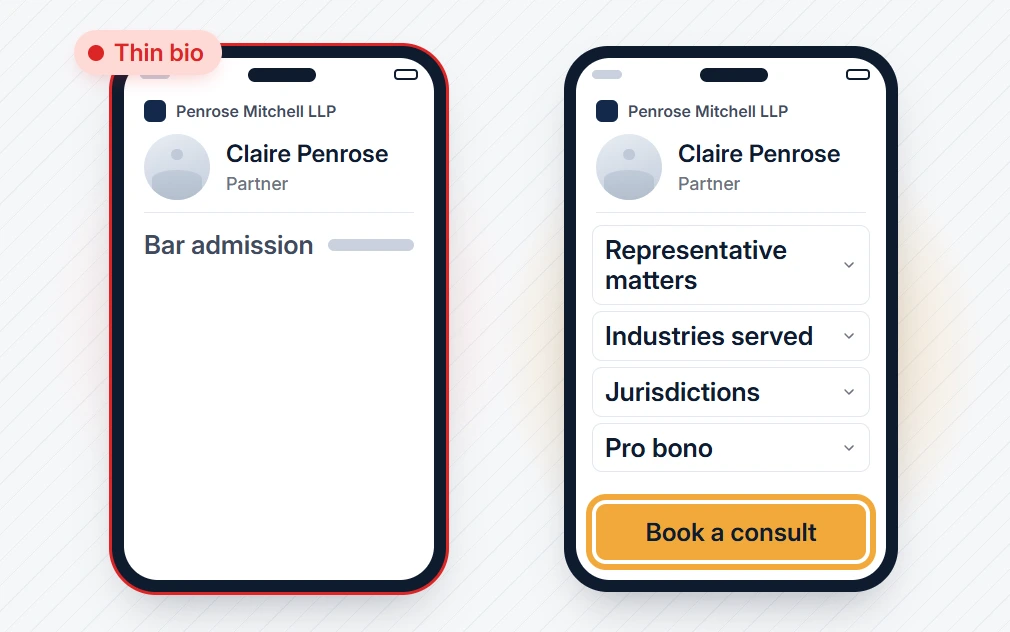
Law firm website design partner bio on phones, a thin bio beside a rebuilt bio with matters and a consult button
PROBLEM 01 · TRUST

Partner bios read thin and shortlist buyers cut you before the call

High-ticket clients shortlist 4 to 6 firm sites and cut to 2 on look alone. When partner bios show a headshot and a bar admission year and nothing else, the buyer bounces to the peer firm with matter wins, jurisdictions, and industry sectors on the page. Rebuild bios around real matter outcomes, industries served, and pro bono work, and the buyer has a reason to keep you on the list.
THIN BIOS · SHORTLIST DROP
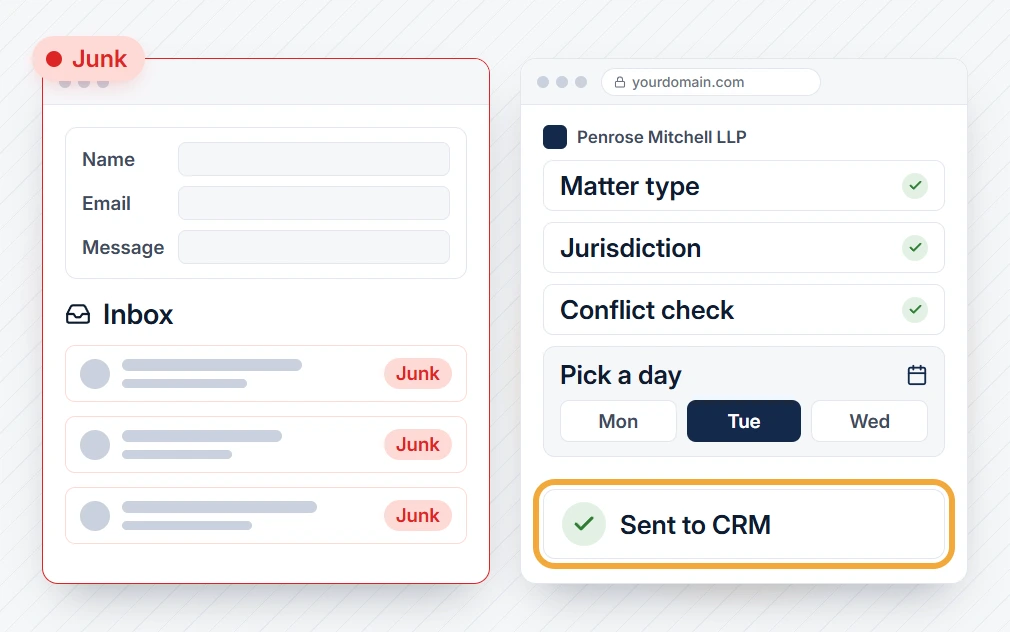
Law firm website design contact form inbox full of junk beside a qualified intake flow sent to the CRM
PROBLEM 02 · INTAKE

Contact form dumps junk into the assistant inbox, 60% garbage

A plain contact form pulls 60% junk (spam, tire kickers, wrong-jurisdiction filings) into the intake assistant inbox. Rebuild it as a qualified intake flow with conflict-check questions, jurisdiction match, matter type, and Calendly booking wired to Clio or HubSpot from day one.
60% JUNK · QUALIFIED INTAKE FIX
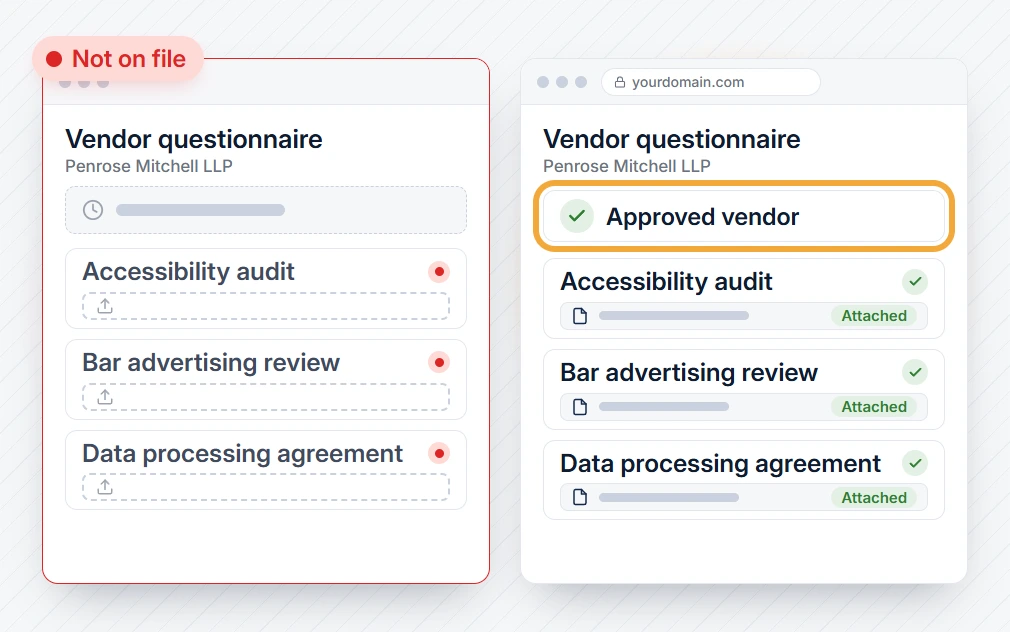
Law firm website design vendor questionnaire with three empty rows beside each row attached and approved
PROBLEM 03 · COMPLIANCE

Enterprise procurement asks for WCAG, ABA 7.1, and DPA in writing

GC teams and enterprise procurement ask for WCAG 2.1 AA proof, ABA Model Rule 7.1 review, and a signed DPA before you land on the shortlist. Miss any of the three and the firm site fails the vendor form. Every build goes live with an accessibility audit, bar-advertising review, and DPA template ready to sign so the firm passes procurement on the first pass.

WCAG · ABA 7.1 · DPA

Three outcomes every law firm website design produces

What each law firm site is built to do, and what your firm owns at handoff.

Higher visitor-to-consult rate on every practice area

Qualified intake above the fold, matter-proof bios, and a shorter booking path move revenue. Every build includes 30 days of launch monitoring after go-live.

Law firm SEO baked into the build, not retrofit

Every page ships with targeted metadata and buying-intent slugs, and from Growth up, LegalService schema. Personal-injury-attorney, family-law, tax-audit URLs mapped from day one.

Firm ownership at handoff, every key in your name

Your name on the domain, your logins on the CMS, and from Growth up, your team trained on the platform. Clio, HubSpot, and Figma files in your name. Walk with the site whole.

Four stages, every step ends in a sign-off

Fixed scope, fixed timeline, fixed outcomes. Nothing moves to the next stage until your managing partner signs the gate deliverable, and every milestone lands on a calendar date.

DISCOVERY

Discovery that earns the brief

A brief signed by managing partner, ops lead, and marketing lead. Partner interviews, technical audit of your current site plus HubSpot plus ad accounts, competitor benchmark against 5 peer firms, and CRM integration mapping to Clio or Salesforce. Nothing moves until it is locked.

SIGN-OFF: BRIEF + SITEMAP
DESIGN

Design built for your ideal client, not a Dribbble reel

Mobile-first design system with practice-area pages and qualified intake flow baked in from wireframe stage. Every component engineer-validated the same week it is drawn. You walk away with an editable Figma file your team owns.

SIGN-OFF: FIGMA + TOKENS
ENGINEERING

Engineering plus integrations that survive your next HubSpot upgrade

WordPress with custom PHP blocks by default. Headless Next.js when the CRM or matter-management stack demands it. Core Web Vitals treated as an acceptance criterion. HubSpot, Salesforce, Clio, or Lawmatics on the intake side. GA4, CallRail, and review platforms wired in with server-side backup.

SIGN-OFF: STAGING BUILD
LAUNCH + 30 DAYS

Launch and 30 days of daily monitoring

Cutover runs off-hours with the whole team on a bridge. Search Console, error logs, CRM submissions, and Core Web Vitals watched daily for 30 days. On day 31 you take the keys and go, or roll into a website maintenance retainer.

SIGN-OFF: LIVE + 30-DAY WATCH

What you actually get from our law firm website design services

Fixed scope. Fixed timeline. Fixed outcomes. Each phase below has a defined deliverable, a written sign-off, and a date on the calendar.

BRIEF

Brief signed by managing partner, ops, marketing

Partner interview, technical audit of your current site, HubSpot + analytics + ad accounts, competitor benchmark of 5 peer firms, and CRM data mapping. The output is a written brief your managing partner, ops lead, and marketing lead sign off on before we design a pixel or write a line of code.

Phase Duration: BRIEF Sign-off: AUDIT
Law firm website design brief sign-off with three firm leaders at a table, one holding a pen
GATE · SITEMAP

Partner and leadership interviews

Three to four working sessions with managing partner, ops lead, and marketing lead. How prospects currently discover you and why they convert or bounce.

Site and CRM tech audit

Current site, HubSpot or Salesforce, ad accounts, analytics, intake form posture, pixel setup, and performance baseline against Core Web Vitals.

5-competitor peer benchmark

Side-by-side comparison of 5 peer firms on mobile intake path, practice-area coverage, matter proof surface, and organic visibility for buying-intent queries.

CRM data mapping

Matter type taxonomy, intake field rules, conflict-check questions, and Clio or HubSpot pipeline mapping locked to the new site before design starts.

Sitemap and IA

Full page inventory with URL structure. Buying-intent slugs (personal-injury-attorney, family-law, tax-audit-defense) carry forward so organic rankings hold through the migration.

Written brief with sign-off

A document. Managing partner, ops lead, and marketing lead sign before anything else moves.

Family law, divorce and bankruptcy pages that book consults

Family law, divorce and bankruptcy prospects call under stress, and each practice area carries its own intake and ad rules. These pages are built around both.

Family law attorney website design, intake first

Family law attorney website design has to book consults without creating a conflict. Under ABA Model Rule 1.18, what a prospect shares can keep your firm from taking the other side. So intake should check conflicts before the story. Our intake puts conflict-check questions, jurisdiction match and matter type on one screen. From Growth up, Calendly booking feeds Clio or HubSpot.

Conflict-check questions on every intake

Divorce lawyer website design with clear fees

Divorce lawyer website design should answer two questions before the call, what it costs and what happens next. From Growth up, each divorce page states your fee structure and the jurisdictions you serve, with booking above the fold. Under ABA Model Rule 7.1, a custody or settlement win shown without context can mislead. Every outcome claim gets a bar review before launch.

Bar review on every outcome claim

Bankruptcy lawyer web design that stays compliant

Bankruptcy lawyer web design has to follow federal ad rules as well as the bar's. Under Section 528 of the Bankruptcy Code, a firm that helps consumers file must call itself a debt relief agency in its ads. Like every disclaimer the rules require, it ships on each bankruptcy page. Chapter 7 and Chapter 13 each get their own page, with fee notes and the districts you serve.

Chapter 7 and 13 on separate pages

Commitments most law firm web design agencies refuse to make

98+ mobile Lighthouse, LCP under 1.8s, WCAG 2.1 AA, a fixed calendar date, Clio and HubSpot keys in your name, and every legacy URL mapped 301 before cutover. In the contract, not the pitch. · No card needed. No sales call required.

See what your site is leaking →

Four law firm website design tiers for every firm stage

Pick the tier that matches your firm size and practice-area count. Every project is a fixed-price quote, not a monthly bill.

Starter

$2,500ONE-TIME PROJECT

THE FOUNDATION: New businesses that need a credible, fast site on a template base

  • Pages included: Up to 8
  • Contact form + click-to-call
  • Compliance-aware form handling
  • On-page SEO setup: Basic
  • Hosting + SSL, first year
  • 30-day launch monitoring
  • Full ownership on handoff
Get this quote

Scale

$7,500ONE-TIME PROJECT

EVERYTHING IN GROWTH, PLUS: Larger sites with more page templates and integrations

  • Pages included: Up to 25
  • Custom design (no template)
  • Per-service page layouts
  • Team + staff profile pages
  • Shared design system
  • Contact form + click-to-call
  • Live scheduling integration
Get this quote

Enterprise

Starts at $12,000ONE-TIME PROJECT

EVERYTHING IN SCALE, PLUS: Large site estates, multi-brand or multi-location

  • Pages included: Unlimited
  • Custom design (no template)
  • Per-service page layouts
  • Team + staff profile pages
  • Shared design system
  • Contact form + click-to-call
  • Live scheduling integration
Scope my build

Ongoing website maintenance is a separate plan starting at $199/mo, on a 6-month minimum term (12 months for larger sites on Enterprise).

Every web design feature, tier by tier

SCROLL THE TABLE SIDEWAYS FOR EVERY TIER
Website + design
FEATURE
STARTER
GROWTH
SCALE
ENTERPRISE
Pages included
Up to 8
Up to 15
Up to 25
Unlimited
Custom design (no template)
—
Per-service page layouts
—
Team + staff profile pages
—
Shared design system
—
—
Booking + conversions
FEATURE
STARTER
GROWTH
SCALE
ENTERPRISE
Contact form + click-to-call
Live scheduling integration
—
Payment + financing copy
—
Compliance-aware form handling
Conversion (CRO) testing setup
—
—
SEO + visibility
FEATURE
STARTER
GROWTH
SCALE
ENTERPRISE
On-page SEO setup
Basic
Organization + LocalBusiness schema
—
Site migration + redirects
—
Core Web Vitals speed budget
—
Local citation setup
—
—
Care + support
FEATURE
STARTER
GROWTH
SCALE
ENTERPRISE
Hosting + SSL, first year
30-day launch monitoring
Team training call
—
Full ownership on handoff
Dedicated project lead
—
—
Case studies

Real law firm websites, real numbers

Each one includes where the client started, what we changed and what happened.
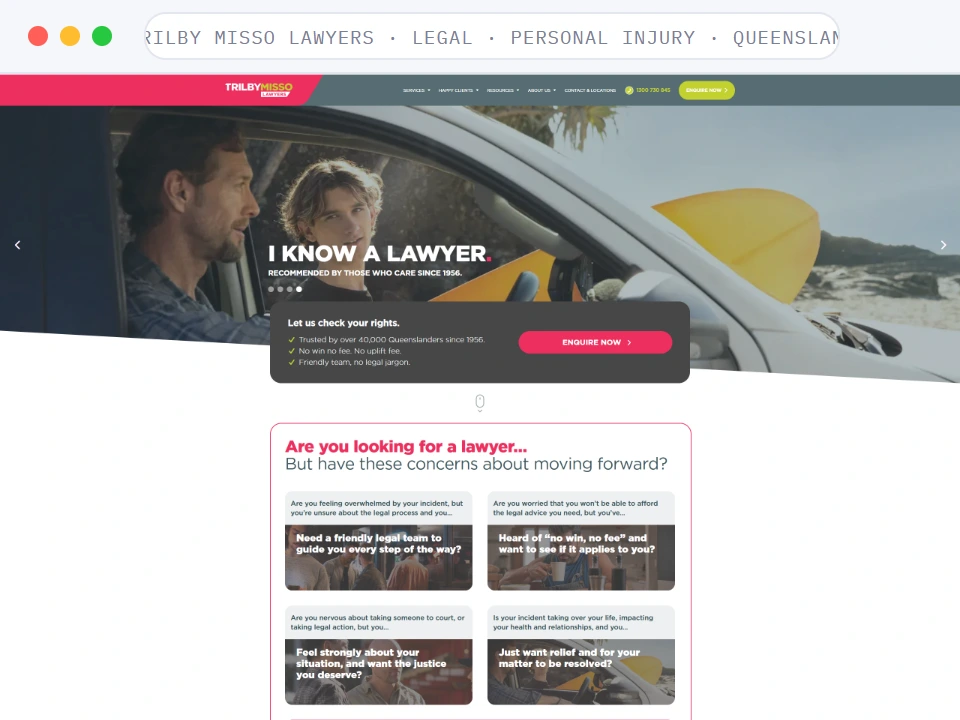
Homepage of Trilby Misso Lawyers, a Legal · Personal injury · Queensland business, shown in a browser window Published case study

Trilby Misso Lawyers

TRILBYMISSO.COM.AU

Legal · Personal injury · Queensland Paid Social Strategy · Creative Development · Campaign Optimization

Drove 8× client acquisition and 88.89% lower acquisition cost on Meta for Trilby Misso Lawyers.

Trilby Misso Lawyers has served Queensland since 1956. But its Facebook and Instagram ads had generic creative, loose targeting and costly leads. We rewrote the messaging, tested new creative formats and split audiences into cold, warm and ready-to-convert groups. Leads rose 183%, the firm won 8× more clients from the same ad spend and cost per client fell 88.89%.
+183%
Lead growth
8×
Client acquisition
-88.89%
Cost per client

Commitments most law firm web design agencies refuse to make

98+ mobile Lighthouse, LCP under 1.8s, WCAG 2.1 AA, a fixed calendar date, Clio and HubSpot keys in your name, and every legacy URL mapped 301 before cutover. In the contract, not the pitch. · No card needed. No sales call required.

See what your site is leaking →

Client words

Demos doubled in a quarter after the funnel rewrite. Nothing about the traffic changed. The pipeline math finally works.
Myles Scolnick
Head of Growth, QuoteWell
Verified via NPS survey 2x booked demos 41s lead response time
QuoteWell Insurance website homepage in a browser window, a wholesale insurance hero above the industries it serves
1 / 10

See what a higher converting site is worth

Move the sliders to your numbers. A redesign earns its cost from the visitors already landing on the site, before it wins a single new one.

4,000
200 50,000
$800
$100 $10,000
1.5%
0.5% 6%
What a 20% improvement on your current conversion rate adds, at today's traffic. Traffic is held flat on purpose.
Added revenue per month
/mo

Free · Written findings · Yours to keep

FAQ

Common law firm web design questions

Straight answers on cost, timeline, platform, Clio integration, WCAG compliance, and practice-area SEO. Call or email if we missed yours.

How much does a law firm website cost?
Law firm website design at Redefine Web starts at $2,500 on the Starter tier and runs up to $12,000 and up on Enterprise. Every project is a fixed-price quote, not a monthly bill. Starter is a WordPress build on a template base for solo practices and small firms, with up to 8 pages and a qualified intake form with click-to-call. Growth adds a custom design, practice-area pages, matter-proof partner bios, and Calendly booking with HubSpot or Clio wired to intake on submit. Scale raises the page count to 25 and adds a shared design system and A/B testing. Enterprise covers unlimited pages for multi-office and multi-brand firms. SOC 2, SSO, a white-label client portal, SLA-backed uptime, multi-office architecture, and matter-outcome case studies are quoted separately. Ongoing website maintenance is a separate plan starting at $199/mo. Firms comparing quotes should check that the number covers bar-compliance review under ABA Model Rules, WCAG 2.1 AA verification with a written statement, and 301 redirect mapping for organic winners. Anything cheaper usually skips one of those three and shows up in year one as lost organic traffic or a bar complaint.
What makes a good law firm website?
A good law firm website design does five things well before it does anything else. First, matter-proof partner bios that surface real outcomes, industries served, bar admissions, publications, and pro bono work, not a headshot and a two-line paragraph. Second, dedicated practice-area pages with jurisdictions served, fee structure notes, matter outcomes, and a booking CTA above the fold. Third, a qualified intake flow with conflict-check questions and jurisdiction match wired to Clio or HubSpot on submit. Fourth, bar-compliant footers and disclaimers that pass ABA Model Rule 7.1 and every state-bar advertising rule for the jurisdictions where the firm practices. Fifth, mobile speed under 1.8s LCP and WCAG 2.1 AA compliance so the firm site does not fail procurement or ADA review. Design polish matters less than any of these five levers. A pretty firm site that dumps junk into the assistant inbox loses to a plain firm site with a qualified intake path every time.
What makes a good lawyer website?
A good lawyer website looks credible in three seconds and books a consult in under three clicks. Credibility comes from a real headshot, bar admissions, matter outcomes tied to jurisdictions, and client testimonials tied to matter type and outcome. Booking speed comes from a qualified intake form above the fold with conflict-check questions, jurisdiction match, matter type, and Calendly on the same screen. Under the hood a lawyer website design needs LegalService or Attorney schema so search results show star ratings and jurisdiction, WCAG 2.1 AA for ADA safety, and mobile Core Web Vitals green (LCP under 1.8s, CLS under 0.05, INP under 200ms). Firms that skip schema lose organic real estate to the peer firm across the street, and firms that skip mobile speed lose 40% of paid clicks before the form even loads. Design taste helps on the shortlist round, but the intake path and the schema decide whether the prospect ever fills out the form or moves on to the next result. Prospects give three seconds, not thirty.
Which law firm has the best website?
The best law firm websites are the ones that convert prospects into signed clients at a rate above 4%, not the ones that win design awards. Wachtell, Cravath, and Skadden run clean, credential-heavy sites built for institutional clients with matter proof front and center. AmLaw 100 firms lean toward matter-proof case studies, industry-vertical pages, and partner bios structured around bar admissions and publications. Boutique PI, family law, and IP firms tend to win with a shorter intake path, review density from Avvo and Google, and jurisdiction-specific landing pages that rank locally for buying-intent queries. Judged by conversion rate and organic traffic per dollar of build cost, boutique firms often outperform the AmLaw giants on a dollar-per-lead basis because the intake flow is tighter and the landing page maps to the search term exactly. Pull three peer firms in your practice area and jurisdiction, put each through a mobile intake speed test on Search Console, and shortlist the one that books the fastest. That is the site to benchmark against, not the one on the awards page.
How much does it cost to build a website for a law firm?
Building a law firm website runs $2,500 to $12,000 and up depending on firm size, practice-area count, and CRM integration depth. A solo practice or small firm with up to 8 pages and a qualified intake form lands on the Starter tier at $2,500. A 3-partner firm with 6 to 12 practice areas, HubSpot integration, matter-proof partner bios, and jurisdiction-specific landing pages runs $4,500 on Growth. Multi-office firms with up to 25 pages, Salesforce integration, and A/B testing sit on Scale at $7,500. Enterprise builds with unlimited pages start at $12,000, and SOC 2 controls, SSO, a white-label client portal, and SLA-backed uptime are quoted separately. Every quote covers bar-compliance review, WCAG 2.1 AA verification with a written statement, and 30 days of post-launch support, plus 301 redirect mapping from the old site on Growth and up. What is not in the quote by default: ongoing website maintenance ($199/mo and up), paid media management, and content writing beyond the practice-area pages included in scope. Add-ons quoted separately, not bundled to inflate the headline number.
How much are attorney websites?
Attorney websites at Redefine Web run $2,500 to $12,000 and up as fixed-price quotes, not monthly bills that stretch out over years. The Starter tier ($2,500) covers solo attorneys and small firms needing up to 8 pages and qualified intake with click-to-call. Growth ($4,500) adds a custom design, practice-area pages, matter-proof partner bios structured around bar admissions and outcomes, Calendly booking, and Clio or HubSpot wiring, with 6 to 12 practice-area templates. Scale ($7,500) covers multi-office firms with up to 25 pages, Salesforce integration, and A/B testing. Enterprise ($12,000 and up) covers unlimited pages. SOC 2 controls, SSO, a white-label client portal, SLA-backed uptime, and multi-language support are quoted separately. Every attorney website ships with bar-compliance review under state-bar advertising rules and WCAG 2.1 AA verification, plus 301 redirect mapping from the legacy site on Growth and up. Ongoing website maintenance sits on a separate plan starting at $199/mo. Compare quotes on scope covered, not headline price. The cheap quote that skips bar review is the expensive quote 12 months in.
What is included in law firm web design services?
Every law firm website design build includes site design on WordPress with custom PHP blocks, a qualified intake flow with conflict-check questions and jurisdiction match, click-to-call, WCAG 2.1 AA verification with a written statement, first-year hosting, GA4 analytics wired with server-side backup, and 30 days of launch monitoring. From Growth up, builds add a custom design, a practice-area page pattern (6 to 20 templates covered depending on tier), and matter-proof partner bios. They also add Calendly booking wired to Clio or HubSpot on submit, a speed budget for 98+ mobile PageSpeed on Lighthouse, and a full 301 redirect map from the legacy site. Optional add-ons, quoted separately, include a white-label client portal (Growth and up), multi-office architecture (Scale and up), SOC 2 controls and SSO (Enterprise), and a matter-outcome case-study module that surfaces settled matters with jurisdiction and outcome tags across practice-area pages. Every build ships with bar-compliance review against state statute references, ABA Model Rule 7.1 language check, and state-bar advertising rules by jurisdiction. Firm-brand voice, matter proof, and mobile intake baked in from the wireframe stage, not bolted on after the site goes live.
What consult booking rate does the firm site hit at launch?
The consult rate after launch depends on practice area and on three levers: qualified intake above the fold on every practice-area page, matter-proof partner bios that survive the shortlist round, and 98+ mobile PageSpeed that stops the pre-booking bounce on 4G connections. Every number is tracked in GA4 with server-side events wired to Clio or HubSpot on submit, not last-touch guesses that lose 30% of attribution to cookie loss. High-intent practice areas (personal injury, immigration, tax audit defense) book highest because prospects with an active legal need convert on the first visit. Family law and IP prospects book less often because the buying window is longer. Corporate and M&A pages book lowest because the qualified conversation happens over months, not one form fill. Baseline your current numbers before we start so the delta is measurable on day 60.
How long does a law firm website design project take?
Every build launches in 4 to 10 weeks. A WordPress Starter build with up to 8 pages and a qualified intake form takes four to six weeks. A full firm rebuild with practice-area pages, HubSpot integration, and content migration, or a headless Next.js build with multi-office architecture or matter-management stack integration, sits at the long end of that range. The date on the SOW is the date you launch, not a rolling window that drifts across quarters. Discovery comes first, then design, build, and QA with content, then the DNS flip. Every milestone (wireframe sign-off, design sign-off, staging review, go-live) carries a calendar date signed by the managing partner. Content bottlenecks are the number one reason firm projects slip past deadline. We map the content responsibility matrix in week 1 so partner interviews, matter approvals, and bar-review sign-off do not stall the build in week 10. If the firm slips, we absorb the cost, not the timeline. Fixed date, fixed scope, fixed price, all in the contract.
Do you handle ADA WCAG 2.1 AA and bar advertising compliance?
Yes on both, and both are non-negotiable on every law firm website design build. Every site ships with Axe DevTools scans, manual keyboard audit, and NVDA plus VoiceOver screen-reader testing so WCAG 2.1 AA is verified before launch. A written accessibility statement is included for firm counsel to keep on file for ADA defense. ADA drift over time is covered by the annual compliance audit on maintenance plans from Scale ($499/mo) up. Bar advertising review covers ABA Model Rule 7.1 language on misleading claims, prior-results disclosures where jurisdictions require them, and state-bar-specific footer requirements by state. Firms in California, Texas, Florida, and New York are the top four we cover, and every state-bar advertising rule gets flagged in discovery. Testimonials, matter outcomes, specialization claims, and comparative statements all get reviewed against the applicable state bar before the page goes live. If your firm counsel wants to see the compliance checklist ahead of the SOW, we send it in the proposal. Bar risk stays on us during the build, not on the firm.
Do you integrate Clio, HubSpot, or Salesforce with the firm site?
Yes, on Growth builds and up. Clio and HubSpot are our default stack for law firm web design projects, and both are wired to intake on submit from day one. Intake form data writes into Clio or HubSpot with campaign-source tagging so paid channels attribute booked consults back to the click. Salesforce is fully supported for firms already running it as the CRM of record. MyCase, PracticePanther, Filevine, and Lawmatics are supported swap options on the matter-management side. Calendly or Chili Piper handles booking round-robin routing to partners with confirmation and reminder emails firing from HubSpot under the firm brand, not a generic template. CallRail dynamic number insertion by traffic source is wired in so phone consults attribute back to the ad channel that drove them. Every integration ships with a documented abstraction layer so the next platform swap is days, not months of custom work. If your firm runs a legacy PMS we have not seen before, we scope the connector in discovery and quote it separately in the proposal. No mystery on integration cost at any tier.
Do you build practice-area pages that rank for buying-intent queries?
Yes. Practice-area pages are the highest-ROI real estate on a law firm web design build, and every one is treated that way. Each practice area gets a dedicated page with matter outcomes, jurisdictions served, fee structure notes (contingency, hourly, or flat fee), a booking CTA above the fold, and matter-proof partner bios linked in-line. URL slugs carry buying-intent keywords like personal-injury-attorney-brooklyn, family-law-manhattan, or tax-audit-defense-nyc. LegalService or Attorney schema goes on every practice-area page, plus internal linking from blog content, city pages, and partner bios. Long-tail queries (dog bite lawyer queens, contested divorce attorney austin, wage theft attorney los angeles) tend to convert 2 to 3x higher than head terms because the buying intent is explicit and jurisdiction is baked into the query. Family law attorney website design follows the same pattern with a slower buyer. Divorce and custody prospects often read several pages before they call, so those pages lead with privacy, fee notes, and what happens at the first consult. Bankruptcy lawyer web design splits Chapter 7 and Chapter 13 onto their own pages, since the two filings answer different searches. If your firm has 15 or more practice areas, we prioritize the top 6 by revenue in phase 1 and roll out the rest across the first 6 months. No page ships without matter proof or a bar-reviewed disclaimer where the jurisdiction requires it.
Do we own the firm website at handoff?
Yes. Every law firm web design build goes live in your firm name with your logins, and none of it lives on a Redefine Web account. The WordPress admin, hosting, GA4 property, Clio, HubSpot, CallRail, and every pixel key sit in your name at handoff. GitHub or Bitbucket repo under your firm from day one, not migrated at handoff week. Redefine Web has agency access only during the build and the paid maintenance window. If you leave, you leave with everything: theme source files, design tokens in Figma, and full technical documentation covering the intake, integration, and analytics wiring. 30 days of post-launch support is included with every build, on every tier, so bugs and intake tweaks land free during the shakeout period. After that, ongoing website maintenance moves onto a monthly plan starting at $199/mo, or you take it in-house with the docs we hand over. Your call. There is no ransomware clause, no proprietary CMS lock-in, and no monthly platform fee that keeps the firm hostage.
What KPIs do you report after launch?
After the 30-day launch watch, reporting runs on a website maintenance plan, with a written report every Friday on every plan. For an attorney website it covers qualified consult volume from GA4 wired to Clio or HubSpot, visitor-to-consult conversion rate by practice area, organic traffic and keyword position from Search Console, Core Web Vitals (LCP, CLS, INP) on mobile and desktop, paid channel cost per booked consult by campaign, and intake form junk rate versus qualified rate. A live Looker Studio dashboard pulling from GA4, Search Console, Clio, HubSpot, CallRail, and the paid platforms is quoted separately. Practice-area-level attribution shows which pages are pulling weight and which need rework. Every month we flag the top 3 wins and top 3 gaps and propose the fix.

Free · Written in 24 hours · No pitch

Get your free website audit.

A written report in your inbox within 24 hours, with three fixes you can ship the same week, whether or not you hire us.

Written in 24 hours · 10,000+ audits run · 300+ clients since 2021