SaaS Website Design Agency for B2B SaaS Growth Teams

SaaS website design for growth-stage B2B teams. Buyer-segmented landing pages, a pricing page that actually explains the offer, and a demo flow that writes straight into HubSpot. Most builds go live in 4 to 10 weeks.

4.9Across 126 reviews on 6 platforms
Fixed price
$2,500 One-time project
Starter, up to 8 pages

Where we start Discovery
Sign-off. brief locked
What’s included Starter
  • Hosting + SSL, first year
  • 30-day launch monitoring
  • On-page SEO setup
Contact form + click-to-call
Ownership 100% yours
Full ownership on handoff

Selected clients we've run full marketing programs for

  • Armanino
  • BSH
  • Delicate Dental
  • Government Legal Department
  • Hightop Health
  • LifeStance Health
  • Marmalade
  • Montegra Capital Resources
  • Noelle Collins Dental Clinic
  • Oxford Capital
  • Paquin & Carroll Insurance
  • PCO Bookkeepers & M&A Specialists
  • Peaceful Mind Psychology
  • Peak Accounting Solutions
  • Pelvic Rehabilitation Medicine
  • RiverSaaS Capital
  • Rosenbaum Personal Injury Lawyers
  • Smile Design Dentistry
  • Stanhope Capital Group
  • Stella Maris
  • Tilghman Builders
  • Toyota
  • Uptime
  • VP Dental & Medical Supplies
  • Wilentz Attorneys at Law
The problems

Where most B2B SaaS websites lose demo requests

If any of these looks familiar, the free website audit names the fix and what it's worth before you spend a dollar.
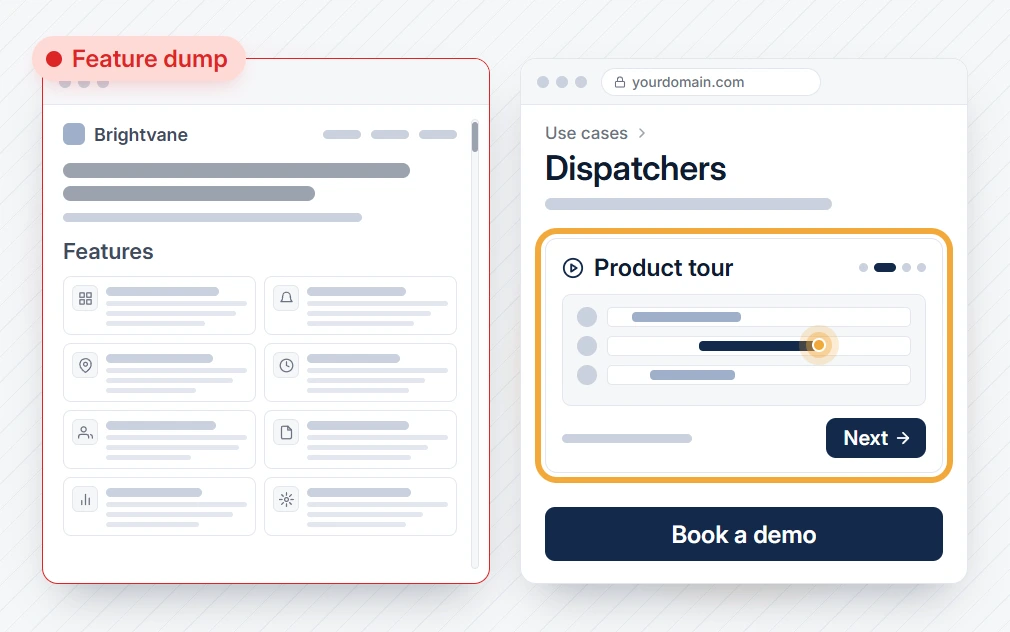
SaaS website design long feature scroll beside a dispatcher use-case page with an interactive product tour
PROBLEM 01. STRUCTURE

SaaS sites die after the hero on a 4,000-word feature dump

Most SaaS marketing sites go live with one giant scroll of features and no ICP anchoring. 68% of buyers bounce past the hero and pipeline funds Google Ads, not sales. We build ICP use-case pages plus an interactive product tour, so each buyer sees the software doing their job in the first 20 seconds.
THE FIX. USE-CASE PAGES + PRODUCT TOUR
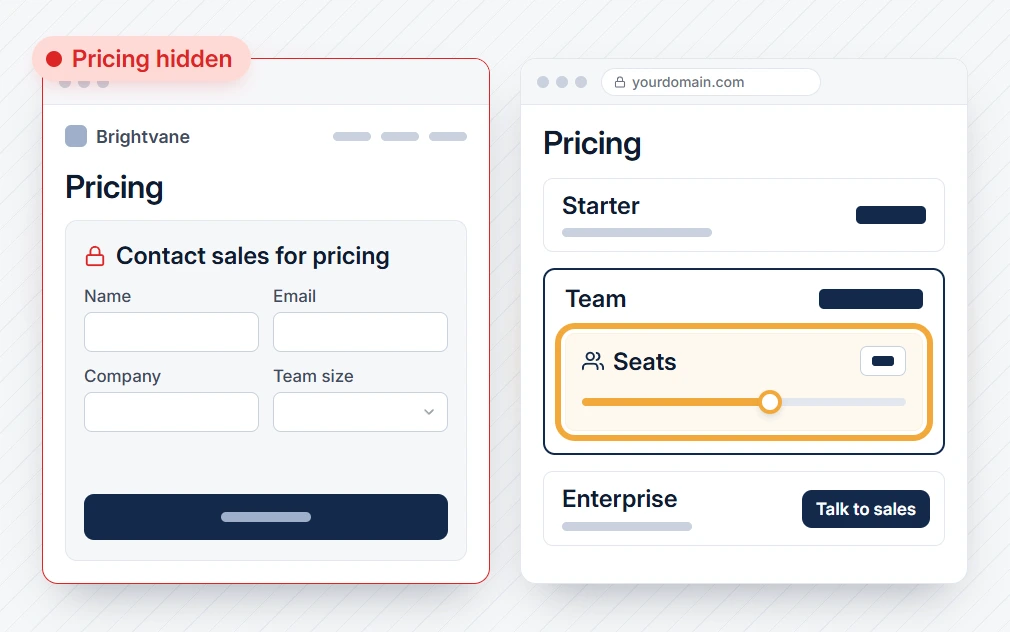
SaaS website design contact-sales pricing wall beside public pricing tiers with a seat calculator
PROBLEM 02. PRICING

Contact-us pricing pushes 47% of Series B buyers to a G2 competitor

Series B procurement builds the business case on the pricing page before Sales ever sees the lead. Hiding tiers behind a form kicks the buyer to G2 and Capterra for a competitor with public seat math. We publish tiered pricing with a seat calculator plus a clear enterprise slot for MEDDIC deals.
THE FIX. PUBLIC TIERS + SEAT CALCULATOR
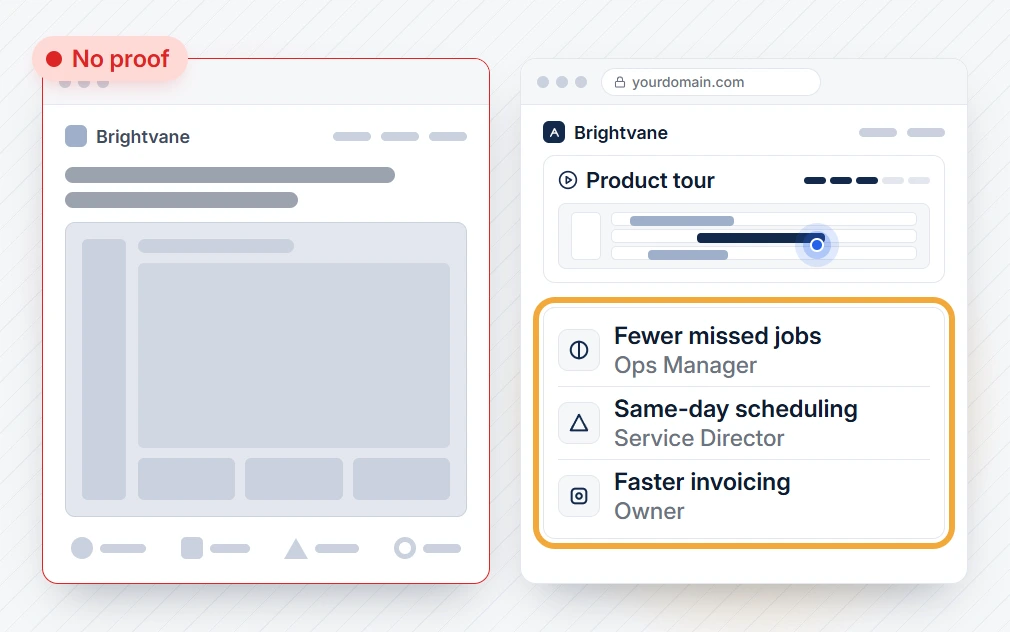
SaaS website design static screenshot and gray logo bar beside a live product tour with role-named proof
PROBLEM 03. PROOF

Static screenshots convert 3.2x worse than animated product visuals

A hero screenshot and a grayscale logo bar without named outcomes read as brochureware. Named case studies with logo, role, and outcome beat stock product shots by 3.2x on demo-request conversion. We wire Storylane or Navattic tours plus logo-plus-outcome proof strips into every ICP page.

THE FIX. LIVE PRODUCT TOURS + NAMED PROOF
What you get

3 outcomes every B2B SaaS build produces

What each B2B SaaS build is designed to deliver, from the demo path and search setup to a site your team owns.

Higher visitor-to-demo conversion rate on paid

Site architecture and qualifying UX at every step move demos onto the board.

B2B SaaS SEO baked into the build, not bolted

From Growth up, every ICP page launches with SoftwareApplication schema, targeted metadata, and intent-mapped slugs.

Owned by your team from the first day of handoff

Your name on the domain, your logins on the CMS, and from Growth up, your team trained on the platform. If we part ways, codebase, hosting, and HubSpot keys stay yours.

4 stages. Every step ends in a sign-off

Fixed scope, fixed timeline, fixed outcomes. Nothing moves to the next stage until your leadership signs the gate deliverable.

DISCOVERY

Discovery that earns the brief

A brief signed by owner, RevOps lead, and marketing lead. Leadership interviews, technical audit of your current site, HubSpot and ad accounts, competitor benchmark against 5 B2B SaaS peers, and HubSpot data mapping. Nothing moves until it is locked.

SIGN-OFF. BRIEF LOCKED
DESIGN

Design built for your B2B SaaS buyer, not a Dribbble reel

Mobile-first design system with B2B SaaS conversion patterns baked in from wireframe. Every component engineer-validated the same week it is drawn. You walk away with an editable Figma file your team owns for future changes.

SIGN-OFF. DESIGN APPROVED
ENGINEERING

Engineering that survives your next HubSpot upgrade

WordPress with custom PHP by default, headless Next.js when your stack asks for it. Core Web Vitals treated as an acceptance criterion. HubSpot, Salesforce, Segment on the CRM side. GA4, Meta CAPI, and demo routing wired in.

SIGN-OFF. STAGING GATE PASSED
LAUNCH + 30 DAYS

Launch, then 30 days of daily monitoring

Cutover runs off-hours with the whole team on a bridge. Search Console, error logs, HubSpot demo events, and Core Web Vitals watched daily for 30 days. On day 31 you take the keys and go, or roll into a maintenance retainer.

HANDOFF. KEYS TO YOUR TEAM

What you actually get from our SaaS build

Fixed scope, fixed timeline, fixed outcomes. Every workstream below has a defined deliverable and a written sign-off, on a date you can put on the calendar with your RevOps team.

DESIGN

Designed around the SaaS buyer choice

From Growth up, the design is custom for your product, not a template with your logo swapped in. Starter runs on a template base. Every page is built around the choice a buyer is making. Pricing answered, product tour visible, demo request never more than one tap away. Design sign-off before development starts.

Phase Duration: DESIGN SIGN-OFF BEFORE DEV Sign-off: WCAG 2.1 AA
SaaS website design sign-off with a designer and marketing lead reviewing the new site on a laptop
GATE · YOUR PRODUCT UI, NOT STOCK

Custom UX for SaaS buyer decisions

ICP pages answer pricing, integrations, and "what changes in week 1" above the fold.

Mobile-first design system

Figma tokens and components your team can extend without a developer.

Product tour built in Storylane

or Navattic, showing the software doing the job in 20 seconds.

Named case study proof strip

logo, role, and outcome beside every H1 hero. No generic marquees.

Pricing page with seat calculator

so procurement can build the business case without a demo call.

Comparison page templates

built to rank on "vs" queries for your top three competitors.

Get a free B2B SaaS site audit. Written report in 24 hours

NO SALES PRESSURE · No card needed. No sales call required.

Get My Free Proposal →

4 SaaS website design tiers for every launch scope

Every line item listed. The quote you get is the invoice you pay. Take any tier as a project fee, or split it into a flat monthly plan.

Starter

$2,500ONE-TIME PROJECT

THE FOUNDATION: New businesses that need a credible, fast site on a template base

  • Pages included: Up to 8
  • Contact form + click-to-call
  • Compliance-aware form handling
  • On-page SEO setup: Basic
  • Hosting + SSL, first year
  • 30-day launch monitoring
  • Full ownership on handoff
Get this quote

Scale

$7,500ONE-TIME PROJECT

EVERYTHING IN GROWTH, PLUS: Larger sites with more page templates and integrations

  • Pages included: Up to 25
  • Custom design (no template)
  • Per-service page layouts
  • Team + staff profile pages
  • Shared design system
  • Contact form + click-to-call
  • Live scheduling integration
Get this quote

Enterprise

Starts at $12,000ONE-TIME PROJECT

EVERYTHING IN SCALE, PLUS: Large site estates, multi-brand or multi-location

  • Pages included: Unlimited
  • Custom design (no template)
  • Per-service page layouts
  • Team + staff profile pages
  • Shared design system
  • Contact form + click-to-call
  • Live scheduling integration
Scope my build

EVERY TIER INCLUDES: 30 DAYS POST-LAUNCH MONITORING · 90-DAY REBUILD COMMITMENT · YOU OWN SITE, DOMAIN, AND DATA

Every web design feature, tier by tier

SCROLL THE TABLE SIDEWAYS FOR EVERY TIER
Website + design
FEATURE
STARTER
GROWTH
SCALE
ENTERPRISE
Pages included
Up to 8
Up to 15
Up to 25
Unlimited
Custom design (no template)
—
Per-service page layouts
—
Team + staff profile pages
—
Shared design system
—
—
Booking + conversions
FEATURE
STARTER
GROWTH
SCALE
ENTERPRISE
Contact form + click-to-call
Live scheduling integration
—
Payment + financing copy
—
Compliance-aware form handling
Conversion (CRO) testing setup
—
—
SEO + visibility
FEATURE
STARTER
GROWTH
SCALE
ENTERPRISE
On-page SEO setup
Basic
Organization + LocalBusiness schema
—
Site migration + redirects
—
Core Web Vitals speed budget
—
Local citation setup
—
—
Care + support
FEATURE
STARTER
GROWTH
SCALE
ENTERPRISE
Hosting + SSL, first year
30-day launch monitoring
Team training call
—
Full ownership on handoff
Dedicated project lead
—
—
Case studies

Real SaaS teams, real numbers

Each one includes where the client started, what we changed and what happened.
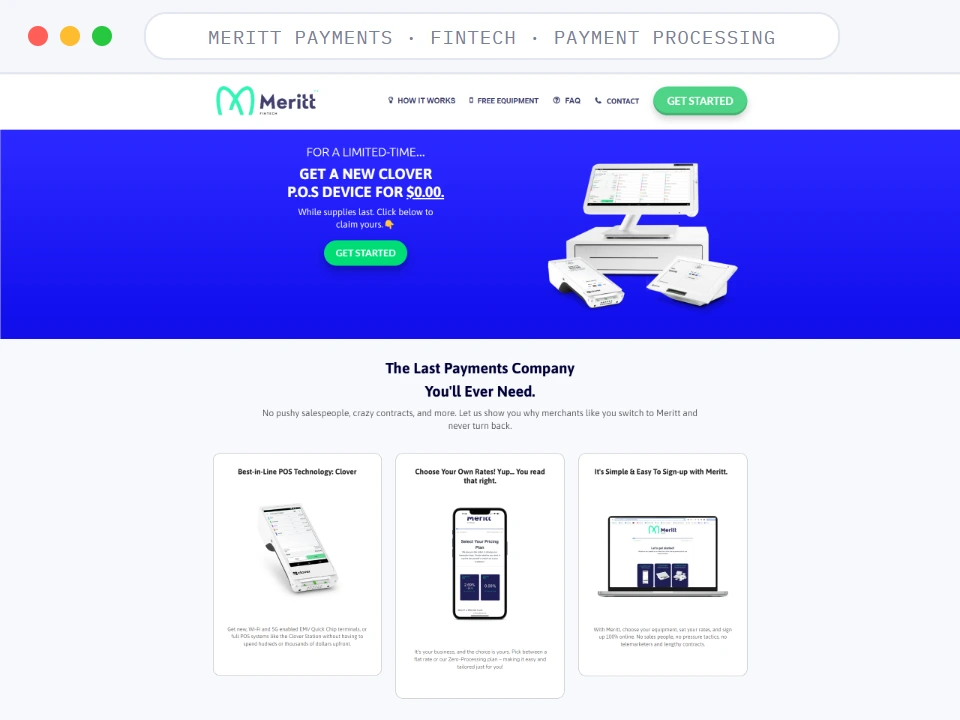
Homepage of Meritt Payments, a Fintech · Payment Processing business, shown in a browser window Published case study

Meritt Payments

MERRITTPAYMENTS.COM

Measured over 6 months
Fintech · Payment Processing Web Design · Web Development

Grew Meritt Payments traffic 108% and cut CPA 65% with a bilingual rebuild.

Meritt Payments, a payment processing fintech, had a site overloaded with plugins. Pages took 10 seconds to load, and the English and French versions were poorly built. We designed a fast, light custom site with clear calls to action and a proper bilingual SEO structure. Organic traffic grew 108% in 6 months, CPA fell 65% and 500+ keywords reached page one in the first year.
500+
First-page keywords
108%
Organic traffic
-65%
CPA

Get a free B2B SaaS site audit. Written report in 24 hours

NO SALES PRESSURE · No card needed. No sales call required.

Get My Free Proposal →

Client words

Demos doubled in a quarter after the funnel rewrite. Nothing about the traffic changed. The pipeline math finally works.
Myles Scolnick
Head of Growth, QuoteWell
Verified via NPS survey 2x booked demos 41s lead response time
QuoteWell Insurance website homepage in a browser window, a wholesale insurance hero above the industries it serves
1 / 10

See what a higher converting site is worth

Move the sliders to your numbers. A redesign earns its cost from the visitors already landing on the site, before it wins a single new one.

4,000
200 50,000
$800
$100 $10,000
1.5%
0.5% 6%
What a 20% improvement on your current conversion rate adds, at today's traffic. Traffic is held flat on purpose.
Added revenue per month
/mo

Free · Written findings · Yours to keep

FAQ

SaaS site build questions, answered

From real quote calls with growth-stage SaaS teams. Anything else, ask on the call and we answer in the first 5 minutes.

What is SaaS in web design?
SaaS in web design means the marketing website for a software-as-a-service product, built to convert paid and organic traffic into trial signups or demo requests. A SaaS website is different from a brochure site. It needs a product tour, public pricing, ICP-named use cases, comparison pages, and a demo request form wired straight into HubSpot or Salesforce. Every section has a job, and the job is pipeline, not brand awareness. Buyers rarely read the site linearly. They land on a "vs competitor" page from Google, jump to pricing, watch 20 seconds of the product tour, and book. Your SaaS marketing site has to make each of those jumps easy and answer the buying question at every step. See Google Search Central for the structured data and Core Web Vitals rules that every SaaS site now competes on.
What is a SaaS website?
A SaaS website is the marketing site for a software product buyers subscribe to instead of install. It sits in front of your product signup or demo flow and does 4 jobs at once. It names the exact buyer (RevOps lead, Head of Data, IT Ops manager) in the H1 so visitors know the page is for them. It shows the software in a 20-second product tour, not a marquee of feature icons. It lists tiered pricing on-page with seat math so procurement can build the business case without a call. It routes demo requests into HubSpot or Salesforce in under 2 minutes. A SaaS marketing site that skips any of the 4 wastes the pipeline the marketing team spent real ad budget to earn. Every SaaS site we build covers all 4 before launch, with CRM routing from the Growth tier.
How to structure a SaaS website?
A SaaS website structure that converts uses 6 core page types. Homepage that names the ICP and outcome in one sentence. Product pages, one per named feature or use case. Solutions pages by industry or company size. Pricing page with public tiers and a seat calculator. Comparison pages that rank on "vs" queries. Customers page with logo, role, and outcome per case study. Every page has one primary CTA, either Start free trial or Book a demo, matched to buying model. Product-led SaaS leans on trial signup. Sales-led SaaS leans on demo request. Mixed motion runs both, with a dominant primary. Navigation stays flat. No mega menus with 40 links, no product taxonomy the buyer has to learn. Internal linking follows the buying path, hub-and-spoke from each ICP page out to proof, pricing, and comparison. See Core Web Vitals on web.dev for the load-speed floor every page needs to hit.
What is an example of a SaaS website?
Stripe, Notion, Linear, Figma, HubSpot, and Attio are the SaaS marketing site examples most B2B teams benchmark against. Each of them names an ICP in the H1, lists public pricing, embeds an interactive product tour, and puts named case studies with logo plus outcome above the fold. Linear ranks the highest on visual polish and load speed. Stripe sets the bar on documentation-driven marketing pages. Attio and Notion show what tiered pricing with per-seat math looks like when procurement is the real buyer. Copying the shape of any of these is fine. Copying the copy is not, because the buyer language pulled from your customer interviews is what actually converts. The mistake most teams make is picking one of these as a reference and hiring a design agency that has never wired a HubSpot demo flow or a comparison page that ranks. Design is the visible part. Pipeline is the point.
How do I market my SaaS website?
Marketing a SaaS website starts with search intent, not channel. Rank on the 5 to 10 "job-to-be-done" queries your ICPs type into Google. Rank on the "vs competitor" queries your buyers use when shortlisting. Run paid on the same queries with landing pages that mirror the SEO version, not a generic form page. Feed the CRM. Route demo requests into HubSpot or Salesforce with round-robin AE assignment and campaign-source tagging. Layer in product-led signals: trial signups, activation events, and PQL scores tied to sales alerts. See HubSpot developer docs for the API and workflow patterns that hook a marketing site into the revenue system. Do content marketing on the exact buyer questions your ICPs ask on demo calls. Skip generic "SaaS growth" blog posts. Every marketing move ties back to a page on your SaaS website, and every page ties back to a specific pipeline outcome.
How much does SaaS website design cost?
SaaS website design at Redefine Web runs 4 fixed-price tiers. Starter at $2,500 for pre-seed and seed teams standing up a first marketing site. Growth at $4,500 for seed to Series A SaaS turning paid traffic into demos. Scale at $7,500 for Series B teams with 2 to 5 ICPs and multi-segment go-to-market. Enterprise custom builds start at $12,000 for Series C+ and public SaaS needing SOC 2, multi-region, and full compliance workflows. Ongoing website maintenance and hosting runs $199 to $499 a month and covers hosting, security patching, and content edits. A marketing retainer, which adds SEO and content on top, with Google Ads from the $1,250 Growth tier, runs $750 to $3,000+ a month. Every build tier includes 30 days of post-launch monitoring, a 90-day rebuild commitment, and full ownership of the site, domain, and data on day 31. Quote you sign on the call is the invoice you pay. No scope creep, no change-order surprises. Split any tier into a flat monthly plan if cash flow needs it.
How long does it take to build a SaaS website?
Every SaaS website build goes live in 4 to 10 weeks. Starter and Growth tier projects go live in 6 to 8 weeks. Scale and Enterprise builds go live in 8 to 10 weeks, with Enterprise timing set by integrations, multi-region rollout, and compliance requirements. Every project runs on a written milestone tracker with owner names and dates from week one, so your marketing team can plan campaign launches against the site launch date without guesswork. Late gates trigger a written recovery plan, not a silent slip. Discovery locks first with a signed brief. Design follows with a signed design system. Engineering then runs to staging sign-off. Launch happens on a scheduled off-hours window, never a Friday. 30 days of daily Search Console and HubSpot monitoring follow launch, then handoff. If a milestone slips, we tell you the same day and adjust the tracker in the shared doc.
What separates a SaaS web design agency from a generalist agency?
A SaaS web design agency knows the patterns that turn SaaS visitors into pipeline. ICP use-case page templates. Pricing pages that serve self-service and enterprise buyers on one URL. Product tour pages that show the software doing the job. Vs comparison pages that rank on competitor queries. HubSpot or Salesforce routing wired before launch. Generalist agencies build brand sites and hand you a Figma file. SaaS specialists build revenue infrastructure and hand you a rep-attributed pipeline number in month 3. The difference shows up in the questions the agency asks on the first call. A generalist asks about brand personality and moodboards. A SaaS specialist asks about your ICP list, your CRM, your comparison SERP, and your last quarter demo-to-close rate. Every SaaS site build we deliver runs around the buyer decisions, not the visual metaphors. Design quality still matters, but pipeline is the acceptance criterion.
Should a SaaS website use Framer, Webflow, or a custom CMS?
Framer and Webflow are great for pre-seed and seed SaaS teams that need to launch a marketing site in 3 to 4 weeks with no dev. Once you cross Series A, custom WordPress with SCF or Next.js with a headless CMS (Contentful, Sanity, Payload) makes more sense. Cheaper at scale, no per-seat CMS pricing, better integration with HubSpot workflows, and no vendor lock-in when you cross 30 pages. Every option we build launches at WCAG 2.1 AA, and from Growth up at 95+ mobile Lighthouse. The right CMS is the one your marketing team will actually use, so we let RevOps and Marketing weigh in on the choice during discovery. If your team already writes in Notion or Google Docs, we can add a docs-to-CMS sync, quoted separately, so publishing feels like editing a doc, not filing a ticket. From Growth up, every SaaS site engagement includes a team training call on the CMS before launch.
Do you integrate the SaaS website with our CRM and marketing stack?
Yes. From Growth up, the build wires demo booking into your CRM (HubSpot, Salesforce, Pipedrive, Attio, or Close) before launch, so demo requests hit the right AE in under 2 minutes. Marketing automation (Marketo, HubSpot, Customer.io, or Braze) and product analytics (Segment, RudderStack, Amplitude, Mixpanel, or PostHog) are quoted separately and wired before launch, so every session is tagged for multi-touch attribution. Round-robin routing tested with 20 dummy submissions across owners, time zones, and territory rules before we push live. Server-side event forwarding for GA4, Meta CAPI, and LinkedIn Insight recovers the conversion loss iOS 14+ caused on paid channels. Segment or RudderStack sits in front of the analytics stack so a future tool swap is a config change, not a rebuild. Marketing automation gets wired to product events on day one, so drip campaigns can fire on trial activation, feature use, or PQL score, not just page visits.
Can you redesign our SaaS website without losing organic rankings?
Yes. From the Growth tier, every redesign includes site migration and redirects. The process starts with a full organic traffic and ranking audit. We identify the top 50 to 200 URLs by organic sessions, map each one to a new equivalent, and lock the 301 redirect strategy before content or design work starts. Search Console monitored daily for 30 days post-launch, with rollback on any URL that loses more than 20% of its organic sessions. Ranking drops during a SaaS redesign are a botched process, not an inevitable cost. Content parity matters more than URL parity. If a top-ranking page loses 40% of its word count on the new site, Google will drop it even with the 301 mapped correctly. We rewrite for voice and conversion but preserve topical coverage on every URL that was earning organic sessions before the redesign. Rollback plan is written into the launch checklist, not a fire drill.
What conversion rate should a SaaS website hit?
A well-built SaaS website converts 4 to 8 percent of qualified traffic on the primary demo request or trial signup CTA. Product-led SaaS with freemium signup runs higher, 6 to 12 percent on trial signup. Sales-led SaaS with a longer buying committee runs lower, 2 to 5 percent on demo request since the ask is harder. Anything under 1.5 percent on either model is an underperforming funnel, usually a mismatch between traffic intent and the CTA the page asks for. Conversion rate is the top-line number, but qualified pipeline is what the CFO cares about. We instrument every funnel with MEDDIC field capture so Sales sees budget, authority, and timeline before the AE picks up the phone. That is the number your board can hold you to.
Do you write the SaaS website copy or do we?
Either. Copywriting sits outside the build tiers. Your team can write from a positioning brief we hand over, or we quote copywriting and positioning work separately and add it to your fixed quote. That work runs 2 to 3 weeks up-front, driven by 5 to 10 customer interviews per ICP. Our copywriters know the buyer language in your category. We pull the exact phrases prospects use on demo calls, quote them back on the page, and skip agency-invented jargon. Positioning work covers ICP definition, category framing, competitor differentiation, and a message architecture doc your team owns after handoff. A copywriting quote includes 2 rounds of revision per page. Extra rounds are quoted before work starts, so you always know what a change costs before you approve it.

Free · Written in 24 hours · No pitch

Get your free website audit.

A written report in your inbox within 24 hours, with three fixes you can ship the same week, whether or not you hire us.

Written in 24 hours · 10,000+ audits run · 300+ clients since 2021