Our ecommerce SEO audit names every product, category, and collection fix your store needs to rank. You get a written report, a ranked roadmap, and a 30-minute walkthrough. Average ecom store owner uncovers 72 fix-worthy items on the first audit across Shopify, Woo, BigCommerce, and Magento.
Selected clients we've run full marketing programs for
Three ways your store rankings are stuck and no tool has told you
If any of these looks familiar, the free SEO audit names the fix and what it's worth before you spend a dollar.
PROBLEM 01 · FACETED NAV CHAOS
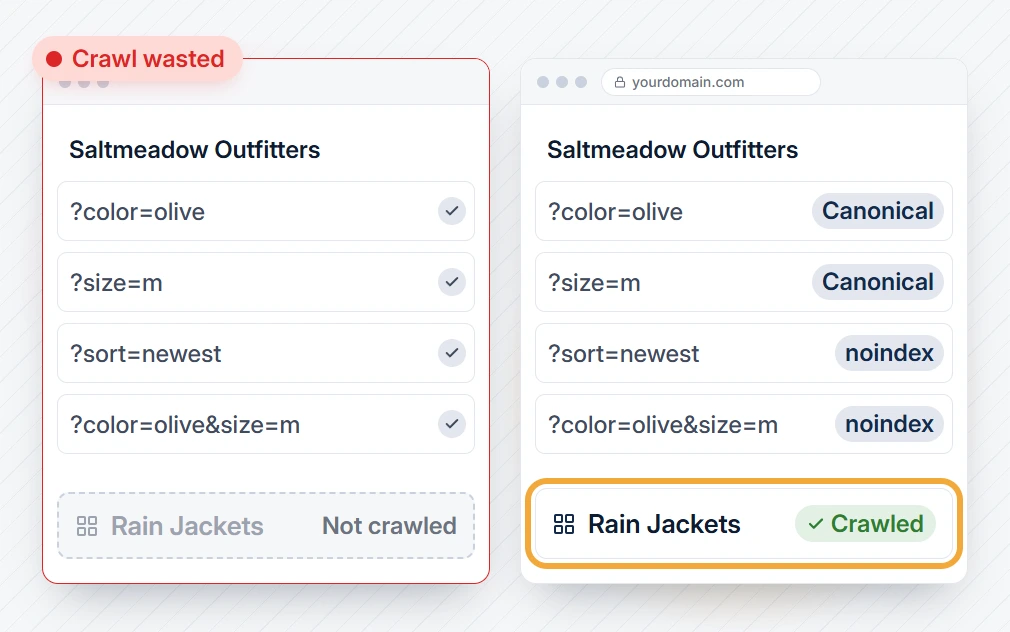
Faceted URLs eat your crawl budget and cannibalize category pages
Every color, size, and price filter spawns a new URL. Google crawls 40,000 near-duplicate variants and skips the money pages. An ecommerce SEO audit maps the canonical rules on every ?color=red and ?size=xl variant, flags the pages you should noindex, and hands you the exact robots and canonical patches your store needs.
FACETED URLS CRAWLED · MONEY PAGES SKIPPED
PROBLEM 02 · PRODUCT SCHEMA BROKEN
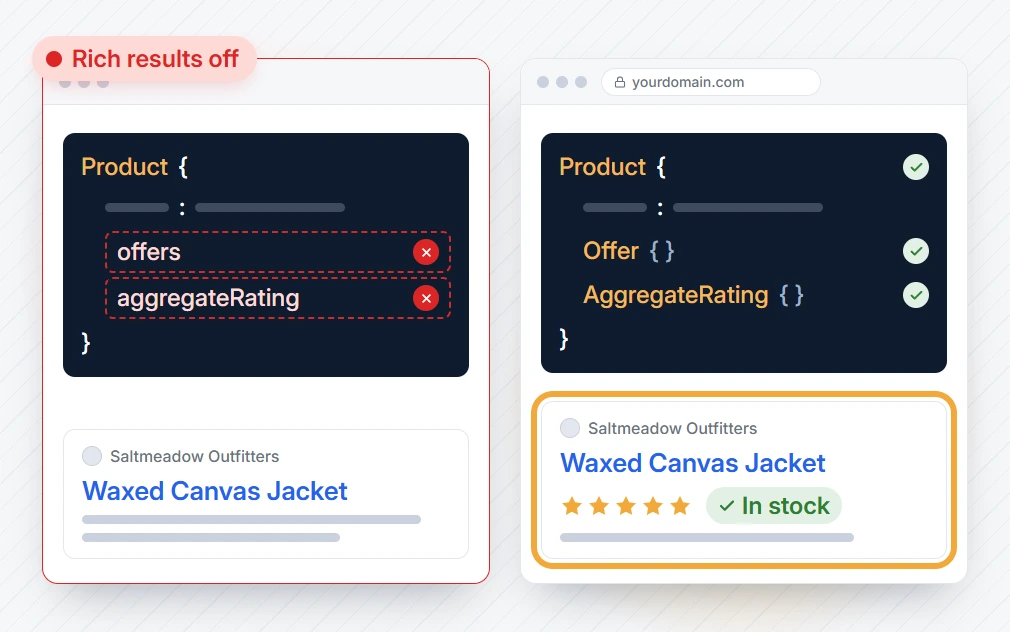
Product schema is missing or broken and rich results never trigger
Rich results drop off. Star ratings, price, and stock disappear from the SERP snippet. An ecom SEO audit checks every Product, Offer, and AggregateRating markup on your PDPs against Google Search Central rules, names the broken fields, and gives you a schema patch you can push live the same afternoon.
RICH RESULTS OFF · CTR DOWN
PROBLEM 03 · THIN CATEGORY COPY
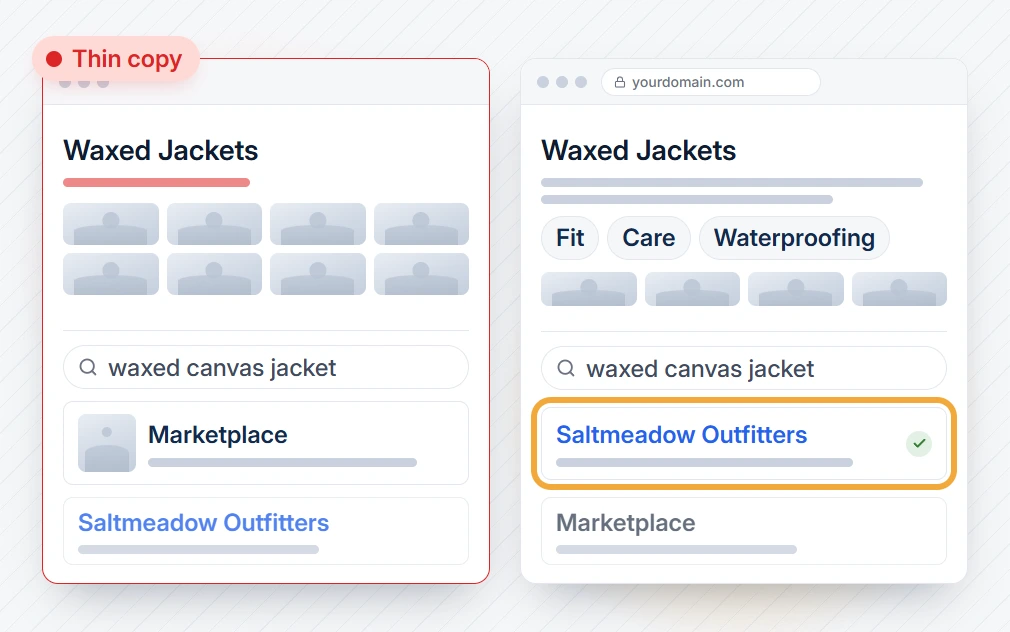
Category and collection pages rank behind Amazon on your own SKUs
Your money categories carry 45 words of copy above a grid of 60 products. Amazon carries 800 words and outranks you on your own brand keywords. Our ecommerce SEO audit maps every category and collection page against the top 5 SERP rivals, names the word-count gap, and drops in the buyer-question outlines you need to close it.
CATEGORY COPY UNDER 100 WORDS
Three outcomes every ecommerce SEO audit report delivers
What every ecommerce SEO audit report gives you, in writing and yours to keep.
A ranked fix list mapped to product, category, and collection URLs
Every finding ranked by revenue impact, with the exact PDP, PLP, or collection page it hits. Your dev team starts on Monday.
First-page movement on money SKUs, tracked once fixes go live
Apply the top 20 fixes first, then track first-page movement on your money SKU keywords in Search Console.
A written report you keep, forever
The PDF is yours the day it lands. Hand it to any Shopify partner, Woo dev, or new agency. No proposal gate, no upsell wall, no expiring access.
Four stages, 24 hours, one written sign-off
Fixed scope, written sign-offs, dates on the calendar. Every ecommerce SEO audit runs the same four stages so you know what lands on which day. Nothing slips.
HOUR 1
Store access and scope lock
You send your store URL, your revenue targets, and the competitors you want compared. You share Search Console, GA4, your Shopify or Woo admin, and any rank tracker, read-only. We confirm the audit scope in writing.
SIGN-OFF: SCOPE + ACCESS
HOURS 7-10
Technical crawl and product feed audit
Full crawl scored against Core Web Vitals, indexation, faceted-nav canonicals, JS-rendered PDPs, and product feed health. Every technical blocker logged with a fix path and the expected rank impact.
TECH FINDINGS LOGGED
HOURS 10-17
On-page, content, and schema audit
Every money PDP, category, and collection page checked for intent match, title formula, breadcrumb schema, review schema, and buyer-question depth. Content gaps mapped to the SKU searches you should be winning.
CONTENT MAP DRAFTED
HOURS 17-24
Report build and walkthrough
Findings written up in a PDF, ranked by revenue impact and mapped to product URLs. A 25-minute call walks your team through the top 20 fixes and agrees the first three to push live.
REPORT + WALKTHROUGH DONE
What you actually get from our ecommerce SEO audit
Five workstreams. Every line item listed here lands in the written report. No hidden phase-two column, no retainer upsell before the fix list is yours.
WEEKS 1–2
PDP audit that names every product page blocker
The product section of the ecommerce SEO audit checks every PDP against Google Product signals. Title formulas, review schema, price and stock markup, image alt, LCP on the hero image, and internal links from category pages. Each finding maps to the SKU URL and the expected rank movement.
Phase Duration: PDPs SCOREDSign-off: PRODUCT SCHEMA LIVE
GATE · VARIANT CANONICALS SET
PDP title and meta formula audit
every money PDP checked against the product + brand + qualifier formula, gaps and rewrites listed per SKU.
Product, Offer, and AggregateRating schema
every PDP schema field validated for coverage, syntax, and rich-result eligibility per Google rules.
Variant canonical and duplicate audit
color, size, and material variant URLs mapped to the correct canonical target so equity pools on one PDP.
PDP internal linking review
category-to-PDP and PDP-to-PDP link paths audited so top-selling SKUs get the equity they earn.
Product image and alt audit
PDP image alt, file name, format, and hero-image LCP reviewed against Core Web Vitals and image-search rules.
Out-of-stock and 404 recovery
out-of-stock and delisted SKUs audited for the right handling: keep, redirect, or 410 the URL.
WEEKS 2–3
Category and collection audit that closes the word-count gap
Category and collection pages carry the money queries and most stores hide them behind 40 words of copy. Our audit scores every PLP against the top 5 SERP rivals for intent match, word count, header structure, breadcrumb schema, and internal links from the top nav.
every money category scored against the top 5 SERP rivals for word count, header depth, and buyer-question coverage.
Collection landing page review
seasonal and buyer-intent collections audited for evergreen keyword targeting and internal link paths.
Breadcrumb schema audit
BreadcrumbList schema checked on every PLP for hierarchy, position, and rich-result eligibility.
PLP title tag and H1 review
every category title scored on CTR patterns, length, and focus keyword placement against SERP rivals.
Nav and hub link paths
top-nav and mega-menu link paths audited so money categories sit two clicks from the homepage.
Pagination and infinite-scroll audit
pagination rules, rel=next, and JS scroll patterns checked for crawlability and canonical drift.
WEEKS 3–4
Faceted nav audit that stops crawl budget waste
Filters spawn URLs. ?color=red&size=xl&price=under-50 multiplies into 40,000 near-duplicates and Google skips your money categories. Our ecommerce SEO audit maps every facet, names the canonical target per parameter, and hands you the robots and canonical patches you push live the same week.
Phase Duration: FACETS MAPPEDSign-off: CANONICALS SET
GATE · CRAWL SAVED
Facet URL parameter inventory
every filter and sort parameter logged with a canonical, noindex, or index rule per parameter.
Crawl budget review
log-file analysis on 30 days of Googlebot hits so you see the URLs it wastes budget on.
Canonical target rules per facet
clean canonical rules per filter type so equity pools on the money category, not on 40,000 variants.
Robots.txt and noindex plan
robots rules for /cart/, /checkout/, /search/, and low-value facets patched so crawl budget hits money URLs.
Indexable facet content rules
facets you should index for keyword targeting flagged with the copy and title patterns they need.
Duplicate content report
near-duplicate PLP variants flagged with a consolidation plan and redirect map per SKU family.
WEEK 4
Product feed and schema audit that turns rich results on
Rich results and Shopping listings run on feed and schema health. Our audit checks Merchant Center feed errors, GTIN and MPN coverage, Product schema against Google Search Central rules, and review and rating markup on every PDP. Findings map to feed patches and schema fixes.
Phase Duration: FEED HEALTH SCOREDSign-off: SCHEMA VALIDATED
GATE · RICH RESULTS ON
Merchant Center feed audit
every error, warning, and disapproval in your Merchant Center feed logged with the exact SKU fix path.
GTIN, MPN, and brand coverage
product identifiers audited across the SKU catalog so Google matches your PDPs to buyer searches.
Product schema field validation
Product, Offer, price, availability, and delivery schema checked field by field against Google rules.
Review and rating markup
aggregate rating and review schema audited on every PDP so star ratings trigger in the SERP snippet.
Free listing eligibility check
PDP structured data and feed health checked for Google free listings eligibility across the SKU catalog.
Organization and Store schema
Organization, Store, and LocalBusiness markup validated for brand-panel and knowledge-graph coverage.
PHASE 5
A written ecommerce SEO audit report
The final deliverable is a PDF plus a 30-minute walkthrough call. Findings ranked by revenue impact, fixes listed with the product URL and the expected rank movement. Yours to keep, share, or hand to any Shopify partner, Woo dev, or new agency.
Phase Duration: WRITTEN PDFSign-off: 30-minute WALKTHROUGH
GATE · YOURS TO KEEP
Written PDF report
every finding written up with the product URL, the fix, and the expected rank impact scored 1 to 5.
Prioritized fix roadmap
top 20 ecommerce fixes ranked by revenue impact and time-to-implement so your dev team knows where to start.
30-minute walkthrough call
live call with the auditor to ask questions, agree the first 3 SKU-page fixes, and plan the rollout together.
Search Console + Merchant Center snapshot
coverage, performance, and Shopping feed status captured the day of the audit with a written fix note.
SERP rival benchmark scorecard
side-by-side scorecard versus your top 5 SERP rivals on PDP, PLP, feed, and schema signals.
Follow-on retainer proposal
optional attached scope if you want us to apply the fixes, priced from our SEO packages tiers.
Request your ecommerce SEO audit. Written report in 24 hours
FIXED SCOPE · 72 ITEMS AVG · WRITTEN REPORT YOU KEEP · No card needed. No sales call required.
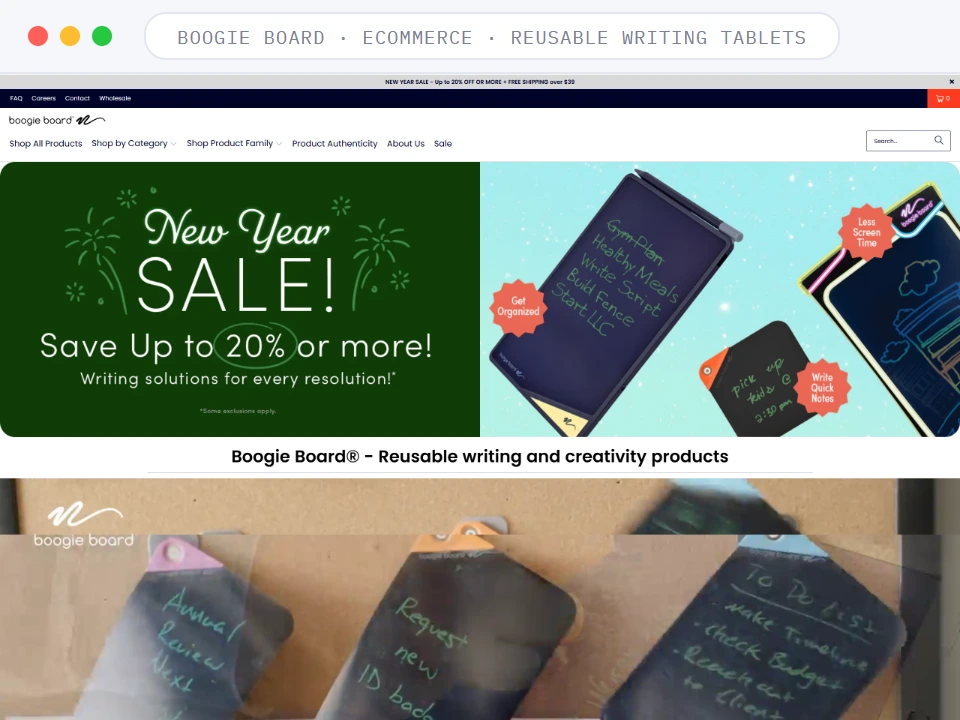
Drove sales for Boogie Board at a $31 cost per conversion, at scale.
Boogie Board, the brand behind the first reusable writing tablet, had loosely targeted Google Ads. Its landing pages undersold the product, and it had no follow-up for repeat buyers. We sharpened keyword targeting, added LinkedIn Ads, optimized landing pages and set up lead magnets and automated follow-ups. Conversion rates rose 11% and cost per conversion reached $31 across $650K in managed ad spend.
Ecommerce · Sustainable Furniture · Sweden•Web Development · WooCommerce Development · API Integration
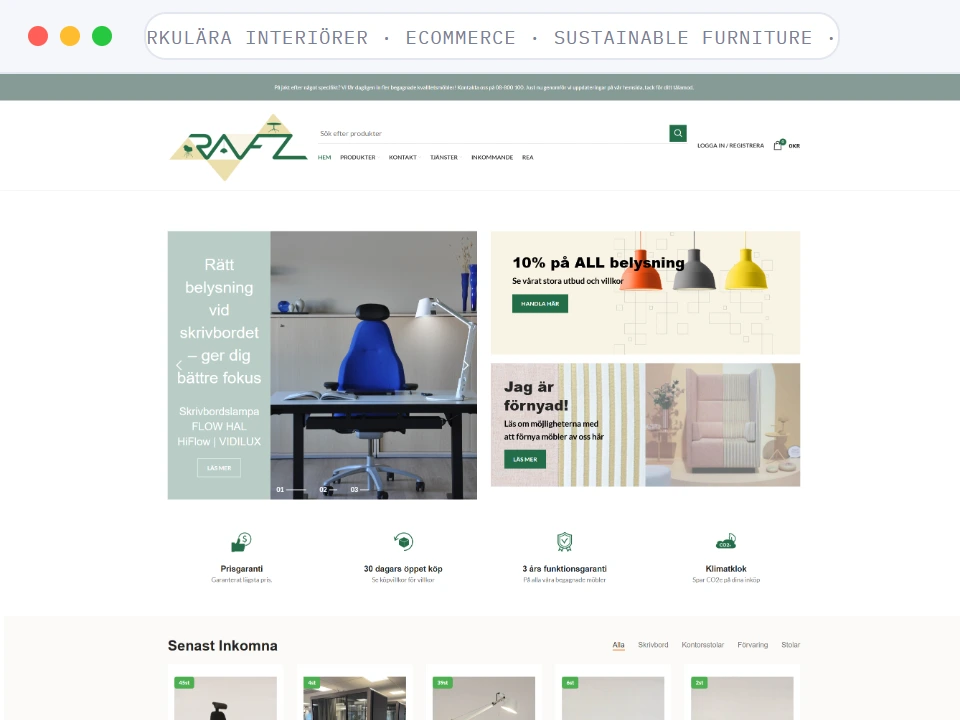
Grew RAFZ conversions 28% with a rebuild that loads in 2 seconds.
RAFZ Cirkulära Interiörer sells eco-friendly furniture in Sweden. Its site was heavy with plugins and took 15+ seconds to load, and shoppers left their carts. We rebuilt it on a light custom theme, tuned WooCommerce, added the place2place API and a repaint feature, and refocused the homepage on products. The site now loads in 2 seconds, server requests fell 82% and conversions rose 28%.
Custom Furniture · Ontario•SEO Strategy · Web Design · Technical SEO
Drove 2.3× keyword rankings and 54% annual traffic growth at Chervin Furniture.
Chervin Furniture & Design makes custom cabinetry and furniture and has three Ontario showrooms. Years of marketing on social media alone brought uneven engagement and poor leads. We built a 12-month SEO roadmap, content shaped by the sales team, Google Ads, digital PR and local SEO for the showrooms. Keyword rankings grew 2.3× from 2022 to 2023, and website traffic grew an average 54% a year.
They cut wasted spend on non-buyer keywords and moved the budget to product-page campaigns. Blended ROAS climbed 40% in the first quarter.
Katetey Maxwell
Digital Marketing Lead, BSH Group
Verified via GoodFirms+40% blended ROAS−22% wasted spend
Enterprise demo requests up 3.2x. First operator we have worked with who cared about the CRM number, not the ad account.
Michael Reid
VP Marketing, Forward Networks
Verified via Trustpilot3.2x enterprise demosCRM-tied reporting
The paid team ran an audit that found $18K/mo in wasted spend on brand terms we were already ranking for. Fixed inside two weeks.
Benjamin Sanger
Director, Demand Generation, Mendix
Verified via Trustpilot$18K / mo saved−21% CPA
The team split our national spend by store catchment. Every location got its own landing page and creative. Booked eye exams up 47% inside two quarters with the same media budget.
Karen Williams
Head of Marketing, Vision Express
Verified via NPS survey+47% booked eye examsPer-store attribution
Demos doubled in a quarter after the funnel rewrite. Nothing about the traffic changed. The pipeline math finally works.
Myles Scolnick
Head of Growth, QuoteWell
Verified via NPS survey2x booked demos41s lead response time
Sign-ups tripled without adding ad spend. They rebuilt the checkout, fixed the pricing page, and the numbers moved every week.
Francis Strutt
Co-founder, N1Mailbox
Verified via NPS survey3x sign-ups−28% churn
Catalog ads at 5.8x where our old agency plateaued at 2x. Weekly notes tell us exactly what changed and what is next.
Josh Gingrich
CEO, Printed Mint
Verified via Clutch5.8x catalog ROAS3.4x return vs prior agency
Site, ads, and follow-up under one contract. Partner inquiries doubled without adding headcount.
Brandon Smith
Marketing Director, Intelisys
Verified via Trustpilot2x partner inquiries1 contract, 3 channels
Vendor and buyer leads went from unpredictable to a monthly forecast we could staff against. First agency that treated the CRM as the scoreboard, not the ad account.
Callan Pang
Marketing Manager, Abels Residential
Verified via NPS surveyForecastable pipelineCRM-tied reporting
Client retainers doubled without adding a single account manager. They rebuilt our funnel and the reporting dashboard sold itself on demo calls.
Corin Goodman
Founder, Corin Management
Verified via NPS survey2x client retainersSame team, same headcount
1 / 10
See what a better organic conversion rate is worth
Move the sliders to your numbers. No ad spend in this one, it works from the organic traffic you already have.
3,000
20050,000
$800
$100$10,000
1.5%
0.5%6%
What a 20% improvement on your current conversion rate adds, on today's traffic. Rankings are assumed flat, so nothing here depends on new traffic arriving.
Added revenue per month
/mo
Free · Written findings · Yours to keep
FAQ
Common questions on the ecommerce SEO audit process
Straight answers on pricing, timelines, deliverables, and what you get in the written report. If your question is not here, book the scoping call.
An ecommerce SEO audit runs in five stages that any store team can follow. Start with a full crawl using Screaming Frog or Sitebulb and log every 4xx, 5xx, redirect chain, duplicate title, and thin product page across the SKU catalog. Second, open Google Search Central and pull Search Console coverage errors, Core Web Vitals status, and top losing SKU queries for the last 90 days. Third, score every money PDP, category, and collection page against the top 5 SERP rivals for intent match, header depth, and word count. Fourth, validate Product, Offer, AggregateRating, and BreadcrumbList schema on every PDP and category page. Fifth, review the backlink profile and internal link paths so category equity flows to your top-selling SKUs. Rank every finding by revenue impact, name the exact URL it hits, and hand the fix list to a dev who can push canonicals, robots rules, and schema patches inside a week.
Can ChatGPT do an SEO audit?
ChatGPT can help draft parts of an ecommerce SEO audit but it cannot replace a real one. It has no access to your live Google Search Console, no crawl data, no log files, and no Merchant Center feed status. Ask it to review a PDP title formula, generate a Product schema patch, or write a category page copy outline and it does a solid job. Ask it to score 500 product pages against SERP rivals and it hallucinates rankings, word counts, and URLs. The right workflow is a hybrid model. Run Screaming Frog for the crawl, pull Search Console and Merchant Center for the truth data on live store performance, then feed that structured input into ChatGPT to draft the copy rewrites and schema patches per URL. That way the audit finds real store issues and the AI speeds up the fix write-up. Bring the real data first, then let the language model help with the report drafting and the dev handoff notes.
What is SEO in ecommerce?
Ecommerce SEO is the set of technical and content practices that get product pages, category pages, and collection pages ranking on Google without paid ads. It covers Product schema, canonical rules on faceted URLs, PDP title formulas, category page word count, breadcrumb schema, review and rating markup, Merchant Center feed health, Core Web Vitals on the PDP hero image, and internal linking from category pages down to top-selling SKUs. An ecommerce SEO audit is how a store owner learns which of those signals are broken and how to fix them without guesswork. Well-optimized ecom stores earn free traffic from Google Shopping listings, organic SERP rankings on SKU keywords, image search, and rich results with stars, price, and stock badges. Stores that skip ecom SEO leave that traffic on the table and pay Google Ads for every visitor they could have earned organically. The audit is the diagnostic that shows you how much of that traffic you are leaving behind.
What are the top 5 SEO audit tools?
For an ecommerce SEO audit, five tools cover 90% of the work across the SKU catalog. Screaming Frog SEO Spider handles the technical crawl, canonical checks, and duplicate title mapping across every product URL. Google Search Console is the source of truth on impressions, clicks, coverage errors, and Core Web Vitals status on your live PDPs and category pages. Ahrefs or Semrush Site Audit runs the automated technical scan and gives you the backlink profile against your top 5 SERP rivals. Google Merchant Center Help tools flag feed errors and Shopping listing disapprovals across the catalog. Sitebulb or a log-file analyzer like OnCrawl shows the crawl budget waste on faceted URLs and low-value filter paths. Pair them with the free Rich Results Test and PageSpeed Insights and you can run a solid audit yourself over a weekend. The hard part is not the tool list, it is knowing which 20 findings to act on and which 180 tool warnings to ignore because they never move a store ranking.
How to do an SEO audit of a website?
To run an ecommerce SEO audit of a website, work through the same five stages every time. Stage one, run a full crawl with Screaming Frog and export every 4xx, 5xx, redirect chain, thin page, and canonical mismatch across the SKU catalog. Stage two, pull Google Search Console data on the last 90 days: coverage errors, top losing queries, Core Web Vitals status, and manual actions. Stage three, score every money PDP, category, and collection page against the top 5 SERP rivals for header structure, intent match, and word count. Stage four, validate Product, Offer, AggregateRating, and BreadcrumbList schema on every PDP and category page against Google Search Central rules. Stage five, review the backlink profile and internal link paths so equity flows to top-selling SKUs. Rank every finding by revenue impact, name the exact URL, and hand the fix list to a Shopify partner, Woo dev, or in-house team who can push the patches inside seven business days.
How much does a website SEO audit cost?
The Redefine Web ecommerce SEO audit is free, whatever the catalog size. You get the written report, the ranked fix list, and the 30-minute walkthrough call with the auditor who ran the review. No retainer required on the audit itself, and you keep the written report forever to hand to any dev. What moves the number other vendors quote is SKU count, platform, and whether a human reads the catalog or a scanner does. If you want us to apply the fixes after, we quote a fixed monthly price based on the audit fix roadmap.
Can I do my own SEO audit?
Yes, and for stores under $10,000 in monthly organic revenue, DIY is often the right call to make first. The tools you need are free or near-free: Google Search Console, Screaming Frog free tier for up to 500 URLs, PageSpeed Insights, and the Rich Results Test. Block a full weekend, work the five stages in order, and log every finding in a spreadsheet with the URL, the fix, and the expected rank impact. What DIY misses is context. A professional ecommerce SEO audit compares your findings against the top 5 SERP rivals per money keyword and tells you which 20 fixes actually move rank versus the 180 that read important in a tool export but change nothing on your live store. If you have the time to learn what matters, you can do it yourself. If you want a ranked fix list ready for a Shopify partner or Woo dev to act on this Monday, book the audit and get seven days of your time back.
What are SEO audits?
SEO audits are structured reviews of a website against current Google ranking signals. An ecommerce SEO audit narrows the scope to product pages, category pages, collections, faceted navigation, product feeds, and Product schema, on top of the general technical, content, and link work every site needs to compete. The point is to find every issue holding rankings back, name the exact PDP or PLP it affects, and hand the store owner a prioritized fix list a dev can act on this week without guesswork. A proper audit runs across five workstreams: technical health, on-page structure, content depth, product feeds and schema, and off-page authority signals. The deliverable is a written report, not a live dashboard. Written because you want a document you can hand to a Shopify partner, a Woo agency, or an in-house team six months later and still act on with confidence and no version drift. Dashboards go stale the day the tool subscription lapses. Written reports do not.
How much does an SEO audit cost?
Paid ecommerce SEO audits are priced on catalog size and platform. The Redefine Web ecommerce SEO audit is free at every catalog size, and every audit includes the written report plus a 30-minute walkthrough call with the auditor. Scope still scales with the catalog. A small store gets technical, PDP, and a top 20 category review. A larger catalog adds products, categories, faceted nav, feeds, and schema scored against SERP rivals. Multi-brand and international stores add log-file analysis, deeper competitor benchmarks, and an executive walkthrough call. If you want fixes applied after, we quote a fixed monthly price based on what the audit finds.
How to perform an SEO audit?
Perform an ecommerce SEO audit in five stages inside 24 hours. Hour 1, lock the platform, catalog size, revenue targets, and top competitor list on a 30-minute scoping call, then share Search Console, GA4, admin access, and any rank tracker credentials. Hours 7 to 10, run a full crawl with Screaming Frog, log-file analysis on 30 days of Googlebot hits, and score Core Web Vitals on the PDP hero image across 20 sample pages. Hours 10 to 17, audit every money PDP, category, and collection page for intent match, title formula, breadcrumb schema, review markup, and internal linking from category hubs. Also validate the Merchant Center feed and Product schema against Google rules. Hours 17 to 24, write the report, rank the top 20 fixes by revenue impact per URL, and run a 30-minute walkthrough call with the store owner and their dev team. Every stage ends with a written sign-off so the store owner knows what has landed and what comes next.
How do you perform an SEO audit?
You perform an ecommerce SEO audit by running structured checks against every ranking signal Google uses on product and category pages. The checks are ordered by revenue impact per URL. Start with the technical layer: crawl the site, log every 4xx, 5xx, redirect chain, and duplicate title, then check indexation on money PDPs and canonical rules on faceted URLs. Move to on-page: score every PDP, category, and collection page against SERP rivals for intent match and word count. Validate schema next: Product, Offer, AggregateRating, BreadcrumbList, and Organization markup on every applicable page. Check the Shopify SEO settings or Woo SEO plugin config so basics like title formulas and sitemap generation are set correctly. Close with off-page: backlink profile quality, toxic link risk, and internal linking maps. Log every finding with the URL, the fix, and the expected rank impact, then rank by revenue impact so the store owner sees the top 20 fixes first.
What is the best SEO tool for WooCommerce?
For WooCommerce SEO work, the best tool stack pairs Rank Math or Yoast SEO for on-page settings with Screaming Frog for the technical crawl and Google Search Console for the truth data. Rank Math handles Product schema, breadcrumb schema, title formulas, and XML sitemap generation on Woo out of the box. Screaming Frog surfaces every duplicate title, thin PDP, and canonical mismatch across the SKU catalog. Search Console shows you which SKU queries are winning and which are losing rank. Add Ahrefs or Semrush for the backlink audit and rival benchmark. For an ecommerce SEO audit of a Woo store, we also review WooCommerce-specific plugins like the product feed manager against the WooCommerce docs to verify Merchant Center compliance. Skip the free automated audit tools that promise a score. They flag 200 warnings that rarely move a ranking. Use the paid stack, run the human review, and act on the top 20 fixes.
How to do SEO for e-commerce?
To do SEO for an ecommerce store, work in four layers. Layer one, technical: fix crawl budget waste on faceted URLs with clean canonicals, patch robots rules on /cart/ and /checkout/, and score Core Web Vitals on the PDP hero image. Layer two, on-page: rewrite every money PDP title with the product + brand + qualifier formula, expand thin category pages past 500 words of buyer-question copy, and validate BreadcrumbList schema on every PLP. Layer three, schema and feeds: patch Product, Offer, and AggregateRating markup on every PDP, then check Merchant Center for feed errors so free listings and Shopping ads run clean. Layer four, off-page: earn 4 to 8 backlinks per quarter from relevant publications and internal-link from category hubs to top-selling SKUs. An ecommerce SEO audit is the diagnostic that names which layer to fix first. Without the audit, most store teams patch the wrong layer and rankings stay flat for another six months.
Free · Written in 24 hours · No pitch
Get your free SEO audit.
A written report in your inbox within 24 hours, with three fixes you can ship the same week, whether or not you hire us.
Written in 24 hours · 10,000+ audits run · 300+ clients since 2021