In this article
- Filter top food marketing agencies by category specialization with 5 plus current brand accounts in the target food category.
- Retainer scope runs $750 to $3,000 monthly at Redefine Web with ad spend and tool licenses held separate from the retainer number.
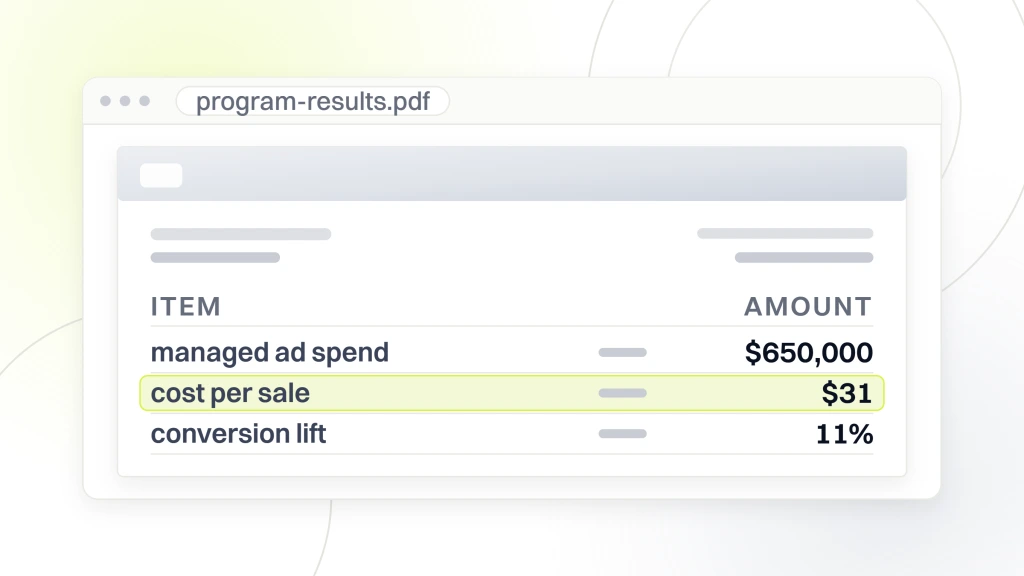
- Boogie Board ran $31 cost per sale at scale with 11 percent conversion rate on $650,000 in managed ad spend.
- Vejrø Resort reached 10K plus organic visitors in 3 months and 200 plus first-page rankings on hospitality keywords.
- Abigail Ahern grew ecommerce revenue 179 percent and hit 3,000 percent paid social return without a single discount banner.
Top food marketing agencies in 2026 split into three working camps that founders can actually tell apart. Category specialists sit deep in CPG snack, beverage, and functional playbooks. DTC operators run Amazon plus Shopify plus TikTok Shop revenue as the primary scorecard. Retail-forward shops build every calendar around Whole Foods, Sprouts, Kroger, and specialty grocery merchandising windows. The category matters because a generalist apparel agency stretching into food misses the shelf math, the FDA claim review, and the Instacart discipline that separates a paid program printing predictable orders from a proposal stapled together on the flight over. Top food marketing agencies read contribution margin per SKU before they touch a bid.
This food marketing agency guide walks the working filter you can run in a single afternoon. Category specialization versus generalist shops, retainer scope by service line, integrated retail-plus-DTC programs, regulatory review workflows on alcohol and functional claims, and named case results from Boogie Board, Vejrø Resort, Abigail Ahern, BSH Hausgeräte, Custimy, and Ibemploy. The named results come from our published case studies, and the retainer prices quoted are our own tiers. Read straight through in 12 minutes and pick from top food marketing agencies with a real rubric in hand.
What separates top food marketing agencies from generalist shops
Top food marketing agencies read contribution margin before they open a media plan. A generalist agency scoping food work with the same slide deck they use for SaaS misses the shelf math, the co-manufacturer lead times, and the demo calendar. Food margins run 18 to 34 percent gross on retail SKUs, which means a target cost per order on paid social can never match the target an apparel or wellness brand tolerates. Working food agencies build target cost per order from the SKU margin, not from an industry benchmark screenshot.
Category specialization by brand mix
Category specialization means the agency runs 5 or more current brands in the target category with named account leads on each. A shop with three CPG snack accounts and one craft beverage account is legitimately specialized in snacks. The same shop pitching a functional beverage brand is stretching. Founders can filter fast by asking for the three most recent food brand launches the agency ran, the specific SKU count on each, and the trailing 12 month revenue outcome. Answers that stall on that question are answering the wrong question.
Retail plus DTC integration on one team
Retail plus DTC integration on one team is the working structure for 2026. Brands running paid social with one agency, Amazon with another, and retail with a broker end up with three separate calendars fighting each other on the same demo week. The working pattern is one team running Meta, TikTok, Amazon Sponsored Brands, Google Search, and retail promotional support on a shared quarterly cadence. That structure keeps a Whole Foods reset from crashing an Amazon Prime Day forecast, and keeps the paid team from bidding against a retail promotion the brand already funded.
Retainer scope across top food marketing agencies
Retainer scope across top food marketing agencies runs $750 to $3,000 per month on standard tiers at Redefine Web, with custom scopes above that band for brands running paid budgets over $250,000 monthly. Founder-led boutique shops in the food category sit at $750 to $1,250 monthly for part-time attention on Meta plus Google. Mid-market food specialists sit at $1,250 to $1,999 monthly for multi-channel paid and organic. Enterprise programs at Redefine Web start at $3,000 monthly with custom volume, and retail support and PR are quoted separately. Every tier is priced against the working scope, not against a padded hourly rate.
What the retainer covers by tier
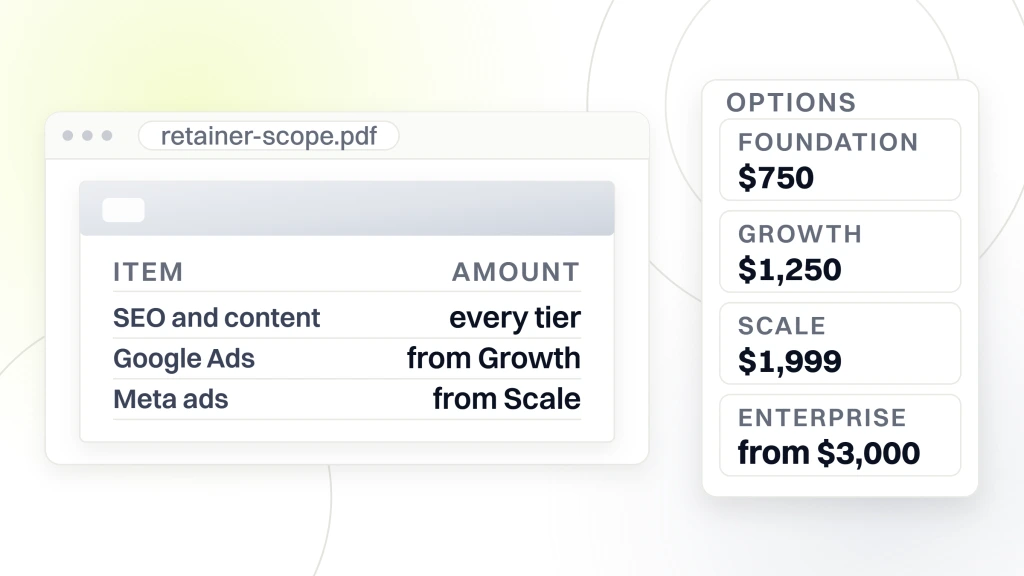
The $750 tier covers on-page SEO and technical fixes, a blog post a month, a new page a quarter, review requests, and a weekly report every Friday. The $1,250 tier adds Google Ads management on up to $3,000 in spend, two posts a month, and review responses. The $1,999 tier adds Meta ads, programmatic SEO pages, monthly landing page tests, and a dedicated account lead. The $3,000 tier sets custom content volume with no ad spend cap and weekly landing page tests. Amazon, TikTok Shop, retail support, PR, and creator programs are quoted separately on every tier. Founders reading a proposal that stuffs everything into a $2,500 line item are reading a proposal that will underdeliver on at least two of the five workstreams.
What every serious retainer excludes
Every serious food agency retainer excludes ad spend, creator flat fees, tool licenses (Triple Whale, Northbeam, Perpetua for Amazon Sponsored, Helium 10 for keyword research), landing page hosting, and creative production for shoots that go beyond the standard scope. Founders reading a proposal that folds ad spend into the retainer number are looking at a scope structured to overspend on paid to justify the retainer. That structure misaligns incentives on tight food margins where contribution margin per SKU already leaves limited room. Ask for line-item scope with ad spend split out. If the agency will not split it, that answer is the answer.
Boogie Board case study on cost per conversion at scale
Boogie Board partnered with Redefine Web on a Google Ads and LinkedIn Ads program. The brand came in with strong product-market fit on reusable writing tablets and loosely targeted Google Ads. Its landing pages undersold the product, and it had no follow-up for repeat buyers.
Our team sharpened keyword targeting in Google Ads, added LinkedIn Ads, and optimized the landing pages so they sold the product. Lead magnets and automated follow-ups gave first-time buyers a reason to come back.
The combined program drove Boogie Board revenue at $31 cost per sale at scale, an 11 percent conversion rate boost through optimized landing pages plus refined ad targeting, and $650,000 in managed ad spend while revenue grew at a steady pace. The pattern carries over to food and beverage brands: tight targeting, landing pages that sell the product, and follow-up that brings buyers back. Our food and beverage marketing hub covers how that work fits a food brand.
Regulatory review workflows top food marketing agencies run
Regulatory review workflows top food marketing agencies run cover FDA structure-function claim compliance for functional beverages and supplements, USDA organic and non-GMO Project verified label compliance for organic food marketing per the USDA organic labeling standards, alcohol advertising rules under the TTB and state ABC boards, and infant formula marketing rules where WHO Code compliance applies in international markets. A working regulatory review workflow catches non-compliant creative before it goes live and blocks assets that would trigger a warning letter from FDA, USDA, or TTB inside a 60 to 90 day window.
Structure-function claim review process
Structure-function claim review process for functional beverages covers the specific claim language (supports focus, promotes hydration, aids sleep), the substantiation documentation on file for each claim, the required disclosure language on paid creative, and the required notification to FDA within 30 days of first commercial use. A working agency-side reviewer holds a legal or scientific advisory role and reviews every claim-heavy asset before launch. Skip this step and the brand catches a warning letter inside 60 to 90 days of a claim-heavy ad launch, which triggers a full asset pull and a rebuild cycle that costs 4 to 6 weeks of forward revenue.
Alcohol advertising rules by state and platform
Alcohol advertising rules by state and platform cover age-gate compliance on Meta and TikTok, geographic targeting restrictions in dry counties and states with specific advertising limits, required disclaimers on creative (drink responsibly, must be 21 to purchase), and creative rules against sports imagery in some jurisdictions. Per the TTB alcohol beverage advertising rules, non-compliant creative on alcohol brands catches a federal warning inside 90 days of platform detection, which is why alcohol brands need agencies with alcohol-specific compliance workflows built into the creative approval chain, not tacked on after launch.
Pricing comparison across top food marketing agencies
Pricing across top food marketing agencies varies more than any other agency category because scope varies more. The table below lists working monthly retainers, target brand stage, included workstreams, and typical reporting cadence across four tiers Redefine Web quotes for food and beverage brands. Every tier holds ad spend, tool licenses, and creator flat fees separate from the retainer number. Founders comparing agency pitches should build the same table from every proposal and compare line by line against the best food marketing agencies shortlist.
| Tier | Monthly retainer | Target brand stage | Included workstreams | Reporting cadence |
|---|---|---|---|---|
| Foundation | $750 | Founder-led, single funnel | SEO and content, 1 post a month, review requests | Weekly |
| Growth | $1,250 | Growth stage, $100K to $500K monthly revenue | Adds Google Ads on up to $3K spend, 2 posts a month | Weekly |
| Scale | $1,999 | Mid-market, $500K to $2M monthly revenue | Adds Meta ads, programmatic SEO, monthly landing page tests | Weekly |
| Enterprise | Starts at $3,000 | $2M plus monthly revenue, retail plus DTC | Custom volume, no ad spend cap (retail, PR and creators quoted separately) | Weekly |
Our Redefine Web tiers at $750, $1,250, $1,999, and from $3,000 monthly cover SEO and content on every tier, with Google Ads from Growth and Meta from Scale, for food and beverage brands from founder-led launch through $10M plus in annual DTC revenue. Paid media, SEO, and content sit on one retainer, which keeps the total food marketing budget on one invoice rather than scattered across three vendors sending three separate reports on three different cadences.
Vejrø Resort case on organic ranking at 200 plus first-page keywords
Vejrø Resort, a private island resort in Denmark, engaged Redefine Web to build its website with direct booking and run its SEO. The resort had strong social media but no website, so guests could not easily find details or book direct. Without a site, there was no organic search layer to compound.
Our team built a fast website made to convert, with direct booking built in and ties to the resort’s social channels. On-site and off-site SEO, shaped by a study of rival resorts, gave it rankings beyond the brand name.
Vejrø Resort reached 10K plus organic visitors in the first 3 months, 200 plus first-page Google rankings, and a 2.2 percent conversion rate from organic traffic into direct bookings. The same approach suits food brands running organic acquisition around recipe, ingredient, and comparison keywords. Our food and beverage SEO team builds that kind of site and keyword plan for food and drink brands.
Creator programs top food marketing agencies build
Creator programs top food marketing agencies build cover TikTok food creators, Instagram Reels partnerships, YouTube long-form recipe content, and Amazon Live streaming for food category brands. Working programs run a named creator database of 15,000 plus vetted food creator handles with searchable filtering by follower count, engagement rate, category, and average creator-driven cost per acquisition. Programs without a searchable creator database are running creator outreach on Instagram DM at scale, which produces 30 to 60 day sourcing cycles and inconsistent brief adherence across the creators who eventually respond.
TikTok Shop coordination on food brands
TikTok Shop coordination on food brands runs against the platform native creator affiliate program, where the brand sets the commission rate it pays on creator-driven Shop revenue. Working agencies negotiate commission rates by SKU category, seed product to the top 40 creators in the food category monthly, and pull creator-driven sales into the same reporting dashboard as Meta and Google paid revenue. Brands running TikTok Shop without agency coordination usually see spiky creator revenue that peaks on one viral video and craters when that creator moves to the next brief.
Amazon Live streaming for food category
Amazon Live streaming for food category runs monthly product-focused streams with named influencers or brand-owned hosts on the top 3 to 5 SKU families. Streams average 40 to 90 minute session lengths with product demos, taste tests, and Q and A that convert 3 to 8 percent of viewers into orders during the stream window. Working programs pair Amazon Live with Sponsored Brands video ads on the SKU family being streamed, which pushes viewers from paid impressions into the live session rather than losing them to the general Amazon browse experience.
Abigail Ahern case on paid social return at 3,000 percent
Abigail Ahern, a luxury home decor ecommerce brand adjacent to the specialty food category in the way it approaches premium DTC positioning, engaged Redefine Web on a restructured SEO plus paid media program. The baseline showed a heavy reliance on discounts and branded search, which drove short bursts of sales and diluted the brand’s premium image.
Our team rebuilt SEO for non-branded searches and restructured shopping, prospecting, and retargeting campaigns around premium creative. The program ran without a single discount banner, which moved the brand from promotional to premium in the customer’s mind.
The combined program drove ecommerce revenue growth of 179 percent, paid search return on ad spend to 1,588 percent, and paid social return on ad spend to 3,000 percent through retargeting and prospecting without a single discount banner. The pattern translates directly to premium food and beverage brands running full-price positioning against a category default of promotional pricing. Craft alcohol, specialty coffee, and premium chocolate brands run the same playbook to break out of the promotional loop the category defaults to on retail shelves.
Measurement stack top food marketing agencies deploy
Measurement stack top food marketing agencies deploy covers GA4 with server-side tagging, Amazon Attribution for off-Amazon impact on Amazon sales, Triple Whale or Northbeam for multi-touch attribution on DTC revenue, and Instacart Ads analytics for retail measurement on Instacart-fulfilled SKUs. Every stack layers a first-party data warehouse on top (Snowflake, BigQuery, or a lightweight Supabase for smaller brands) that keeps 24 months of channel-level performance data queryable without depending on platform reporting windows that expire at 28 or 90 days depending on the source.
Server-side tagging on GA4
Server-side tagging on GA4 catches the 20 to 35 percent of paid conversions that browser-side tags miss on iOS 17 plus browsers, which routinely blocks pixel firing on privacy-conscious buyer segments. Working stacks deploy Google Tag Manager server-side containers on a subdomain, pipe every conversion event through server-side processing, and hydrate the event with server-known context (order value, product ID, first-party email hash) before sending to Meta CAPI, TikTok Events API, and Google Ads Enhanced Conversions. Brands running browser-only tagging lose 20 to 35 percent of conversion volume in reporting, which usually shows up as an inflated cost per acquisition on paid social in particular.
Amazon Attribution for off-Amazon impact
Amazon Attribution for off-Amazon impact tracks how paid social and paid search off Amazon drive sales on Amazon marketplace listings. Working setups tag every off-Amazon ad campaign with an Amazon Attribution tag, pull the tagged revenue back into the reporting dashboard, and credit off-Amazon spend for the Amazon revenue it drove. Brands running paid social to Amazon PDP links without Attribution tagging see the sales in Amazon Seller Central but cannot credit the source, which routinely leads to paid social budget cuts against campaigns that were actually printing efficient Amazon revenue.
BSH Hausgeräte case on backend plus UX optimization
BSH Hausgeräte GmbH, the European consumer goods brand behind Bosch and Siemens home appliances, engaged Redefine Web on a backend and UX optimization program for the Turkish market. The baseline showed an outdated backend, a weak funnel, and a lead generation program running well below the traffic the brand could support. The brand needed structural improvements without disturbing the SEO equity the site had built over years of ranking on high-intent appliance searches.
Our team modernized the backend and ran a full UX redesign paired with funnel optimization. The work preserved the URL structure, schema, and internal linking that fed the site’s organic ranking. Every change went through a pre-launch SEO check to catch any ranking risk before deploy.
The program produced a 15 percent increase in lead generation through UX redesign plus funnel optimization, 3 percent organic traffic growth on preserved SEO structure, and a 45 second increase in average session duration after the frontend redesign. The pattern translates directly to established food and beverage brands running site rebuilds without wanting to torch existing organic traffic. Brands rebuilding a legacy Magento or WordPress site to Shopify or headless commerce need the same discipline to protect the ranking equity they have already built.
Monthly reporting top food marketing agencies deliver
Monthly reporting top food marketing agencies deliver covers program-level revenue, channel-level return on ad spend with target versus actual, creative-level performance ranked by top and bottom quartile, creator program metrics on TikTok Shop and Amazon Live, and a forward-looking test plan for the next 30 days. Working reports run 12 to 20 slides and land in the brand inbox on the first Tuesday of every month with a 45-minute review call. Reporting cadence tighter than monthly usually reflects an agency trying to look busy. Cadence looser than monthly usually reflects an agency avoiding accountability on the numbers.
Channel-level return with target versus actual
Channel-level return with target versus actual covers Meta return set against contribution margin math, TikTok Shop return with the commission-adjusted target, Google Search return on branded and non-branded, Amazon Sponsored Brands and Sponsored Products advertising cost of sale, and Instacart Ads return on featured product placement. Every channel reports against the target set at the start of the quarter, with a delta explanation on channels missing target and a scaling recommendation on channels exceeding target. Targets that reset every month without a stated reason are a red flag for an agency avoiding accountability on the previous month miss.
Creative performance ranked by quartile
Creative performance ranked by quartile identifies the top 25 percent of creative by conversion rate and the bottom 25 percent by conversion rate across every channel. Top quartile creative gets budget expansion inside the next 14 days. Bottom quartile creative gets paused inside 7 days. Middle 50 percent stays in rotation while data accumulates for the next quarterly review. This discipline compounds over 6 months as the creative library refines toward the patterns that consistently produce revenue rather than the patterns that produced revenue once and got repeated on autopilot.
Custimy case on 500 plus first-page rankings for a SaaS platform
Custimy, a customer data platform serving ecommerce brands with SaaS positioning adjacent to food and beverage brands running their own data stack, engaged Redefine Web on an isometric design plus SEO program. The baseline showed a new entrant with little search visibility and a backend that could not handle its API integrations, in a category with substantial non-branded search volume.
Our team designed an isometric website that fits the brand, built it on a backend that scales, and ran industry-focused off-site SEO. The program pulled in 25K plus monthly organic visits, ranked Custimy for 500 plus first-page SaaS keywords, and pushed average session duration to 165 seconds.
The pattern translates directly to food and beverage brands running content-driven acquisition on ingredient, recipe, comparison, and use-case keywords. Functional beverage brands, specialty coffee brands, and premium snack brands all run similar content architectures to compound organic acquisition without depending on paid media spend continuing indefinitely. Read the food and beverage marketing retainer plans for the working structure across food and adjacent DTC categories.
Red flags in top food marketing agencies proposals
Every food brand founder reads at least one agency proposal a quarter promising guaranteed page-one Google rankings, a 5x return across every channel, and a 25 percent retail sell-through improvement for $2,500 monthly. The red flags below catch the majority of these pitches before the founder signs a contract that produces spend without revenue. Read every proposal against this list line by line, and if the pitch triggers three or more of these flags, the pitch is not worth a second meeting.
- Guaranteed return on ad spend across channels. Nobody guarantees return with algorithm changes week to week and iOS attribution losing a share of browser-side conversions.
- A low monthly retainer with multi-channel scope promised. That budget covers only a few hours of coordinator time on the workstream promised.
- No mention of contribution margin per SKU in the discovery call. Skips the math and the target cost per acquisition becomes guesswork.
- No regulatory review workflow on alcohol or claims-heavy categories. Missing this puts the brand in line for a warning letter.
- No named creator database size. A real food agency has 15,000 plus vetted food creator handles with searchable filtering.
- No case study with named brand and specific outcome numbers over 6 months. Generic marketing material is not evidence of a working program.
- Ad spend folded into the retainer number. This structure will overspend paid to justify the retainer.
Green flags in a real pitch
Green flags: category specialization with 5 plus current brand accounts in the target category, contribution margin math done during the discovery call, named measurement stack with Amazon Attribution setup covered, regulatory review workflow on alcohol and claims-heavy categories, named creator database size with searchable filtering, and case studies with named brands plus specific cost per acquisition or return numbers over 6 months. Any proposal hitting five of these six green flags is worth a second meeting inside the week the pitch lands.
Ibemploy case on 7,500 monthly visits and 4.2 percent conversion
Ibemploy, a Latvia-based recruitment agency, engaged Redefine Web on a 12-month website and SEO program. The agency hired mostly offline and needed a site simple enough for job seekers with few digital skills.
Our team built an accessible, mobile-friendly site with a fast way to apply, a backend that can scale, and full SEO with strong local targeting. The short application path let job seekers with few digital skills finish it.
Within a year of launch, Ibemploy grew to 7,500 plus monthly organic visits, ranked for 100 plus keywords, and converted 4.2 percent of its organic traffic. The pattern translates directly to DTC food and beverage subscription brands running conversion-focused organic acquisition against the paid channels that carry the launch phase. Once organic acquisition reaches 30 to 50 percent of total revenue, paid budget can shift from acquisition into brand and creative testing without dropping topline growth.
Wrapping up top food marketing agencies selection
Picking from top food marketing agencies in 2026 comes down to six operational disciplines that show up in the first discovery call. Category specialization matching the brand SKU mix. Contribution margin math done live during the pitch. Regulatory review workflow on alcohol and claims-heavy categories. Named measurement stack with Amazon Attribution layered on top of platform-native pixels. Retailer-forward operational discipline on Whole Foods, Sprouts, and Instacart calendars. Monthly reporting with named quartile bands on creative. Programs running all six produce compounding revenue growth with clean unit economics visible every month on one dashboard.
Real programs like the Boogie Board engagement produce $31 cost per sale at scale by pairing sharper ad targeting with landing pages that sell the product. Real programs like Vejrø Resort produce 10K plus organic visitors in 3 months by pairing a fast booking site with on-site and off-site SEO. Real programs like Abigail Ahern produce 3,000 percent paid social return by running prospecting and retargeting around premium creative, without a single discount banner. If a food brand is picking a marketing partner in the next 30 days, ask three agencies for line-item scopes with named tooling, contribution margin math, regulatory review coverage, and case studies with real brand names and real cost per acquisition numbers. Book a call and we will walk through how we would scope your program, from launch through a 12-month scorecard.
Match retainer scope to the working stack the brand actually needs, not to a proposal padded to justify a headcount. Redefine Web tiers at $750, $1,250, $1,999, and from $3,000 monthly cover SEO and content on every tier, with Google Ads from Growth and Meta from Scale, for food and beverage brands from founder-led launch through $10M plus annual DTC revenue on one invoice.
Ask every agency pitch for a named creator database size, a contribution margin math walkthrough during the discovery call, and case studies with real brand names plus specific cost per acquisition or return numbers over 6 months. Any pitch that stalls on any of the three questions is answering the wrong question.
How to do marketing for a food business?+
Marketing a food business well starts with brand positioning, packaging, and a clear unique selling point, then adds paid social, Google Business Profile, and email flows for repeat orders. For CPG and DTC food brands, the working stack is Meta and Google paid, Amazon Sponsored Brands, TikTok Shop or licensed creator content, Instacart Ads for grocery, and a monthly email plus SMS cadence. Retail-ready brands also fund demo calendars and shopper marketing tied to Whole Foods, Sprouts, and Kroger set windows. The right mix depends on brand stage and contribution margin per SKU. Brands under $6 million a year (under $500K a month) typically start on a $750 to $1,250 monthly retainer, with Google Ads from $1,250 and creator work quoted separately. Brands past $24 million a year move to retainers from $3,000 monthly, with retail and PR quoted separately.
What separates top food marketing agencies from generalists?+
Top food marketing agencies separate from generalists through category specialization, retail-forward operational discipline, and regulatory review workflows on alcohol and claims-heavy categories. Category specialists carry 8 to 20 active brand accounts in the target category, a creator database of 15,000 to 40,000 vetted food-and-beverage handles, and case studies with named brands showing revenue growth over 6 to 18 month windows. The specialization compounds pattern recognition on TikTok Shop commission structures, Amazon Sponsored Brands video templates, and Instacart category takeover windows that generalists have to learn on the brand budget.
How much do top food marketing agencies charge per month?+
Top food marketing agencies charge $750 to $3,000 monthly on standard retainers at Redefine Web, with custom scopes above that band for brands running paid budgets over $250,000 monthly. The $750 tier covers SEO and content on a single funnel. The $1,250 tier adds Google Ads for food and beverage PPC. The $1,999 tier adds Meta ads and a dedicated account lead. From $3,000 monthly sets custom volume with no ad spend cap. Amazon, TikTok Shop, retail support, and PR are quoted separately. Every tier holds ad spend, tool licenses, creator flat fees, and creative shoots separate from the retainer number to keep incentives aligned on tight food margins.
How do top food marketing agencies handle FDA regulatory review?+
Top food marketing agencies handle FDA regulatory review through a structured workflow covering FDA structure-function claim compliance for functional beverages, USDA organic and non-GMO Project verified label compliance, alcohol advertising rules under the TTB and state ABC boards, and WHO Code compliance for infant formula marketing. A working agency-side regulatory reviewer holds a legal or scientific advisory role and reviews every claim-heavy asset before launch. Skip the review and the brand catches a warning letter inside 60 to 90 days of a claim-heavy ad launch.
Should a food brand hire a category specialist or a full-service agency?+
Food brands under $6 million in annual revenue (under $500K a month) typically win with a boutique paid media agency at $750 to $1,250 monthly for multi-channel paid media. Brands from $6 million to $24 million a year typically win with a category specialist at $1,999 monthly for paid plus creative plus SEO with category depth. Brands past $24 million a year typically consolidate multiple agency relationships into a full-service integrated partner from $3,000 monthly covering every channel plus retail plus PR. Matching agency profile to brand stage predicts engagement success over the first 12 months.
What case studies should top food marketing agencies show?+
Top food marketing agencies should show case studies with named brand outcomes over 6 to 18 months with specific revenue, CPA, and ROAS numbers. A working case study covers the starting position of the brand, the agency intervention scope, the outcome numbers at 6-month and 12-month checkpoints, and the ongoing operational cadence the brand runs today. Generic case studies without named brands or specific numbers should be treated as marketing material, not evidence of a working program. Our Boogie Board case study on $31 cost per conversion at scale is an example of what named-brand outcome numbers look like.
What red flags catch a bad food marketing agency proposal?+
Red flags in a food marketing agency proposal include guaranteed ROAS across channels (impossible once iOS attribution loses a share of conversions), a low monthly retainer with multi-channel scope promised (it buys a few hours of coordinator time), no mention of contribution margin per SKU in the discovery call (skips the math and target CPA becomes guesswork), no regulatory review workflow on alcohol or claims-heavy categories (an invitation to a warning letter), no named creator database size, and no case study with named brand and specific outcome numbers over 6 months. Any proposal hitting three of these six should not progress.
What should a food marketing agency retainer include?+
A food marketing agency retainer should include named account lead time, strategy work, paid media management, creative refresh cadence, monthly reporting with a review call, and regulatory review workflow on claims-heavy categories. The retainer should exclude ad spend, tool licenses, creator flat fees, and creative production for shoots beyond the standard scope. Every workstream in the retainer should have a stated monthly hour band and named deliverable calendar. Retainers that describe deliverables in vague strategic language rather than named workstreams with hour bands are structured to underdeliver on at least two of the promised areas inside the first 90 days.
How long before a new food marketing agency shows revenue results?+
A working food marketing agency shows first paid media performance signal within 30 to 45 days on Meta plus Google, first Amazon Sponsored Brands lift within 45 to 60 days once search-term reports build, and first retail velocity signal within one full 12-week set cycle at Whole Foods or Sprouts. Organic SEO on the food category earns first ranking movement in 90 to 120 days on long-tail queries and 6 to 9 months on category head terms. Founders expecting a full CPA and ROAS turnaround inside 30 days are usually being sold on a channel that is not working yet. Real programs post their first honest 90-day scorecard and course-correct from there.
Frequently asked questions
How to do marketing for a food business?
Marketing a food business well starts with brand positioning, packaging, and a clear unique selling point, then adds paid social, Google Business Profile, and email flows for repeat orders. For CPG and DTC food brands, the working stack is Meta and Google paid, Amazon Sponsored Brands, TikTok Shop or licensed creator content, Instacart Ads for grocery, and a monthly email plus SMS cadence. Retail-ready brands also fund demo calendars and shopper marketing tied to Whole Foods, Sprouts, and Kroger set windows. The right mix depends on brand stage and contribution margin per SKU. Brands under $6 million a year (under $500K a month) typically start on a $750 to $1,250 monthly retainer, with Google Ads from $1,250 and creator work quoted separately. Brands past $24 million a year move to retainers from $3,000 monthly, with retail and PR quoted separately.
What separates top food marketing agencies from generalists?
Top food marketing agencies separate from generalists through category specialization, retail-forward operational discipline, and regulatory review workflows on alcohol and claims-heavy categories. Category specialists carry 8 to 20 active brand accounts in the target category, a creator database of 15,000 to 40,000 vetted food-and-beverage handles, and case studies with named brands showing revenue growth over 6 to 18 month windows. The specialization compounds pattern recognition on TikTok Shop commission structures, Amazon Sponsored Brands video templates, and Instacart category takeover windows that generalists have to learn on the brand budget.
How much do top food marketing agencies charge per month?
Top food marketing agencies charge $750 to $3,000 monthly on standard retainers at Redefine Web, with custom scopes above that band for brands running paid budgets over $250,000 monthly. The $750 tier covers SEO and content on a single funnel. The $1,250 tier adds Google Ads. The $1,999 tier adds Meta ads and a dedicated account lead. From $3,000 monthly sets custom volume with no ad spend cap. Amazon, TikTok Shop, retail support, and PR are quoted separately. Every tier holds ad spend, tool licenses, creator flat fees, and creative shoots separate from the retainer number to keep incentives aligned on tight food margins.
How do top food marketing agencies handle FDA regulatory review?
Top food marketing agencies handle FDA regulatory review through a structured workflow covering FDA structure-function claim compliance for functional beverages, USDA organic and non-GMO Project verified label compliance, alcohol advertising rules under the TTB and state ABC boards, and WHO Code compliance for infant formula marketing. A working agency-side regulatory reviewer holds a legal or scientific advisory role and reviews every claim-heavy asset before launch. Skip the review and the brand catches a warning letter inside 60 to 90 days of a claim-heavy ad launch.
Should a food brand hire a category specialist or a full-service agency?
Food brands under $6 million in annual revenue (under $500K a month) typically win with a boutique paid media agency at $750 to $1,250 monthly for multi-channel paid media. Brands from $6 million to $24 million a year typically win with a category specialist at $1,999 monthly for paid plus creative plus SEO with category depth. Brands past $24 million a year typically consolidate multiple agency relationships into a full-service integrated partner from $3,000 monthly covering every channel plus retail plus PR. Matching agency profile to brand stage predicts engagement success over the first 12 months.
What case studies should top food marketing agencies show?
Top food marketing agencies should show case studies with named brand outcomes over 6 to 18 months with specific revenue, CPA, and ROAS numbers. A working case study covers the starting position of the brand, the agency intervention scope, the outcome numbers at 6-month and 12-month checkpoints, and the ongoing operational cadence the brand runs today. Generic case studies without named brands or specific numbers should be treated as marketing material, not evidence of a working program. Our Boogie Board case study on $31 cost per conversion at scale is an example of what named-brand outcome numbers look like.
What red flags catch a bad food marketing agency proposal?
Red flags in a food marketing agency proposal include guaranteed ROAS across channels (impossible with iOS attribution decay running 20 to 35 percent), retainer under $750 monthly with multi-channel scope promised (covers 5 hours of coordinator time), no mention of contribution margin per SKU in the discovery call (skips the math and target CPA becomes guesswork), no regulatory review workflow on alcohol or claims-heavy categories (catches a warning letter within 60 days), no named creator database size, and no case study with named brand and specific outcome numbers over 6 months. Any proposal hitting three of these six should not progress.
What should a food marketing agency retainer include?
A food marketing agency retainer should include named account lead time, strategy work, paid media management, creative refresh cadence, monthly reporting with a review call, and regulatory review workflow on claims-heavy categories. The retainer should exclude ad spend, tool licenses, creator flat fees, and creative production for shoots beyond the standard scope. Every workstream in the retainer should have a stated monthly hour band and named deliverable calendar. Retainers that describe deliverables in vague strategic language rather than named workstreams with hour bands are structured to underdeliver on at least two of the promised areas inside the first 90 days.
How long before a new food marketing agency shows revenue results?
A working food marketing agency shows first paid media performance signal within 30 to 45 days on Meta plus Google, first Amazon Sponsored Brands lift within 45 to 60 days once search-term reports build, and first retail velocity signal within one full 12-week set cycle at Whole Foods or Sprouts. Organic SEO on the food category earns first ranking movement in 90 to 120 days on long-tail queries and 6 to 9 months on category head terms. Founders expecting a full CPA and ROAS turnaround inside 30 days are usually being sold on a channel that is not working yet. Real programs post their first honest 90-day scorecard and course-correct from there.
Omor Sarif founded Redefine Web in 2021 to run websites, SEO, paid media, and marketing automation as one revenue-tied program for growth-stage brands. He is Lead Web Developer at Spicy Pixel since 2022, and holds a Bachelor of Science in Electrical and Electronics Engineering from Bilkent University. Earlier roles include Software Developer at Apple (2012 to 2015), Freelance Translator at Coursera (2014), and Student Ambassador at Student Competitions AB (2014 to 2016). His work has been covered by Business Insider, MSN, Polygon, Popular Mechanics, and MarketWatch.