In this article
- Website maintenance for food brands runs weekly, monthly, and quarterly work on a fixed cadence.
- The right tier hands the hours a founder spends on WordPress upkeep back to growth work.
- Peak windows need 30-second uptime polls, hourly cart tracking, and a 5-minute Slack response path.
- Vet vendors on named SLA, hosting provider, backup retention, and staging environments.
- Redefine Web maintenance tiers start at $199, $299, and $499 per month.
Website maintenance for food brands keeps a DTC snack, drink, or specialty CPG storefront patched, backed up, fast, and ranking without the founder writing SQL queries at midnight. The scope covers WordPress core updates run on staging, plugin updates deployed after test passes, daily off-site backups with 30-day retention, uptime monitoring polling every 60 seconds, weekly Core Web Vitals checks, security scans plus WAF rule reviews, quarterly restore drills, monthly Google Search Console error triage, and one hour of copy edits per month for new SKUs, seasonal promos, or hours changes. Nothing exotic about the list. A neglected food brand site catches a bad plugin update on a Wednesday and pushes a broken Add to Cart button live through peak Q4.
Every DTC food brand past $30,000 monthly hits the same ceiling. The founder cannot push plugin updates on Friday afternoon and also run creative sprints for Meta plus TikTok Shop. Something drifts. Usually it’s the site, and the drift shows up as a slow checkout on the weekend that Meta ROAS goes soft.
This guide breaks down what food brand website maintenance actually covers, what a working cadence looks like week by week, how to price the retainer against your revenue band, how to vet a vendor without falling for a shallow proposal, and what a real onboarding runs across 4 weeks. Real numbers throughout. No filler.
What website maintenance for food brands actually covers
Website maintenance for food brands is the invisible discipline of keeping the storefront patched, backed up, fast, and secure between marketing pushes. The scope splits into six work streams that run on a fixed cadence. WordPress core plus plugin updates, off-site backups with retention, uptime and Core Web Vitals monitoring, security scans plus WAF review, restore drills against staging, and light content edits for new SKUs or promo windows. Every stream carries a named tool, a named cadence, and a named owner on the retainer team.
The list is short by design. Ten monthly line items done every month for 12 months beats 40 line items promised once and abandoned by month three. A DTC food brand does not need exotic maintenance. It needs the boring stuff done every Tuesday without fail, so peak weekends run clean and paid ROAS holds through Q4.
The 10 line items on a fixed monthly scope
- WordPress core updates run on staging first, deployed to production after tests pass.
- Plugin updates on the same staging-first pattern, batched weekly.
- Daily off-site backups with 30-day retention on a provider separate from the host.
- Uptime monitoring polling every 60 seconds, dropping to 30 seconds during peak windows.
- Weekly Core Web Vitals check on the top 4 pages (home, PDP, cart, checkout).
- Monthly security scan plus WAF rule refresh.
- Quarterly full backup restore drill against a staging environment.
- Monthly Google Search Console error triage.
- Up to one hour of copy edits per month for new SKUs or promo copy.
- A written weekly report to the founder every Friday.
On Redefine Web plans, the tier sets the cadence. Backups and security scans run weekly on Essential and daily from Growth, Core Web Vitals tune-ups run quarterly on Growth and monthly on Scale, and content edits run 1, 2 or 4 a month. A quarterly restore drill is quoted separately and written into the scope.
What a Food Brand Maintenance Retainer Changes
A common starting point is a DTC food brand on a self-managed cloud droplet, with the founder doing the WordPress upkeep. That means plugin updates, database optimization, backup verification, and firefighting broken cron jobs at 11 PM. The site tends to go down during peak marketing pushes, often on a Friday afternoon promo launch that overloads a shared PHP worker pool.
The fix is a retainer at the right tier. For a brand past $30,000 monthly, that is our $499 per month tier, with bundled hosting, weekly updates on staging, daily and on-demand backups, and a monthly Core Web Vitals tune-up. A quarterly restore drill and the tighter peak-window cadence are quoted on top. Faster pages help paid landing pages convert, and a tested stack holds up when Q4 traffic surges.
The bigger win is founder time. Hours that went to plugin updates and backup checks go back into retail buyer conversations, creative sprints, and new sales channels. That is the retainer in practice. The site stays up and fast, and the founder works on growth.
The pattern repeats across verticals when the discipline holds. Boring maintenance done every Tuesday compounds into rankings held, checkout speed retained, and revenue that shows up in year two.
Cadence for food brand website maintenance work
Cadence on a working food brand WordPress retainer runs weekly, monthly, and quarterly. Weekly work happens every Tuesday. Monthly work lands the first Wednesday. Quarterly audits land in month 3, 6, 9, and 12. Skip the cadence and the site drifts inside 90 days. A missed month of updates means the next month runs three plugin update cycles at once, which raises the odds of a production incident by 4x. Every skipped week compounds into the next quarter.
The reason for the fixed day matters. Tuesday is far enough from a Friday promo launch that a bad update caught in staging tests has 72 hours to be rolled back before it can hurt weekend traffic. The first Wednesday of the month puts the monthly checks early enough that the founder can act on them inside the same calendar month. Quarterly restore drills land on the second Tuesday of month 3, 6, 9, and 12, which keeps them off the ends of quarters when the finance team runs close reports.
Weekly cadence tasks
Weekly work covers WordPress core and plugin updates against staging, deploy to production if tests pass, Core Web Vitals check on the top 4 pages, security scan review, uptime report review, Klaviyo integration health check, and the written weekly report to the founder. Total time on the account runs 45 to 90 minutes depending on plugin update volume that week. Emergency security patches jump the Tuesday queue when the patch window is under 48 hours. The weekly cadence works best when it stays synced with the food and beverage SEO scope, so ranking work and page speed work compound on the same discipline.
Monthly and quarterly deep work
Monthly work covers content edits (up to one hour included), form testing, GA4 event review, and Google Search Console error review. Quarterly work covers a full security audit with Wordfence Central review, WAF rule refresh, database optimization, expired plugin license renewals, and a full backup restore drill against a staging environment. This cadence holds a food brand site in top rankings quarter after quarter, keeps mobile Largest Contentful Paint (LCP) under 2 seconds, and blocks the compounded plugin drift that quietly kills conversion.
Peak season food brand website maintenance for DTC food brands
peak season maintenance for a DTC food brand covers Black Friday weekend, holiday gift box drops, Valentine’s chocolate windows, Mother’s Day baking kits, back-to-school snack pushes, and any retail launch that spikes traffic in unpredictable bursts. Every peak window doubles the risk of a production incident because volume amplifies any small drift in page speed, plugin behavior, or content delivery network (CDN) cache rules. Peak maintenance tightens the cadence and pre-warms the escalation path with the hosting provider.
Pre-peak checklist 14 days before a launch
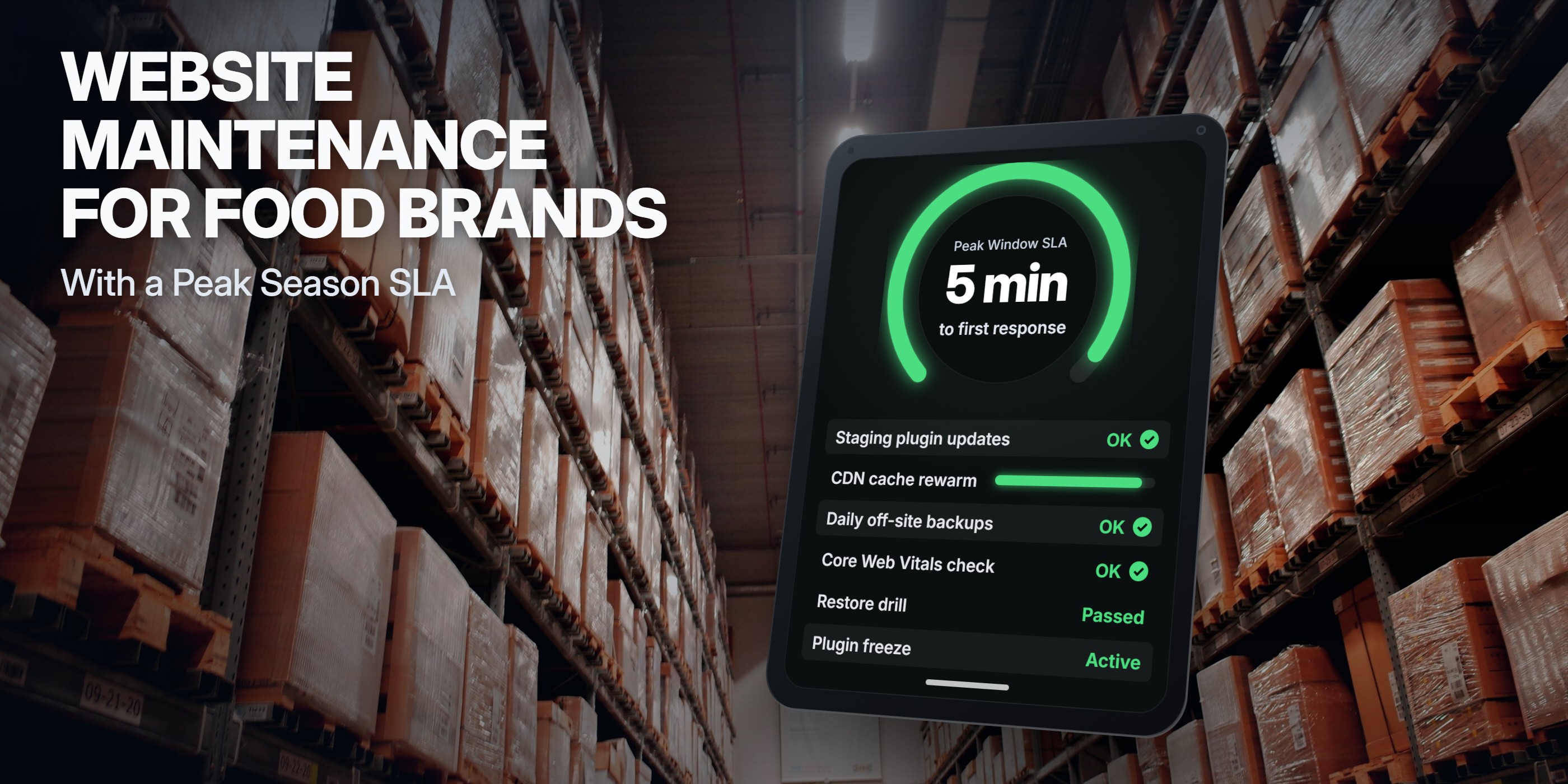
Fourteen days before a peak launch, the maintenance team runs a pre-peak checklist. Purge and rewarm the CDN cache. Run a synthetic Lighthouse audit against the checkout flow from three mobile networks. Confirm burst capacity in writing with the hosting provider. Pre-warn the support team of the expected traffic window. Freeze all non-critical plugin updates until 48 hours after peak. Google’s web.dev LCP guide sets mobile LCP under 2.5 seconds as the threshold that holds Meta and Google Shopping delivery through a peak traffic window.
During-peak monitoring and incident response
During peak windows, uptime monitoring polls every 30 seconds instead of the standard 60. Cart abandonment rate is tracked hourly instead of daily. Any Core Web Vitals drift over 200 ms triggers a same-hour fix ticket. The account manager stays on Slack standby with the founder and the hosting engineering team, so a 502 error at 2 PM on Black Friday gets a response in 5 minutes, not 45. That intensified cadence is the reason peak maintenance justifies a temporary retainer premium. The same peak-season discipline shows up inside our food and beverage hosting and maintenance retainer as a documented pre-launch checklist.
How to vet a website maintenance vendor for food brands
Vet a website maintenance vendor for food brands by comparing named specifics side by side across three proposals. The differences show up in the details the shallow proposal leaves out. SLA numbers, hosting provider named, backup retention documented, and staging environments listed by name. Ask each vendor for a sample monthly report before signing anything. If the sample report is a screenshot of a plugin update log with no uptime chart, no CWV trend, and no security incident count, the vendor is not running a real retainer.
Red flags in a food brand website maintenance proposal
- Under $100 per month with a promise of full managed hosting plus updates. That budget covers a bot doing plugin updates on Fridays with no test before deploy.
- No mention of staging environments or update testing.
- Backups stored on the same host with no off-site copy.
- No SLA in the contract for uptime, response time, or restore time.
- No mention of Core Web Vitals monitoring or ranking checks.
- Bundled content marketing or design work in a maintenance scope.
- No 2FA requirement on admin accounts.
Green flags in a real food brand website maintenance proposal
Green flags on a real proposal include a written Service Level Agreement (SLA) for uptime at 99.9% minimum, response time at 4 business hours or better, and restore time at 24 hours for a full site restore. Named hosting provider in the contract. Staging environment named. Backup provider and retention named. Weekly update process documented step by step. Sample monthly report you can view before signing. Cross-reference the proposal against three peer vendors and score line by line before signing. The green flags feel almost boring in aggregate. That is the point. Real maintenance is a boring, repeatable discipline, and the proposals that show that texture on paper deliver it in practice.
Reporting cadence inside a food brand website maintenance retainer
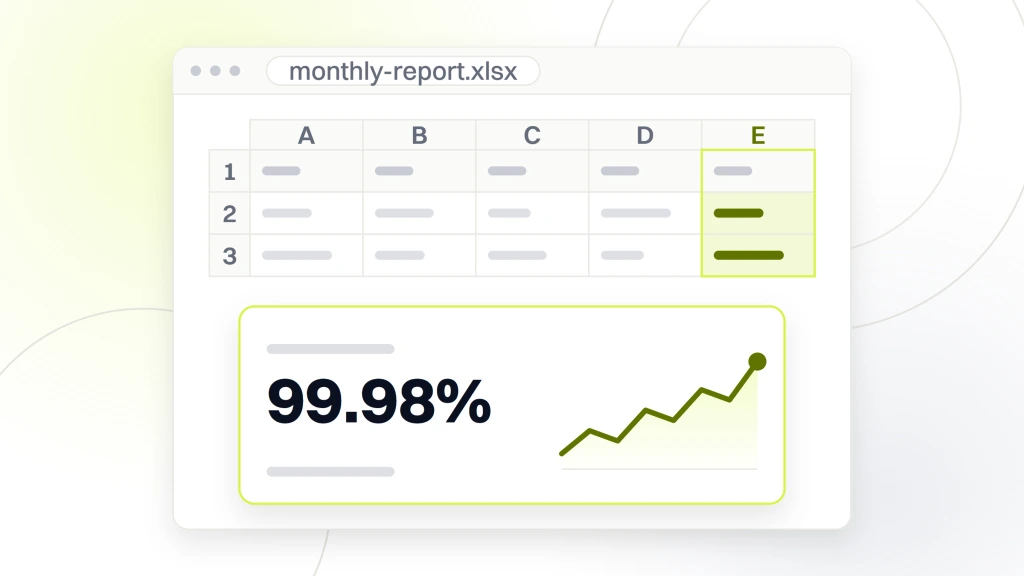
Reporting cadence inside a DTC food website maintenance retainer runs a written weekly report every Friday and a quarterly business review. The weekly report covers updates run, uptime percentage, Core Web Vitals trend, security incidents blocked, backup verification results, content edits completed, and next week’s priorities. It trades in numbers, not narrative.
Quarterly business review with the founder
The quarterly business review (QBR) runs 60 minutes with the DTC food brand founder. Agenda covers Core Web Vitals trend across the quarter, three highest-impact security incidents blocked, backup results, plugin churn added and removed, Klaviyo and ShipStation integration health, and specific fix recommendations for the next quarter. The QBR is where the founder picks the next tier, holds the current one, or adds a Q4 peak-season premium for the coming holiday window.
Numbers not vague progress narrative
Every report line item carries a specific number and a comparison to the last period. Uptime at 99.98%, up from 99.94. LCP at 1.7 seconds, flat versus prior month. Backups, every scheduled run completed. Security incidents blocked, 47 brute-force attempts, 12 malware probes. Content edits, 4 delivered against 4 included. Vague progress narrative is what shallow maintenance vendors deliver when they cannot answer with specifics. If a monthly report reads like a blog post instead of a scoreboard, the vendor is filling space, not doing work.
Onboarding a food brand onto a website maintenance retainer
Onboarding a DTC food brand onto a maintenance retainer takes 2 to 4 weeks, depending on the current state of the WordPress install. Week one covers audit, hosting migration prep, and staging environment setup. Week two covers hosting migration, plugin cleanup, and Core Web Vitals baseline documentation. Week three covers Klaviyo, Attentive, and ShipStation integration validation plus backup verification. Week four covers the first weekly report and QBR scheduling. Zero customer-visible downtime is the target across every step.
Audit checklist across 40 items
The onboarding audit runs a 40-item checklist covering hosting provider, WordPress version, plugin inventory, theme customizations, database size, image count, CDN configuration, Klaviyo sync status, ShipStation webhook health, backup provider, DNS records, SSL certificate expiry, WAF configuration, admin user list, 2FA status, GA4 event tracking, Google Search Console errors, Google Ads pixel installation, Meta pixel installation, TikTok Shop integration, and 20 more items specific to DTC food and beverage storefronts. The audit output is a color-coded PDF the founder can read in 15 minutes and act on the same week.
Hosting migration executed during off-peak hours
The hosting migration to Kinsta or WP Engine runs during the account’s lowest-traffic hour, usually 3 AM Tuesday. The engineering team pre-warms DNS with a low Time To Live (TTL) 48 hours ahead, spins up staging on the new host, validates every plugin loads without errors, confirms every third-party integration reconnects with new credentials, then flips DNS to production. Zero customer-visible downtime is the target and the standard for a working DTC food brand migration. Hosting is bundled into the maintenance retainer at every tier, so the brand never pays a separate host invoice on top of the monthly fee.
Pricing tiers for food brand website maintenance
Redefine Web runs fixed-scope maintenance tiers at $199, $299, and $499 per month. The $199 tier covers weekly updates on staging, weekly off-site backups and security scans, 24/7 uptime monitoring, one content edit a month, and a written weekly report every Friday. That tier fits a DTC food brand under $30,000 monthly revenue that runs a stable WooCommerce or Shopify stack with light plugin churn. The $299 tier moves backups and security scans to daily and adds a quarterly Core Web Vitals tune-up, Klaviyo plus ShipStation integration monitoring, and two content edits a month for new SKUs or seasonal copy.
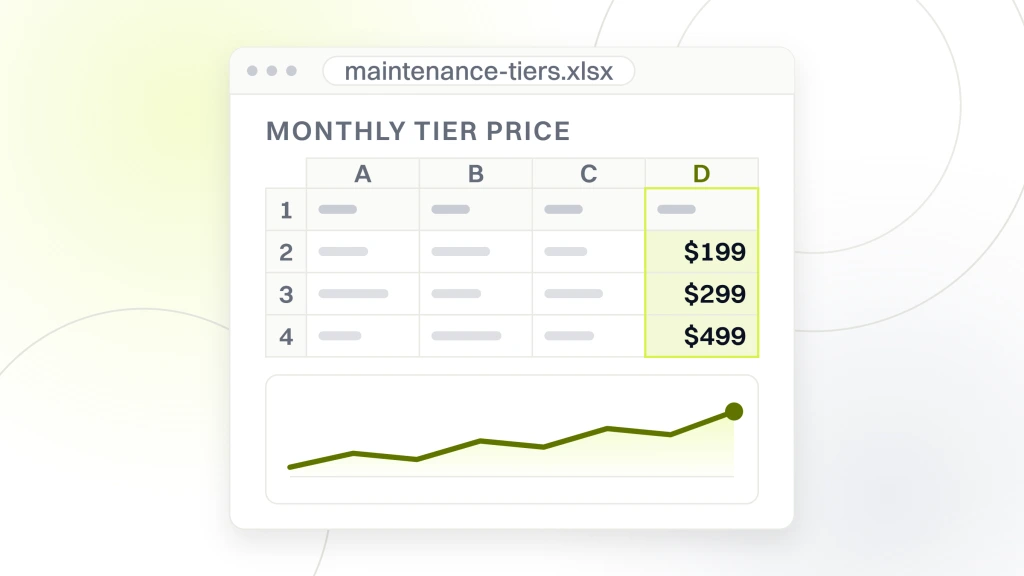
The $499 tier adds on-demand backups before big changes, a monthly Core Web Vitals tune-up, four content edits a month, and an annual compliance audit. That tier fits a DTC food brand past $30,000 monthly that runs multiple ad channels and cannot afford a Friday afternoon outage. A quarterly restore drill is quoted separately and written into the scope. Peak season windows carry a temporary retainer premium for the 30-second uptime polls, hourly cart tracking, and 5-minute Slack response path. Hosting on Kinsta or WP Engine is bundled at every tier, so the brand never sees a separate host invoice on top of the monthly fee.
Wrapping up food brand website maintenance
Website maintenance for food brands is the invisible discipline that keeps the DTC storefront patched, ranking, and converting through every peak season on the calendar. Ten monthly line items. A retainer tier that scales with revenue band. A cadence that runs weekly, monthly, and quarterly. The compounding value shows up in year two, when the site never drifted out of top rankings, never lost a peak weekend to a 502 error, and never bled 40% of paid ROAS to a stale plugin update that a bot pushed on a Friday afternoon.
If your DTC food brand runs on a self-managed cloud droplet or a shared budget host with no maintenance retainer, professional website maintenance for food brands pays for itself inside 90 days on rankings retained and founder time reclaimed. Ask three vendors for line-item scopes with SLA numbers, hosting provider named, and backup retention named. Redefine Web runs a fixed-scope maintenance package inside our monthly website maintenance packages starting at $199 per month, with the DTC-food-specific tier for brands running WooCommerce or Shopify. Book a call and we’ll walk you through the scope line by line, with the cadence, the SLA numbers, and the peak-season plan for your store.
Frequently asked questions
What is website maintenance for food brands?
Website maintenance for food brands is the monthly discipline that keeps a DTC snack, drink, or CPG storefront patched, backed up, fast, and ranking without the founder writing SQL queries at midnight. The scope covers WordPress core and plugin updates run on staging, daily off-site backups with 30-day retention, uptime monitoring polling every 60 seconds, weekly Core Web Vitals checks, security scans plus WAF rule reviews, quarterly restore drills, Google Search Console error triage, Klaviyo integration health checks, and one hour of content edits per month for new SKUs or seasonal promos.
How much does website maintenance for a food brand cost per month?
Website maintenance for food brands runs $199, $299, or $499 per month on Redefine Web's tiers, with hosting bundled. The $199 tier fits a DTC food brand under $30,000 monthly revenue on a stable WooCommerce or Shopify stack. The $299 tier adds daily backups and security scans, a quarterly Core Web Vitals tune-up, integration monitoring, and two content edits a month. The $499 tier adds on-demand backups, a monthly Core Web Vitals tune-up, and four content edits a month for brands past $30,000 monthly. Quarterly restore drills and the peak-window cadence are quoted separately, and larger multi-brand stacks are quoted.
What is included in a food brand WordPress maintenance retainer?
Every month covers ten line items. Managed WordPress hosting on Kinsta, WP Engine, or a comparable NVMe-backed tier with CDN included. Weekly WordPress core and plugin updates run on staging before production deploy. Daily off-site backups with 30-day retention. Uptime monitoring polling every 60 seconds with SMS alerts. Weekly Core Web Vitals checks against a documented baseline. Security scans with Wordfence or Sucuri plus quarterly WAF review. Google Search Console error triage. Klaviyo, Attentive, and ShipStation health checks. One hour of content edits. And a weekly report every Friday with specific numbers, not vague progress narrative.
How does website maintenance for a food brand handle Black Friday traffic?
Peak season maintenance tightens the cadence and pre-warns the hosting provider escalation path. Fourteen days before a Black Friday launch, the maintenance team purges and rewarms the CDN cache, runs a synthetic Lighthouse audit against the checkout flow from three mobile networks, confirms burst capacity in writing, pre-warns the support team of the expected traffic window, and freezes all non-urgent plugin updates until 48 hours after peak. During peak, uptime monitoring polls every 30 seconds instead of 60, and any Core Web Vitals drift over 200 ms triggers a same-hour fix ticket.
Can a food brand founder run maintenance themselves instead of hiring a retainer?
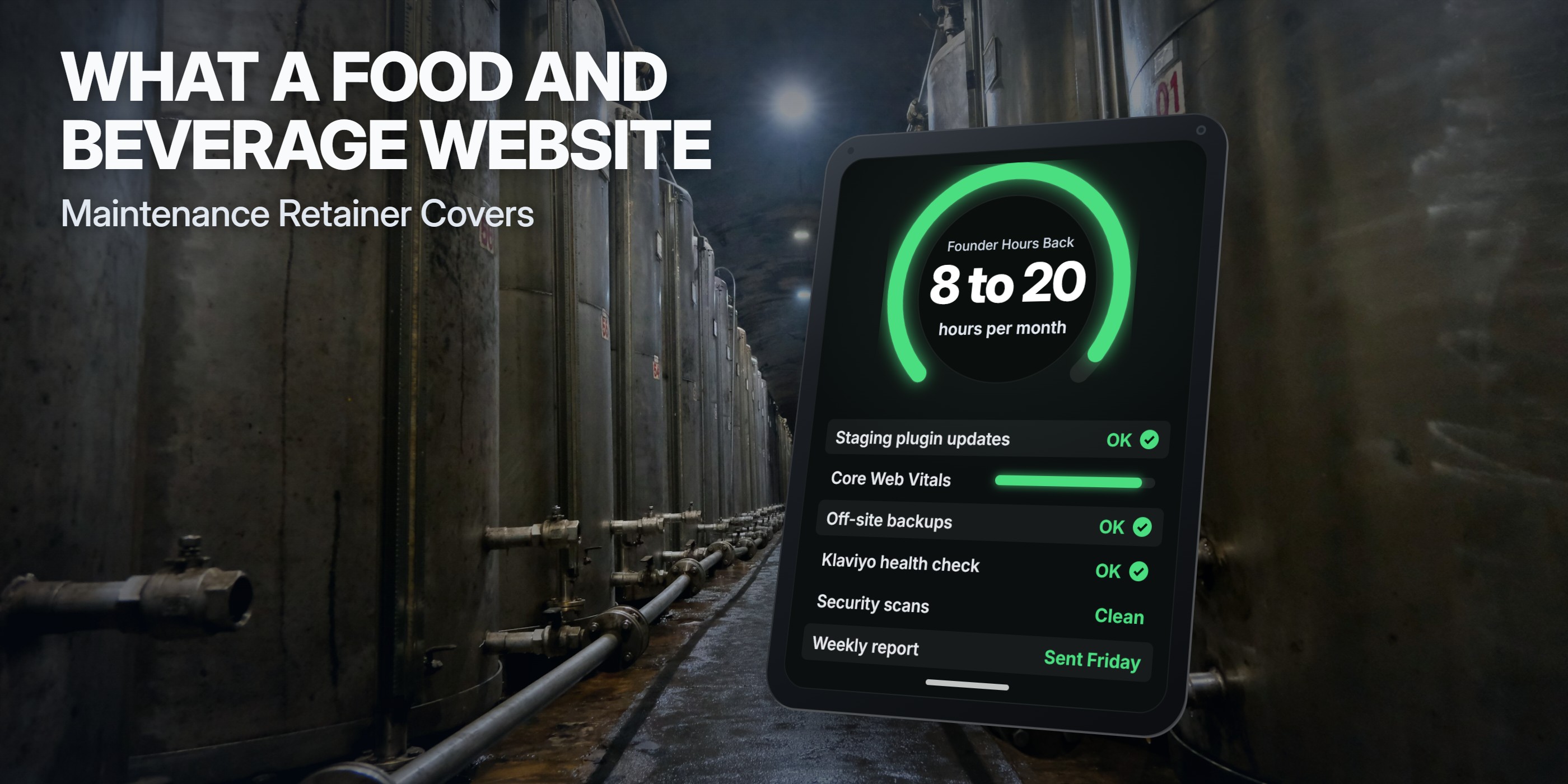
Technically yes, but the math rarely works. A DTC food brand founder billing their time at $150 per hour spends 8 to 20 hours monthly on WordPress upkeep, which is $1,200 to $3,000 in opportunity cost. A $499 per month website maintenance for food brands retainer saves $701 to $2,501 per month in opportunity cost and delivers better outcomes. That means staging tests before production deploys, daily and on-demand off-site backups, and specialized WooCommerce plus Klaviyo tuning that most solo developers do not carry as depth.
How often should a food brand website be backed up?
Food brand WordPress sites need daily off-site backups with 30-day retention, plus one weekly full backup with 90-day retention. Off-site means the backup lives on a different provider from the hosting account. A backup stored on the same server the site runs on is not a backup. Working retainers store backups on BackupBuddy, UpdraftPlus, Kinsta off-site backups, or a direct S3 bucket. Every site runs a restore drill once per quarter against a staging environment. About 15 percent of untested backups fail on first restore due to database charset mismatches or missing user tables.
What maintenance do websites need?
Every website needs a fixed monthly cadence of checks and repairs to stay fast, safe, and rank-worthy. For a food brand DTC storefront, that means WordPress core and plugin updates run on staging first, daily off-site backups with 30-day retention, uptime monitoring polling every 60 seconds, weekly Core Web Vitals audits, security scans plus WAF review, Google Search Console error triage, and monthly link and content refreshes. Skipping any one of these lets a small issue compound into a checkout outage. A $199 to $499 monthly retainer bundles the full checklist under one owner.
How to perform website maintenance?
Run website maintenance on a fixed cadence with a written checklist tied to real outcomes. Weekly tasks. Test WordPress core and plugin updates on staging, then push to production. Check Search Console for new errors. Confirm the daily off-site backup ran and can restore. Monthly tasks. Review Core Web Vitals against baseline. Purge and rewarm the CDN. Scan for malware with Wordfence or Sucuri. Quarterly tasks. Run a full restore drill on a staging environment. Review the WAF ruleset. Audit third-party scripts. Log every action in a shared report so the founder can see what actually moved.
Omor Sarif founded Redefine Web in 2021 to run websites, SEO, paid media, and marketing automation as one revenue-tied program for growth-stage brands. He is Lead Web Developer at Spicy Pixel since 2022, and holds a Bachelor of Science in Electrical and Electronics Engineering from Bilkent University. Earlier roles include Software Developer at Apple (2012 to 2015), Freelance Translator at Coursera (2014), and Student Ambassador at Student Competitions AB (2014 to 2016). His work has been covered by Business Insider, MSN, Polygon, Popular Mechanics, and MarketWatch.