In this article
- Most agency retainers for google ads management for hvac run $499 to $3,500 per month.
- Cost per booked repair job holds at $45 to $85 with disciplined intake.
- Cooling spend climbs 60 to 90% above baseline from May through August.
- Pair LSA (25 to 35%) with standard Google Ads for full HVAC intent coverage.
- Judge results after one full seasonal transition, where ROAS numbers stabilize.
Google Ads management for HVAC means running repair, install and maintenance campaigns on a two-peak seasonal budget, side by side with Local Service Ads. Agency retainers usually run $499 to $3,500 a month, plus $3,500 to $22,000 in ad spend. Healthy accounts hold cost per booked repair job at $45 to $85 all-in. The math works when the retainer covers service-area campaign segmentation for repair versus install versus commercial jobs, Local Service Ads (LSA) pairing beside standard Google Ads, dynamic call tracking with keyword-level attribution, and seasonal budget reshaping that expands cooling spend from May through August and heating spend from October through February. Below that scope, the account defaults to a single-campaign structure with a flat budget, and cost per booked job climbs past $150 within the first slow-season month.
Skip to the fee table if you already know the seasonal math.
Seasonal budget curve for google ads management for hvac
Real google ads management for hvac spend follows a two-peak seasonal curve that most non-vertical agencies ignore. Cooling spend climbs 60 to 90% above baseline from mid-May through late August, dips through September into October, then heating spend climbs 40 to 70% above baseline from November through February. A retainer that budgets a flat monthly spend across all 12 months wastes 20 to 35% in shoulder months and misses demand in peak windows. That’s why a real HVAC scope loads the budget calendar six weeks ahead of each peak.
Cooling-season budget reshape
Cooling-season spend needs to climb about 25% by mid-May, plateau at 60 to 90% above baseline through July, and taper starting the second week of August. Real agencies set automated budget rules that trigger against 10-day temperature forecasts in the service area. Parker Heating and Cooling, a family-owned HVAC business, shows what this kind of scaling can do. We rebuilt its Google Ads with service landing pages, full tracking, and heatwave scaling. Leads reached 125+ a month at under $15 each, down 82% from an $83 starting cost per lead, with an 18x return on ad spend across a 24-month engagement.
Heating-season and shoulder-month structure
Heating-season spend needs a shorter, sharper reshape. October runs at baseline, November climbs 40%, December through mid-February holds at 60 to 70% above baseline, and March tapers back. The shoulder months from mid-March through April and September through mid-October run best on maintenance-plan and tune-up campaigns rather than repair or install campaigns. Homeowners in shoulder months buy planned service, not emergency service. The retainer scope has to include the campaign rebuild for each seasonal transition, or the account bleeds spend on wrong-intent traffic for two to three weeks.
An HVAC Google Ads Budget Calendar, Month by Month
Here is the curve above as a calendar for a one- or two-truck shop at a $3,500 monthly baseline, the low end of the ad spend range for that fleet size. Each month shows which campaigns lead and what the ad spend becomes.
| Months | Campaigns that lead | Ad spend at a $3,500 baseline |
|---|---|---|
| January to mid-February | Heating repair and install | $5,600 to $5,950 (60 to 70% above) |
| Late February and March | Heating taper | Back down toward $3,500 |
| Mid-March to April | Maintenance plans and tune-ups | $3,500 |
| May | Cooling ramp | About $4,375 by mid-May (25% above) |
| June and July | Cooling repair and install | $5,600 to $6,650 (60 to 90% above) |
| August | Cooling taper from the second week | Back down toward $3,500 |
| September to October | Maintenance plans and tune-ups | $3,500 |
| November | Heating ramp | $4,900 (40% above) |
| December | Heating repair and install | $5,600 to $5,950 (60 to 70% above) |
Load each change into the account calendar six weeks ahead. That means the cooling ramp is set by early April and the heating ramp by late September. A flat $3,500 every month looks simpler, but it wastes 20 to 35% of the budget in the shoulder months and runs short at both peaks.
Google ads management for hvac fee band by company size
Across the market, HVAC agency retainers land in a tight band by company size and monthly ad budget. Solo owner-operators and two-truck shops pay $499 to $999 monthly. Growing companies with three to eight trucks pay $999 to $1,999. Regional companies with nine or more trucks and multiple service areas pay $1,999 to $3,500. Multi-location or franchise-scale HVAC operators pay from $3,500 upward. Anything under $499 monthly skips seasonal reshapes and Local Service Ads pairing, two of the three moves that separate a real HVAC retainer from a templated one.
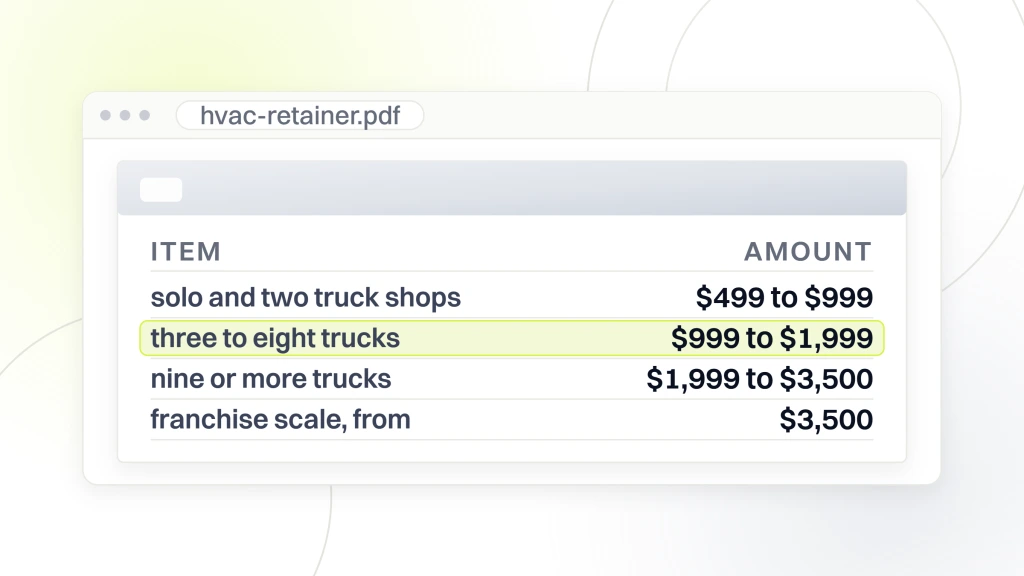
Across the market, retainers for google ads management for hvac hold at $499 to $3,500 for mid-market fleet sizes. Anything below $499 skips seasonal reshapes and LSA pairing.
Solo and two-truck operations
Owner-operator and two-truck HVAC shops running $3,500 to $7,500 monthly ad spend usually pay agencies $499 to $999 for a real Google Ads scope. That retainer covers one to two campaigns split between repair and maintenance, seasonal budget rules for cooling and heating peaks, LSA pairing under the standard Google Ads campaign, and monthly call recording review with the dispatcher. Retainers under $499 usually cover a monthly login and a static bid rule. Read our home services PPC page for the fee ranges by trade type.
Growing and regional HVAC operators
Three-truck to nine-truck HVAC companies with $10,000 to $22,000 monthly ad spend usually pay agencies $999 to $1,999. The retainer adds service-area geographic segmentation across two to five ZIP-code clusters, install-versus-repair campaign splits, offline conversion imports from ServiceTitan or Housecall Pro, and weekly bid work on top-cost keywords. Regional operators running nine trucks or more pay $1,999 to $3,500 and add dedicated analyst hours for quarterly incrementality tests and executive reporting to a general manager or private-equity backer.
Local Service Ads pairing inside google ads management for hvac
Google Local Service Ads pair with standard Google Ads at every serious HVAC retainer. The two channels cover different intent bands. LSA runs on the pay-per-lead model with Google-verified contractor badges and captures highest-intent emergency-repair calls. Standard Google Ads runs on the pay-per-click model and captures broader intent for install quotes, maintenance plans, and commercial jobs. Skipping either channel leaves 20 to 40% of qualified booking demand uncaptured.
LSA budget split versus standard Google Ads
Healthy HVAC budget splits run 25 to 35% LSA and 65 to 75% standard Google Ads at the mid-market operator level. LSA costs land at $18 to $45 per lead for repair calls in most metros. Standard Google Ads costs run $65 to $180 per booked job depending on the ratio of install to repair traffic. A retainer that manages both channels together prevents budget cannibalization, which happens when the same searcher sees an LSA and a search ad, then clicks the search ad after the LSA, doubling your cost per booking.
Contractor verification and profile work
LSA participation requires Google-verified background checks on the contractor license, insurance, and technicians. Real agencies handle verification submission, annual renewal, and profile optimization work of collecting Google Reviews at the LSA badge threshold. The Google Local Services Ads verification documentation outlines the raw requirements. The practical work of collecting reviews, keeping the badge, and pushing dispatch response time under three minutes sits inside the retainer, covered in depth in the Local Service Ads management guide.
Cost per booked job for google ads management for hvac
Cost per booked job is the metric that matters for google ads management for hvac, not cost per click or cost per lead. Fair cost per booked job runs $45 to $85 for repair work, $180 to $420 for install work, and $95 to $200 for maintenance plans. That translates to $9,000 to $18,000 monthly ad spend booking 90 to 200 jobs per month at a mid-market shop with disciplined intake.
Repair versus install economics
Repair jobs book faster and cheaper than install jobs. Intent is emergency and price sensitivity is low. Cost per booked repair job at $45 to $85 pairs against an average ticket of $340 to $580, so return on ad spend runs 5x to 7x. Install jobs book slower and cost more. Homeowners get three quotes and the sales cycle runs 10 to 45 days. Cost per booked install at $180 to $420 pairs against an average ticket of $6,500 to $18,000, so return on ad spend still runs 15x to 40x. Both campaigns belong in the account, split by intent, with different landing pages and different bidding strategies.
Maintenance plans as a booked-job stream
Maintenance-plan campaigns produce lower-margin sign-ups, but lifetime value math wins. Cost per booked maintenance plan sign-up runs $95 to $200. Average annual plan value runs $220 to $480 with a 68 to 82% renewal rate over three years. That produces $1,100 to $2,600 in lifetime revenue against a $95 to $200 acquisition cost, plus every plan customer generates two to five repair or install jobs over the life of the plan. Read our Google Ads management pricing guide for the fee-versus-lifetime-value math applied across verticals.
Google ads management for hvac pricing table by fleet size
Below is the market fee band by fleet size, the range HVAC-vertical Google Ads agencies commonly quote. Our own flat-fee tiers, set by monthly ad spend, are in the last section of this guide.
| Fleet size | Monthly ad spend | Market retainer | What the retainer covers |
|---|---|---|---|
| 1 to 2 trucks | $3,500 to $7,500 | $499 to $999 | Single-service-area, seasonal budget rules, LSA pairing, monthly reporting |
| 3 to 5 trucks | $8,000 to $15,000 | $999 to $1,499 | ZIP-cluster segmentation, install versus repair split, offline conversion imports |
| 6 to 9 trucks | $15,000 to $22,000 | $1,499 to $1,999 | Multi-campaign structure, weekly cadence, dedicated LSA management, monthly landing page tests |
| 10+ trucks (regional) | $22,000 to $45,000 | $1,999 to $3,500 | Dedicated analyst, quarterly incrementality tests, executive review, private-equity reporting |
| Multi-location franchise | $45,000 to $150,000 | from $3,500 | Franchise pod, location-level attribution, brand-plus-territory campaign structure |
Reading the table without getting fleeced
The market retainer column reflects mid-market HVAC agency rate cards after removing outliers. A quote 30% above the top of your row usually reflects true home-services specialization worth paying for, especially if the agency runs 10 or more HVAC accounts and can show current cost per booked job benchmarks in your metro. A quote 40% below the floor means the agency will farm the account against a template and skip the seasonal reshape work, which produces a 45 to 70% higher cost per booked job by the second peak season.
Ad spend to retainer ratio
Healthy retainer to ad spend ratio for HVAC work sits at 15 to 25%. Below 12%, the agency cannot afford the seasonal reshape work and skips the LSA management piece. Above 30%, you overpay for weekly attention that a smaller HVAC-vertical shop delivers at the fair rate. The ratio holds inside that band across every fleet size, from solo operator through 10-truck regional. Multi-location franchise operators can hold at 12 to 15% once the location-level attribution stack is built.
Campaign structure for google ads management for hvac accounts
A real google ads management for hvac account splits into six campaign buckets. Emergency repair, planned repair, install quote request, maintenance plan sign-up, brand terms, and commercial or property-management inquiries. Each bucket needs a distinct landing page, distinct ad copy, and distinct bidding strategy. Accounts that dump all traffic into one campaign lose 30 to 50% of budget to intent mismatch within 45 days.
Split your HVAC account into six campaign buckets from day one. Single-campaign accounts lose 30 to 50% of budget to intent mismatch within 45 days.
Emergency repair campaign
Emergency repair sits on the tightest keyword set. No ac, no heat, ac not working, ac blowing warm air, furnace not turning on, and same-day service phrases. Ad copy calls out fast dispatch, no dispatch fee, and warranty coverage. Bidding runs at target cost per action against the booked job goal, with maximum bid caps around $80 in most metros. The landing page shows a click-to-call in the hero, dispatch time within 60 minutes, and star rating from Google Reviews. McCormick Heating & Cooling, an HVAC company in Greeley, Colorado, doubled annual revenue and grew organic traffic 80%. We rebuilt its site with real photos, ran HVAC SEO and seasonal PPC, and set up a review system that collected 230+ five-star Google reviews.
Install and maintenance-plan campaigns
Install-quote campaigns sit on higher-intent research phrases. New ac install cost, furnace replacement cost, heat pump quote, ductless mini-split install. Ad copy calls out free quote, financing, and rebate availability. The landing page runs a multi-step quote form asking for home size, current system age, and preferred appointment window. Maintenance-plan campaigns sit on planned-service phrases. Ac tune up, furnace maintenance, hvac maintenance plan. Ad copy calls out the annual plan price, priority scheduling, and the discount on future repairs. The landing page runs a sign-up form and a price comparison against ad-hoc service.
Tracking setup for google ads management for hvac
Google ads management for hvac tracking runs on three layers. Ad-platform conversion tracking captures form fills and clicks-to-call. Call tracking with dynamic number insertion attributes phone calls to the exact keyword that produced them. Then ServiceTitan or Housecall Pro integration imports booked jobs back into Google Ads through the Enhanced Conversions API. Missing any layer leaves the account bidding against the wrong signal.
ServiceTitan and Housecall Pro imports
ServiceTitan and Housecall Pro both export booked-job data through a webhook that a real agency imports into Google Ads through the Enhanced Conversions for Leads API. The setup takes an engineer eight to fourteen hours per account and runs about $400 to $700 in one-time build cost. Once installed, Google Ads bids against booked jobs and revenue rather than form fills or calls, which produces a 20 to 30% drop in cost per booked job within 45 days. Read the Google Ads Enhanced Conversions documentation for raw setup steps.
Call whisper and dispatcher qualification
Call whisper messages let the dispatcher hear a pre-answer message identifying which Google Ads keyword produced the call. That tells the dispatcher whether the caller matched a repair, install, or maintenance query before the greeting. Qualification tagging in CallRail then flags each call as booked, quoted, or wrong-number, and those tags feed back to Google Ads through Zapier or a native integration. Firms running google ads management for hvac without this piece optimize against raw call volume rather than booked jobs, so budget flows to wrong-intent traffic within 30 days.
Gwinnett Area Plumbers, a plumbing company in Gwinnett County, Georgia, generated 141 qualified leads in 4 months at a 14.6% conversion rate on 968 targeted ad clicks. We built service-specific ad groups and landing pages and tracked every call. The same setup pattern works one-to-one on google ads management for hvac accounts.
Red flags in a google ads management for hvac quote
Six patterns in an HVAC Google Ads quote signal you should walk away. Two red flags together is a hard pass, not a negotiation opening. Memorize them before your next agency call.
No seasonal budget reshape in the scope
Any HVAC Google Ads scope that budgets a flat monthly ad spend across all 12 months is a hard pass. Cooling peak and heating peak demand budget shifts of 40 to 90% above baseline, and shoulder months need budget shifts to maintenance-plan campaigns. A scope that quotes a static $5,000 monthly ad spend all year signals the agency treats HVAC like a template industry and skips the vertical-specific work.
No LSA pairing or shared budget model
Any HVAC quote that treats Local Service Ads as a separate line item outside the retainer or ignores LSA entirely signals a non-vertical agency. LSA and standard Google Ads share the top four search positions on any HVAC repair query, so the two channels must be managed together. Ask the agency exactly how they split budget between LSA and standard Google Ads, how they handle cannibalization when both channels bid on the same searcher, and what the LSA lead-dispute policy is. If any answer wavers, the shop does not actually manage the channel.
In-house versus agency google ads management for hvac
Hiring an in-house paid media specialist to handle google ads management for hvac in-house costs $65,000 to $110,000 in loaded salary at the mid-market level, or roughly $5,400 to $9,100 monthly. Add an analyst and the internal team lands at $11,000 to $16,000 monthly, which is the fair comparison point for an agency retainer above $3,500. Below $3,500 monthly, the agency wins on cost per booked job. The specialist team runs 15 or more HVAC accounts and pattern-matches wins fast.
When to bring HVAC Google Ads in-house
Bring the work in-house when monthly ad spend clears $60,000 across HVAC plus adjacent trades like plumbing or electrical, when three or more paid channels need coordinated attribution, and when the company has an operations partner willing to run a paid media team. Below those triggers, the agency model produces better cost per booked job. A specialist team pattern-matches wins across many HVAC accounts. Our home services marketing hub covers the multi-trade in-house-versus-agency tradeoff in more depth.
Hybrid staffing pattern for larger operators
The best-performing regional HVAC operators run a hybrid model. One internal marketing manager owns the roadmap, plus a specialist HVAC Google Ads agency runs execution. Total spend lands at $8,500 to $16,000 monthly and produces about 25% better cost per booked job than a pure agency stack at the same budget. The marketing manager owns brand, community sponsorships, and dispatch coordination. The agency owns platform depth and daily execution. The split works because the marketing manager knows the community and dispatch capacity, while the agency team touches 15 or more HVAC accounts a month and pattern-matches wins faster than any solo hire.
Contract length and cancellation terms for google ads management for hvac
Ask how long the first term is and what the exit clause says before you sign any google ads management for hvac contract. Contracts longer than 12 months often signal the agency needs runway to earn back an underpriced setup. Whatever the term, judge the account after it clears at least one peak season. That is where the seasonal reshape math proves out and the return on ad spend numbers stabilize.
Why HVAC Results Take a Full Season
The first 30 days go to account audit, tracking install, LSA verification submission, and campaign restructure. Days 31 to 60 launch campaigns against the current-season demand curve. Days 61 to 90 scale winners and cut losers as the season transitions. Month four is when bidding algorithms have enough booked-job data to price keywords properly and the seasonal reshape logic proves out. Three months barely gets past LSA verification. Six months clears at least one full season transition, so judge results on that window.
Ad account ownership clauses
Every fair HVAC contract transfers full Google Ads account ownership to the company at signing. The agency runs the account under the company’s Google Ads ID through the manager-account link, not the other way around. The same rule applies for the Local Services Ads profile, since the LSA badge and review history belong to the contractor license. Any agency that insists on holding the ad account or LSA profile inside their own manager account is signaling what happens to your keyword history and review data on the way out. Get that clause in writing before setup runs.
Pricing by service mix for google ads management for hvac
Service mix moves the market retainer 20 to 40% from the baseline table. Repair-heavy operators pay 15 to 20% below baseline because campaign structure is simpler. Install-heavy operators pay 15 to 30% above baseline because sales cycles are longer and landing pages need more work. Commercial and property-management operators pay 25 to 40% above baseline because the campaign structure adds account-based targeting and lengthy quote workflows.
Repair-heavy versus install-heavy operators
Repair-heavy operators booking 70% or more of jobs on emergency and planned repair pay $499 to $1,499 monthly at the retainer level. LSA runs at 35 to 45% of ad budget because emergency queries fit LSA’s pay-per-lead model. Install-heavy operators booking 40% or more on new install pay $1,499 to $3,500. Install landing pages need more work and the sales cycle produces quote-follow-up workflows outside the ad platform. Read our post on Google Ads management pricing for the fee-versus-service-mix breakdown across verticals.
Commercial and property-management operators
Commercial HVAC operators serving property managers, industrial facilities, and multi-family housing pay $1,999 to $3,500 monthly at the retainer level. Campaign structure adds account-based targeting layers, lengthy quote workflows, and multi-decision-maker landing pages. Ad spend runs $12,000 to $28,000 monthly split across commercial-repair, commercial-install, and preventive-maintenance-contract campaigns. Cost per booked commercial contract lands at $400 to $900 with average contract value at $4,500 to $22,000 annually. The retainer earns back inside the first two signed contracts.
HVAC PPC marketing and when to hire an HVAC advertising agency
HVAC PPC marketing is every paid channel that charges per click or per lead, from Google Ads search and Local Service Ads to Performance Max and Microsoft Ads. Google Ads for HVAC sits at the center, because repair and install searches are where booked jobs start. The real choice is who runs it. An HVAC PPC agency owns those paid channels and the tracking under them. An HVAC advertising agency adds broader media on top.
| Who runs it | What they own | Fits best |
|---|---|---|
| HVAC PPC agency | Google Ads, Local Service Ads, call tracking, booked-job imports, seasonal budget rules | One- to nine-truck shops where search books most jobs |
| HVAC advertising agency | PPC plus Meta and YouTube ads, TV or radio, direct mail, brand creative | Multi-location and franchise operators with a brand budget |
| In-house team | The same channels, run by your own staff | Operators spending more than $60,000 a month across trades |
Below franchise scale, a focused HVAC PPC agency usually books more jobs per dollar. The work that moves cost per booked job is the seasonal reshape, LSA pairing and dispatch call review covered above. Add broader advertising once search demand in your service area is fully captured. Whoever you hire, test them with the discovery questions below.
How to pick the right google ads management for hvac agency
Pick a google ads management for hvac agency by three inputs. Number of active HVAC accounts they run today, whether their scope includes weekly call recording review by a named staffer, and their case-study library for HVAC operators in your metro and fleet size. Match those inputs against your ad budget and service mix, then check the six red flags before signing.
Five questions to ask on the discovery call
Ask five questions on the discovery call. First, how many active HVAC accounts run at your agency today and how many in my exact fleet size. Second, how does your scope handle seasonal budget reshaping and who owns the peak-season transition calendar. Third, how do you pair Local Service Ads with standard Google Ads and what is the shared-budget model. Fourth, how do you handle offline conversion imports from ServiceTitan or Housecall Pro. Fifth, what does the cancellation clause say and who owns the Google Ads and LSA profiles. If any answers dodge or defer, keep looking.
Case study patterns worth trusting
Trust a case study that names the HVAC company, the fleet size, the metro, the retainer band, and the cost per booked job at 90-day and 12-month marks. Skip case studies that quote impression counts or click rates without a booked-job number. Berks Plumbing, a family-run plumbing company in Berks County, ran a similar service-segmented rebuild. Google Ads conversions grew 99%, cost per acquisition fell 67%, and organic users rose 75%. That’s the shape of a real HVAC-adjacent case study. See our best Google Ads management agencies shortlist for the vertical-specific scoring rubric.
Getting real value from google ads management for hvac
HVAC Google Ads management sits in a tight fee band once you strip out the templated retainers under $499 and enterprise 25-percent-of-spend outliers. Between $499 and $3,500 monthly is where 80% of mid-market HVAC operators find real value. Match the fee to fleet size and service mix, keep retainer-to-spend ratio at 15 to 25%, and hold the agency accountable to seasonal reshapes and weekly call-recording review.
Where Redefine Web sits on the HVAC price band
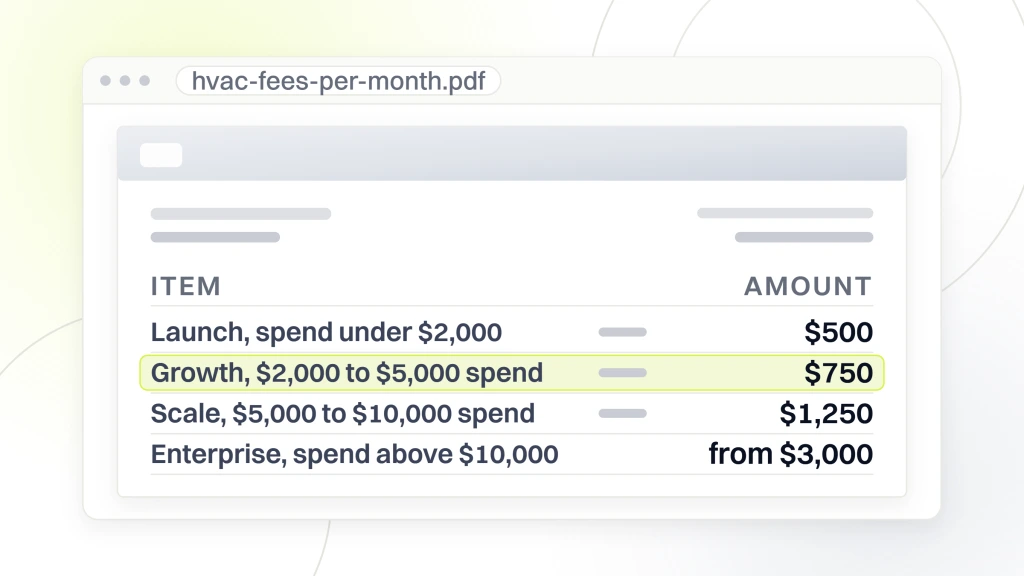
Our HVAC Google Ads management runs on four flat-fee tiers set by monthly ad spend. Launch is $500 a month for spend under $2,000, and Growth is $750 for $2,000 to $5,000. Scale is $1,250 for $5,000 to $10,000. Enterprise starts from $3,000 for spend above $10,000, which covers three-truck to nine-truck operators at $10,000 to $22,000 a month. Ad spend is paid to Google, not to us. Every tier includes seasonal reshape logic, call tracking with recording, and a weekly written report, not a monthly PDF. From Growth up, we add LSA management, a weekly optimization cycle, and CRM offline-conversion sync with your dispatch software.
Next steps if the fee still feels murky
Take our free Google Ads audit before signing anything. A media buyer checks your account against a 15-point checklist and sends a priority fix plan within 24 hours. If a quote you got sits 30% above or below the market range in this guide, ask the agency to explain the gap. See the Google Ads audit page to start.
Frequently asked questions
How much does Google Ads management for HVAC contractors cost per month?
Across the market, Google Ads management for HVAC contractors runs $499 to $3,500 monthly on the agency side depending on fleet size and service mix. Solo and two-truck shops spending $3,500 to $7,500 monthly on ads pay $499 to $999. Three-truck to nine-truck operators spending $10,000 to $22,000 monthly pay $999 to $1,999. Regional operators with 10 or more trucks spending $22,000 to $45,000 monthly pay $1,999 to $3,500. Multi-location franchise operators pay from $3,500. Any HVAC-vertical quote below $499 monthly skips the seasonal reshape work and Local Service Ads pairing that separate a real retainer from a templated one. Our own flat-fee tiers are set by ad spend: $500 a month under $2,000 and $750 for $2,000 to $5,000. Scale is $1,250 for $5,000 to $10,000, and Enterprise starts from $3,000 above $10,000.
What is a fair cost per booked job for HVAC Google Ads?
Fair cost per booked job for HVAC Google Ads runs $45 to $85 for repair jobs, $180 to $420 for new installs, and $95 to $200 for maintenance-plan sign-ups. Repair jobs book faster and cheaper because intent is emergency and price sensitivity is low. Install jobs book slower and more expensive because homeowners get three quotes and the sales cycle runs 10 to 45 days. Both campaigns belong in the account, split by intent, with different landing pages and different bidding strategies. Retainers that miss the split blend repair and install into one campaign, which produces cost per booked job 40 to 70 percent higher than the fair band.
Should HVAC Google Ads pair with Local Service Ads?
Yes. Local Service Ads and standard Google Ads sit side by side on every HVAC repair query in the top four search positions, so the two channels must be managed together. LSA runs on pay-per-lead with Google-verified contractor badges and captures highest-intent emergency-repair calls at $18 to $45 per lead. Standard Google Ads runs on pay-per-click and captures broader intent for install quotes, maintenance plans, and commercial jobs at $65 to $180 per booked job. Healthy HVAC budget splits run 25 to 35 percent LSA and 65 to 75 percent standard Google Ads at the mid-market operator level, with joint bid management to prevent cannibalization on shared searchers.
How does the seasonal budget curve work for HVAC Google Ads?
HVAC Google Ads spend follows a two-peak seasonal curve. Cooling spend climbs 60 to 90 percent above baseline from mid-May through late August, dips through September into October, then heating spend climbs 40 to 70 percent above baseline from November through February. Shoulder months from mid-March through April and September through mid-October run best on maintenance-plan and tune-up campaigns rather than repair or install campaigns. A retainer that budgets a flat monthly ad spend across all 12 months wastes 20 to 35 percent of budget in shoulder months and leaves demand on the table in peak windows. Real agencies preload the reshape into the account calendar six weeks in advance.
How long does it take to see results from HVAC Google Ads management?
Real cost-per-booked-job results from a new HVAC Google Ads program show up in month four, not month one. The first 30 days go to audit, tracking install, LSA verification submission, and campaign restructure. Days 31 to 60 launch campaigns against the current-season demand curve. Days 61 to 90 scale winners and cut losers as the season transitions. Month four is when bidding algorithms have enough booked-job data to price keywords properly and the seasonal reshape logic proves out. Any agency promising results in 30 days is either lying or gaming a click-based metric rather than a booked-job one. Plan on at least one full seasonal transition before you judge the account, and ask how long the first term is and what the exit clause says before you sign.
What red flags should I watch for in an HVAC Google Ads pricing quote?
Six red flags in an HVAC Google Ads quote signal you should walk away. First, no seasonal budget reshape in the written scope. Second, no Local Service Ads pairing or shared-budget model between LSA and standard Google Ads. Third, retainer under $499 monthly for any HVAC vertical work. Fourth, no ServiceTitan or Housecall Pro conversion import in the tracking scope. Fifth, Google Ads account or LSA profile ownership held inside the agency's manager account rather than the contractor's. Sixth, contracts longer than 12 months paired with a low setup fee, which signals the agency plans to recover setup through the monthly. Two red flags together is a hard pass, not a negotiation opening.
Do Google Ads work for contractors?
Yes. Google Ads works for HVAC and other contractors when the account structure matches how homeowners actually search. Emergency repair queries convert fast at $45 to $85 per booked job since intent is high and price sensitivity is low. Install queries convert slower at $180 to $420 per booked job since homeowners get three quotes. The two intent bands need separate campaigns, separate landing pages, and separate bidding strategies. Contractors who blend repair and install into one campaign pay 40 to 70 percent more per booked job than the fair band. Pair standard Google Ads with Local Service Ads to cover the full top-four position on every repair query.
What is a fair Google Ads management fee for a small HVAC company?
Most agencies charge a small HVAC company $499 to $999 monthly at the solo owner-operator or two-truck level, plus $3,500 to $7,500 in monthly ad spend. On our flat-fee tiers, that ad spend sits on Growth at $750 (spend of $2,000 to $5,000) or Scale at $1,250 (spend of $5,000 to $10,000). That range covers seasonal budget reshape work six weeks ahead of each peak, Local Service Ads verification and renewal, dynamic call tracking with keyword-level attribution, weekly bid and negative keyword updates, and a monthly dispatch sync on booked-job data. Any HVAC-vertical quote below $499 monthly skips the seasonal reshape and LSA pairing that separate a real retainer from a templated one. Compare quotes on scope, not on price alone.
What tracking setup do HVAC Google Ads accounts need?
HVAC Google Ads accounts need three tracking layers wired end to end before dollar one gets spent. First, dynamic call tracking with keyword-level attribution so every phone call ties back to the ad that produced it. Second, ServiceTitan or Housecall Pro conversion import so the booked-job outcome flows back to Google Ads as an offline conversion. Third, enhanced conversions on the form and phone paths to recover the 20 to 40 percent of match rate lost to iOS privacy defaults. Without all three layers, the bidding algorithm optimizes on clicks or form fills rather than booked jobs, and cost per booked job drifts 30 to 60 percent above the fair band inside eight weeks.
How do LSA and Google Ads share budget for HVAC accounts?
LSA and standard Google Ads share budget at a 25 to 35 percent LSA split and 65 to 75 percent standard Google Ads split for mid-market HVAC operators. LSA runs on pay-per-lead at $18 to $45 per repair lead and captures highest-intent emergency-repair calls with Google-verified contractor badges. Standard Google Ads runs on pay-per-click at $65 to $180 per booked job and captures broader install, maintenance-plan, and commercial-job intent. Joint bid management prevents cannibalization when the same homeowner sees an LSA and a search ad on one query. Franchise operators at 10 or more trucks can shift toward 35 to 45 percent LSA once the location-level attribution stack is built.
Omor Sarif founded Redefine Web in 2021 to run websites, SEO, paid media, and marketing automation as one revenue-tied program for growth-stage brands. He is Lead Web Developer at Spicy Pixel since 2022, and holds a Bachelor of Science in Electrical and Electronics Engineering from Bilkent University. Earlier roles include Software Developer at Apple (2012 to 2015), Freelance Translator at Coursera (2014), and Student Ambassador at Student Competitions AB (2014 to 2016). His work has been covered by Business Insider, MSN, Polygon, Popular Mechanics, and MarketWatch.